frequencies binaural
Binaural Beats Side Effects Under Dream-Self Audio
Binaural beats side effects can include headaches, agitation, dizziness, or sleep disruption when layered under voice audio. Learn safer listening levels.
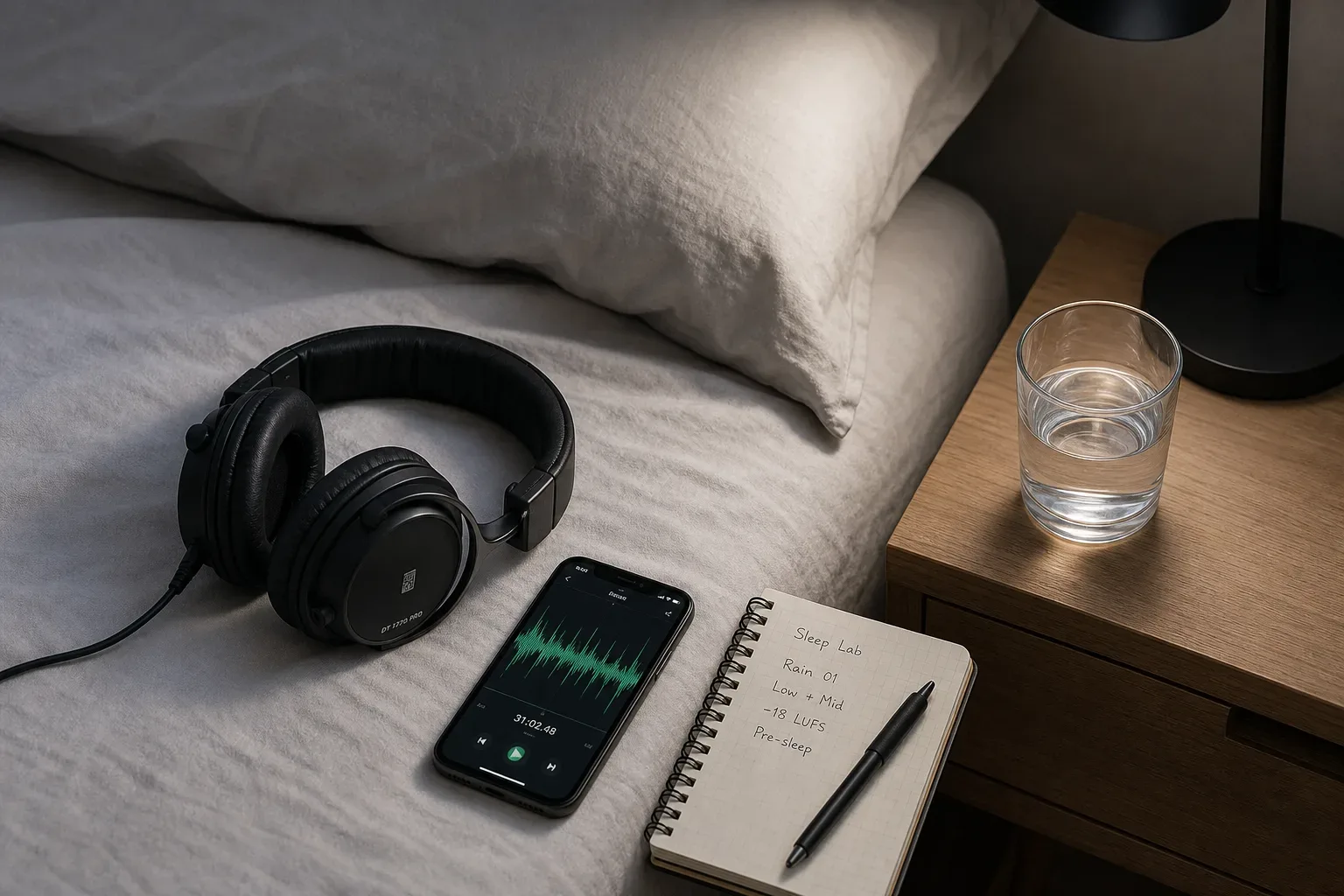
Binaural beats side effects under Dream-Self audio are usually mild, but they’re real: headache, ear fatigue, dizziness, agitation, strange dreams, or worse sleep can happen when the beat is too loud, too sharp, or too long. Keep the voice primary, the beat secondary, and stop if your body argues.
What side effects can binaural beats cause under spoken audio?
The most common side effects are listening fatigue, headache, dizziness, irritability, and sleep disruption, especially when tones compete with a voice.
A binaural beat is not a sound wave in the room. It’s a perceptual effect your brain constructs when each ear receives a slightly different pure tone, such as 200 Hz in the left ear and 206 Hz in the right. The perceived 6 Hz beat happens inside the auditory system. That mechanism is why headphones are usually required, and why even small changes in volume or pitch can matter.
When you place that beat under a spoken Dream-Self recording, you’re asking the ear to track two things at once: language and a steady tonal mismatch. In small studies, listeners report effects ranging from relaxation to annoyance. A 2015 review by Chaieb and colleagues in Frontiers in Human Neuroscience noted that binaural beat findings vary widely by frequency, duration, and listener state. Mixed evidence is not the same as no effect. It means the details matter.
The side effects I hear about most often in rest teaching are plain and practical:
- A dull forehead headache after 10 to 20 minutes
- Pressure or tickle in one ear
- A wired feeling when the beat is meant to be calming
- Trouble following the spoken words
- Vivid dreams or more waking after midnight
- Mild nausea or swaying when the carrier tone is high
A tone that helps one nervous system settle can make another nervous system work harder. Yours gets a vote every night.
If you notice symptoms, don’t push through as proof of discipline. First reduce volume by 20 to 30 percent. Then shorten the session to 5 or 10 minutes. If the same effect returns, remove the beat and use plain voice, soft noise, or silence. The cleanest test is simple: change one variable at a time.
Why does layering beats under Dream-Self audio change the effect?
Layering changes the effect because speech needs clarity, while binaural beats ask for steady stereo attention.
A Dream-Self audio track works through voice, imagery, and repetition. The AYA Method is a daily audio manifestation practice. Each day you listen to a short personalized recording — your Dream-Self Moment — narrated from the version of you who has already manifested the life you intend. Listening is the practice. Repetition is the work. The audio is the method. If a beat makes the voice harder to receive, it has moved from support to interference.
Speech intelligibility is sensitive. In hearing research, even a few decibels of masking can change word recognition, especially in the presence of steady tones or competing noise. The World Health Organization has warned for years that many personal audio devices can exceed safe levels; NIOSH sets 85 dBA for 8 hours as a workplace limit, with allowable time dropping as level rises. Bedside listening should be much lower, because the goal isn’t endurance. It’s rest.
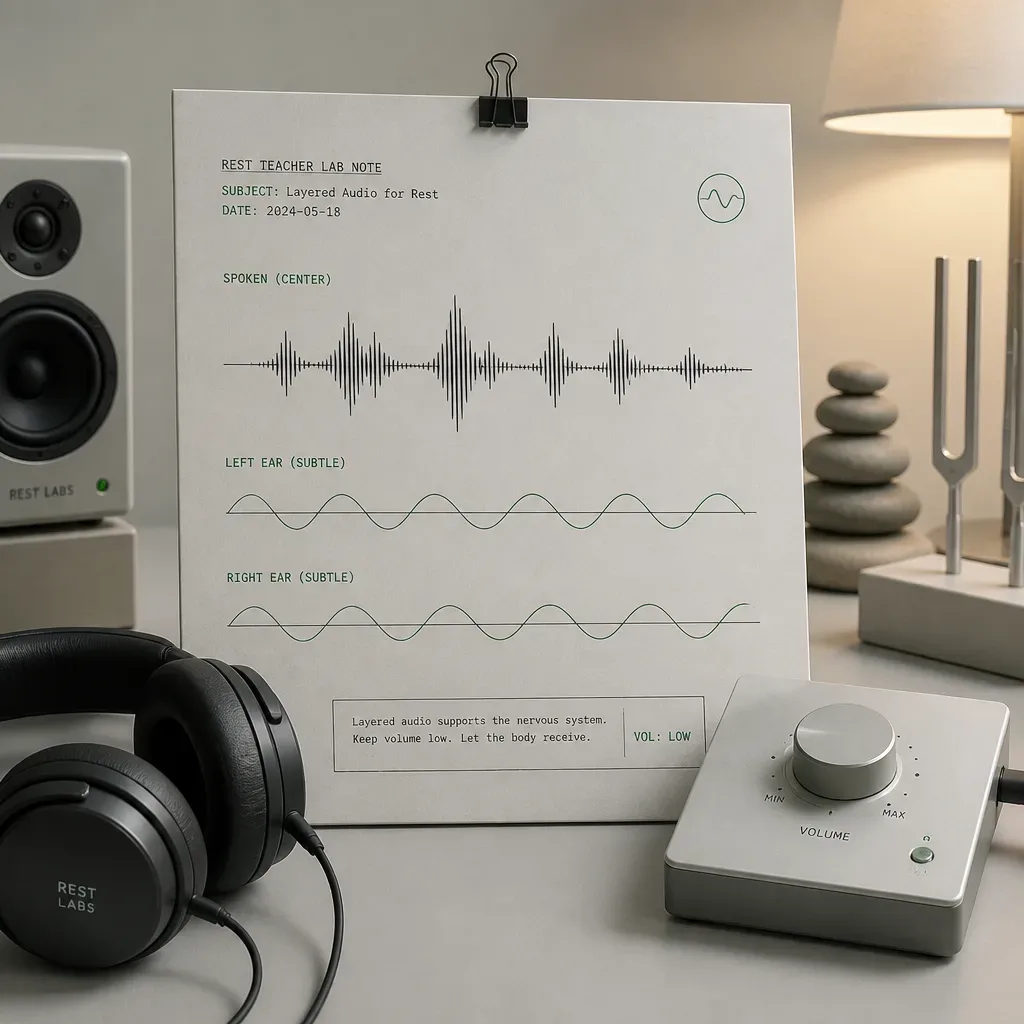
The binaural beat also depends on separation between left and right channels. If the spoken recording is centered, both ears receive the voice equally while the beat differs by ear. Some listeners find that clean. Others feel a subtle tug, as if the voice sits on top of a moving floor. That can be more noticeable at bedtime, when external cues are reduced and the nervous system is scanning for safety.
Use this order of importance:
- The spoken words must be clear without effort.
- The beat should be barely audible, not featured.
- The carrier tone should feel soft in the ear.
- The session should end before irritation begins.
- Silence after the audio should feel welcome, not abrupt.
The support track should never become the practice. The voice carries the meaning; the tone only prepares the room.
Which frequencies are more likely to feel uncomfortable?
Discomfort is more likely when carrier tones are piercing, beat differences are poorly matched to the session, or the audio runs too long.
People often discuss binaural beats by the beat frequency: delta around 0.5 to 4 Hz, theta around 4 to 8 Hz, alpha around 8 to 12 Hz, and beta above about 13 Hz. But your ears also hear the carrier tones, such as 180 Hz and 186 Hz. A 6 Hz beat can feel quite different if the carriers are low and soft than if they’re high and glassy.
A 2019 meta-analysis by Garcia-Argibay and colleagues in Psychological Research reviewed binaural beat studies across memory, attention, anxiety, and pain. The authors found small and variable effects, with protocol details influencing results. That matters for side effects too. A 7 Hz beat for 8 minutes under warm narration is not the same as a 7 Hz beat for 45 minutes under bright headphones.
| Audio choice | What it tends to do | Side effect risk | Bedtime note |
|---|---|---|---|
| Low-theta beat, soft carrier | May support drowsy attention | Low to moderate | Often tolerable under voice |
| Delta beat, very low difference | May feel heavy or blurry | Moderate | Can make speech less distinct |
| Alpha beat, warm carrier | May support calm focus | Low | Good first test for spoken audio |
| Beta beat | May feel alerting | Moderate to high | Usually not ideal before sleep |
| High carrier tone | Easier to hear sharply | Higher | Lower it or remove it |
For Dream-Self listening, I usually prefer alpha or low-theta if a beat is used at all. In yoga nidra rooms, fixed low tones can help attention stay with the guide, but the tone must not demand attention. A fixed frequency suits rest only when it behaves like a floor, not a flashlight.
If you want to hear the mechanism before layering it under voice, use the Binaural beats generator + guide. Press play at a low level, change the beat by 2 Hz, and notice whether your face, jaw, or breath responds. If your jaw tightens in the first minute, that’s useful data.
How loud should binaural beats be with Dream-Self audio?
The beat should sit below the voice, at a level you can forget without straining to hear the narration.
For sleep or near-sleep audio, a practical range is about 40 to 55 dB at the ear. That’s softer than many conversations, which often sit around 60 dB at 1 meter. Most phones don’t show true ear-level dB, and headphones vary widely, so use behavior as your meter: you should be able to hear your own breathing, swallow comfortably, and understand every word without tightening your forehead.
Hearing safety standards are built for damage prevention, not rest quality. NIOSH recommends limiting 85 dBA exposure to 8 hours, and the allowed time halves with each 3 dB increase. That doesn’t mean 84 dBA is a good bedtime level. It means the legal safety ceiling is far above the quiet level a sleeping body usually prefers. Children’s listening should be more conservative still, with adult supervision and shorter sessions.
A simple setup test works better than guessing:
- Start the Dream-Self voice alone at the lowest clear level.
- Add the binaural beat until it is just detectable.
- Lower the beat one small step.
- Listen for 3 minutes with eyes closed.
- If speech effort rises, reduce or remove the beat.
The correct volume is the one that makes the practice easier to keep tomorrow.
If you need masking for traffic, neighbors, or a hallway door, a steady noise layer may be less intrusive than a beat. Try the White noise generator + guide and keep it lower than the voice. White noise has more high-frequency hiss; pink and brown options often feel softer. The point is not to cover everything. It’s to reduce the startle edge enough for the voice to remain plain.
Who should be cautious or avoid binaural beats?
People with seizure history, severe tinnitus, migraine sensitivity, vertigo, or serious sleep disorders should be cautious and ask a professional before using binaural beats.
Binaural beats are usually marketed as gentle, and for many people they are. Still, sound is a stimulus. Repetitive auditory stimulation can bother migraine-prone listeners, and stereo mismatch can feel unstable for people with vestibular sensitivity. If you’ve had seizures, ask a clinician before using rhythmic audio or flicker-like stimulation. The risk profile is not identical to flashing light, but caution is reasonable.
Tinnitus deserves special care. Some tinnitus patients benefit from sound enrichment, while others find pure tones aggravating. The American Tinnitus Association commonly recommends individualized guidance because tinnitus pitch, hearing loss, stress, and sleep all interact. A binaural carrier tone near a tinnitus pitch can draw attention to the symptom. If ringing increases after a session, don’t repeat the same track the next night to test your toughness.
Sleep apnea and chronic insomnia also need a plain sentence: audio can support a routine, but it doesn’t diagnose or treat breathing pauses, panic, trauma symptoms, or months of sleeplessness. The American Academy of Sleep Medicine recommends cognitive behavioral therapy for chronic insomnia as a first-line treatment in adults. If sleep is consistently impaired for 3 months or more, get help from someone trained to assess it.
Use extra caution if any of these apply:
- You feel dizzy with stereo headphones
- You have one-sided hearing loss
- You use hearing aids or cochlear implants
- You are pregnant and prone to vertigo or migraine
- You are giving audio to a child
- You feel emotionally flooded by guided recordings
There is no prize for tolerating the wrong sound. Rest gets quieter when the method respects the body in front of it.
How can you test binaural beats under Dream-Self audio safely tonight?
Test safely by using a short session, low volume, one beat frequency, and a clear stop rule.
Start with 5 to 12 minutes, not a full night. Research protocols vary widely, but many laboratory binaural beat sessions use short exposures, often 3 to 30 minutes. That’s enough to learn whether your body leans toward settled or irritated. Long looping sleep tracks make it harder to know what caused the 3 a.m. wake-up: the beat, the voice, the volume, or ordinary sleep cycling.
Here’s a clean first test:
- Choose an alpha beat, around 8 to 10 Hz, or a gentle low-theta beat around 6 Hz.
- Use low carrier tones if available, roughly 150 to 250 Hz.
- Set the Dream-Self voice first, then add the beat underneath.
- Listen for 10 minutes before sleep, not all night.
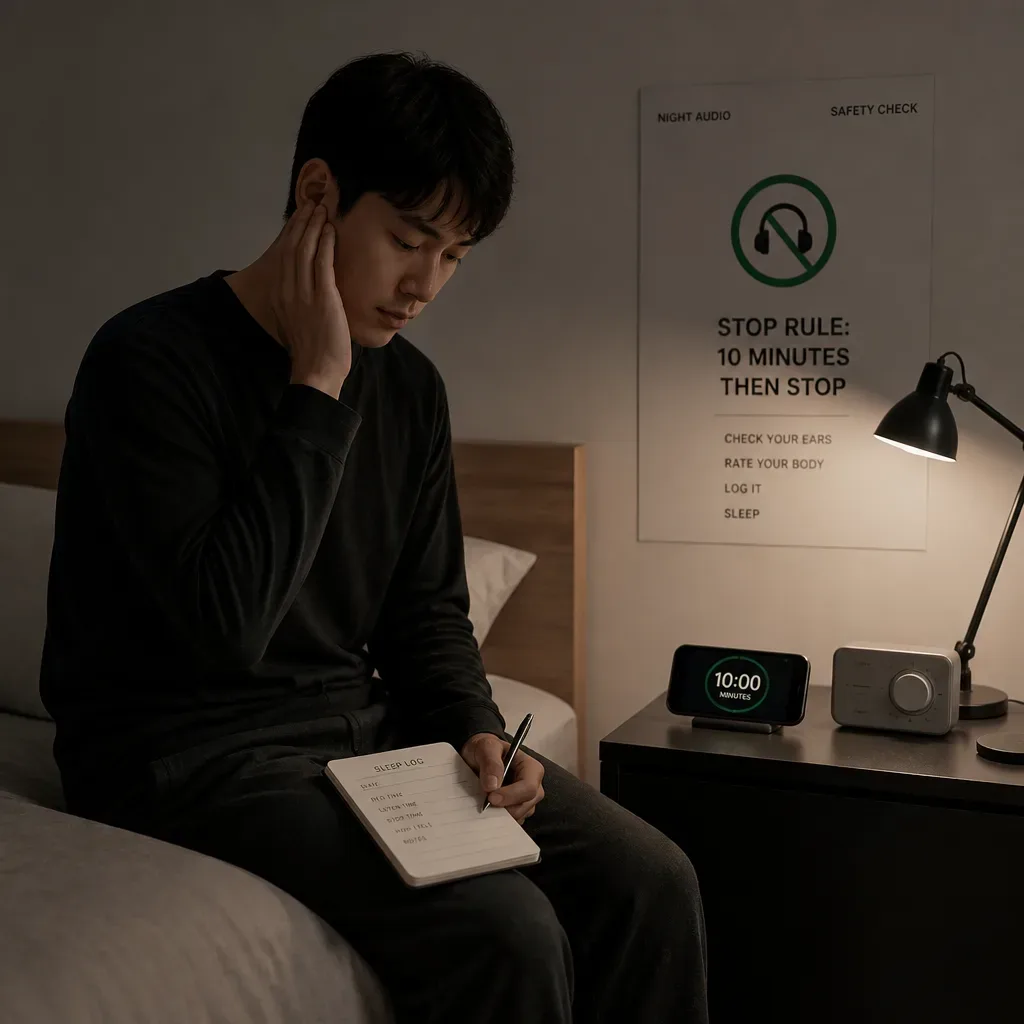
- Stop if you feel pressure, nausea, agitation, or speech strain.
- Write one line in the morning: sleep better, worse, or unchanged.
Repeat the same setup for 3 nights before judging it. In behavioral sleep work, single nights are noisy data because stress, caffeine, alcohol, menstrual phase, room temperature, and bedtime can all shift sleep. The National Sleep Foundation often cites 7 to 9 hours as the adult sleep range, but quality can change even when duration doesn’t.
If the beat isn’t right, you have good alternatives. Soft masking from the White noise generator + guide can cover small environmental sounds. The Binaural beats generator + guide lets you compare beat rates without mixing them into personal audio. If you like tonal ritual and historical frequency lore, read the Solfeggio frequencies guide with the evidence label kept intact. For a lower, steadier mask, a brown noise guide may be easier on tired ears.
Keep one rule above the rest: if the tone makes the voice harder to receive, the tone is too much.
What should you do if side effects appear after listening?
If side effects appear, stop the beat, return to plain audio or silence, and note the exact volume, frequency, and duration.
Most mild symptoms fade once the stimulus stops. Take off the headphones, sit up slowly if you feel dizzy, drink water if your mouth is dry, and give your ears a few minutes of quiet. Don’t replace an irritating beat with another bright tone right away. The auditory system has already done enough work for that session.
Track the pattern with specific numbers. Write down: beat frequency, carrier tone if known, volume setting, headphone type, session length, bedtime, caffeine after 2 p.m., and symptom. After 4 or 5 entries, patterns often become obvious. Maybe 6 Hz is fine for 8 minutes but not 30. Maybe earbuds cause pressure while open-back headphones don’t. Maybe the issue is not the beat at all, but a voice track that’s too loud at midnight.
If you still want a sound bed, switch to something simpler for a week. Pink noise or brown noise has no stereo beat requirement and may mask household sound with less cognitive pull. Keep it low, use a sleep timer, and place speakers away from the head if you’re not using headphones. Many people do better with 20 to 45 minutes than with all-night audio.
Seek medical advice if symptoms are intense, one-sided, recurring, or linked with hearing change, vertigo, panic, seizure-like events, or severe insomnia. That sentence is not meant to make sound frightening. It’s meant to keep sound in its proper size.
A practice kept gently for months outperforms any tone chosen perfectly once.
Let the voice be clear, and let the tone stay low.