frequencies binaural
Isochronic Tones vs Binaural Beats Under Voice
Compare isochronic tones and binaural beats under Dream-Self audio, with volume guidance, evidence limits, and a quiet setup for tonight.
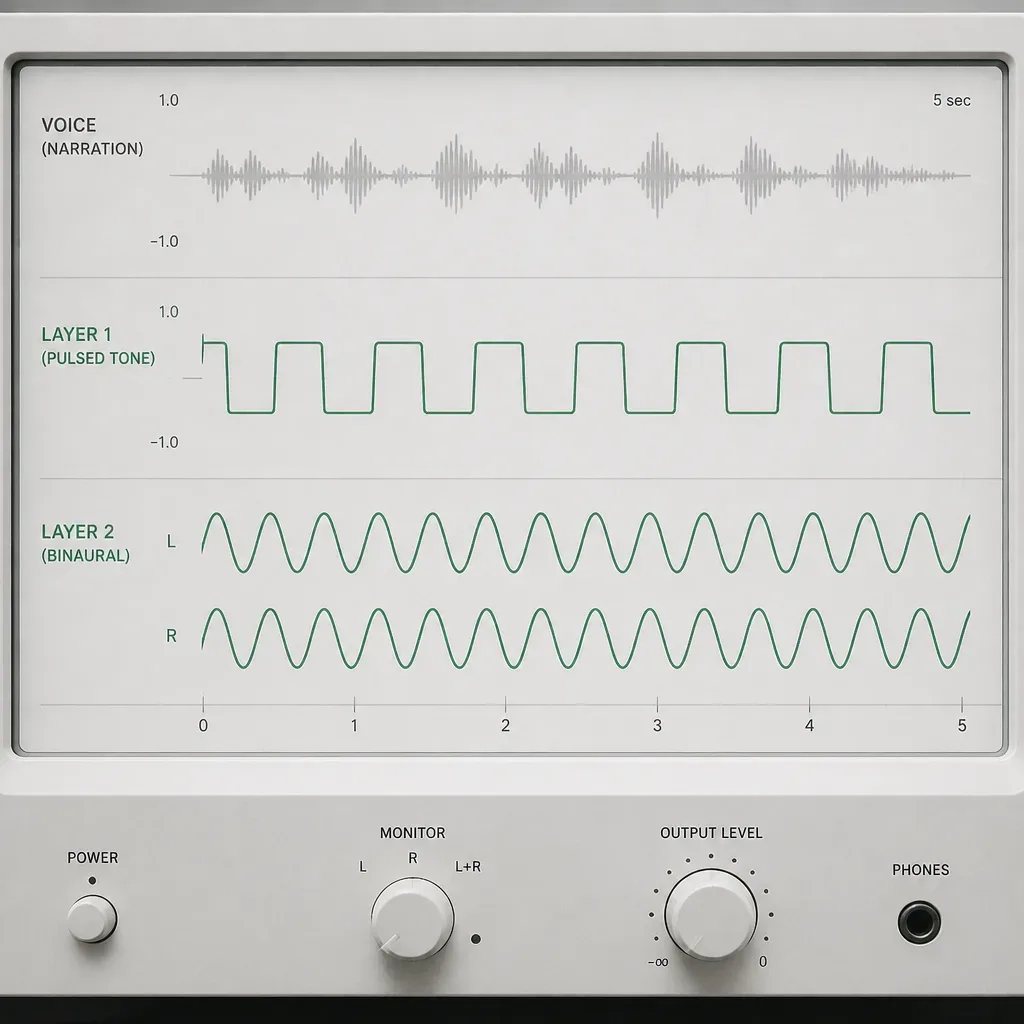
Isochronic tones are audible on-off pulses, while binaural beats are a stereo illusion created by two slightly different tones. Under Dream-Self audio, binaural beats usually interfere less with the voice; isochronic tones can work, but only when the pulse is slow, soft, and mixed well below the narration.
What are isochronic tones, and how are they different from binaural beats?
Isochronic tones are regular sound pulses; binaural beats are perceived beats made inside the auditory system.
An isochronic tone is usually one carrier tone that turns on and off at a fixed rate, such as 6 Hz or 10 Hz. The sound itself contains the pulse. If you play it from a phone speaker, you still hear the rhythm. A binaural beat uses two steady tones, one sent to each ear, such as 200 Hz in the left ear and 206 Hz in the right ear. The 6 Hz beat is not in either speaker channel. Your brainstem and auditory cortex infer the difference.
That distinction matters under spoken audio. A Dream-Self recording asks the ear to follow consonants, vowels, pacing, and emotion in a voice. Isochronic pulses can slice through that layer if they are too bright or too deep in the mix. Binaural beats tend to feel steadier because each channel is continuous, though the carrier tone can still become irritating if it sits near the voice band, roughly 100 Hz to 4 kHz.
Gerald Oster’s 1973 article in Scientific American is still the common reference point for binaural beats, especially the basic mechanism. Later reviews, including Chaieb and colleagues in Frontiers in Human Neuroscience in 2015, found mixed evidence across attention, mood, pain, and memory tasks. The mechanism is real. The claims around it are uneven.
A tone is not useful because the label sounds technical. It is useful if it leaves the voice intact and the body quieter.
Which one sits better under Dream-Self audio?
Binaural beats usually sit better under Dream-Self audio because they don’t add a hard amplitude pulse to the same space as the voice.
Spoken audio is information-rich. English speech intelligibility depends strongly on the 1 kHz to 4 kHz region, with lower frequencies carrying warmth and higher frequencies carrying consonant edges. If an isochronic tone clicks or gates sharply, it can mask parts of that information. This is not a mystical conflict. It is ordinary masking: one sound reduces your ability to hear another sound near it in time or frequency.
The AYA Method is a daily audio manifestation practice. Each day you listen to a short personalized recording, your Dream-Self Moment, narrated from the version of you who has already manifested the life you intend. Listening is the practice. Repetition is the work. The audio is the method. If you use the AYA Method, the spoken layer should remain the lead signal, not the decoration.
In practice, a binaural carrier placed low, often around 120 Hz to 250 Hz or higher than the speech focus, can stay out of the narrator’s way. Isochronic tones can also work when they use a soft envelope, meaning the pulse fades in and out rather than snapping on and off. A 2022 review of auditory beat stimulation studies noted large variation in protocols, from minutes to weeks, which makes one-size advice weak. Your mix needs a listening test, not just a frequency label.
What does the evidence say about entrainment claims?
The evidence says auditory beats can affect some measures in some settings, but the results are not strong enough to promise sleep, focus, or manifestation effects.
A 2019 meta-analysis by Garcia-Argibay, Santed, and Reales examined 22 studies on auditory beat stimulation and reported small to medium effects depending on outcome and protocol. Effects were not uniform. Timing, frequency band, headphones, carrier tone, and expectation all mattered. That is useful, but it is not a blank check for marketing.
Isochronic tones have less published research than binaural beats. They are often grouped with rhythmic auditory stimulation or amplitude-modulated tones, which makes direct comparison difficult. In small studies, steady rhythmic sound can influence attention or relaxation markers, but the evidence base is thinner than the number of tracks online suggests. If someone claims that 7.83 Hz automatically produces a specific mental state, ask for the study design, sample size, and outcome measure.
Here is the plain comparison:
| Feature | Isochronic tones | Binaural beats |
|---|---|---|
| Needs headphones | No | Yes, for proper stereo separation |
| Beat exists in audio file | Yes | No, it is perceived from two tones |
| Risk of masking speech | Higher if pulsed sharply | Lower if carrier is quiet |
| Research volume | Smaller direct base | Larger, still mixed |
| Best under narration | Soft pulse, very low mix | Low carrier, low volume |
If you want to hear the mechanism before mixing it with voice, use the Binaural beats generator + guide and compare 4 Hz, 8 Hz, and 12 Hz at the same volume. Keep the carrier tone quiet. The difference should be audible, but it should not demand attention.
How should you set volume when tones sit under a voice?
Set the voice first, then bring the tone up only until it is barely detectable.
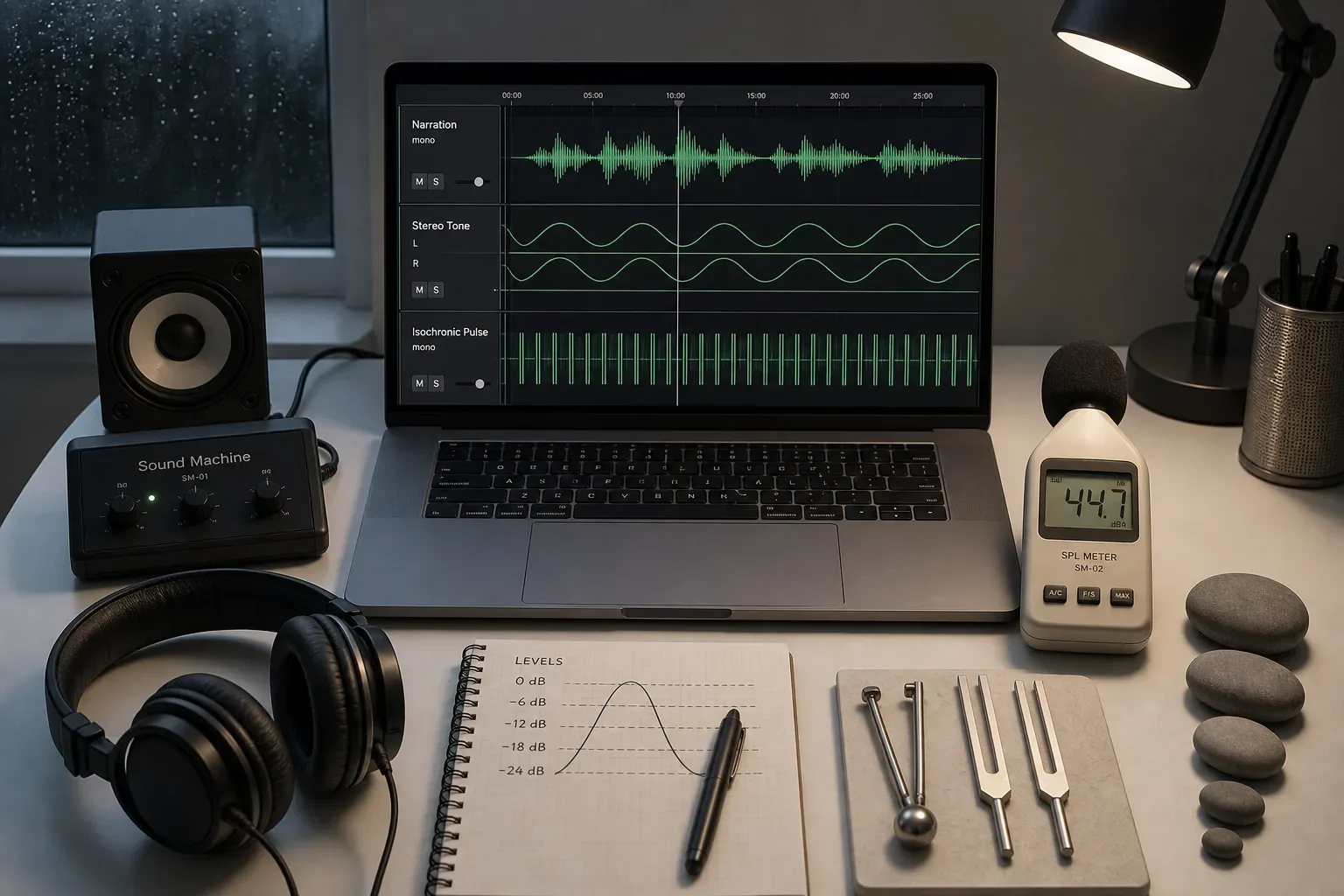
Volume is where good sleep audio usually succeeds or fails. Normal conversation is often cited around 60 dB SPL at 1 meter, though real rooms vary. For bedtime listening, the safer target is lower: roughly 40 to 55 dB at the ear if you can measure with a calibrated meter, and lower still for children. Phone sound-level apps are imperfect, but they can help you avoid accidental loudness.
The World Health Organization estimated in 2015 that about 1.1 billion young people were at risk of hearing damage from unsafe listening habits. Sleep audio is not a concert, but duration matters. A quiet tone for 20 minutes is different from earbuds pressing sound into the ear canal for 8 hours. If you use headphones, prefer low volume, a timer, and hardware that does not create pressure points.
Use this order:
- Play the spoken track alone and set it to the lowest clear level.
- Add the tone at zero gain.
- Raise the tone until you notice it, then reduce it by 2 to 4 dB.
- Listen for 3 minutes, not 10 seconds, because the ear adapts.
- If consonants blur, the tone is too loud or too close to the voice band.
A good under-layer is something you stop noticing without having to fight it.
If outside sound is the real problem, masking may help more than tones. The White noise generator + guide lets you compare steady noise with tonal rhythm. White noise has equal power per hertz, so it can sound bright; many listeners prefer lower, softer noise for sleep.
Which frequencies make sense for a night routine?
Slow beat rates are usually the least intrusive for a night routine, but the carrier tone and mix matter more than the number on the label.
Many tracks advertise delta, theta, alpha, and beta bands. In EEG language, delta is often around 0.5 to 4 Hz, theta about 4 to 8 Hz, alpha about 8 to 12 Hz, and beta roughly 13 to 30 Hz. Those ranges describe measured brain rhythms, not guaranteed responses to audio. A 6 Hz tone bed does not force the brain into theta. It presents a rhythmic cue near that rate.
For spoken Dream-Self audio, slower rhythms tend to be less distracting. A 2 Hz isochronic pulse can feel like a soft lighthouse if the envelope is rounded. A 10 Hz pulse can become a flutter behind the voice. Binaural beats between 4 Hz and 8 Hz are common in wind-down tracks, but carrier tone choice matters. A carrier near 440 Hz may be more noticeable than one tucked lower, depending on the narrator.
A practical routine could be:
- 5 minutes of steady room masking if the home is noisy.
- 8 to 12 minutes of Dream-Self audio with a low binaural bed or no tone.
- A 15 to 30 minute timer so headphones are not running all night.
- One setting held for 7 nights before changing the frequency.
Solfeggio tones sit in a different category. The tradition names frequencies such as 396 Hz, 528 Hz, and 852 Hz, and many people like them as musical anchors. The evidence for specific life outcomes is not established. If you enjoy that sound, our Solfeggio frequencies guide explains the tradition without treating preference as proof.
How do you test which one works for you without fooling yourself?
Test one variable at a time for at least a week, because single-night impressions are noisy.
Sleep is not a lab bench, but it can still be measured gently. The American Academy of Sleep Medicine often points adults toward 7 or more hours of sleep as a general target, while also noting that quality and timing matter. If you change tone type, volume, bedtime, caffeine, and screen use on the same night, you will not know what helped.
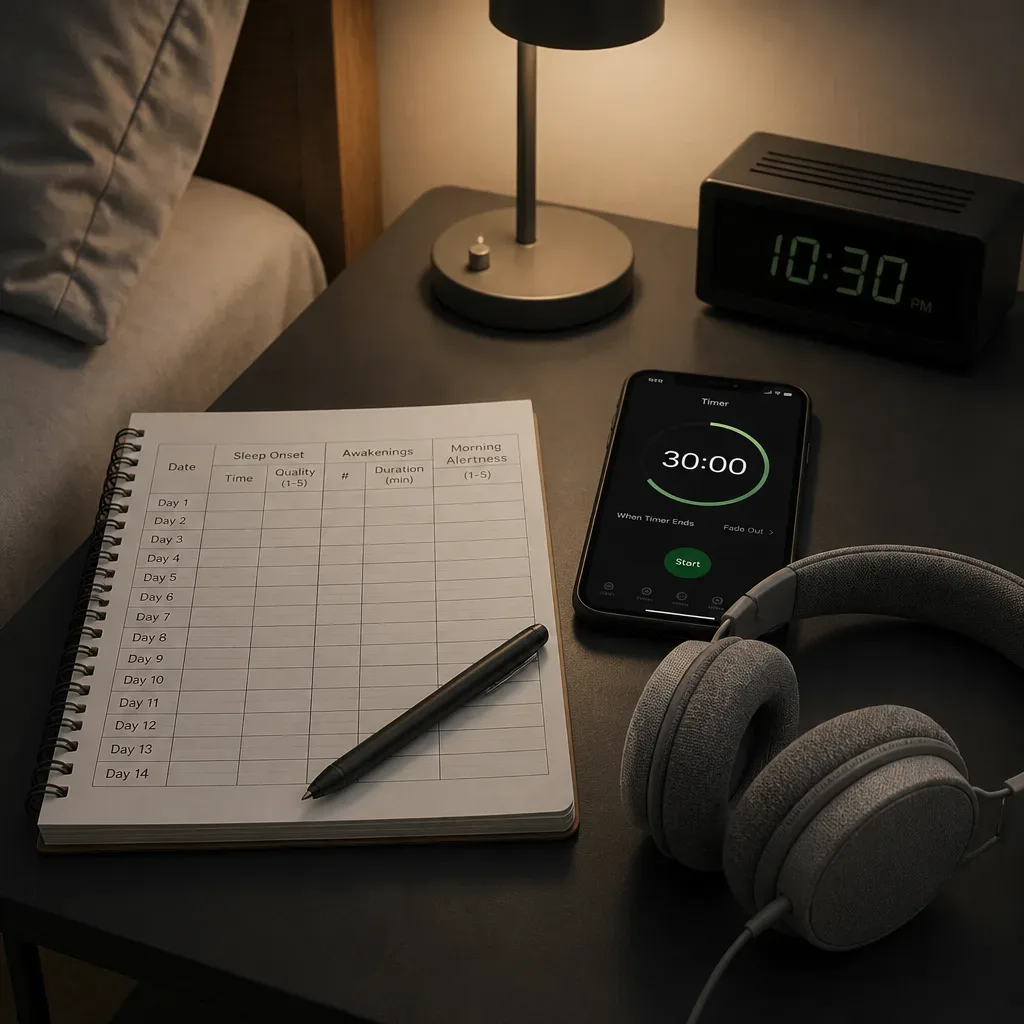
Use a simple A/B plan. Week A is Dream-Self audio with no tone, or with binaural beats. Week B is the same recording with isochronic tones at matched volume. Keep the spoken file, start time, timer length, and listening device the same. If possible, do not look at the label each night. Expectation effects are real; in audio tests, sighted preference can change what people report hearing.
Track only a few measures:
- Time you pressed play.
- Estimated minutes to sleep.
- Number of remembered awakenings.
- Morning alertness from 1 to 5.
- Any ear irritation, headache, or annoyance.
After 14 nights, look for a plain pattern. If isochronic tones help you settle but make the voice harder to follow, they are not the right under-layer for this use. If binaural beats feel neutral and the narration stays clear, that is a better engineering result even if it sounds less dramatic. The best sleep audio often wins by not calling attention to itself.
For another calibration point, spend 2 minutes with the Binaural beats generator + guide, then 2 minutes with the White noise generator + guide. Press play below and listen for the difference between rhythm and masking. Your nervous system gets a vote, but it votes more clearly when the test is simple.
When should you avoid tones under audio?
Avoid tones if they irritate your ears, sharpen tinnitus, disturb sleep, or make the spoken recording harder to receive.
Some people do better with no added tone. That is not a failed practice. It is a cleaner signal path. If you have tinnitus, hyperacusis, migraines triggered by sound, ear pain, seizure history, sleep apnea, or chronic insomnia, talk with a qualified clinician before using rhythmic audio as a nightly tool. Sound can support a routine, but it is not medical treatment.
Children need extra caution. Their listening habits are often harder to monitor, and smaller ears do not make loud audio safer. The same conservative rule applies: low volume, short duration, no pressure to keep headphones on, and no track that causes distress. For adults, all-night loops are rarely necessary. A 20 to 30 minute timer is usually enough to cover the settling period.
My default recommendation is simple: if the voice matters, start with no tone. If the room is noisy, add gentle masking. If you still want rhythmic support, try binaural beats before isochronic tones under narration. If you love isochronic tones, use a slow rate, a rounded pulse, and a level so low that the narrator remains easy to hear.
The ear adapts, but it also keeps score.
Tonight, choose the quietest layer that leaves the words clear.