frequencies binaural
Monaural Beats vs Binaural Beats Under Dream-Self Audio
Monaural beats can sit under Dream-Self audio more cleanly than binaural beats for some listeners. Here is how to compare both safely.
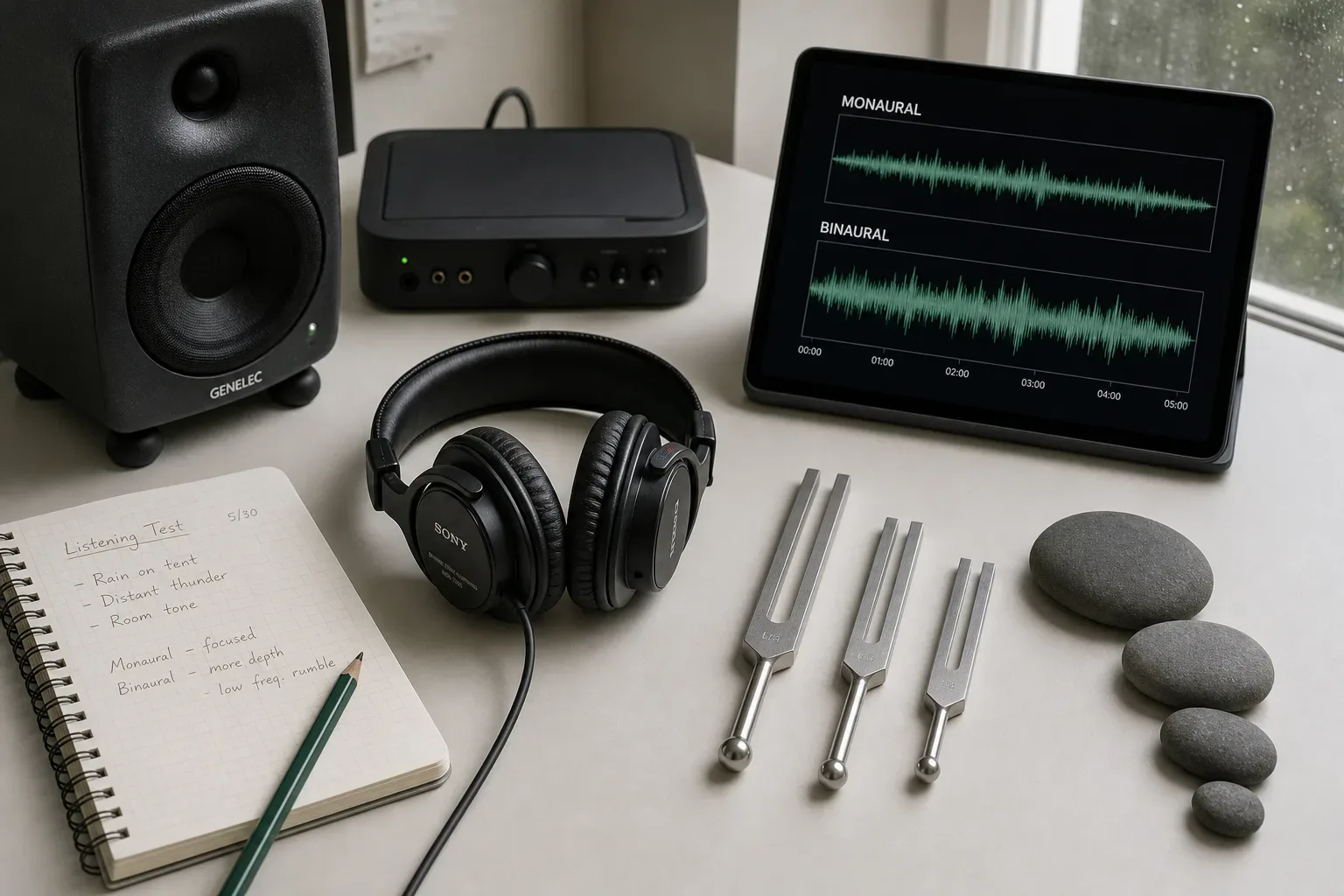
Monaural beats are single mixed pulses; binaural beats are two-tone illusions built by the brain through headphones. Under Dream-Self audio, monaural beats tend to be simpler to mix, easier to hear on speakers, and less fragile beneath narration. Binaural beats can still work, but they need cleaner stereo conditions.
What is the actual difference between monaural beats and binaural beats?
Monaural beats are acoustic pulses in the audio file, while binaural beats are perceived pulses created when each ear receives a different tone.
A monaural beat is made by combining two close frequencies before playback. If 200 Hz and 206 Hz are mixed into one channel, the waveform rises and falls 6 times per second. That 6 Hz pulse exists in the air pressure coming from one speaker. You can hear it with one ear, two ears, headphones, or a small bedside speaker.
A binaural beat is different. One ear might receive 200 Hz, the other 206 Hz. There is no 6 Hz amplitude pulse in either channel. The auditory system compares the tones and tends to perceive a 6 Hz fluctuation. Gerald Oster’s 1973 paper in Scientific American helped popularize this distinction and remains one of the most cited introductions to binaural beats.
The practical difference is not subtle when you place narration above the beat. Monaural beats tolerate voice, room playback, and a little stereo mess. Binaural beats need separation. If your phone speaker folds the audio to mono, the binaural effect is gone. If your headphones leak or an app adds spatial processing, the beat can blur.
The beat under a voice should not ask for attention; it should make attention easier to keep.
For comparison, the Binaural beats generator + guide lets you hear the headphone-based version directly. If you want a non-tonal control, the White noise generator + guide is useful because it masks sound without adding a rhythmic target.
| Feature | Monaural beats | Binaural beats |
|---|---|---|
| Needs headphones | No | Yes |
| Beat exists in waveform | Yes | No |
| Works from speakers | Yes | Not as intended |
| Survives mono playback | Usually yes | No |
| Best under narration | Often simpler | Possible, but fragile |
Which one sits more cleanly under Dream-Self audio?
Monaural beats usually sit more cleanly under Dream-Self audio because the pulse remains stable below the spoken layer.
Dream-Self audio asks the ear to follow language. The words carry identity, timing, and emotional detail. If the under-bed competes with consonants, breath, or stereo location, the voice has to work harder. In practice, a low-volume monaural beat around 4 to 8 Hz can be mixed as a soft tremor under a centered voice without forcing headphone separation.
Binaural beats can be elegant when the voice is sparse and centered. The problem is not the beat itself; it is the routing. If narration is stereo-widened, if music pads spread across the field, or if a listener uses one earbud, the beat condition changes. A 2015 review in Frontiers in Human Neuroscience noted that binaural-beat findings vary widely by frequency, task, duration, and protocol. That variability matters when a spoken practice is placed above the tones.
I would test both with the same words, same level, and same duration, then ask one plain question: can you forget the carrier and still hear the sentence? If not, the bed is too present. The audio is not there to show itself.
For the AYA Method, the core is daily listening to a short personalized recording, your Dream-Self Moment, narrated from the version of you who has already manifested the life you intend. Listening is the practice. Repetition is the work. The audio is the method. A beat underneath is only a support layer.
What does the research say about beats and attention?
The evidence is mixed, with small positive findings in some tasks and many protocol differences that make broad claims unwise.
Binaural beats have been studied for anxiety, attention, memory, pain, and sleep, but sample sizes are often modest. A 2019 meta-analysis in Psychological Research reviewed 22 studies and reported that binaural beats may affect cognition and anxiety, with outcomes depending on exposure length and beat frequency. That is interesting, not settled. It also does not prove that a beat improves manifestation audio.
Monaural beats are less famous in wellness writing but easier to define acoustically. Because the amplitude modulation is physically present, some auditory researchers use related modulation techniques to study neural entrainment. In plain terms, the ear and brain are good at tracking repeated changes in loudness. Speech itself depends on amplitude patterns in the 2 to 8 Hz range, close to syllable timing in many languages.
That overlap is a reason to be careful. A strong 6 Hz monaural pulse can make a voice feel lumpy, especially if it lands in the same low-mid band as the narrator. A faint pulse can feel steady. A loud pulse becomes another speaker in the room.
The safest reading is this: beats may help some listeners hold a narrow attentional lane, but the words, repetition, and nightly cue probably matter more. Joe Dispenza and Neville Goddard are often cited in manifestation circles for rehearsal and assumed identity; neither tradition requires a specific carrier tone. Dr. Andrew Huberman has also emphasized repeatable behavioral cues and light timing when discussing sleep and nervous-system state, not miracle frequencies.
A beat is a metronome for attention, not proof that attention has changed.
How should you set volume, frequency, and playback tonight?
Start lower than you think, choose one beat range, and protect the voice from the bed.
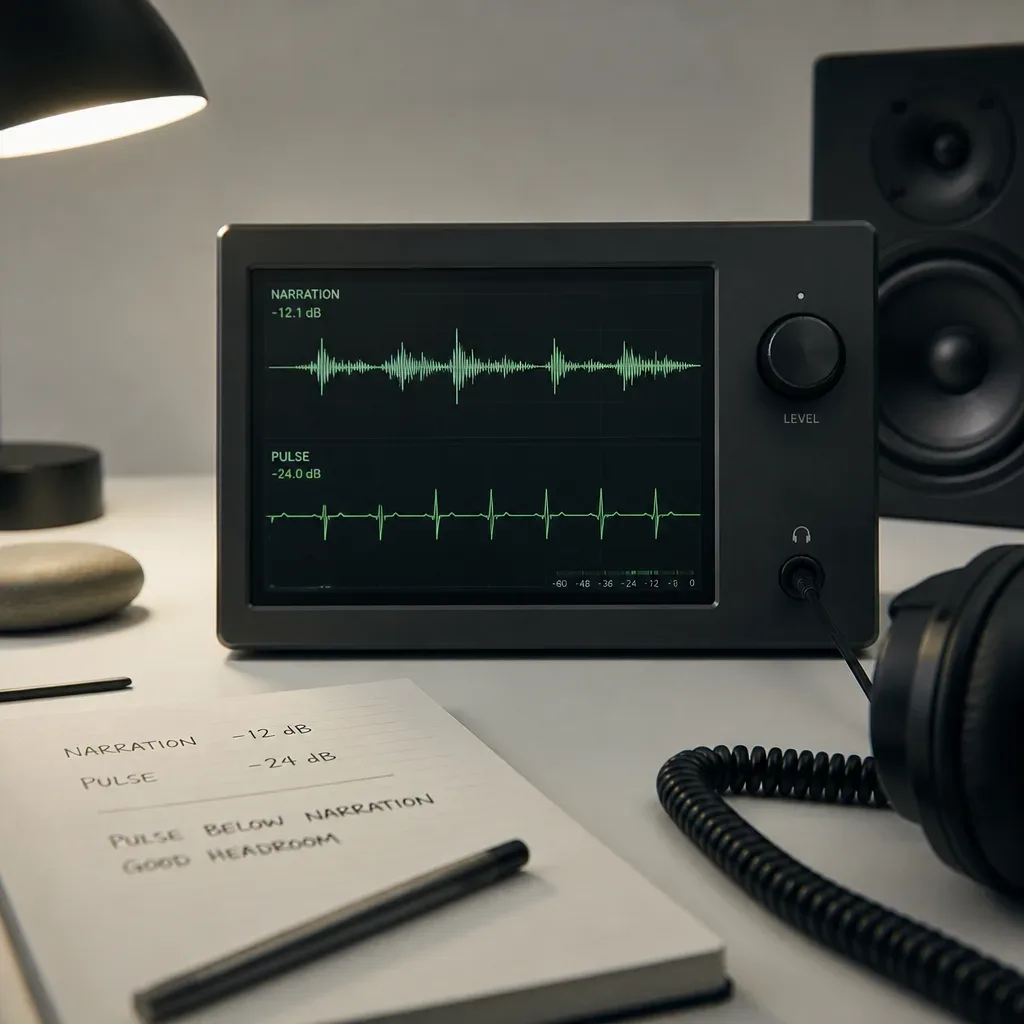
For nighttime use, I keep tonal beds quiet: often 10 to 18 dB lower than the narration in a finished mix. At the pillow, many calm sleep tracks measure roughly 40 to 55 dB SPL, depending on the room. The World Health Organization has treated 40 dB as a useful night-noise reference in environmental guidance, though headphones make exact levels harder to judge.
Frequency choice should be conservative. Many users associate theta with 4 to 8 Hz and alpha with 8 to 12 Hz. Those labels come from EEG bands, not from guaranteed outcomes. If you are listening to spoken Dream-Self audio before sleep, a 4 to 7 Hz beat often feels slower, while 8 to 10 Hz can feel more awake. Use perception as data: if your jaw tightens, the setting is wrong.
A simple test sequence works better than guessing:
- Play the voice alone for 2 minutes and set it just above room noise.
- Add monaural beats at a very low level for 3 minutes.
- Switch to binaural beats at the same apparent loudness, using headphones.
- Remove the beat and notice whether the voice feels clearer or flatter.
- Repeat on a second night before deciding.
If you use speakers, monaural is the fair test. If you use headphones and want the classic stereo illusion, binaural is the fair test. Keep sessions short at first: 10 to 20 minutes is enough to learn whether the sound settles you or irritates you. If you have tinnitus, epilepsy, sound sensitivity, sleep apnea symptoms, or chronic insomnia, check with a qualified professional before making repetitive tones part of your night.
For a control night, try the White noise generator + guide. Noise has no beat target, so it helps you hear whether rhythm is helping or whether masking alone is doing the work.
When would binaural beats be the better choice?
Binaural beats are the better choice when you are using headphones, want a very subtle bed, and can keep the stereo field clean.
The best binaural setup is almost boring: left tone, right tone, centered voice, low volume, no stereo widening, no loud music, no smart-speaker mono fold-down. If the left ear receives 220 Hz and the right ear receives 226 Hz, the intended beat is 6 Hz. Add a wide pad, phone processing, or one loose earbud, and the condition is no longer the same.
Some listeners prefer binaural beats because they feel less mechanical. There is no obvious throbbing in the waveform, so the sound can seem smoother beneath speech. In a 30-minute pre-sleep session, that subtlety can matter. The voice remains the foreground; the tones stay nearly invisible.
The drawback is headphone comfort. Sleep headphones vary widely, and in-ear buds can raise the risk of irritation if used nightly. Many consumer devices can exceed 85 dB SPL at higher settings, a level often used in occupational hearing guidance as a threshold for time-limited exposure. Your sleep audio should be nowhere near that. Quiet is part of the design.
Binaural beats are also worth testing if you already use tone-based tools. The Binaural beats generator + guide lets you compare beat rates without committing to a full spoken mix. Keep notes for 3 nights: sleep onset, restlessness, and whether the words remained easy to follow.
The cleaner the stereo path, the more honest the binaural test.
When would monaural beats be the better choice?
Monaural beats are the better choice when you need speaker playback, consistent routing, or a beat that survives real rooms.
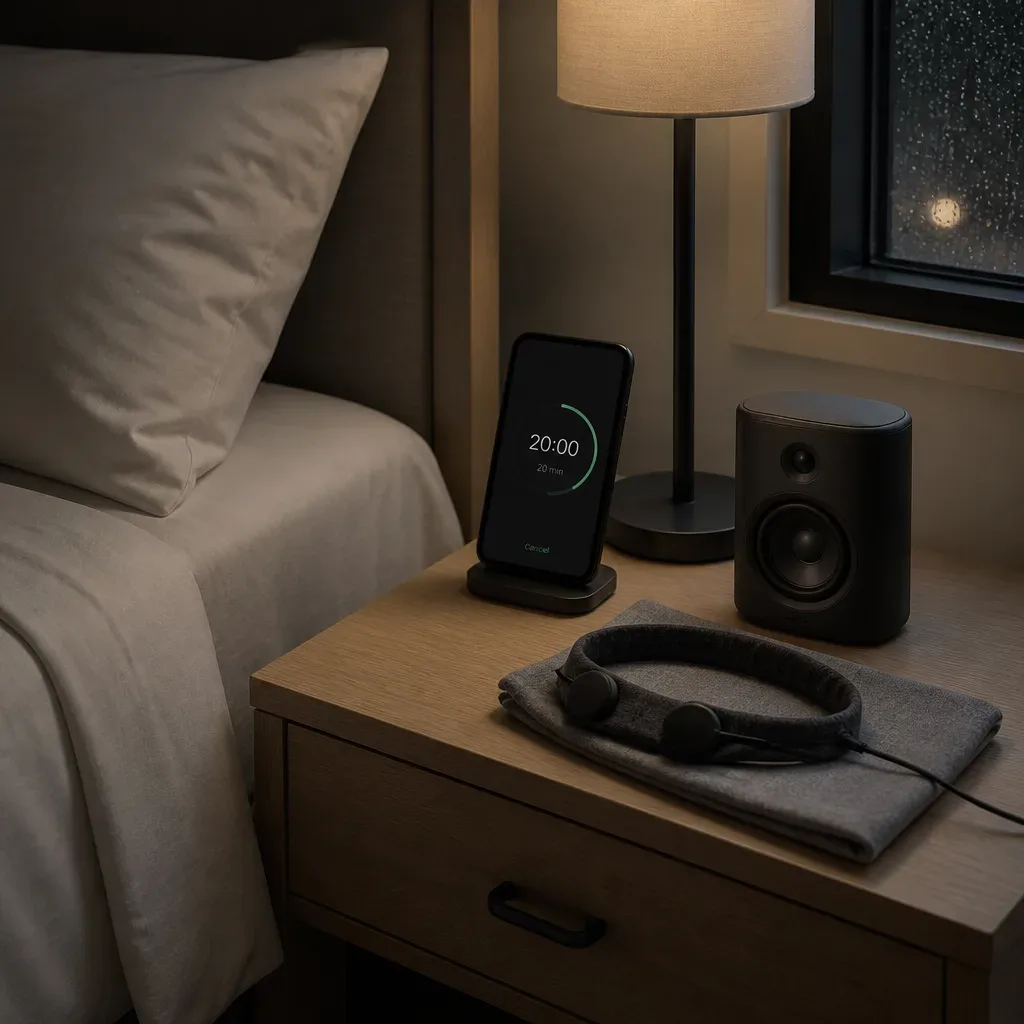
This is the field recordist’s answer because rooms are imperfect. Phones sit on books. Pillows cover one ear. A partner turns over. Bluetooth speakers sum channels in ways the app never tells you. Monaural beats handle this mess better because the modulation is already in the sound. A single bedside speaker can reproduce it.
Monaural beats also give the mixer more control. You can place the pulse low, filter the carrier, and leave the narrator’s consonants untouched. For spoken audio, that matters. Intelligibility often lives between roughly 1 kHz and 4 kHz, while warmth and masking conflicts can build below 500 Hz. A monaural beat with a carefully chosen carrier can stay out of the voice’s way.
The risk is obvious pulsing. If a monaural beat is too loud, it can feel like a machine behind the words. That may be fine for focus audio, but Dream-Self listening usually wants less edge. I prefer a pulse you notice only after it is removed. The absence should tell you it was there.
Monaural beats are useful when you want to compare with other frequency traditions too. The Solfeggio frequencies guide explains the lore around 396 Hz, 528 Hz, and related tones with respect and plain evidence boundaries. You can like a frequency without asking it to carry the whole practice.
Use monaural beats if you share a room, dislike headphones, or want a stable under-bed for nightly repetition. Use binaural beats if headphones feel natural and the stereo path stays clean. Use neither if the voice alone is clearer.
What is the best practical setup for Dream-Self listening?
The best setup is the one where the voice stays primary, the bed stays quiet, and the practice repeats without friction.
Here is my comparison after recording rain, surf, and room tone for 15 years: the ear trusts sound that behaves. It does not need perfection. It needs a stable reason to stop scanning. A small imperfection, like breath in the narrator or a faint room tail, can feel more believable than a loop polished until it no longer breathes.
For most Dream-Self audio, I would start with no beat for 3 nights, then monaural for 3 nights, then binaural for 3 nights if headphones are comfortable. Keep the script, time, and playback level the same. This is not a laboratory-grade trial, but it controls the variables that usually mislead us. Nine nights gives you better information than one strong opinion after a restless evening.
Track only a few measures:
- Did I finish the recording without adjusting the volume?
- Did the words remain clear the whole time?
- Did the under-bed feel steady or distracting?
- Did I want to listen again the next day?
If the answer to the last question is no, the sound design has failed. Repetition is not a bonus in this kind of practice; it is the structure. A 2022 review of habit formation research noted that repeated cues and stable contexts are central to automatic behavior, though timelines vary widely by person and behavior.
My default recommendation is plain: use monaural beats under Dream-Self audio when playback conditions are mixed, use binaural beats only when headphones are comfortable and clean, and keep both quieter than the voice. If either beat pulls you away from the sentence, remove it.
The right bed is the one you stop noticing before the second paragraph.
Tonight, let the voice stay close and the low hum stay lower.