frequencies binaural
Schumann Resonance Frequency Under Dream-Self Audio
Schumann resonance frequency claims sound precise, but audio setup matters. Learn what 7.83 Hz can and cannot do under Dream-Self listening.
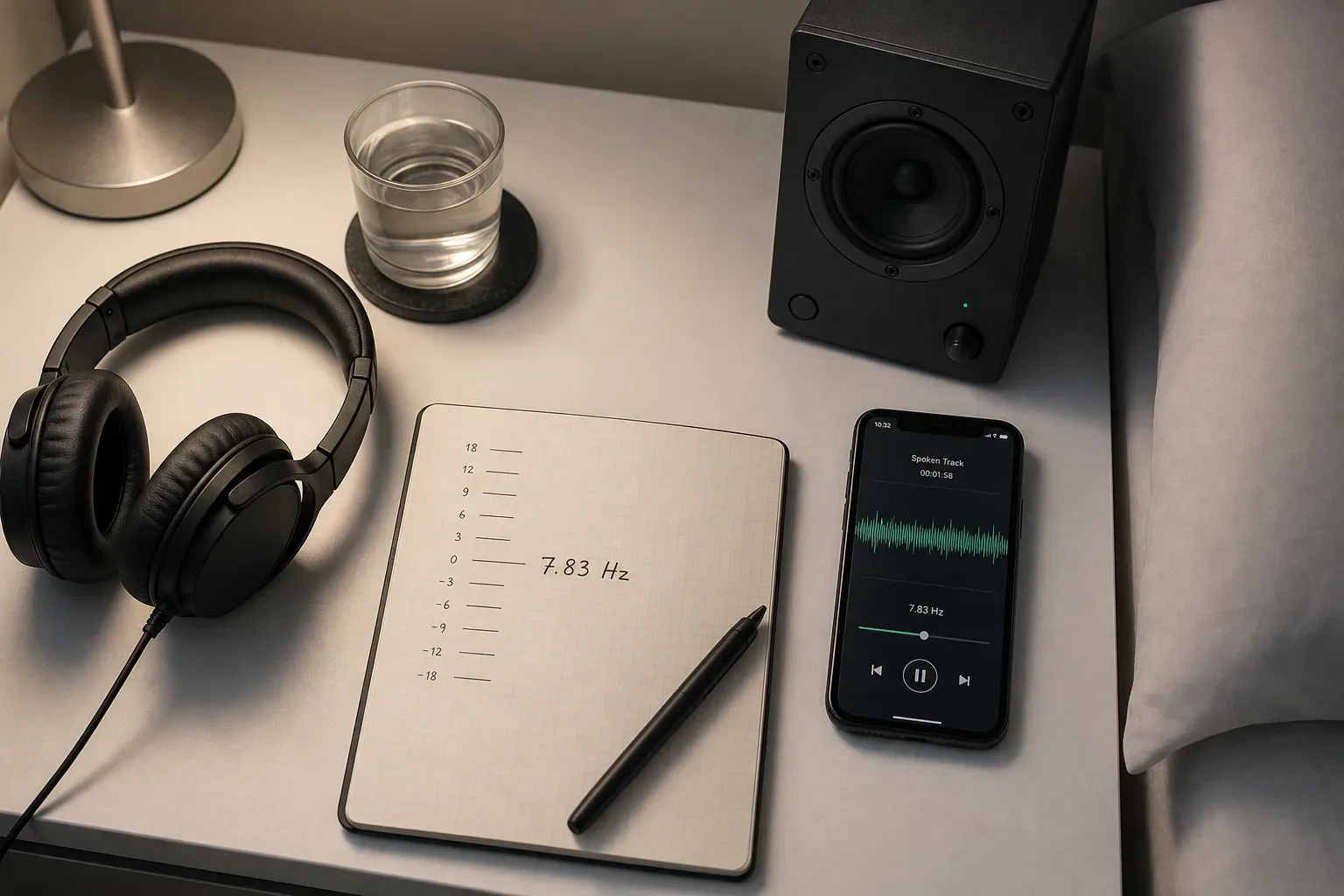
Schumann resonance frequency usually refers to the Earth-ionosphere resonance near 7.83 Hz, not a normal audible tone. Under Dream-Self audio, it should be treated as a quiet support layer: a represented frequency or binaural beat that may help some listeners settle, without replacing the spoken recording or proving any manifestation claim.
What is the Schumann resonance frequency, exactly?
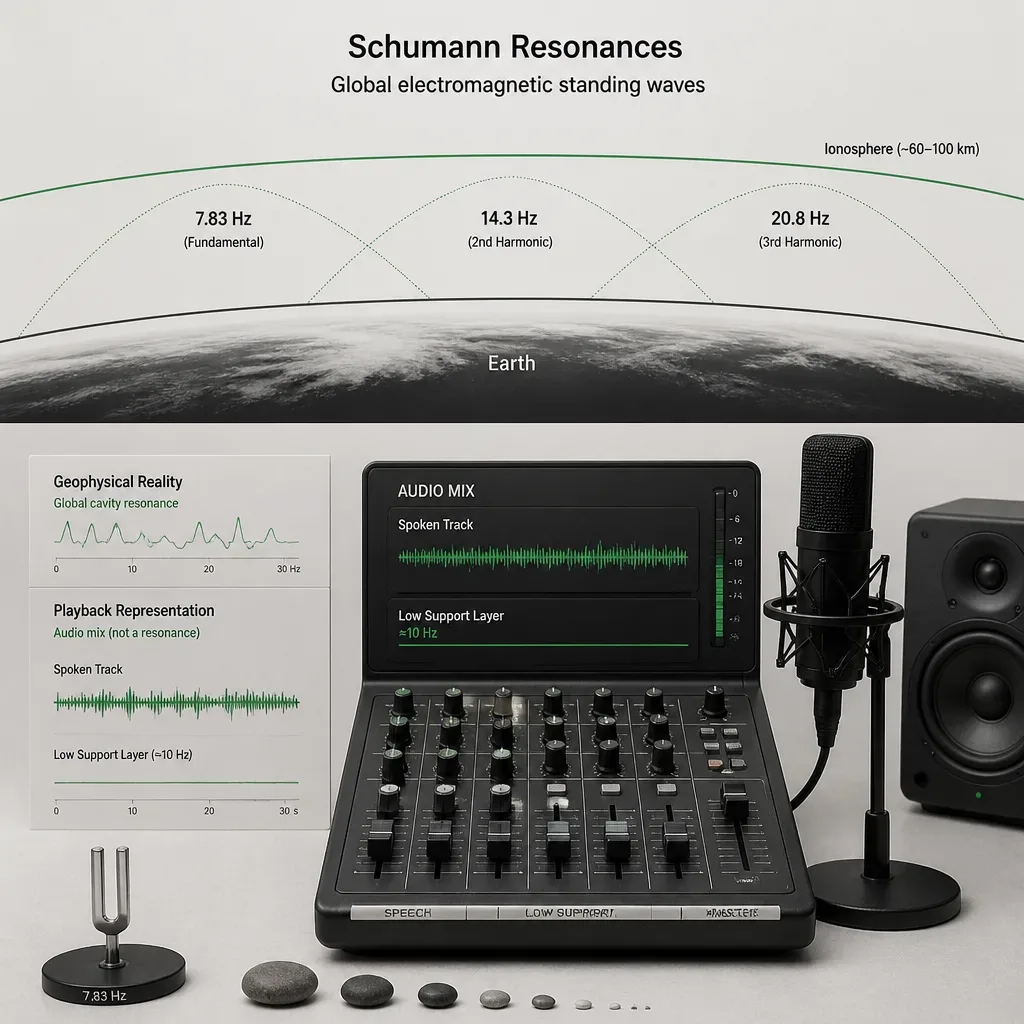
The Schumann resonance frequency is the lowest standing electromagnetic resonance of the cavity between Earth’s surface and the ionosphere, most often cited near 7.83 Hz.
Physicist Winfried Otto Schumann predicted the effect mathematically in 1952, and measurements in later decades found a family of resonances rather than one fixed line. The common peaks are often listed around 7.83 Hz, 14.3 Hz, 20.8 Hz, 27.3 Hz, and 33.8 Hz, though real values shift with lightning activity, ionospheric height, day-night changes, and solar conditions. The source is mostly global lightning. Around 40 to 50 lightning flashes occur per second worldwide, according to common estimates used by atmospheric electricity researchers.
The important audio fact is plain: 7.83 Hz is below the normal hearing range. Most textbooks place adult hearing roughly between 20 Hz and 20,000 Hz, with sensitivity declining at the high end with age. A speaker can move at 7.83 cycles per second, but most small speakers and headphones cannot reproduce that as clean acoustic pressure. If you hear a Schumann track, you’re usually hearing a higher carrier tone, a binaural difference, amplitude modulation, harmonics, or added noise.
That distinction matters when placing it under Dream-Self audio. The planetary resonance is electromagnetic. Your playback system is acoustic. A label can be useful, but a label is not a measurement.
A 7.83 Hz label does not make a speaker into the Earth-ionosphere cavity.
Here is the practical map:
| Term | What it means | What you hear |
|---|---|---|
| Schumann resonance | Electromagnetic cavity resonance | Not directly audible |
| 7.83 Hz low tone | Speaker cone movement at 7.83 cycles per second | Usually little or nothing, sometimes distortion |
| 7.83 Hz binaural beat | Two tones separated by 7.83 Hz | A slow pulsing impression in headphones |
| Modulated noise | Noise volume shaped at 7.83 Hz | A soft swell or tremor |
For background listening, the best version is not the most literal one. It’s the one that stays quiet, stable, and out of the way.
Can Schumann resonance audio change your brain state?
Schumann-style audio may influence attention or relaxation for some listeners, but the evidence is indirect and mixed, especially when claims move from brain rhythms to life outcomes.
The tempting link is that 7.83 Hz sits near the border of theta and alpha activity in electroencephalography. EEG bands are commonly described as delta below 4 Hz, theta around 4 to 8 Hz, alpha around 8 to 12 Hz, beta around 13 to 30 Hz, and gamma above that. Those ranges are useful, but they are not switches. A brain rhythm measured at the scalp is not the same thing as an external tone or electromagnetic resonance.
Binaural beat research is the closest audio evidence. A 2019 meta-analysis by Garcia-Argibay, Santed, and Reales reviewed 22 studies and reported small effects on memory, attention, anxiety, and pain, with results depending on frequency, timing, and study design. Small effects are not nothing. They are also not proof that a specific frequency creates a specific outcome on command.
Princeton Engineering Anomalies Research and later Global Consciousness Project discussions are often mentioned in manifestation circles, but those projects studied random event generators and group attention, not Schumann audio under spoken recordings. They remain controversial and do not establish a playback protocol. If a claim needs 3 separate leaps to reach your headphones, keep the volume low and the confidence lower.
In practice, the stronger mechanism is probably simpler: a steady layer masks room noise, reduces sudden contrast, and gives the mind fewer edges to catch. The White noise generator + guide explains this masking effect more directly than any 7.83 Hz claim can. Noise does not persuade the nervous system. It reduces interruptions so the nervous system can notice it is safe enough to settle.
How should Schumann resonance sit under Dream-Self audio?
Schumann resonance should sit below the voice as a low, almost unnoticed bed, never as the main event.
For Dream-Self listening, speech intelligibility is the first measurement. If the spoken recording loses consonants, the bed is too loud. Human speech carries key intelligibility information roughly between 1 kHz and 4 kHz, while low beds occupy a different region, but masking can still happen through attention. Your ear does not only measure frequency. It measures what matters.
The daily practice reference here is the AYA Method: a daily audio manifestation practice where you listen to a short personalized recording, your Dream-Self Moment, narrated from the version of you who has already manifested the life you intend. Listening is the practice. Repetition is the work. The audio is the method. A Schumann layer can prepare the room, but it is not the method.
Use a simple gain structure. Set the Dream-Self voice first at a comfortable level. Then bring the Schumann-style layer up from silence until you barely notice it. On a phone, that may mean the backing layer is 10 to 20 dB quieter than the voice if you’re mixing files. If you’re using two devices, the support layer should disappear when the voice begins, not compete with it.
Try this 4-step setup tonight:
- Play the Dream-Self audio alone for 30 seconds and set the voice level.
- Start the Schumann-style layer at zero volume.
- Raise it until you can just detect steadiness, then lower it slightly.
- Listen for 2 minutes and ask whether the voice became clearer or less clear.
If you prefer headphones, a binaural version may give a more defined 7.83 Hz beat. If you prefer speakers, a modulated noise layer is usually safer and more stable. The Binaural beats generator + guide is a better place to test beat perception before you put anything under a spoken practice.
The support layer is successful when you stop caring about it.
Which setup is safest for sleep and hearing?
The safest setup is quiet, time-limited, and easy to stop, with the voice clear and the low layer far below speech level.
Volume is the part people under-measure. The World Health Organization has warned for years that unsafe listening habits put over 1 billion young people at risk of hearing damage, mainly from loud personal audio and venues. That warning is not about Schumann resonance specifically. It is about the habit of turning private sound into a high-pressure environment. Sleep audio should be boring to the ear.
If you can measure with a phone app, treat the number as approximate, not laboratory-grade. Many phone microphones are unreliable in low frequencies, and cases can change readings by several decibels. Still, a rough 40 to 50 dB SPL at the pillow is a conservative target for background sound in many quiet bedrooms. For comparison, normal conversation is often cited around 60 dB SPL at 1 meter.
Use these guardrails:
- Keep the spoken audio comfortable at the lowest clear level.
- Keep the Schumann-style bed lower than the voice.
- Avoid heavy bass boost, especially on small speakers.
- Use a timer of 20 to 45 minutes if you fall asleep to sound.
- Do not place speakers close to a baby, child, or pet.
- Stop if the sound causes pressure, nausea, headache, or ear ringing.
People with tinnitus, sound sensitivity, sleep apnea symptoms, chronic insomnia, or neurological conditions should treat frequency tracks as nonmedical tools and speak with a qualified professional when symptoms persist. This is not a legal disclaimer placed at the end. It is part of the setup.
For many rooms, a stable noise bed is more useful than a frequency label. If your building has traffic, elevators, or a refrigerator hum near 60 Hz in North America or 50 Hz in many other regions, broad masking can be kinder than a thin pulse. Press play on the White noise generator + guide and listen for whether your room edges soften.
What claims should you treat carefully?
Treat any claim carefully if it says Schumann resonance frequency directly manifests outcomes, repairs the body, or guarantees a brain state.
There are three separate claims often folded into one sentence. First, Schumann resonance exists. That is well supported in geophysics. Second, audio can represent 7.83 Hz through beats, modulation, or low-frequency motion. That is technically true, with playback limits. Third, listening to that representation creates a specific manifestation result. That third claim is not established by controlled evidence.
The same caution applies to frequency traditions more broadly. The Solfeggio frequencies guide covers tones such as 396 Hz, 528 Hz, and 852 Hz with respect for the tradition and plain limits around evidence. You can like a tone without assigning it medical authority. Preference is real data for your routine, but it is not proof of a universal mechanism.
A useful test is to ask what would change the claim. If someone says 7.83 Hz works no matter the volume, carrier tone, listener, device, room, time of day, or comparison condition, the claim cannot be measured cleanly. Good acoustic claims usually specify parameters. They say 7.83 Hz difference tone, 30 minutes, stereo headphones, 45 dB listening level, compared with a sham track. Without parameters, the claim is not ready to guide a setup.
Respect the tradition, then measure the playback.
This does not mean the sound is useless. It means the likely value is modest and practical: a cue, a settling layer, a ritual boundary, a way to make the first 5 minutes of listening feel less abrupt. The nervous system often responds to repetition. In behavioral sleep medicine, stimulus control and consistent pre-sleep routines are used because the body learns patterns over repeated nights, not because one sound contains a guaranteed result.
What is a plain 10-minute setup for tonight?
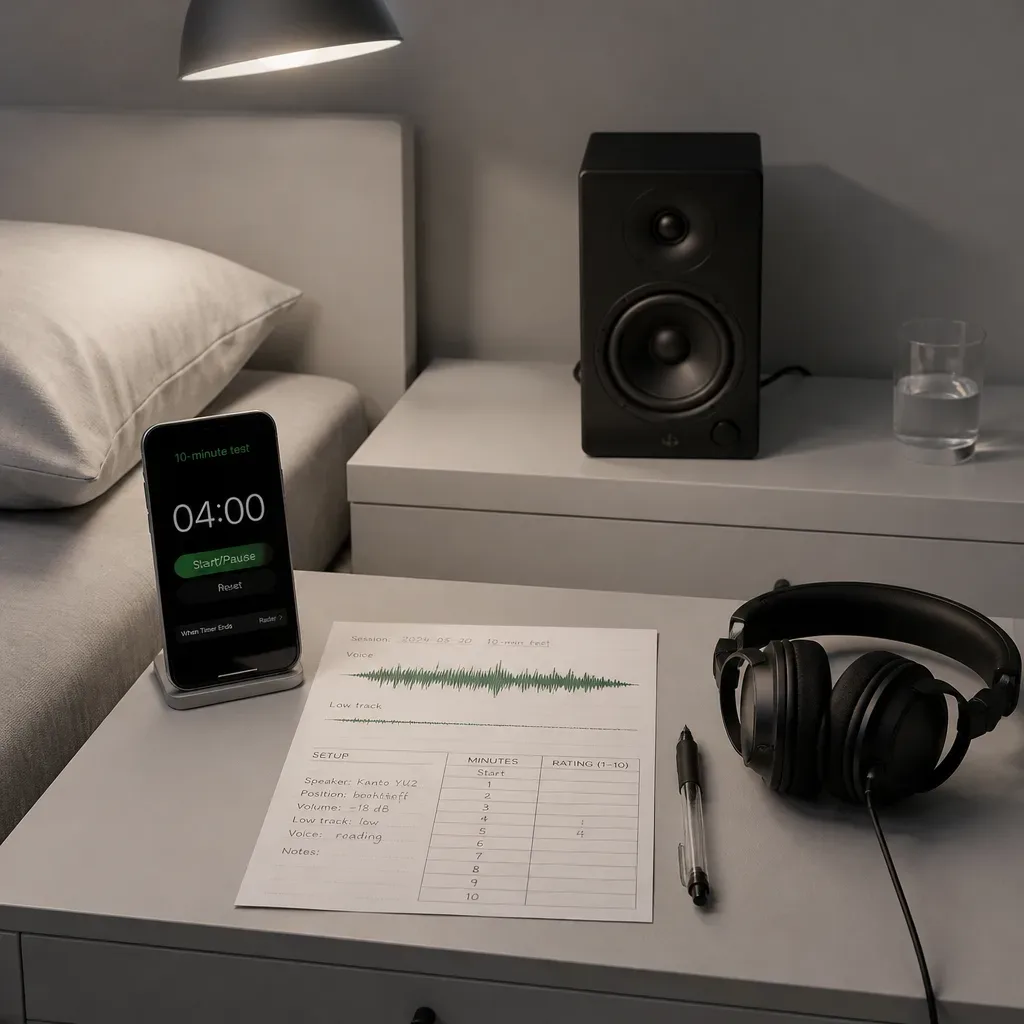
A plain 10-minute setup is voice first, low layer second, room noise third, with one setting changed at a time.
Start with the room. Turn off one avoidable noise source if you can, such as a fan rattle or laptop speaker hiss. Then choose the playback path. If you’re using headphones, test stereo balance with ordinary music for 15 seconds first. Binaural beats require separate left and right signals, so a single Bluetooth speaker will not deliver the intended beat. If you’re using speakers, place them 1 to 2 meters away rather than beside your head.
Set the Dream-Self recording next. The voice should be easy to understand at a level that would not bother someone in the next room. Then add the support layer. If you want a Schumann-style bed, use either a quiet 7.83 Hz binaural beat in headphones or a softly modulated brown or pink noise bed over speakers. Brown noise puts more acoustic energy in low frequencies than white noise, so it can feel steadier, but it can also mask speech if it is too loud.
Here is the 10-minute protocol:
| Minute | Action | What to listen for |
|---|---|---|
| 0 to 1 | Room check | Remove one sharp interruption |
| 1 to 2 | Voice only | Clear consonants and relaxed jaw |
| 2 to 4 | Add low layer | Barely noticed steadiness |
| 4 to 8 | Full listening | Voice remains central |
| 8 to 10 | Reduce or stop layer | Notice whether quiet feels easier |
If the Schumann layer pulls your attention away from the words, remove it. If the room is too sharp without support, use a simple masking sound instead. The Binaural beats generator + guide can help you compare a beat against plain tones, while the Solfeggio frequencies guide can help if you prefer named tones with a long tradition.
A routine works best when the sound is repeatable enough to become uninteresting.
Keep notes for 7 nights if you want a real answer from your own system. Use only 3 columns: setup, time listened, next-morning rating from 1 to 5. Seven nights is not a clinical trial, but it is better than changing 4 variables every evening and trusting memory. If the Schumann bed helps, keep it quiet. If it does nothing, plain noise is not a downgrade.
Set the tone low, press play, and leave the room quieter than you found it.