frequencies binaural
Binaural Beats Anxiety: Calm Before Dream-Self Audio
Use binaural beats anxiety audio as a short settling layer before Dream-Self audio, with safe volume, headphones, and realistic evidence.
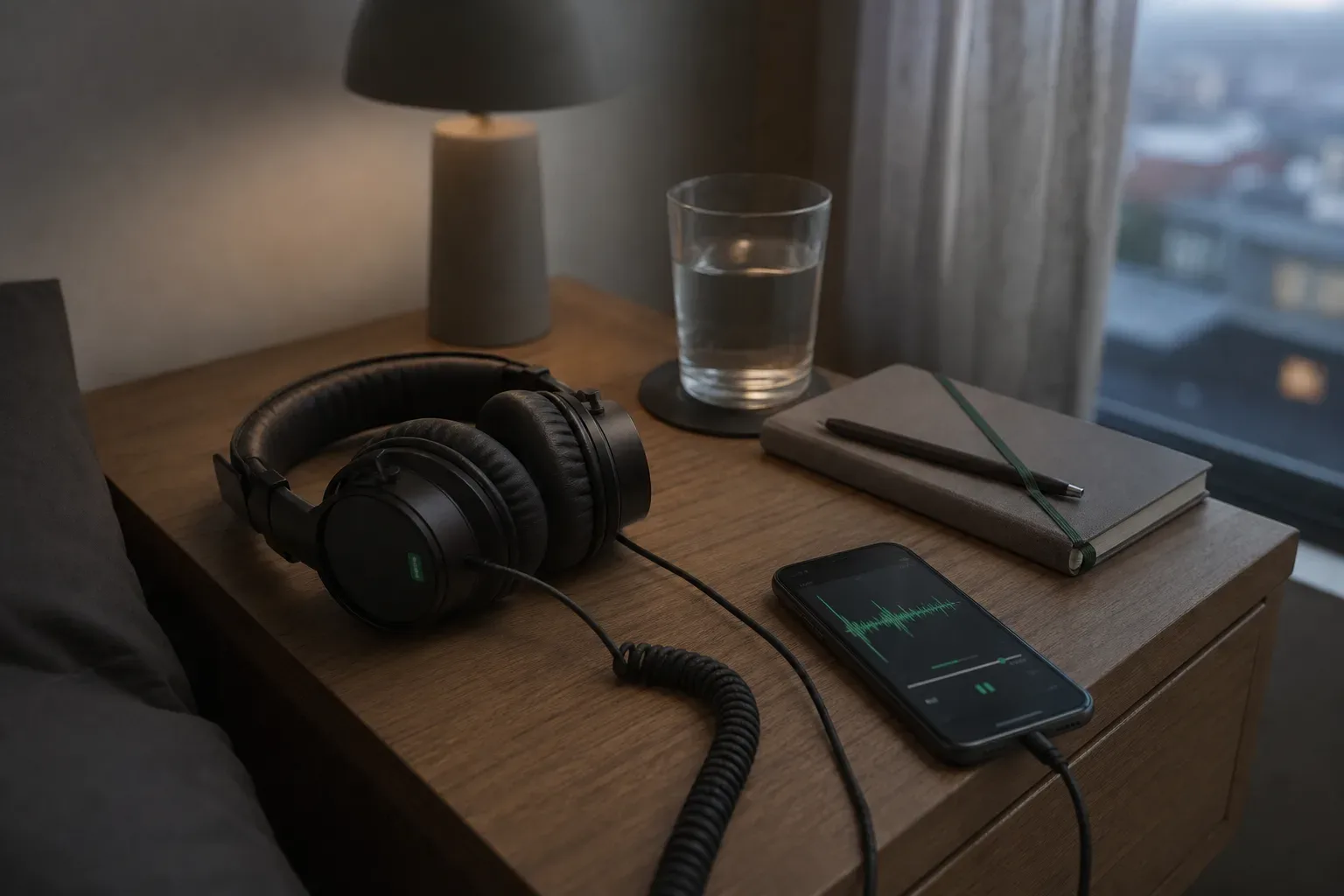
Binaural beats anxiety listening can be useful as a short settling layer before Dream-Self audio, but it’s not a cure and it doesn’t work for everyone. Use headphones, choose a gentle alpha or theta beat, keep the volume low, and treat the sound as preparation for the spoken practice that follows.
What are binaural beats, and why do people use them for anxiety?
Binaural beats are a listening illusion created when each ear receives a slightly different tone, and some people use them because the steady difference can make the nervous system feel easier to follow.
If your left ear hears 200 Hz and your right ear hears 210 Hz, you don’t hear two clean tones for long. Your brain tends to perceive a 10 Hz pulse, even though no speaker is physically producing a 10 Hz sound wave. That perceived 10 Hz rhythm sits in the alpha range, often discussed in relation to relaxed wakefulness. The mechanism is auditory, not mystical. The beat is constructed by the listener’s brainstem and auditory cortex from the mismatch.
The claims around anxiety are more mixed than the marketing. A 2019 meta-analysis by Garcia-Argibay and colleagues reviewed 22 studies of binaural auditory beats and reported effects on anxiety, pain perception, memory, and attention, with larger effects often linked to longer exposure and beats presented before a task. That doesn’t mean every track labeled “anxiety relief” is doing what it says. It means the question is worth testing carefully, at ordinary volume, over several nights.
Anxiety itself is not a fringe concern. The World Health Organization estimated that 301 million people were living with anxiety disorders in 2019. A sound tool that helps even a narrow group settle before sleep or reflective audio deserves a plain explanation. It also deserves limits. Audio can support attention and arousal regulation; it can’t replace therapy, medication, diagnosis, or sleep medicine when those are needed.
A steady sound can give the mind one clean edge to rest against. That is the practical reason binaural beats sometimes help before spoken audio: they reduce the number of competing signals in the room and in the head.
For a deeper technical pass, the Binaural beats generator + guide lets you hear the frequency difference directly and compare ranges without guessing from a track title.
Which binaural beat range tends to work before Dream-Self audio?
Alpha and low-theta beats are usually the most sensible starting points before Dream-Self audio because they aim for calm attention rather than sedation.
Most listeners don’t need anything extreme. A beat around 8 to 12 Hz is commonly described as alpha. In EEG research, alpha activity is often associated with relaxed wakefulness, especially with eyes closed, though that association is broad rather than diagnostic. A beat around 4 to 7 Hz is called theta and is often linked with drowsiness, imagery, and the border of sleep. If you’re preparing to hear a spoken recording clearly, alpha is usually the safer first test.
Here is a practical comparison:
| Beat range | Common label | Best use before audio | Possible drawback |
|---|---|---|---|
| 4–7 Hz | Theta | Very quiet evenings, body already tired | May make speech feel far away |
| 8–12 Hz | Alpha | Settling while staying receptive | May feel too plain at first |
| 13–20 Hz | Low beta | Focused work, not wind-down | Can feel alerting for some |
| 1–3 Hz | Delta | Sleep masking experiments | Too slow for attentive listening |
Carrier tone matters too. Many anxiety tracks use high, glassy tones because they read as “pure.” In practice, a lower carrier around 100 to 250 Hz can feel more tolerable for nightly listening, especially under headphones. The ear is sensitive around 2 to 5 kHz, the same broad region important for speech intelligibility; a sharp tone there can become irritating after 3 minutes.
The right frequency is the one you stop noticing for the right reasons. If you keep checking whether it’s working, the track is now part of the anxiety loop.
I’d start with 10 Hz for 5 minutes, then play your spoken audio. If you want to compare frequency traditions without mixing them up with brainwave claims, the Solfeggio frequencies guide separates inherited listening lore from measured acoustic effects.
How should you use binaural beats anxiety audio before the AYA Method?
Use binaural beats as a brief preparation stage, then switch to the voice recording so the audio practice remains the center.
The AYA Method is a daily audio manifestation practice. Each day you listen to a short personalized recording — your Dream-Self Moment — narrated from the version of you who has already manifested the life you intend. Listening is the practice. Repetition is the work. The audio is the method. Binaural beats are not the method here. They’re the quiet room before the voice begins.
A simple routine is enough:
- Put on comfortable headphones, not tight studio clamps.
- Set volume low, around the level of soft background sound.
- Play an 8 to 10 Hz binaural beat for 5 minutes.
- Stop the beat or fade it very low.
- Play the Dream-Self Moment once, without multitasking.
- Remove the headphones if your ears feel warm, tired, or pressured.
Conservative volume matters. The U.S. National Institute for Occupational Safety and Health uses 85 dBA over 8 hours as an exposure limit for workplace noise, and that isn’t a nightly listening target. For wind-down audio, aim far below that. A useful rule: if someone spoke to you from 1 meter away, you should still be able to understand them.
Some listeners prefer to leave a very soft beat under the spoken recording. I usually don’t recommend that at first. Speech carries detail: consonants, breath, pace, emotional contour. If the beat competes with the voice, it’s no longer preparation. It’s another layer to manage.
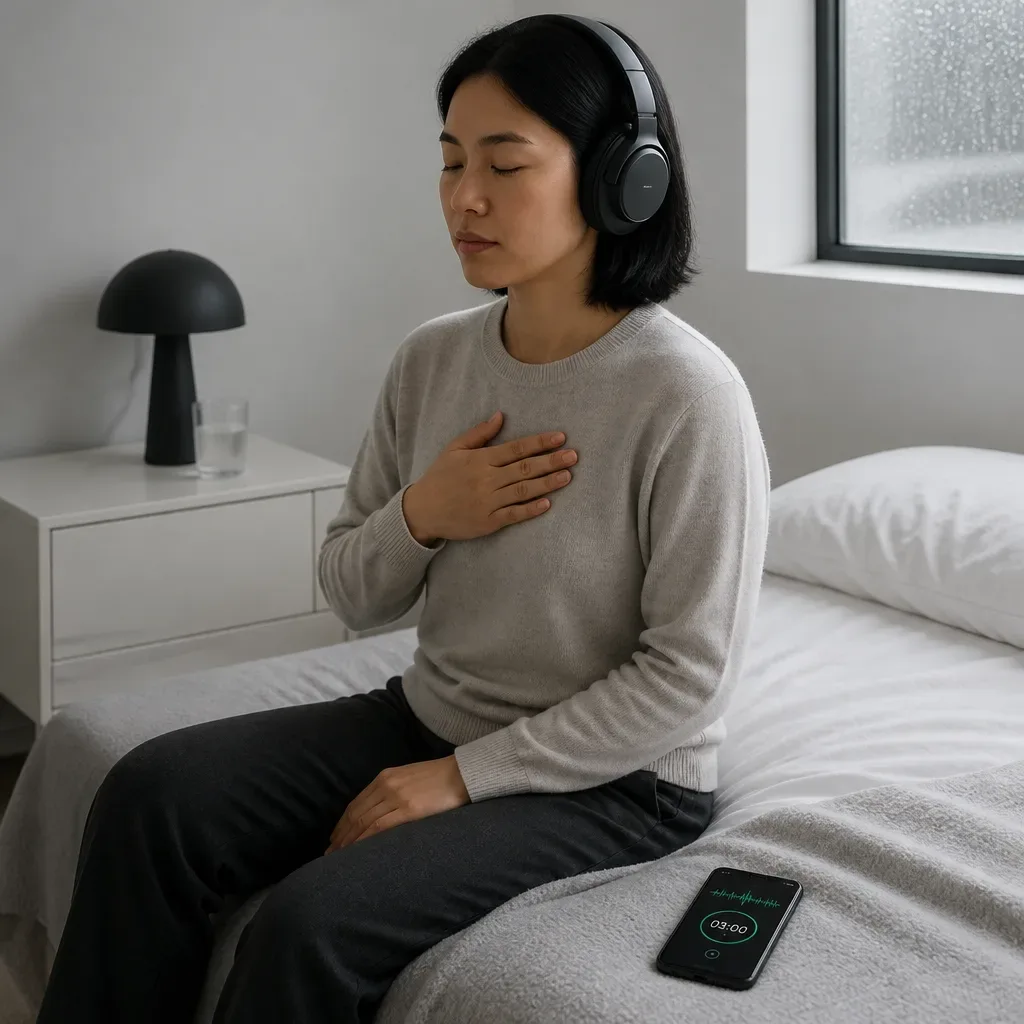
The cleanest routine is often two sounds, not ten. First the hum, then the voice. The nervous system likes fewer instructions than the mind does.
What does the evidence actually say about binaural beats and anxiety?
The evidence suggests binaural beats may reduce anxiety in some settings, but the research is uneven and the effect should be treated as modest.
One often-cited randomized study by Padmanabhan, Hildreth, and Laws in 2005 looked at preoperative anxiety in 108 patients. The group listening to binaural beat audio had a larger reduction in anxiety than control audio groups before surgery. That’s a useful signal because surgery waiting rooms are not gentle environments. Still, a hospital study before anesthesia is not the same as nightly listening before reflective audio at home.
The 2019 Garcia-Argibay meta-analysis is helpful because it gathered 22 studies instead of leaning on one dramatic result. It found that binaural beats can influence anxiety, cognition, and pain perception, with exposure duration and listening context affecting results. But meta-analyses inherit the weaknesses of the studies they include: small samples, different frequencies, different outcomes, and uneven blinding. If a study compares a beat track with silence, the benefit may come partly from receiving any structured sound.
A 2015 review by Chaieb and colleagues in Frontiers in Human Neuroscience described binaural beats as a subject with promising but inconsistent evidence. That word, inconsistent, is important. It keeps us honest. The effect is not imaginary just because it varies, and it’s not guaranteed just because some trials are positive.
This is where field recording has taught me caution. Two rain recordings can share the same decibel level and still feel completely different because one has harsh roof transients and the other has soft leaf scatter. Binaural beats are similar. Frequency is only one variable. Tone color, volume, headphones, expectation, fatigue, and the next sound in the routine all matter.
If you want masking rather than a pulse, use the White noise generator + guide and compare it against binaural listening on separate nights. White, pink, or brown noise can sometimes settle anxiety by covering unpredictable sound, not by producing a beat.
What should you listen for in your body while the beat plays?
Listen for signs of reduced guarding: slower breathing, less jaw pressure, softer attention, and less urge to change tracks.
The body usually reports before the mind writes a theory. After 2 minutes, check simple signals. Are your shoulders lower than when you began? Is your breathing quieter? Are you swallowing less often? Has the room stopped feeling like it needs monitoring? These are small observations, but small is the correct scale for audio preparation.
A 2022 review in Nature Human Behaviour on music and health noted that music interventions often show benefits for anxiety and stress, but the mechanisms vary by tempo, familiarity, attention, and context. Binaural beats are narrower than music, yet they still sit inside that larger truth: sound changes state through attention, prediction, memory, and physiology together.
Watch for the opposite signals too:
- Forehead tension after 60 to 90 seconds
- Irritation at one ear more than the other
- A feeling of pressure inside the head
- Urge to raise the volume to “make it work”
- Monitoring your anxiety every few breaths
If any of those appear, stop. A track that makes you self-measure every 15 seconds is not calming you. It’s recruiting you as lab staff.
You can keep a simple 7-night log without turning the routine into homework. Use three numbers: anxiety before, anxiety after the beat, and steadiness after the spoken audio, each from 0 to 10. After a week, look for a pattern of at least 2 points of difference. Anything smaller may be random variation, especially after ordinary changes in caffeine, conflict, work, or sleep pressure.
The ear trusts consistency, but it also trusts relief. If the beat helps, you’ll usually know by what you stop doing: less adjusting, less checking, less bracing.
How do binaural beats compare with white noise, brown noise, and nature sound?
Binaural beats are best for a focused pre-listening ritual, while noise and nature recordings are often better for masking a room over time.
This distinction matters because anxiety before Dream-Self audio can come from different sources. If the problem is internal arousal, a gentle beat may give attention a stable rail. If the problem is external disturbance, like traffic or a neighbor’s television, masking may work better. White noise distributes acoustic energy broadly across frequencies; brown noise emphasizes low frequencies and removes much of the hiss. Rain and surf add natural variation that some ears find easier to trust than a synthetic tone.
In a 2021 Proceedings of the National Academy of Sciences review, Buxton and colleagues reported that natural sounds were associated with improved health outcomes, including lower stress and improved mood, across a body of evidence from parks and soundscape studies. That doesn’t prove a rain recording treats anxiety. It does explain why many nervous systems respond well to water, wind, and birds when the recording is clean and not over-looped.
| Sound type | Mechanism | Good before Dream-Self audio? | Best duration |
|---|---|---|---|
| Binaural beats | Interaural frequency difference | Yes, as a short primer | 5–10 min |
| White noise | Broad masking | Sometimes, if room noise is the issue | 10–60 min |
| Brown noise | Low-heavy masking | Good for low hum preference | 10–60 min |
| Rain recording | Natural variation and masking | Good if not too detailed | 10–45 min |
| Spoken audio | Meaning, repetition, identity rehearsal | Yes, this is the main practice | Track length |
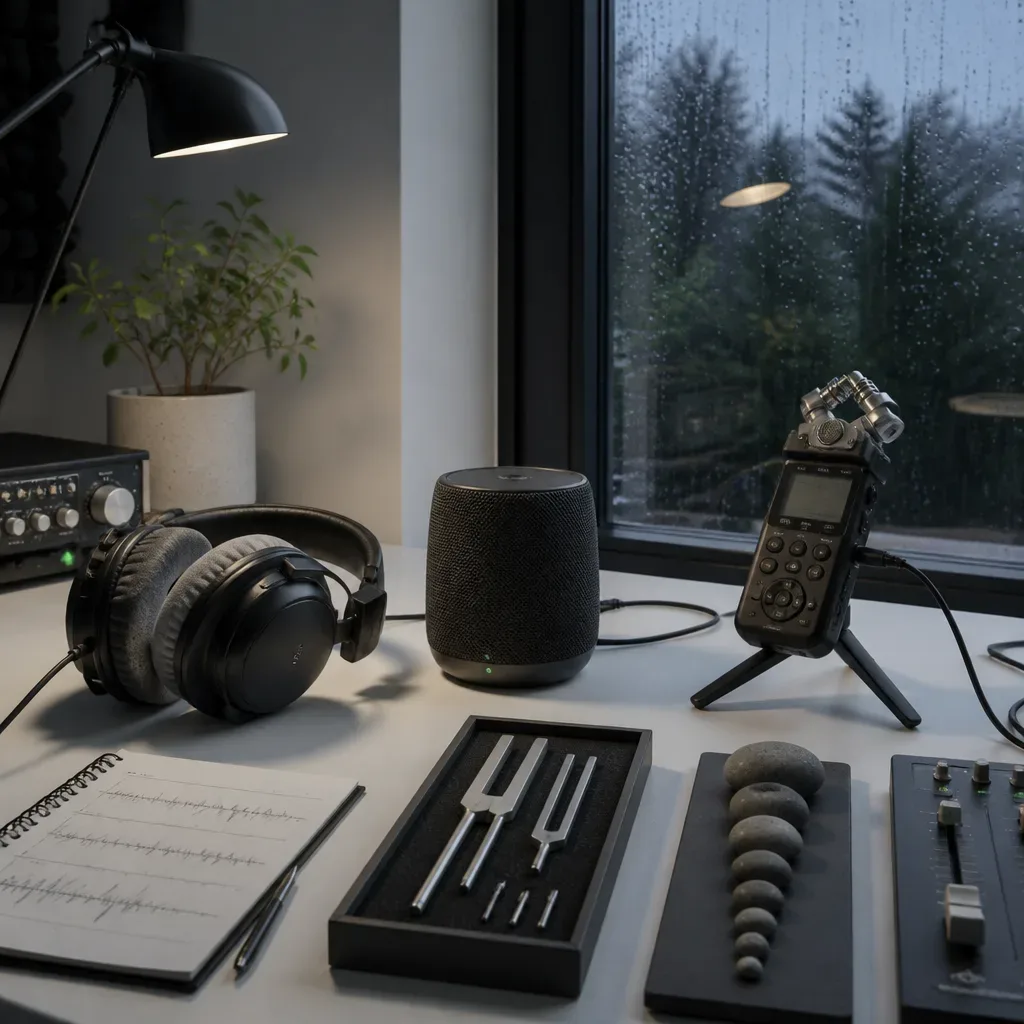
For some listeners, the best preparation is not a beat at all. It’s two minutes of brown noise to cover the building, then the voice. Press play on the White noise generator + guide and listen for whether your body settles because the world is masked. Then compare that with the Binaural beats generator + guide on another night. Don’t test both in the same sitting if you’re anxious; too many comparisons can become stimulation.
When should you avoid binaural beats or get professional support?
Avoid binaural beats if they worsen symptoms, and seek professional support when anxiety, sleep disruption, tinnitus, or panic is persistent or severe.
Most healthy adults can try quiet headphone audio without difficulty, but “low risk” doesn’t mean “right for everyone.” If you have epilepsy or a seizure history, ask a clinician before using rhythmic auditory stimulation. If you have tinnitus or hyperacusis, use extra caution with pure tones; some people find them intrusive even at low volume. If you suspect sleep apnea because of loud snoring, choking awakenings, or daytime sleepiness, sound masking can’t solve the airway problem.
The American Academy of Sleep Medicine recommends cognitive behavioral therapy for insomnia, CBT-I, as a first-line treatment for chronic insomnia in adults. That matters here because many people search for anxiety audio when the larger issue is a months-long sleep pattern. Binaural beats can be a tool inside a routine, but chronic insomnia deserves care that measures behavior, timing, light exposure, and medical factors.
Use these stop rules:
- Stop immediately if the sound increases panic, dizziness, nausea, or ear pain.
- Stop for the night if you raise the volume twice and still feel unsatisfied.
- Stop the experiment after 7 nights if there’s no clear benefit.
- Talk with a professional if anxiety regularly changes your sleep, work, appetite, or relationships.
There is no virtue in forcing a sound your body dislikes. A good audio routine should become easier to repeat, not harder to endure.
The quiet test is simple: after the beat, can you hear the Dream-Self audio with less resistance and more steadiness? If yes, keep it brief and consistent. If no, choose a softer tool. The practice doesn’t need drama. It needs repeatable conditions and ears that still feel safe when the headphones come off.
Leave the sound lower than you think it needs to be, and let the voice arrive into the space it made.