frequencies binaural
Binaural Beats Lucid Dreaming Before Dream-Self Audio
Binaural beats lucid dreaming guidance: what the evidence says, how to set safe volume, and when to play Dream-Self audio in a quiet routine.
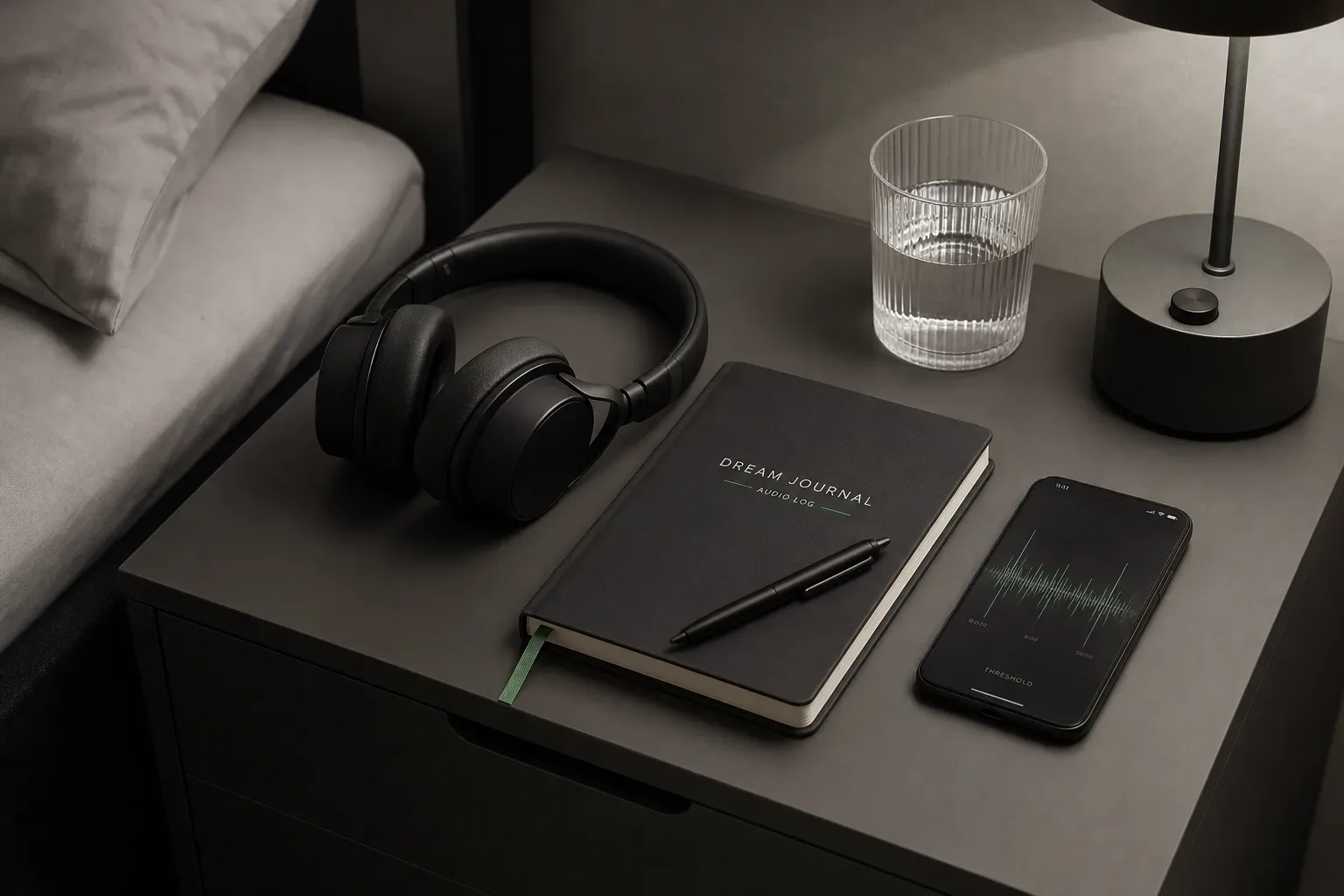
Binaural beats lucid dreaming routines use two slightly different tones to create a perceived beat before sleep, usually to steady attention and support dream recall. The evidence is limited: beats may change mood or attention for some listeners, but lucid dreaming still depends more on timing, intention, and repeatable dream practices.
What are binaural beats, and why are they linked to lucid dreaming?
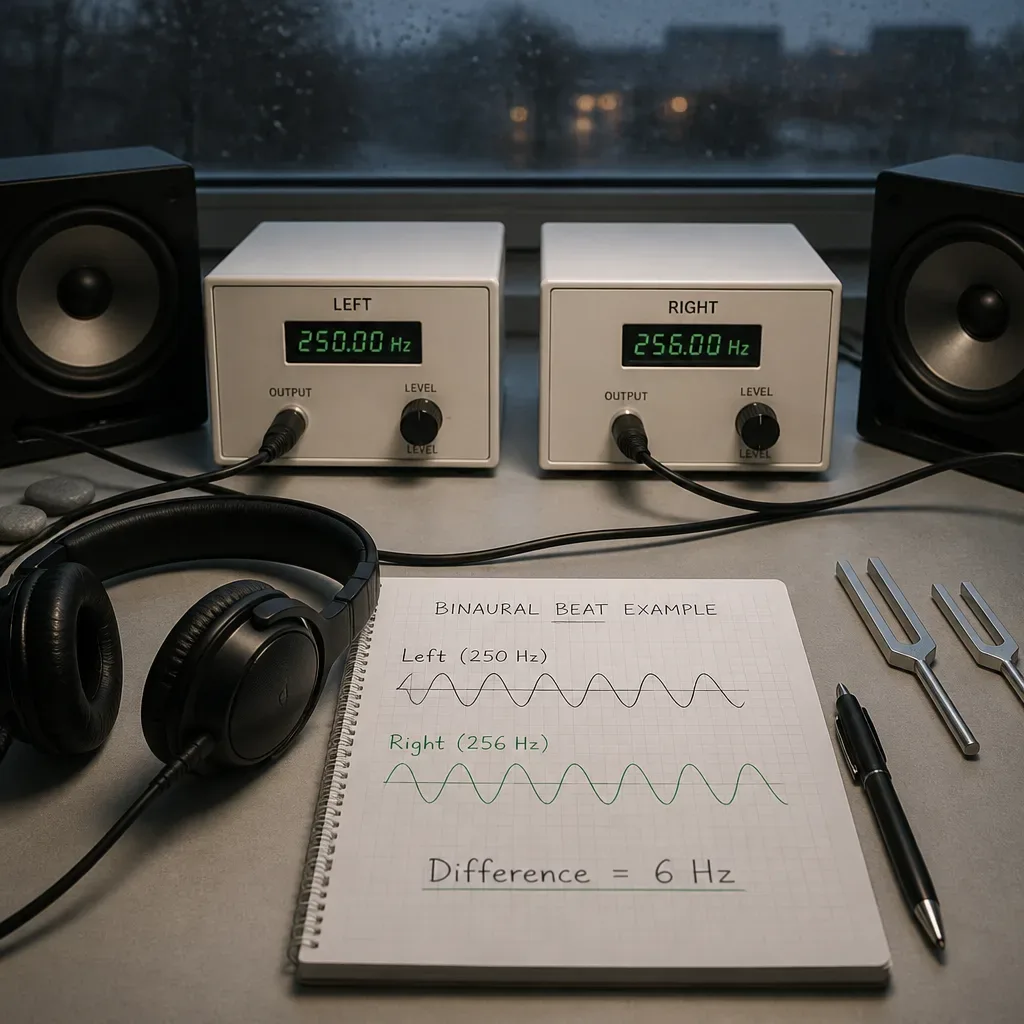
Binaural beats are an auditory illusion made by the brain when each ear hears a different steady tone.
If your left ear hears 200 Hz and your right ear hears 206 Hz, you don’t hear two clean tones for long. You tend to perceive a slow 6 Hz pulsing inside the sound. That perceived difference is the binaural beat. The mechanism was described in the 19th century by Heinrich Wilhelm Dove, and modern studies usually test beats in the 1–40 Hz range because those numbers overlap with common EEG bands.
The lucid dreaming link comes from a reasonable but often overstated idea: if certain brain rhythms are associated with drowsiness, REM sleep, or self-awareness in dreams, perhaps an external beat near that rhythm might nudge the system. A 2019 meta-analysis by Garcia-Argibay and colleagues in Psychological Research reviewed 22 studies on binaural beats and found small-to-moderate effects on anxiety, attention, memory, and pain, with results depending on frequency, duration, and context. That is not the same as proof for lucid dreaming.
Lucid dreaming has its own evidence base. Stephen LaBerge’s early laboratory work in the 1980s showed that trained dreamers could signal lucidity with prearranged eye movements during REM sleep. A 2017 study by Denholm Aspy in the journal Dreaming tested lucid-dream induction techniques with 169 participants and found that MILD, the mnemonic induction of lucid dreams, performed better than several simpler methods. That matters because MILD is behavioral: you wake, remember a dream, set an intention, and return to sleep.
A beat can set the room. It can’t do the remembering for you.
For a plain generator and a closer look at the mechanism, use the Binaural beats generator + guide. Press play, choose a low volume, and listen for the difference between an audible rhythm and a perceived one. The distinction is small, but it’s the whole instrument.
Which frequencies are usually tried before lucid dreaming?
Most lucid-dreaming beat routines use theta-range beats before sleep, while gamma-range beats are discussed more often in research than in practical bedtime listening.
Theta is usually defined around 4–8 Hz in EEG language. Because theta activity is common in drowsiness and early sleep, many sleep-audio tracks choose 4 Hz, 6 Hz, or 7 Hz binaural beats. This is plausible as a settling cue, but plausibility isn’t proof. A person can listen to a 6 Hz beat for 20 minutes and still have no lucid dream because the beat doesn’t supply REM timing, dream memory, or the metacognitive habit of noticing a dream.
Gamma is the more complicated story. A 2014 paper by Voss and colleagues in Nature Neuroscience reported that frontal stimulation at 40 Hz during REM sleep increased lucid-dream reports in a small laboratory sample. That study used transcranial alternating current stimulation, not audio. A 40 Hz binaural beat is therefore not an equal substitute. It may be interesting to test while awake, but it shouldn’t be sold as the same intervention.
Here is the clean comparison:
| Beat range | Common numbers | Why people try it | Evidence note |
|---|---|---|---|
| Delta | 1–4 Hz | Deep sleep association | May be too sleep-heavy for lucidity practice |
| Theta | 4–8 Hz | Drowsiness, imagery, pre-sleep attention | Common in practice, limited lucid-dream evidence |
| Alpha | 8–12 Hz | Relaxed wakefulness | Useful for settling, not dream-specific |
| Low beta | 12–18 Hz | Alert attention | Usually too active for bedtime |
| Gamma | 30–40 Hz | Lucidity research interest | Lab stimulation evidence isn’t audio evidence |
If you’re using beats before Dream-Self audio, choose comfort over mythology. A 6 Hz beat that lets your jaw unclench is more useful than a 40 Hz beat that makes you monitor the track. The ear adapts quickly; the nervous system keeps voting after the label has stopped impressing you.
For frequency traditions outside binaural beats, read the Solfeggio frequencies guide. It treats 528 Hz and related numbers as tradition, not as sleep-lab certainty. That same boundary helps here: respect what feels steady, then keep the claim measured.
Does the research actually support binaural beats for lucid dreaming?
The research supports careful curiosity, not certainty.
There are three evidence layers to separate. First, binaural beats can affect some measured outcomes in some studies. The 2019 meta-analysis of 22 studies found effects that varied by exposure length and target outcome. Second, lucid dreaming can be trained, especially with techniques that involve prospective memory. The Aspy study with 169 participants found the strongest results when people used MILD after waking from sleep. Third, direct evidence that binaural beats reliably induce lucid dreams is thin.
That gap is important. Many audio claims quietly move from “this frequency resembles an EEG band” to “this track creates that state.” The brain doesn’t work like a tuning fork on a bench. EEG bands are descriptions of measured activity from large groups of neurons; they aren’t simple buttons. A 7 Hz perceived beat is not the same thing as a whole brain entering theta in the way a marketing page may imply.
Still, beats can be useful in a narrower way. They create a stable auditory object. That object can reduce wandering for 10–20 minutes, similar to how breath counting gives attention a place to rest. In small laboratory and clinical studies, repetitive sound has also been tested for anxiety reduction, and lower arousal can help sleep onset. The American Academy of Sleep Medicine and Sleep Foundation commonly point adults toward at least 7 hours of sleep; a tool that protects bedtime regularity has more practical value than one heroic track.
Use this evidence filter:
- Strongest claim: lucid dreaming improves with training, recall, and timed waking.
- Moderate claim: binaural beats may affect attention or arousal for some listeners.
- Weak claim: a specific beat frequency directly causes lucid dreams.
- Unsupported claim: one track guarantees a lucid dream tonight.
A quiet claim is not a weak practice. It is a practice that can survive measurement.
How should you use binaural beats before Dream-Self audio tonight?
Use binaural beats as a short settling phase, then play your Dream-Self audio while you’re relaxed but still awake enough to hear the words.
The simple order is: reduce sensory load, use a beat for 10–20 minutes, stop before irritation, then listen to the spoken recording. The AYA Method is a daily audio manifestation practice: each day you listen to a short personalized recording, your Dream-Self Moment, narrated from the version of you who has already manifested the life you intend. Listening is the practice. Repetition is the work. The audio is the method.
That definition matters for placement. If the spoken Dream-Self Moment is the practice, binaural beats are not the main event. They’re the room tone before the voice enters. You can use them to settle breathing, reduce phone checking, and mark the start of the routine. Then you let the words be heard cleanly.
Try this 25-minute structure for 7 nights before judging it:
- Set the room for 2 minutes. Dim the screen, put the phone face down, and keep the bed for sleep rather than scrolling.
- Play a theta or alpha beat for 10 minutes. Choose 4–8 Hz for drowsy settling or 8–10 Hz if theta makes you foggy too early.
- Lower the volume by one step. The track should be easy to ignore. If you have to attend to it, it’s too present.
- Play the Dream-Self audio once. Stay awake enough to hear the narration. If you drift, don’t restart three times.
- Record one dream cue in the morning. A phrase, image, or emotion is enough. Dream recall is trained by capture, not by pressure.
This routine pairs well with the wake-back-to-bed method, where you wake after about 4.5 to 6 hours of sleep and return to bed after a short interval. REM periods tend to lengthen later in the night, often around 90-minute sleep cycles, which is why late-night recall is usually richer than first-sleep recall. If you use beats then, keep the track brief. Losing 45 minutes of sleep to chase lucidity is bad engineering.
For masking a noisy room before the routine, the White noise generator + guide may be more useful than beats. Noise masks external variation; beats ask the brain to compare two tones. Different job, different tool.
What volume, headphones, and timing are safest?
Keep binaural beats quiet, time-limited, and comfortable enough that you can forget the hardware.
True binaural beats need headphones because each ear receives a different tone. Open-back headphones can leak sound and may be less practical beside another sleeper. In-ear buds isolate well, but overnight pressure can irritate the ear canal. Sleep headbands reduce pressure, though their small drivers may roll off low frequencies. None of these details are glamorous, but they decide whether you repeat the routine for 30 nights or abandon it after two.
For volume, use a conservative rule: quieter than normal conversation, ideally under about 60 dB SPL if measured near the ear. The World Health Organization has warned that long exposure to high-volume personal audio can raise hearing-risk concerns, especially above 80 dB over extended durations. Sleep audio shouldn’t be anywhere near that. If you remove the headphones and still feel a ghost of the tone, lower it next time.
Timing also matters. A 10–20 minute pre-sleep beat is enough for most routines. Longer isn’t automatically better; the 2019 binaural-beat meta-analysis found that study effects depended partly on exposure duration, but it didn’t establish an ideal bedtime dose. In practice, fatigue, ear comfort, and sleep continuity matter more than squeezing in another 30 minutes.
Use this setup checklist:
- Headphones sit lightly, with no jaw or ear-canal pressure.
- Beat frequency is chosen before bed, not adjusted repeatedly in bed.
- Volume is low enough that speech audio remains clear afterward.
- Playback stops automatically within 20 minutes.
- No looping tones run all night unless your clinician has cleared regular sleep-audio use.
If you have tinnitus, epilepsy, migraines triggered by sound, diagnosed sleep apnea, or chronic insomnia lasting more than 3 months, talk with a qualified professional. Audio can support a routine, but it shouldn’t be asked to cover a medical signal.
What should you do if beats make sleep worse?
Stop using the beat, switch to simpler masking or silence, and keep the Dream-Self audio routine intact if the voice still feels steady.
Some nervous systems dislike pulsing tones. The problem may be the carrier tone, the beat rate, the headphones, or the act of monitoring whether anything is happening. Monitoring is arousal. Once you’re checking the track every 2 minutes, the tool has become a small alarm.
Start by changing only one variable for three nights. Lower the volume first. If that fails, shorten the track from 20 minutes to 8 minutes. If that fails, move from theta to a soft alpha beat around 9–10 Hz. If that still feels busy, drop binaural beats entirely and use plain noise or no sound before the spoken audio. The White noise generator + guide and Binaural beats generator + guide make this comparison easy because you can hear the difference without changing apps.
A useful test is morning function, not nighttime drama. Did you fall asleep within a reasonable window? Did you wake fewer times? Did dream recall improve by even one line? The Sleep Foundation often cites 7–9 hours as the recommended adult range, and lucid-dream practice shouldn’t cut into that. A lucid dream is not a good trade for a dull morning.
Here are quieter alternatives when beats don’t suit you:
- Pink noise: more low-frequency balance than white noise, often perceived as softer.
- Brown noise: even more low-frequency weight, useful for some people who dislike hiss.
- Rain or fan recordings: less precise, but familiar and easy to ignore.
- Solfeggio tones: meaningful for some listeners as tradition, with evidence kept separate from preference.
- Silence with timed audio: often the cleanest option if your room is already quiet.
The spectrum matters more than the label. If “lucid dreaming audio” keeps you awake, it’s not helping your lucid dreaming.
How do you track whether the routine is working?
Track three small numbers for two weeks: sleep continuity, dream recall, and whether lucidity occurred.
The easiest mistake is to judge by one strange night. Dreams vary naturally. REM sleep tends to cluster more heavily in the second half of the night, alcohol can suppress REM early in sleep, stress can fragment recall, and alarm timing changes what you remember. A 14-night log is still small, but it’s better than one vivid dream and a guess.
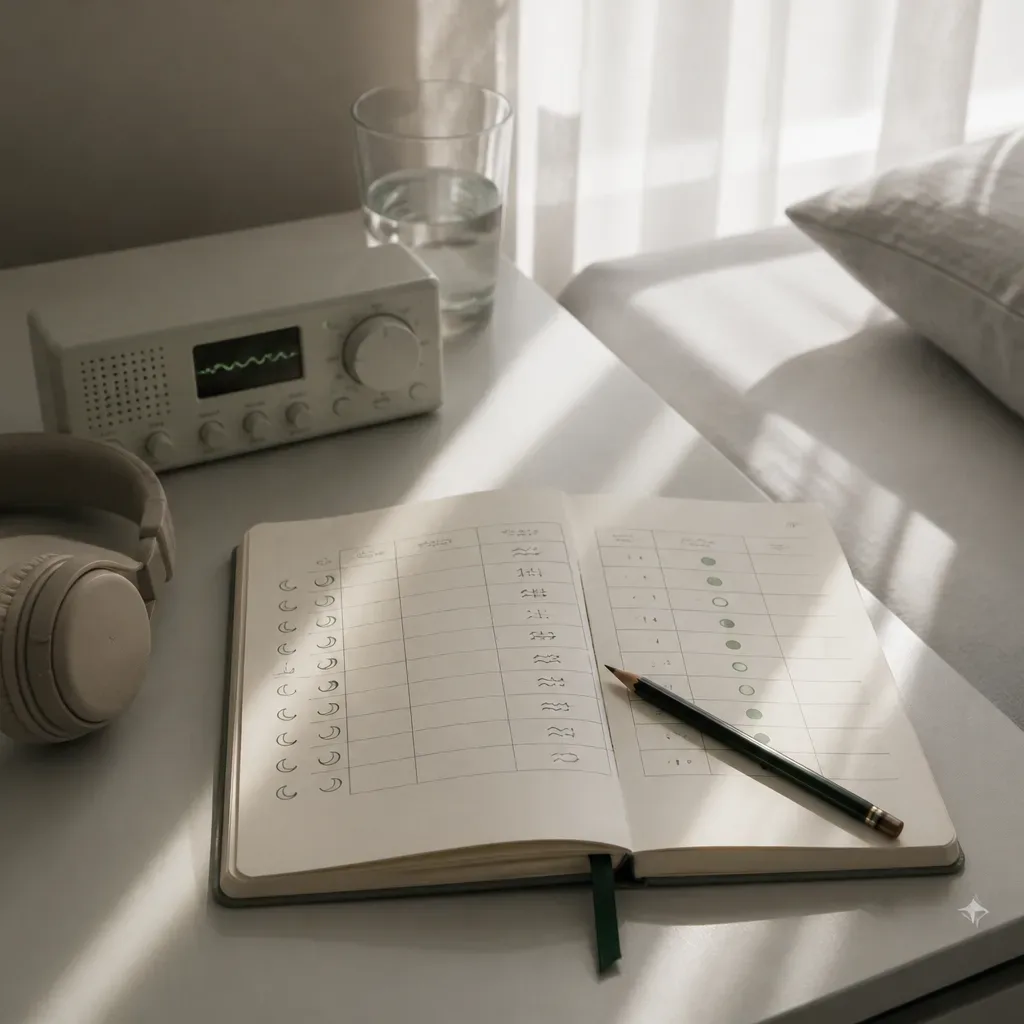
Use a simple table in a notebook or notes app:
| Date | Beat used | Dream-Self audio heard clearly? | Wake-ups | Dream recall 0–3 | Lucid moment? |
|---|---|---|---|---|---|
| Oct 14 | 6 Hz, 12 min | Yes | 1 | 2 | No |
| Oct 15 | 6 Hz, 12 min | Partly | 2 | 1 | No |
| Oct 16 | None | Yes | 0 | 2 | Yes, brief |
A recall score can stay plain: 0 means no memory, 1 means a fragment, 2 means a scene, 3 means a sequence with detail. If recall rises from 0 to 2 across 14 nights, that is useful even without lucidity. LaBerge’s work made clear that trained dreamers weren’t relying on luck alone; they had repeatable cues and practiced recall.
Compare conditions only after enough nights. Try beats for 7 nights, then no beats for 7 nights, while keeping bedtime, wake time, and Dream-Self audio as stable as possible. If beats improve recall without harming sleep, keep them. If they reduce sleep or make the routine feel technical in a tense way, remove them. A good sleep tool disappears into the night.
You can also pair this with gentle frequency literacy. The Solfeggio frequencies guide is useful if you like named tones but want the evidence kept tidy. Preference is allowed. False certainty isn’t required.
Tonight, choose the quietest tool that lets you hear the voice and then let the room go still.