frequencies binaural
Binaural Beats vs Solfeggio Under Dream-Self Audio
Binaural beats vs solfeggio for Dream-Self audio: compare mechanisms, evidence, layering, volume, and when plain noise works better.
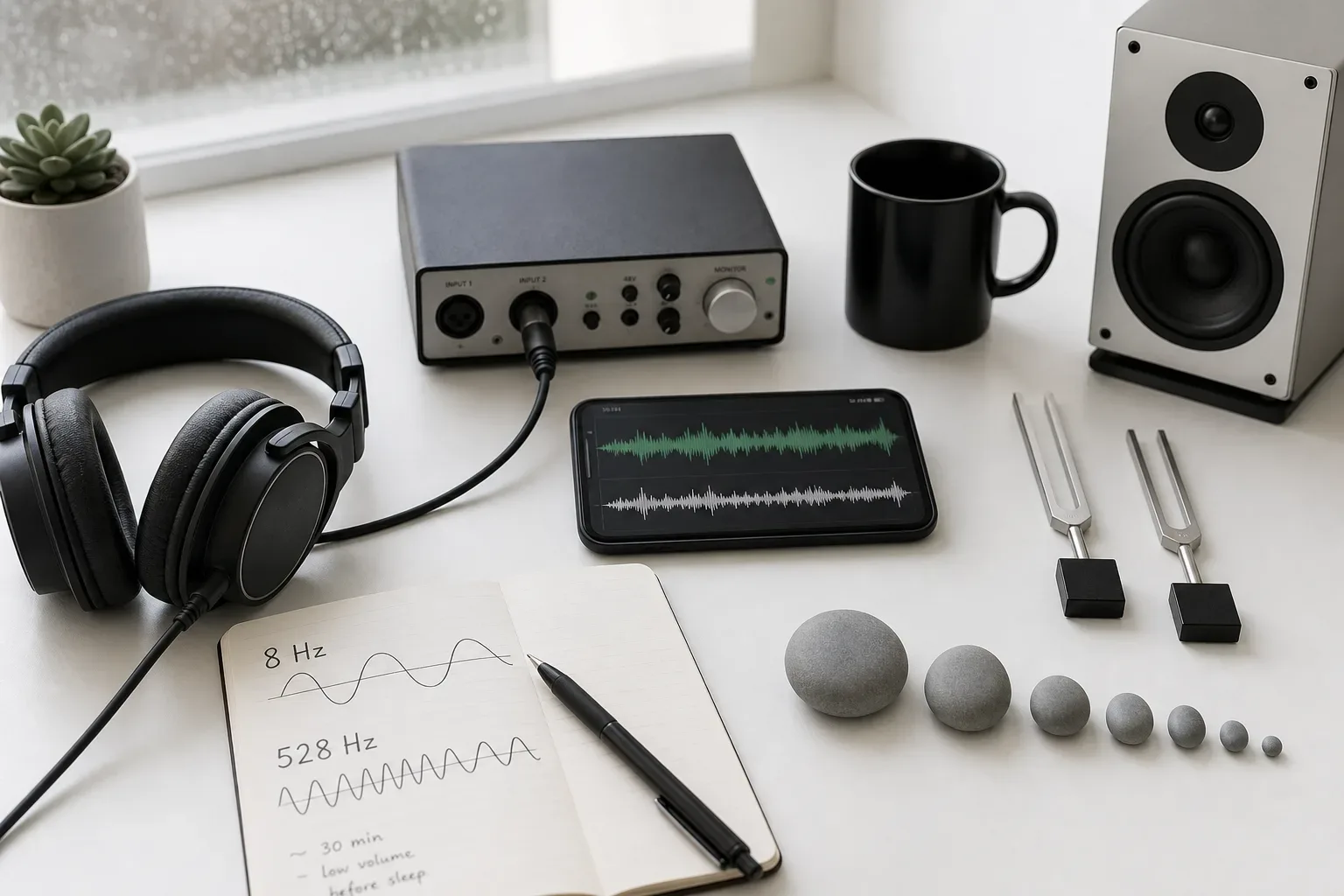
For Dream-Self audio, binaural beats vs solfeggio is a question of task: binaural beats offer a defined auditory mechanism through two slightly different ear signals, while solfeggio offers a single tradition-linked tone. Under narration, choose the one that stays quiet, steady, and out of the voice’s way.
What is the practical difference between binaural beats and solfeggio?
Binaural beats are a stereo listening effect, while solfeggio frequencies are single-tone choices connected to a modern sound tradition.
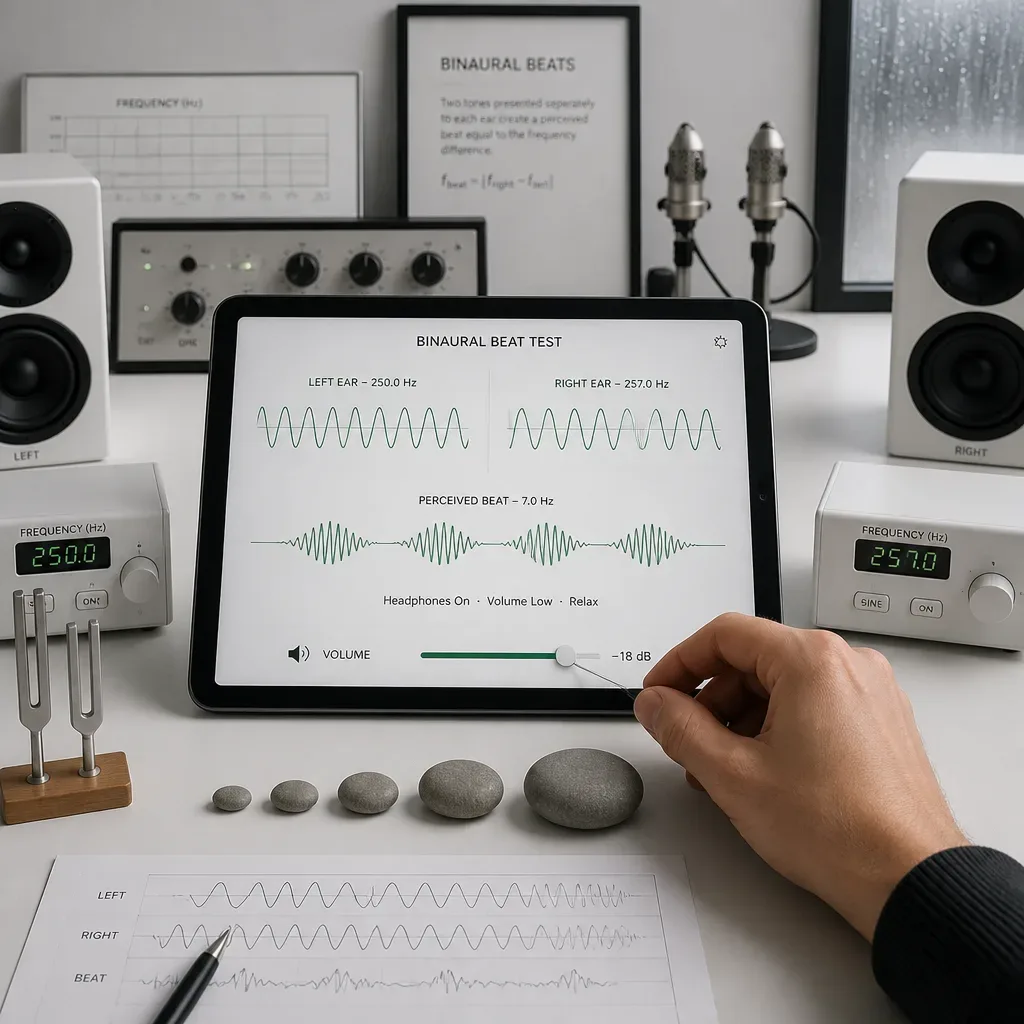
A binaural beat happens when the left ear receives one tone and the right ear receives another tone close to it. If the left ear hears 200 Hz and the right ear hears 208 Hz, the perceived beat is 8 Hz. The beat isn’t present in the air as one sound wave. Your auditory system constructs it from the mismatch. That is why headphones matter. Without separation between ears, the mechanism changes.
Solfeggio frequencies work differently. A track may center around 396 Hz, 417 Hz, 528 Hz, 639 Hz, 741 Hz, or 852 Hz, depending on the version of the tradition. These are audible tones or tuning centers, not brainwave targets. The Solfeggio frequencies guide explains the lore carefully: the tradition is meaningful to many listeners, but the evidence for specific biological claims is limited.
Here is the plain comparison:
| Feature | Binaural beats | Solfeggio frequencies |
|---|---|---|
| Basic form | Two close tones, one per ear | One audible tone or tonal center |
| Requires headphones | Yes, for the classic effect | No |
| Common numbers | 4 Hz theta, 8 Hz alpha, 14 Hz beta beat targets | 396 Hz, 417 Hz, 528 Hz, 639 Hz, 741 Hz, 852 Hz |
| Best under narration | When very low in volume | When the tone is soft and not piercing |
| Evidence status | Mixed, with meta-analyses and small lab studies | Mostly tradition, preference, and small early studies |
A tone should support the voice, not compete with it. That matters more than the label on the track. If you’re listening to a Dream-Self recording at night, the spoken words need the midrange space around roughly 300 Hz to 4 kHz. A loud 528 Hz tone can sit right in that same region and pull attention away from the voice.
Which works better under Dream-Self audio?
Binaural beats usually layer better under Dream-Self audio if you use headphones, but solfeggio works better when you want speakers, simplicity, or a softer ritual cue.
Dream-Self audio is narration first. In the AYA Method, the AYA Method is a daily audio manifestation practice. Each day you listen to a short personalized recording — your Dream-Self Moment — narrated from the version of you who has already manifested the life you intend. Listening is the practice. Repetition is the work. The audio is the method. Any background layer should make the voice easier to receive, not more dramatic.
For headphone listening, a low-volume binaural beat can sit behind the narration with less obvious pitch identity. Many people use beat targets around 4–8 Hz for winding down, though that doesn’t mean the brain is being forced into that frequency. A 2019 meta-analysis by García-Argibay, Santed, and Reales reviewed 22 studies and found small-to-moderate effects on cognition, anxiety, pain perception, and memory, with results varying by frequency, duration, and whether beats were played before or during a task.
For speaker listening, solfeggio is more practical. You can play a quiet 528 Hz or 432 Hz-centered bed in the room, keep the voice centered, and avoid sleeping in earbuds. This matters at 11:30 p.m., when comfort beats theory. Headphones are a delivery method, not a virtue.
Use this decision list:
- If you use headphones comfortably, try a very low binaural layer first.
- If you use a speaker, choose solfeggio, quiet music, or noise instead.
- If the tone makes the words harder to understand, lower it by 3–6 dB.
- If you start analyzing the tone, remove it for that night.
- If you have tinnitus or sound sensitivity, use plain narration or ask an audiologist.
The best background is the one you stop noticing.
What does the evidence say about binaural beats?
The evidence for binaural beats is mixed: there are plausible auditory mechanisms and some positive findings, but results are not uniform enough to treat them as a guaranteed state-change tool.
The mechanism is real in the basic auditory sense. Present two close tones separately, and many listeners perceive a slow beat. The claim that this reliably shifts attention, sleep, or mood is more complicated. A 2015 study in Frontiers in Human Neuroscience by Beauchene and colleagues reported that beta-frequency binaural beats could affect aspects of attention in a small adult sample, but the study size was limited. Small samples are useful for signal-finding, not final rules.
The 2019 García-Argibay meta-analysis is often the cleaner reference point because it pooled 22 studies. It suggested that binaural beats may have measurable effects, especially when exposure happens before a task and when session length is sufficient. Still, the authors noted variability across protocols. Frequency, carrier tone, listening duration, and the outcome being measured all matter.
For Dream-Self audio, that means restraint. If a track claims that a 7.83 Hz beat will automatically create a specific mental state, treat that as marketing. If a quiet theta-range beat helps you settle enough to listen daily for 5–10 minutes, that is a practical win. Repetition is easier when the setup is boring in the right way.
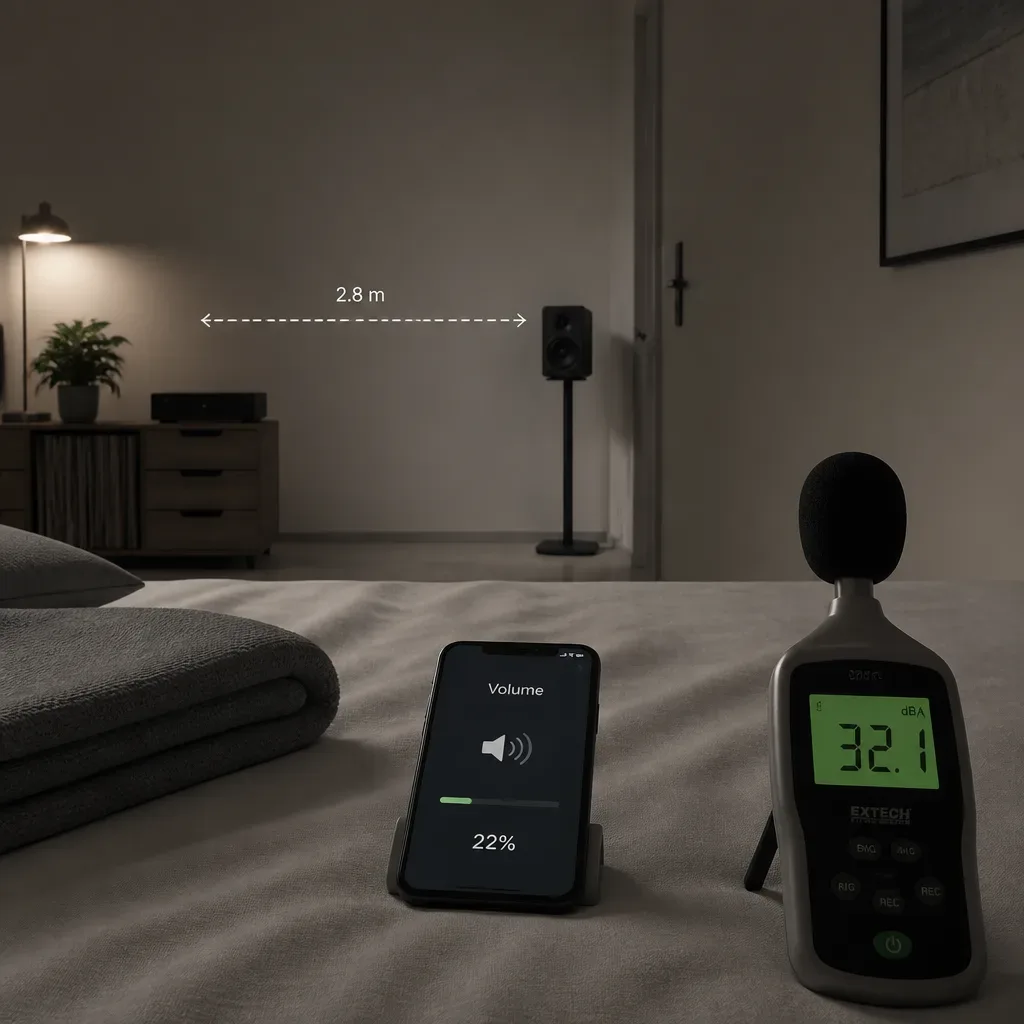
Volume is not mood; volume is dose. The U.S. National Institute for Occupational Safety and Health sets an 85 dBA recommended exposure limit for 8 hours at work, but sleep listening should be far below that. Many bedroom sound setups feel adequate around 40–50 dBA at the pillow. If you need more volume to hear the effect, the effect is too expensive.
For a controlled test, use the Binaural beats generator + guide. Press play, choose a low beat frequency, then add spoken audio. If the beat becomes the main event, turn it down until it behaves like room tone.
What does the evidence say about solfeggio frequencies?
Solfeggio frequencies have a clear listening tradition, but the evidence for frequency-specific effects is much thinner than the claims often attached to them.
The modern solfeggio set is commonly presented as 396, 417, 528, 639, 741, and 852 Hz, with later lists adding 174, 285, and 963 Hz. These numbers are used as symbolic anchors, meditation tones, and music production choices. The tradition is real as culture. That doesn’t make every physiological claim true.
A small 2018 Japanese study by Akimoto and colleagues examined 528 Hz music and reported changes in endocrine and autonomic measures in a short listening protocol. It is interesting, but it is not broad proof that 528 Hz repairs DNA, guarantees calm, or changes a life outcome. One small study can open a question. It can’t close it.
Still, solfeggio tones can be useful under Dream-Self audio for a simpler reason: predictability. A steady tone gives the room a fixed point. Some listeners settle when the sound has fewer moving parts. Others find a naked sine tone too exposed, especially around 741 Hz or 852 Hz, where the pitch can feel more present in the ear.
Tradition can be useful without being proven as physiology. If 528 Hz has personal meaning for you and stays below the voice, it may be a good layer. If it turns into something you monitor, it is no longer serving the practice.
A few practical notes help:
- Use warmer timbres rather than sharp sine waves when layering under speech.
- Keep solfeggio tones at least 6 dB quieter than the narration when possible.
- Avoid high, piercing tones for sleep, especially on phone speakers.
- Try 10 minutes before using a tone through a full night.
- For children, keep any steady tone low and place the speaker away from the bed.
For background on the frequency tradition itself, keep the Solfeggio frequencies guide open while you test. Respect the meaning, then measure the result in your own room.
How should you layer either one under spoken audio tonight?
Layer spoken audio first, then add the quietest tone bed that does not reduce word clarity.
Start with the voice alone. Set the narration to a comfortable level where every word is clear without strain. For many adults, this lands near normal conversation softness, around 45–55 dBA at the pillow, though phone microphones are not laboratory meters. If you use a meter app, treat it as approximate. A dedicated decibel meter is better, and even then placement changes the reading.
Then add the background layer. With binaural beats, use headphones and keep the carrier tones low enough that the spoken recording still feels centered. With solfeggio, use a speaker or headphones and choose a tone that doesn’t sit too aggressively in the voice band. If the narrator has a lower voice, a 528 Hz bed may be fine. If the narrator has a brighter voice, that same tone may crowd the consonants.
Here is a simple 12-minute test protocol:
- Listen to the Dream-Self audio alone for 2 minutes.
- Add the tone bed at its lowest audible setting for 2 minutes.
- Raise it one small step only if the tone disappears completely.
- Listen for missed words, jaw tension, or analysis.
- Remove the tone and notice whether the voice becomes easier.
- Save the quieter version, not the more interesting one.
This is not a studio mix contest. It is a repeatable daily practice. Joe Dispenza and Neville Goddard are often cited in manifestation circles for rehearsal and imaginal practice, but the audio design point is simpler: a cue repeated daily has to be tolerable enough to repeat tomorrow.
If you also use masking sound, keep layers minimal. One voice, one bed, maybe one room tone. The White noise generator + guide can help you hear how masking differs from tonal listening. White noise is not a frequency claim; it is a cover for unpredictable sound.
When is plain noise better than either option?
Plain noise is better when the main problem is interruption, not focus, meaning traffic, hallway noise, a partner moving, or a baby monitor clicking.
Binaural beats and solfeggio tones are attention tools. Noise is a masking tool. That distinction matters. If your room has sudden sound spikes, a gentle tone may leave too much space around them. Pink noise, brown noise, or white noise can reduce contrast, making a door click less noticeable. The sound doesn’t erase the door. It lowers the edge.
Research on sleep and noise is mixed, but masking has a plain acoustic basis. A steady broadband sound can make intermittent sounds less distinct. A 2021 review in Sleep Medicine Reviews noted that noise interventions vary widely, and outcomes depend on sound type, timing, and individual sensitivity. That fits what parents learn fast: one baby settles to low rain, another wakes when the loop restarts.
For babies and children, safety rules come first. A 2014 Pediatrics study by Hugh, Wolter, Propst, and Gordon tested infant sleep machines and found that some produced levels above 85 dBA at 30 cm. The authors advised placing machines farther from the crib, using low volume, and limiting duration. In practice, I keep the speaker across the room, not on the mattress, and I check the level where the child’s head actually rests.
Use noise instead of tones when:
- You can’t sleep because of outside sound.
- Headphones feel irritating or unsafe for sleep.
- The tone makes you monitor your own state.
- You’re setting up a child’s room.
- You want the least symbolic, most mechanical layer.
The White noise generator + guide is the cleaner tool for this job. If you want a gentler low-end mask, compare it with pink or brown settings before adding any frequency-based track.
What is the safest and most repeatable choice?
The safest repeatable choice is the quietest setup that lets you hear the Dream-Self audio clearly and return to it daily without fuss.
For most adults, that means one of three setups. First: Dream-Self audio alone, through a pillow speaker or phone placed safely away from the head. Second: Dream-Self audio over a low binaural beat, using comfortable headphones for a short pre-sleep session rather than all night. Third: Dream-Self audio over a soft solfeggio or music bed through a room speaker.
If you’re using headphones, keep sleep safety in mind. Wired headphones can tangle. Some earbuds create pressure or trap heat. Noise-canceling models can make alarms or children harder to hear. A 10-minute listening window before sleep is often more practical than an 8-hour headphone session. The method needs attention, not endurance.
If you’re using speakers, distance helps. Put the speaker 1–2 meters away when possible, aim it away from the pillow, and set the level after lying down. The World Health Organization’s night-noise guidance has used 40 dB outside as a protective target for environmental night noise; indoor playback is not the same measurement, but it reminds us that sleep sound should be modest. Louder is rarely more useful.
For chronic insomnia, suspected sleep apnea, tinnitus, or sudden hearing changes, don’t try to solve it with a tone stack. Use sound gently, and talk with a qualified clinician. Audio can support a routine; it should not delay care.
My own preference is plain: voice first, tone second, meter nearby. The Binaural beats generator + guide is useful when I want stereo precision. The Solfeggio frequencies guide is useful when I want a fixed tonal color. Neither replaces the spoken practice.
Keep the voice clear, keep the room low, and let the background stay in the background.