frequencies binaural
396 Hz Frequency Before Dream-Self Audio
396 hz frequency is a Solfeggio tone often used before Dream-Self audio. Learn what the claims mean, what evidence says, and how to set it up safely.
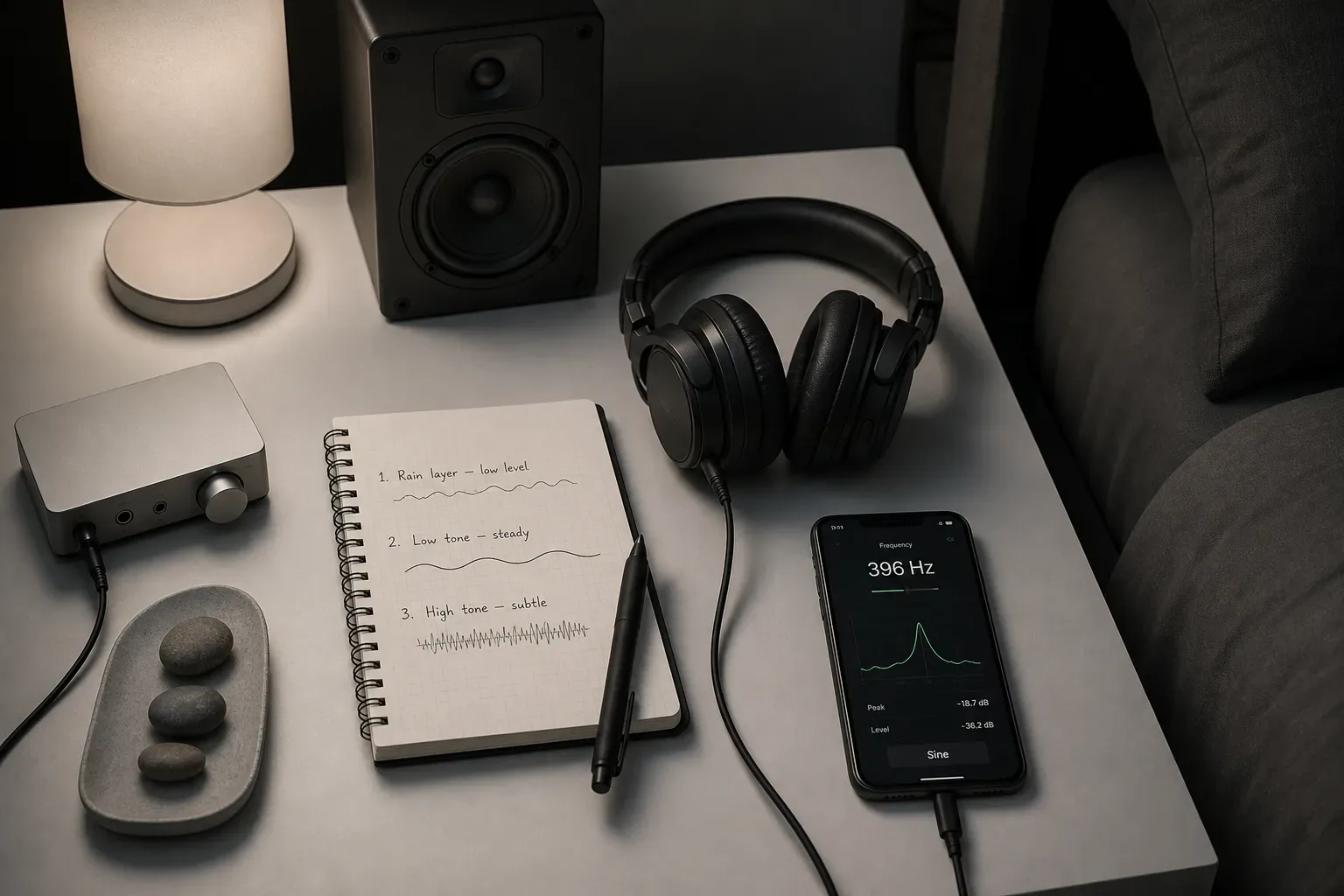
396 hz frequency is a Solfeggio tone often played before manifestation or Dream-Self audio to mark a quiet transition. The traditional claim links it with releasing fear and guilt; the evidence for that specific effect is thin. Used gently, it can still work as a useful listening cue.
What is the 396 Hz frequency, exactly?
396 Hz is a single pitch, measured as 396 cycles per second, used in modern Solfeggio listening practices.
A frequency is not a mood by itself. It is a rate: 396 vibrations per second. If you play a clean sine tone at 396 Hz, you hear a steady pitch a little below the note G4 in equal temperament, since G4 is usually tuned to about 392.00 Hz when A4 is 440 Hz. That closeness is one reason the tone can feel musically familiar without turning into a melody.
The Solfeggio set is usually presented as 174, 285, 396, 417, 528, 639, 741, 852, and sometimes 963 Hz. These numbers are part of a modern spiritual listening tradition, not a standardized system used in acoustics or medicine. The Solfeggio frequencies guide gives the wider map, including where tradition ends and measured evidence begins.
The common claim for 396 Hz is release from guilt and fear. That wording circulates widely in frequency lore, often connected to devotional chant histories and later numerological interpretations. The historical trail is mixed. Gregorian chant is real; a fixed therapeutic meaning for exactly 396 Hz is not well established in peer-reviewed research.
Still, sound can act as a threshold. A tone can tell the nervous system, “we’re doing the same quiet thing again.” In behavioral terms, that is a cue. Habits often become more reliable when they attach to a stable signal; Charles Duhigg popularized the cue-routine-reward loop in 2012, but the underlying habit literature is older and broader.
A tone doesn’t need to prove a miracle to become useful; it only needs to help you repeat the next right action.
What claims about 396 Hz should be treated carefully?
Treat emotional-release claims as tradition, not as a proven effect of one exact frequency.
There is no strong clinical evidence showing that 396 Hz specifically removes guilt, dissolves fear, or changes life circumstances. If a recording promises guaranteed emotional clearing in 7 minutes, the promise is doing more work than the audio. A 396 Hz tone can be meaningful without carrying a medical or metaphysical guarantee.
The better-supported claim is narrower: steady sound can reduce the contrast between you and the room. Masking has been studied for sleep and environmental noise, though results vary by person and sound type. The American Academy of Sleep Medicine has repeatedly emphasized that sleep health depends on timing, light, substances, and medical factors, not one audio variable.
Research on music and relaxation is stronger than research on Solfeggio numbers. A 2018 Cochrane review on music for insomnia included randomized trials and found possible improvements in sleep quality, but the authors rated the evidence with caution. Music is a broad intervention; a bare sine tone is much narrower.
Auditory beat research is adjacent, not identical. A 2019 meta-analysis by Garcia-Argibay, Santed, and Reales reviewed 22 studies on binaural and monaural beats and found mixed effects depending on frequency, timing, and task. That doesn’t validate 396 Hz claims, but it reminds us that listening protocols matter.
Use this plain filter:
- Reasonable: 396 Hz may help you settle because it is steady and repeatable.
- Traditional: 396 Hz is associated with releasing guilt and fear in Solfeggio lore.
- Unsupported: 396 Hz reliably removes fear, treats trauma, or guarantees manifestation.
- Practical: If it makes the next audio easier to receive, it has done enough.
The listener’s body is the final measuring instrument, but it still benefits from honest labels.
How does 396 Hz fit before Dream-Self audio?
396 Hz fits best as a short prelude, not as the main practice.
The order matters. A tone is simple; a voice is specific. If you’re preparing for Dream-Self audio, the tone can reduce the number of things competing for attention before the narration begins. Five minutes is usually long enough to make a clean boundary between scrolling, talking, or working and the quieter listening that follows.
The AYA Method is a daily audio manifestation practice. Each day you listen to a short personalized recording, your Dream-Self Moment, narrated from the version of you who has already manifested the life you intend. Listening is the practice. Repetition is the work. The audio is the method.
That means the 396 Hz frequency is not the center. It is the vestibule. If it becomes so dramatic that the Dream-Self recording feels secondary, shorten it or remove it. Good preparation disappears when the main work starts. As a composer, I trust openings that know when to leave.
A simple evening sequence can look like this:
- Set the room: dim the light 30 to 60 minutes before bed if possible.
- Play 396 Hz quietly: use 5 to 10 minutes, not a full hour.
- Pause for one breath: let the tone stop before the voice begins.
- Play the Dream-Self audio: keep attention soft rather than strained.
- Stop adding inputs: no second playlist, no extra video, no checking results.
A 2022 review in Sleep Medicine Reviews noted that bedtime routines tend to help because they reduce variability. The frequency is only one part of that stability. The real signal is repetition.
What is the safest setup for listening tonight?
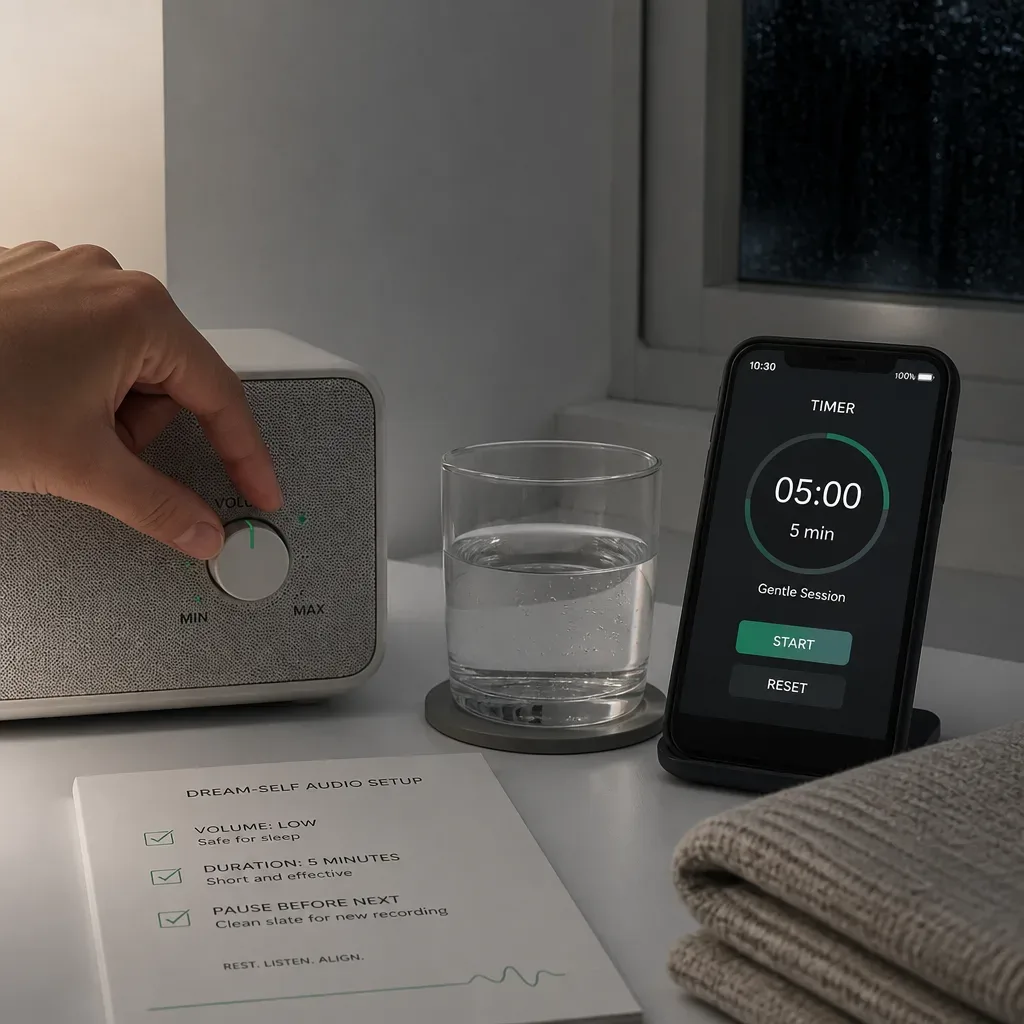
The safest setup is low volume, short duration, and no pressure to keep listening if the tone irritates you.
Start with speakers if you can. Headphones put sound close to the ear canal, which is useful for detail but easy to overdo at night. If you use headphones, choose a comfortable pair and set the level lower than you think you need. NIOSH commonly cites 85 dBA as an 8-hour occupational exposure limit; sleep and relaxation audio should sit well below workplace-limit thinking.
The tone should be audible, not dominant. If your jaw tightens, your forehead lifts, or you feel the need to monitor the sound, turn it down. A good sleep-adjacent tone asks almost nothing from you. It marks time without demanding attention.
Here is a practical comparison:
| Setup choice | Best use | Caution |
|---|---|---|
| Phone speaker | Casual 5-minute prelude | Thin speakers may make tones buzzy |
| Bedside speaker | Most stable nightly setup | Keep it away from your head |
| Over-ear headphones | Shared room or travel | Use low volume and avoid sleeping in rigid cups |
| Earbuds | Last resort for privacy | Higher risk of pressure and excess loudness |
| Silence | When tones feel irritating | Silence is a valid protocol |
If you share a bed or room, ask once before making the tone part of the space. A 396 Hz sine wave can feel calm to one person and mosquito-like to another. Preference is not a moral category.
For masking outside noise, a single tone is usually less effective than broadband sound. If traffic, neighbors, or hallway noise is the real problem, try the White noise generator + guide and compare it with the tone. White noise spreads sound across many frequencies; 396 Hz sits on one narrow point.
If you have tinnitus, sound sensitivity, chronic insomnia, panic symptoms, or suspected sleep apnea, use audio gently and speak with a qualified clinician. Audio can support a routine, but it should not replace care.
Should you use 396 Hz, binaural beats, Solfeggio tracks, or noise?
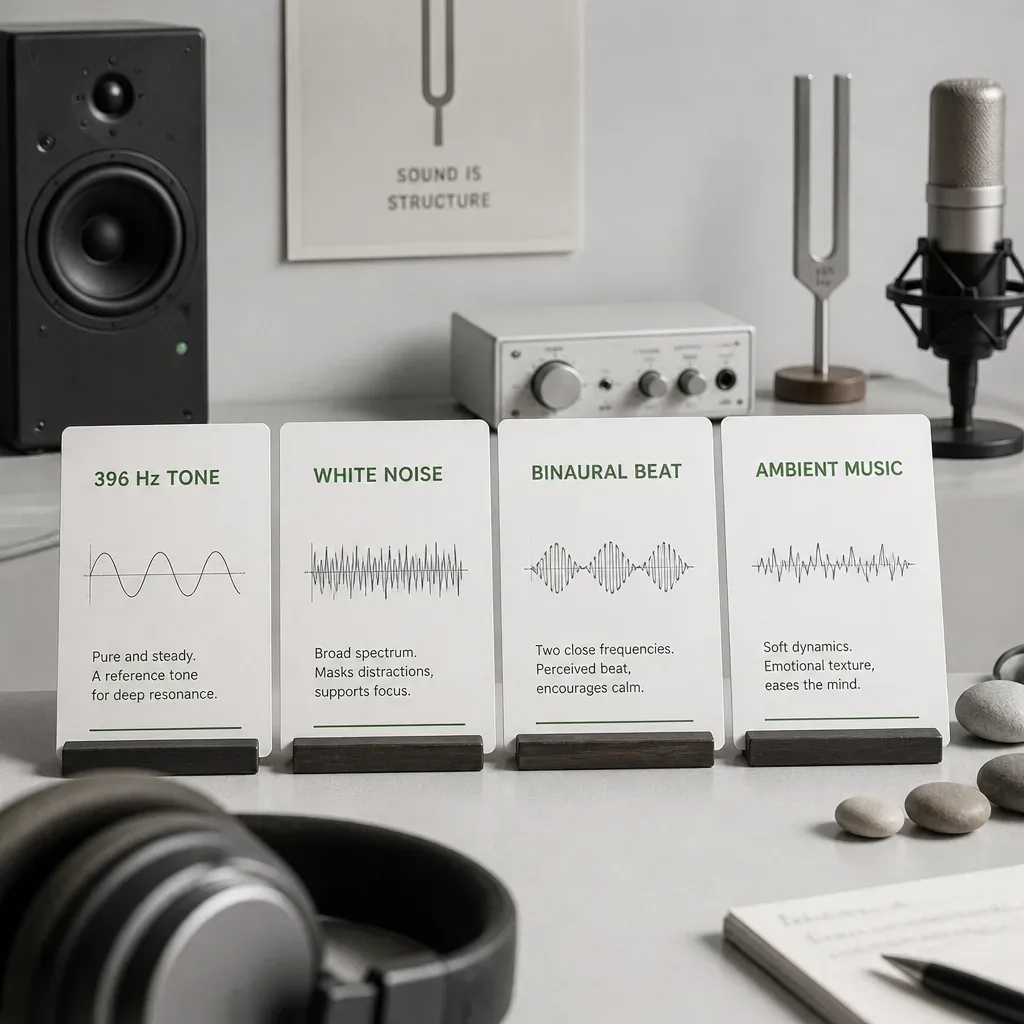
Choose the tool by the job: tone for ritual, beats for a measured experiment, noise for masking, music for soft attention.
A 396 Hz track is not the same as a binaural beat. Binaural beats require two slightly different tones, one in each ear, so the brain perceives a third pulsing rate. For example, 396 Hz in one ear and 402 Hz in the other can create a perceived 6 Hz beat. That requires headphones. A plain 396 Hz tone does not.
The Binaural beats generator + guide is a better place to test that mechanism because you can hear how small frequency differences change the pulse. Claims around binaural beats are mixed, but at least the mechanism is clear: two inputs, one perceived beat, usually measured in hertz.
Solfeggio listening is more symbolic. It uses named frequencies with inherited meanings. The Solfeggio frequencies guide explains why someone might choose 528 Hz for repair symbolism or 396 Hz for release symbolism while still keeping the evidence plain.
For sleep, boring often wins. Brown noise has more low-frequency weight than white noise, and many people find it less hissy. Pink noise reduces high frequencies compared with white noise. In small sleep studies, pink noise has been associated with changes in slow-wave sleep, but sample sizes are often modest and methods vary.
A quick decision table helps:
| If you need… | Try… | Why |
|---|---|---|
| A symbolic start | 396 Hz | Clear ritual cue before voice audio |
| Sound masking | White or brown noise | Covers more of the room |
| A testable pulse | Binaural beats | Adjustable beat rate in Hz |
| Less mental grip | Slow ambient music | Texture can be easier than a naked tone |
The right sound is the one you can forget at the right moment.
How long should 396 Hz play before the voice begins?
Use 5 to 10 minutes before Dream-Self audio, then let the tone stop cleanly.
Longer is not automatically deeper. A single-frequency tone can become fatiguing if it stays too present for too long. In composition, repetition is useful until the listener starts counting it. Then the spell breaks in the most ordinary way: attention gets bored in the wrong direction.
For most people, 5 minutes is enough to lower stimulation and mark the routine. Ten minutes may suit a more deliberate evening wind-down. Thirty minutes is usually unnecessary before a short voice recording unless you are using the tone as background for breathing, stretching, or journaling. Even then, volume matters more than duration.
Try this 7-night test rather than deciding from one evening:
- Nights 1 and 2: no tone, Dream-Self audio only.
- Nights 3 and 4: 5 minutes of 396 Hz before the audio.
- Nights 5 and 6: 10 minutes of 396 Hz before the audio.
- Night 7: choose the version you missed most when it wasn’t there.
Track only 3 variables: ease of starting, ease of staying with the voice, and how you feel 10 minutes after the recording. A 1 to 5 score is enough. Wearables can be interesting, but a single consumer sleep score is not a verdict.
This is where the discipline stays plain. If the tone improves the start, keep it. If it adds friction, cut it. Ritual should reduce negotiation, not create a new assignment.
The cleanest routine is the one you can repeat when you’re tired.
What should you listen for while it plays?
Listen for settling, irritation, and readiness, not for proof that the frequency is working.
A clean 396 Hz tone can reveal the state of the room. You may notice refrigerator hum, traffic, a laptop fan, or the small asymmetry of your headphones. That is normal. The task is not to purify attention. The task is to let the tone become ordinary enough that the next audio can arrive without competition.
Three signs it is helping are simple: your breathing becomes less held, your hand stops reaching for the phone, and the coming voice recording feels easier to start. None of these requires a mystical interpretation. They are behavioral markers. In sleep research, regularity often matters more than specialness; large cohort studies have linked irregular sleep timing with worse health markers, though causation is complex.
Three signs it is not helping are just as useful: you keep judging the pitch, you wait for an emotional release, or you feel disappointed when nothing dramatic happens. A frequency practice can become noisy if expectation gets too loud.
If the pitch feels too exposed, layer it under quiet ambient music or use a softer generator setting. You can also test masking first with the White noise generator + guide, then compare a narrow tone with a wider sound bed. Press play below and listen for the difference when a sound covers the room instead of pointing to one pitch.
For people who like symbolic listening, 396 Hz can be a respectful part of the night. For people who prefer measurement, it can be a controlled cue before the real recording. Both approaches can be honest if the claims stay clean.
Leave the tone at the door, and let the voice be heard.