noise colors
Air Purifier White Noise for Dream-Self Audio
Air purifier white noise can mask a room while your Dream-Self audio stays clear. Set distance, volume, and timing for safer nightly listening tonight.
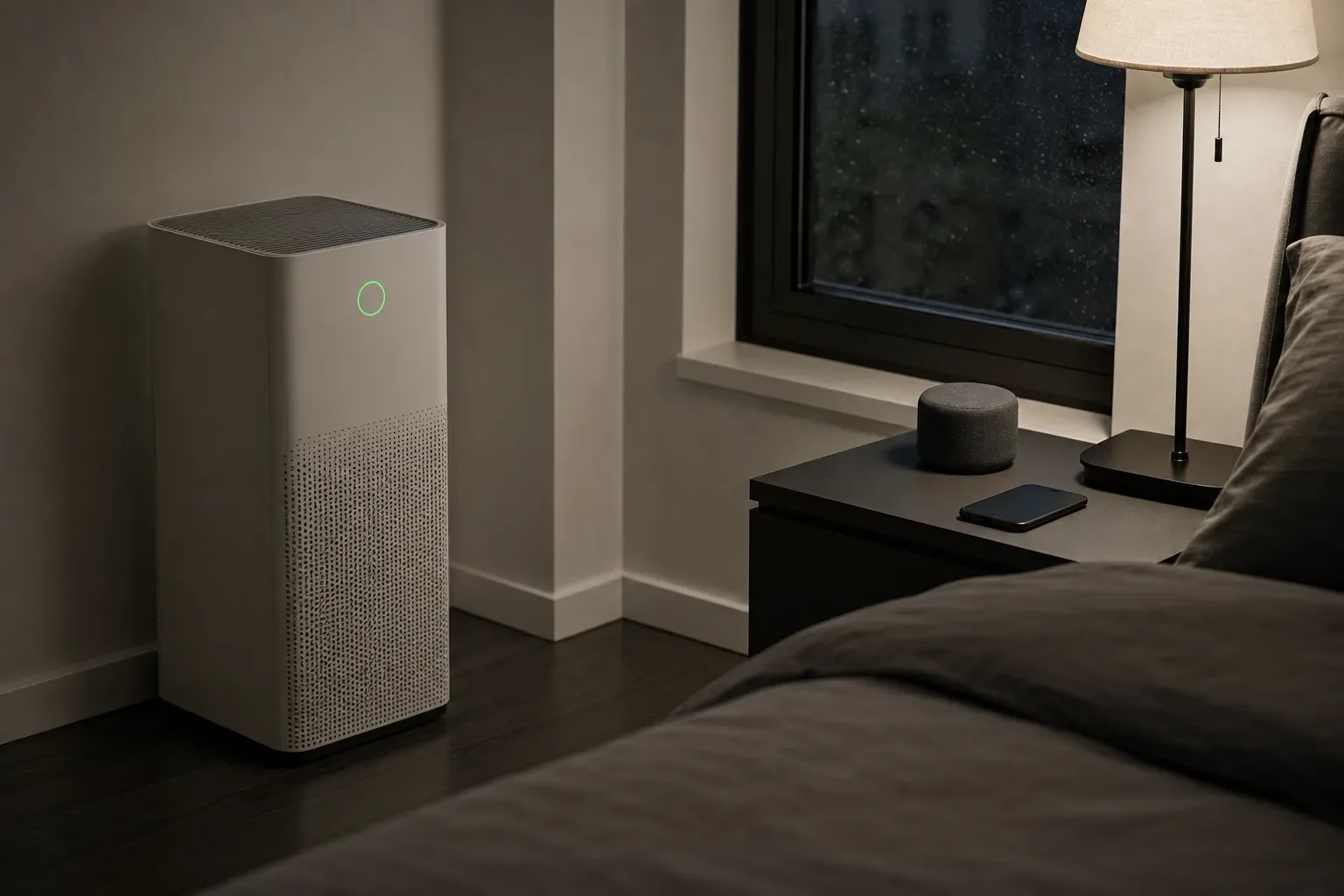
Air purifier white noise works under Dream-Self audio when it stays below the voice, masks the room, and doesn’t ask your ears to work. Place the purifier farther away than the speaker, keep volume conservative, and treat the fan as a soft bed for the spoken recording, not a competing sound.
What makes air purifier white noise useful under spoken audio?
Air purifier white noise is useful because it creates a steady broadband sound that covers smaller, irregular noises without demanding attention.
A purifier fan isn’t mathematically perfect white noise, but it behaves close enough for a bedroom. True white noise has equal power per hertz across the audible band, usually named from 20 Hz to 20,000 Hz. A purifier adds motor tone, air movement, grille turbulence, and room reflections. That mixture tends to make a low-to-mid hum with some hiss. The result is less clinical than a generator and often easier to ignore.
Masking is the practical mechanism. If a hallway click peaks 10 dB above a quiet room, your nervous system may mark it as new information. If a purifier raises the room floor gently, the click has less contrast. The World Health Organization’s night noise guidance, published in 2009 for Europe, treats 40 dB Lnight outside as a health-based target and notes that sleep disturbance rises as night noise increases. Indoors, we usually work softer and closer to the pillow.
Spoken Dream-Self audio adds a second task: intelligibility. A voice needs consonants, breath, and timing. Too much fan hiss can cover s, f, t, and k, especially from a phone speaker. Too much low hum can blur warmth and make the voice feel boxed in. Sound that masks the room should not mask the sentence.
A good night sound is not the loudest sound in the room. It is the one you stop checking.
For a controllable version of the same idea, compare your purifier against the White noise generator + guide. Press play below that guide at a low level, then switch back to the purifier. You’ll hear the difference between synthetic broadband noise and mechanical air noise in about 30 seconds.
How should you place the purifier, speaker, and bed?
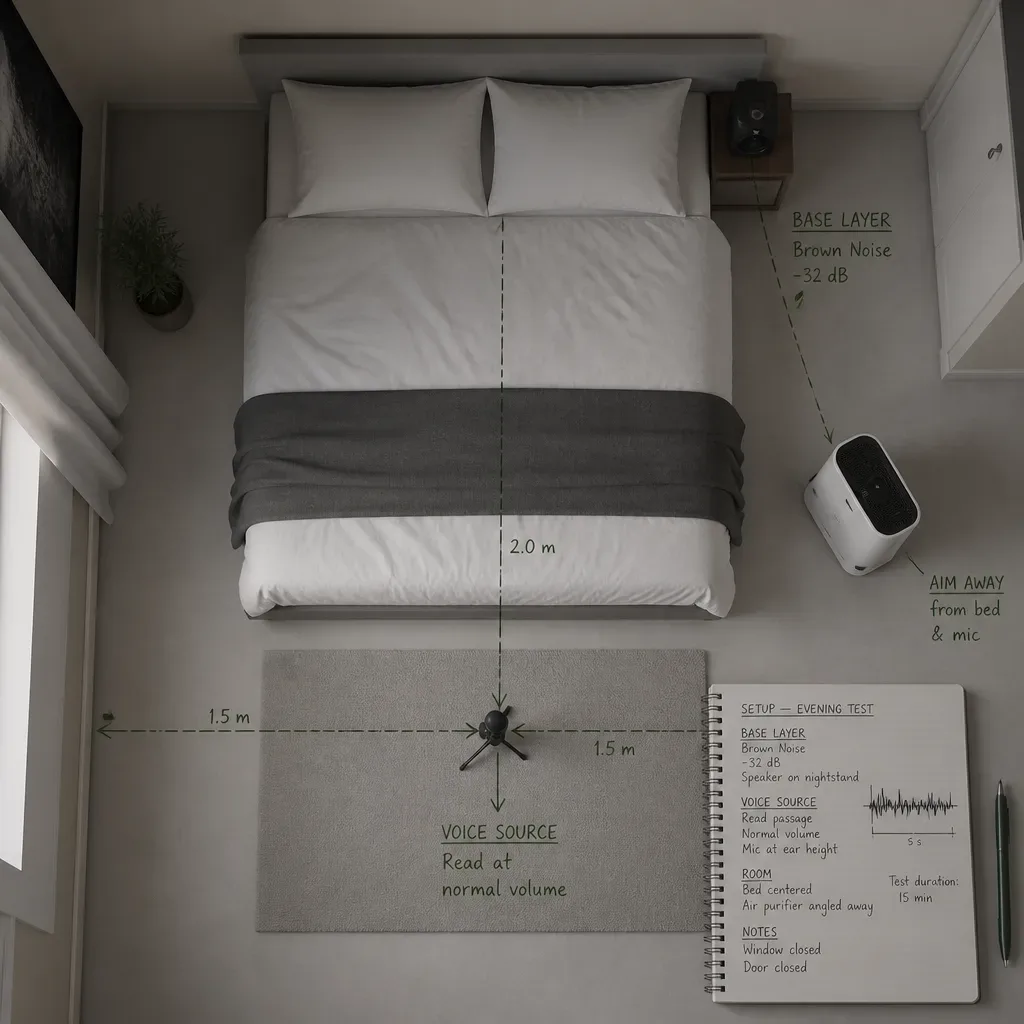
Place the voice closer to your head than the purifier, with the purifier set back 1 to 2 meters and off the direct line to your ears.
Start with geometry before touching volume. A source that is twice as far away can drop by roughly 6 dB in free space, though bedrooms are not free space because walls reflect sound. Put the speaker or phone near the bedside table, about 40 to 80 cm from your pillow, and place the purifier farther away. This simple distance rule lets the voice stay present while the fan fills the room.
Avoid aiming the purifier directly at your face. Airflow can dry the throat, cool one side of the body, or make the sound feel louder because the grille points at the ear. If the fan has a round outlet, rotate it 20 to 45 degrees away. If it has a tower shape, move it beside the bed rather than at the foot of the bed.
Use this as a starting layout, then adjust by ear:
| Item | Starting position | Why it helps |
|---|---|---|
| Phone or small speaker | 40 to 80 cm from pillow | Keeps speech clear at low volume |
| Air purifier | 1 to 2 m from bed | Spreads the fan sound through the room |
| Bedside wall gap | 10 to 30 cm if possible | Reduces boomy boundary buildup |
| Purifier angle | 20 to 45 degrees off-axis | Softens direct hiss and airflow |
Small rooms exaggerate placement. A 3 m by 4 m bedroom has early wall reflections within milliseconds, so a hard corner can make a purifier sound larger than it is. If the hum becomes too thick, move the unit out of the corner by 30 cm. If the hiss feels sharp, put a soft surface on the far wall, not over the purifier intake.
What volume balance works best tonight?
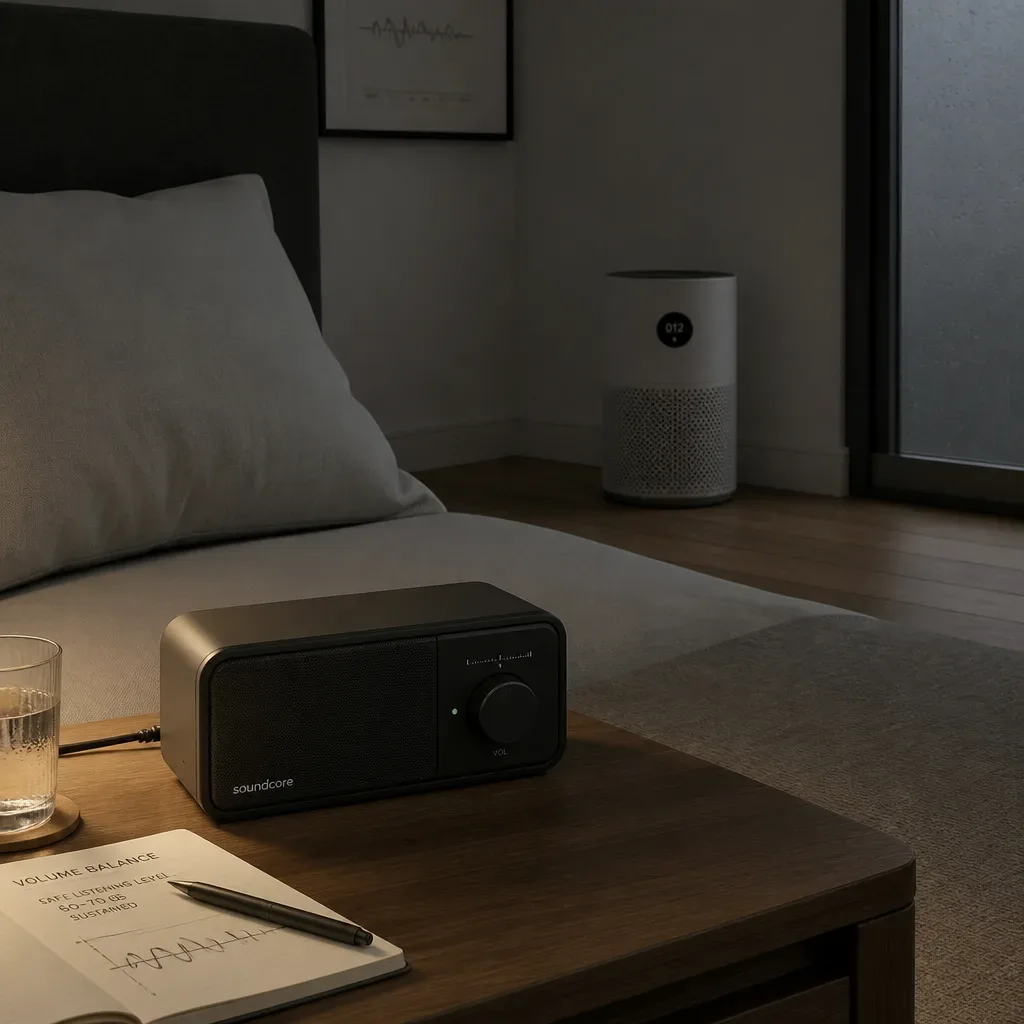
The best balance is purifier first, voice second, with the voice clear at the lowest comfortable playback level.
Use decibels as a guardrail, not a ceremony. Many phone sound meter apps are off by several dB, but they can still show whether you’re near 35 dBA or drifting toward 60 dBA at the pillow. For long listening, conservative is the right bias. NIOSH uses 85 dBA for 8 hours as an occupational exposure limit, with risk rising as level and time increase. Sleep audio should be far below that.
A practical balance test takes less than 2 minutes:
- Set the purifier to low or medium and sit where your head will be.
- Play the spoken audio at the lowest audible level.
- Raise the voice until every word is easy, not merely possible.
- Lower the purifier one step if consonants feel soft.
- Stop when you no longer want to adjust either source.
The spoken layer should feel like someone reading in the room, not a podcast you have to follow. If your phone has a volume scale from 0 to 100, many rooms land somewhere around 15 to 35, but speakers differ too much to make that a rule. If you use earbuds, be more careful. Direct sound at the ear can feel gentle while still being too high over several hours.
Apple’s headphone safety tools and similar phone features can report weekly listening exposure, but they don’t measure the purifier in the room. For room sound, a simple meter app placed on the pillow is enough for a rough check. If a child is in the room, use still lower levels and avoid placing any speaker near the crib or bed. Children’s ears deserve a larger safety margin.
How do you prepare the room before pressing play?
Prepare the room by removing sharp interruptions first, then using the purifier as the steady layer beneath the voice.
Before the audio starts, listen to the room for 30 seconds. Not poetically, mechanically. Is there a radiator tick every 12 seconds, a window rattle, a charger whine, or a door latch that clicks when the hallway pressure changes? A purifier won’t fix every sound. It lowers contrast. If a loose blind taps the frame, fix the blind before adding more sound.
Then check the purifier itself. Filters clogged with dust can raise fan noise and add a rough edge. Many manufacturers suggest replacing HEPA filters every 6 to 12 months, though room dust, pets, smoke, and usage change that number. If the fan suddenly sounds uneven, clean the prefilter if your model allows it. A clean fan tends to sound steadier.
Now add the voice. The AYA Method is a daily audio manifestation practice. Each day you listen to a short personalized recording, your Dream-Self Moment, narrated from the version of you who has already manifested the life you intend. Listening is the practice. Repetition is the work. The audio is the method. In this setup, the purifier only prepares the room so the recording can be heard without strain.
A simple order works well:
- Lights down 20 to 30 minutes before sleep if that fits your evening.
- Purifier on low or medium before you get into bed.
- Phone on Do Not Disturb and placed screen-down.
- Dream-Self audio started once, without looping unless the recording is designed for it.
- Volume left alone after the first minute.
Dr. Andrew Huberman often notes that bright light timing has a measurable effect on circadian rhythm; audio doesn’t replace that. The room works as a system. Dimmer light, cooler air around 18 to 20 degrees Celsius for many adults, and steady sound all reduce the number of decisions you make at the edge of sleep.
Which purifier settings and audio types should you avoid?
Avoid auto modes, aggressive fan changes, bright alerts, and any audio layer that competes with the spoken recording.
Auto mode is good for air quality, but not always for sleep audio. A purifier that jumps from level 1 to level 4 when it detects dust can create a sudden 5 to 15 dB change, depending on the model. That change pulls attention back to the machine. If your purifier has a sleep mode, test whether it actually holds a steady speed. Some sleep modes dim the display but still change fan speed.
Avoid high fan settings unless the room requires them for air quality and you can keep the voice clear. Clean Air Delivery Rate, often listed in cubic feet per minute or cubic meters per hour, tells you how much filtered air a unit can move. It doesn’t tell you whether the sound is sleepable. A purifier can be efficient and still too rough beside a bed.
Layered audio also needs restraint. Pink noise, brown noise, rain, binaural beats, music, and spoken audio all ask for space. Brown noise isn’t deeper sleep. It’s deeper sound, with more low-frequency content and less hiss. If you add it under a purifier, the room can become muddy. If you want to test beat perception separately, use the Binaural beats generator + guide on headphones at a low level, not under a fan and a voice at the same time.
Solfeggio tones are different again. The tradition assigns meaning to frequencies such as 396 Hz, 528 Hz, and 852 Hz. The evidence for specific life outcomes is limited, but some listeners like the steadiness of a simple tone. If you’re curious, read the Solfeggio frequencies guide as tradition plus listening practice, not as a medical claim.
The rule is plain: one base layer, one voice layer. More layers rarely make a better night.
How can you test the setup in 12 minutes?
Test the setup while you’re still awake, using one controlled change at a time.
A 12-minute test is long enough to reveal irritation and short enough that you’ll actually do it. Sleep researchers often score sleep in 30-second epochs, but home listening doesn’t need lab detail. You’re looking for three things: intelligible speech, no startle points, and no urge to keep adjusting. If the system passes while you’re awake, it has a better chance after lights out.
Use this sequence:
- Minute 0 to 2: Run the purifier alone from the pillow position.
- Minute 2 to 4: Move the purifier if the hiss points at one ear.
- Minute 4 to 6: Add the spoken recording at low volume.
- Minute 6 to 8: Adjust only the voice, not the fan.
- Minute 8 to 10: Lie down in your real sleep position.
- Minute 10 to 12: Stop adjusting and notice whether the room settles.
Write down only the final setting. Not a full log, just fan level, speaker position, and phone volume. A note such as purifier level 2, speaker left table, phone 24 percent is enough. Repeating the same setup for 3 nights gives you better information than rebuilding it each evening.
If you need a neutral reference, compare your room with the White noise generator + guide at the same measured pillow level. Synthetic noise will usually be smoother. The purifier may feel more natural because air movement and filtration are doing something physical in the room. Neither is morally better. Your nervous system gets a vote.
The correct setting is the quietest one that still lets the sentence arrive.
What should you change if you can’t hear or can’t settle?
Change distance before volume, and change one variable at a time.
If you can’t hear the Dream-Self audio clearly, don’t immediately raise the voice. First lower the purifier one step or move it 30 to 60 cm farther away. Speech clarity often improves more from reducing competing hiss than from adding volume. Consonants live largely in higher frequencies, and small speakers already struggle there. A fan pointed at the same side as the speaker can erase detail.
If the room feels too quiet when the recording pauses, raise the purifier slightly or move it closer to a reflecting surface. If the room feels too full, move the purifier away from corners. If the hum has a pitch that bothers you, try a different fan level. Motors sometimes resonate at one speed and smooth out at another. A change from level 2 to level 3 can be worse in dB but better in tone, so listen rather than trusting the label.
If your mind keeps following the purifier, switch to a simpler generated sound for one night. Pink noise has equal power per octave, so many people hear it as softer than white noise. Brown noise has still more low content. The White noise generator + guide lets you compare these without buying another machine.
If you use hearing aids, have tinnitus, suspect sleep apnea, or deal with chronic insomnia lasting more than about 3 months, ask a qualified professional for guidance. Night sound can support a routine, but it shouldn’t cover symptoms that need care. The American Academy of Sleep Medicine treats chronic insomnia as a clinical pattern when it occurs at least 3 nights per week for at least 3 months.
A small adjustment beats a loud correction. The ear trusts consistency.
What does a safe nightly routine look like?
A safe routine is repeatable, low in level, and simple enough that you don’t have to manage it after lights out.
Use the same order each night for a week. Purifier first, room check second, voice third, no further changes after minute 1. Repetition matters because the brain learns the cue. In behavioral sleep medicine, stimulus control is built around predictable associations: bed, low arousal, and sleep. You don’t need to make the setup elaborate for it to become familiar.
Keep the sound below normal conversation. Conversational speech is often described around 60 dBA at 1 meter. Your sleep setup should usually be well below that at the pillow. If you must raise the voice near conversation level to hear it over the purifier, the purifier is too loud or too close. Protecting hearing is not an aesthetic choice. It is part of the method.
Here is the final plain setup:
- Purifier on a fixed low or medium speed.
- Purifier 1 to 2 meters from the bed, angled away.
- Speaker closer than the purifier, but not against the ear.
- Measured room level roughly 35 to 45 dBA if possible.
- Spoken audio clear without effort.
- No extra tones unless you are testing them on a separate night.
The daily affirmation and Manifestation Board can be useful complements if they belong in your practice, but they don’t replace the listening. The sound is not there to impress you. It is there to hold a steady floor while the voice does its quiet work.
Leave the fan low, let the sentence be heard, and stop adjusting.