noise colors
Rain Sounds for Sleep vs White Noise Under Dream-Self Audio
Rain sounds for sleep can sit under Dream-Self audio, but white noise masks more evenly. Here’s how to choose, set volume, and listen tonight.
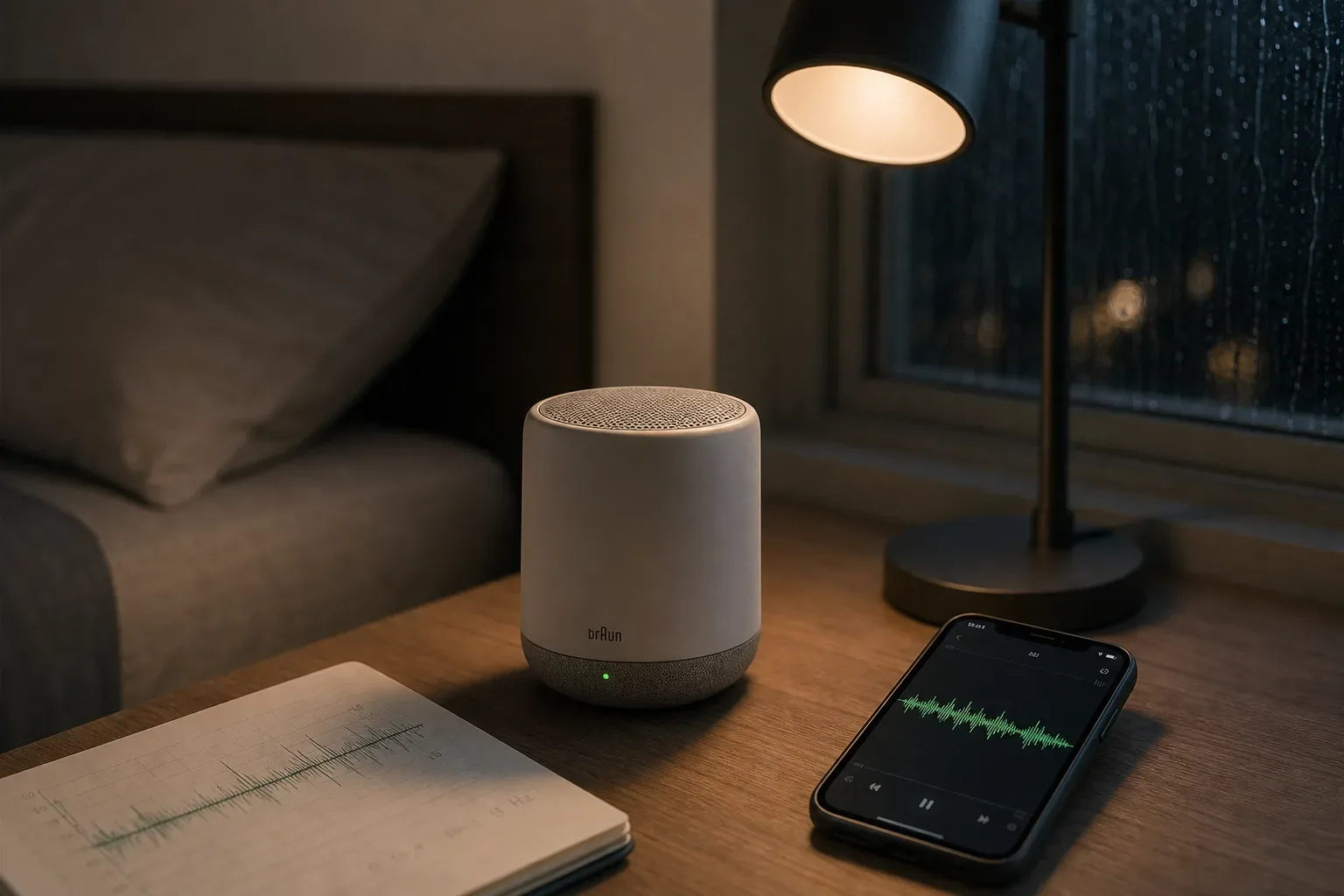
Rain sounds for sleep work well under Dream-Self audio when you want a natural, uneven bed of sound. White noise works better when you need steady masking. The choice is not spiritual or universal; it’s acoustic. Use the background that keeps the spoken voice clear, low, and easy to return to.
Which is clearer under Dream-Self audio: rain or white noise?
White noise is usually clearer under spoken audio, but soft rain often feels easier to stay with.
A Dream-Self recording asks the ear to follow language. That means consonants matter. In English and many other languages, speech intelligibility depends heavily on higher-frequency detail, often around 2–5 kHz. White noise has equal acoustic power per hertz, so it can cover that band if it’s too loud. Rain sounds vary more, which can leave small gaps where the voice comes through. Those gaps can feel kind, but they can also become distracting if the rain track has sharp droplets.
The main difference is time. White noise is steady from one second to the next. Rain has micro-events: drops on leaves, window taps, gutter runs, distant swells. The nervous system may read those changes as natural and safe, but the auditory system still has to process them. A 2012 paper by Buxton and colleagues in Annals of Internal Medicine found that sleeping brains respond differently to sound types, and meaningful or sudden sounds are more likely to cause arousal than neutral steady noise.
Here’s the plain comparison:
| Background under voice | Best use | Risk | Practical setting |
|---|---|---|---|
| Light rain | Calm room, anxious mind, bedtime ritual | Droplets compete with words | 10–20% below voice |
| White noise | Traffic, voices, thin walls | Hiss masks consonants | Very low, steady |
| Pink noise | Softer masking, less hiss | Can still blur speech | Often easier than white |
| Brown noise | Low hum, less top-end | May feel too heavy | Good for rumble, not words |
A background sound should serve the voice, not become the practice. Speech first, mask second, sleep third.
What does the research say about rain sounds for sleep?
The research supports masking and relaxation more than it supports rain as a special sleep signal.
Rain recordings are rarely studied as a separate category. Most sleep-audio research looks at continuous noise, music, nature sounds, or hospital sound masking. The evidence is useful, but not as tidy as product pages make it sound. A small 2005 study by Stanchina and colleagues in Sleep Medicine tested white noise in a noisy sleep setting and found that it reduced awakenings caused by recorded hospital noise. That result points to masking, not magic.
The World Health Organization’s night noise guidance has long treated 30 dB LAeq inside bedrooms as a useful target for sleep protection, with individual noise events above 45 dB more likely to disturb sleep. Those numbers matter because a rain track played too loudly becomes another noise source. If your background has to be loud to work, the room may need a different fix: closed window, fan placement, carpet, door seal, or a steadier masking signal.
Natural sounds may also help by giving attention something soft to rest on. Small studies on nature audio have reported reduced sympathetic arousal, but sample sizes are often modest and methods vary. In clinical practice, I see the same pattern in yoga nidra: the sound matters, but permission matters too. When someone lies down for 20 minutes and stops asking the body to perform, the body often settles.
If rain helps you stop checking the hallway, use rain. If rain makes you track every drop, use something plainer. The ear is not a moral instrument; it’s a measuring instrument with preferences.
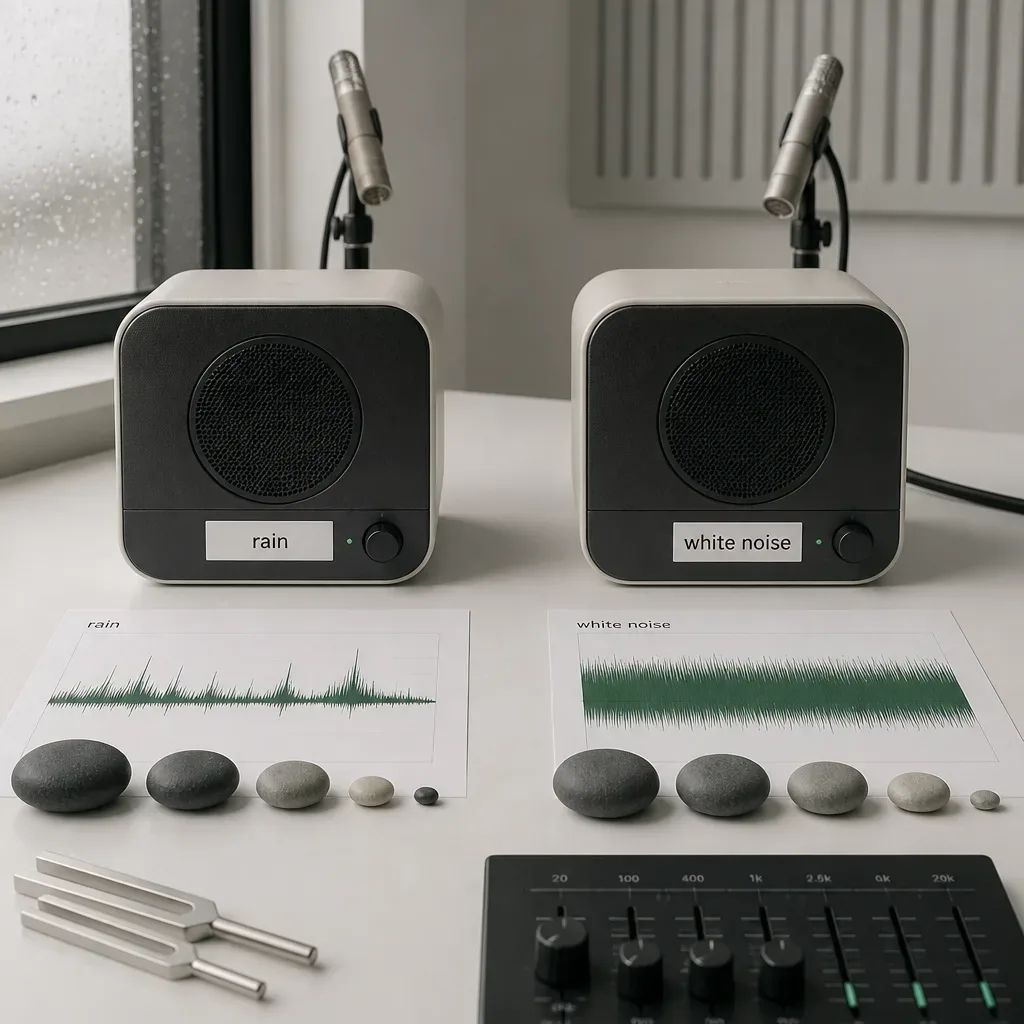
When does white noise beat rain under a spoken practice?
White noise beats rain when the room is unpredictable and the background must stay mechanically steady.
White noise is broadband. It contains low, middle, and high frequencies at the same power per hertz, which is why it can sound bright or hissy. That brightness is also why it can mask a lot of household sound. If your neighbor’s television leaks through the wall at 1 a.m., a steady signal can reduce the contrast between silence and intrusion. The goal is not to erase the world. The goal is to reduce the spike.
For a deeper technical pass, the White noise generator + guide lets you press play and hear the difference between plain masking and colored alternatives. Many people who dislike white noise prefer pink or brown noise because they reduce the high-frequency edge. Brown noise has more low-frequency weight; pink noise falls by about 3 dB per octave. Both can sit more gently under a voice than bright white noise.
Use white noise under Dream-Self audio when:
- the room has intermittent sound, such as doors, pipes, or street noise
- you don’t want the background to have a recognizable scene
- rain makes you listen outward instead of inward
- you need the same sound every night for conditioning
- the spoken track has a clear midrange voice and no added music
There is a cost. White noise can blur speech quickly because it fills the same bands the voice needs. Keep it low enough that you can hear whispered consonants. OSHA’s occupational limit is 85 dBA over 8 hours, but sleep listening should be far below that. For a bedside speaker, think soft room tone, not headphone intensity.
When do rain sounds work better than white noise?
Rain works better when your room is already fairly quiet and you want a softer attention anchor.
The best rain for spoken audio is boring rain. No thunder, no dramatic roof hits, no sudden stereo sweeps. A steady light shower gives the mind something familiar without pulling it into a story. In yoga nidra, fixed and simple cues often work better than rich music because the listener can stop evaluating them after a few minutes. A rain bed can do the same if it stays plain.
Rain also has a ritual advantage. Many people associate rain with being indoors, covered, and finished for the day. That association is learned, but learned signals are real in practice. Cognitive behavioral sleep protocols often use stimulus control: repeat the same cues until the bed becomes linked with sleep rather than planning. A 2021 review in Sleep Medicine Reviews on environmental noise and sleep noted that habituation can occur, but sudden changes still matter. A consistent rain track is more useful than a playlist that changes every 4 minutes.
If you’re listening to the AYA Method, keep the definition simple: it’s a daily audio manifestation practice where each day you listen to a short personalized recording, your Dream-Self Moment, narrated from the version of you who has already manifested the life you intend. Listening is the practice. Repetition is the work. The audio is the method.
Put rain underneath only if it supports that spoken practice. The daily affirmation and Manifestation Board can complement the work, but they’re not the acoustic center. The voice is the center. Rain is the room.
How should you set volume so the voice stays clean?
Set the background sound lower than feels interesting and the spoken audio lower than feels impressive.
A useful starting point is simple: set the Dream-Self audio first, then add rain or noise beneath it. If you can’t understand every word at the start, the mix is too dense. If the background disappears completely, that may be fine. You’re not trying to create a studio bed; you’re trying to reduce contrast so the body stops scanning.
Try this 5-step setup tonight:
- Play the spoken audio at a comfortable low level.
- Add rain or white noise until the room sounds less sharp.
- Lower the background by one more notch.
- Listen for consonants: s, t, f, k, and p should stay clear.
- After 3 minutes, reduce both tracks slightly if you feel yourself leaning in.
For numbers, a bedroom target around 30–45 dB at the pillow is a reasonable conservative range, though phone apps are not calibrated meters. Apple and Android volume percentages aren’t standardized, so don’t trust “30%” as a universal safe setting. Distance matters too: a speaker 1 meter away can feel very different from earbuds sealed in the canal.
If you use the Binaural beats generator + guide on other nights, remember that binaural beats require headphones to create the beat illusion. That’s different from rain or white noise, which work well from a speaker. For sleep, I prefer speakers unless there’s a specific reason to use headphones.
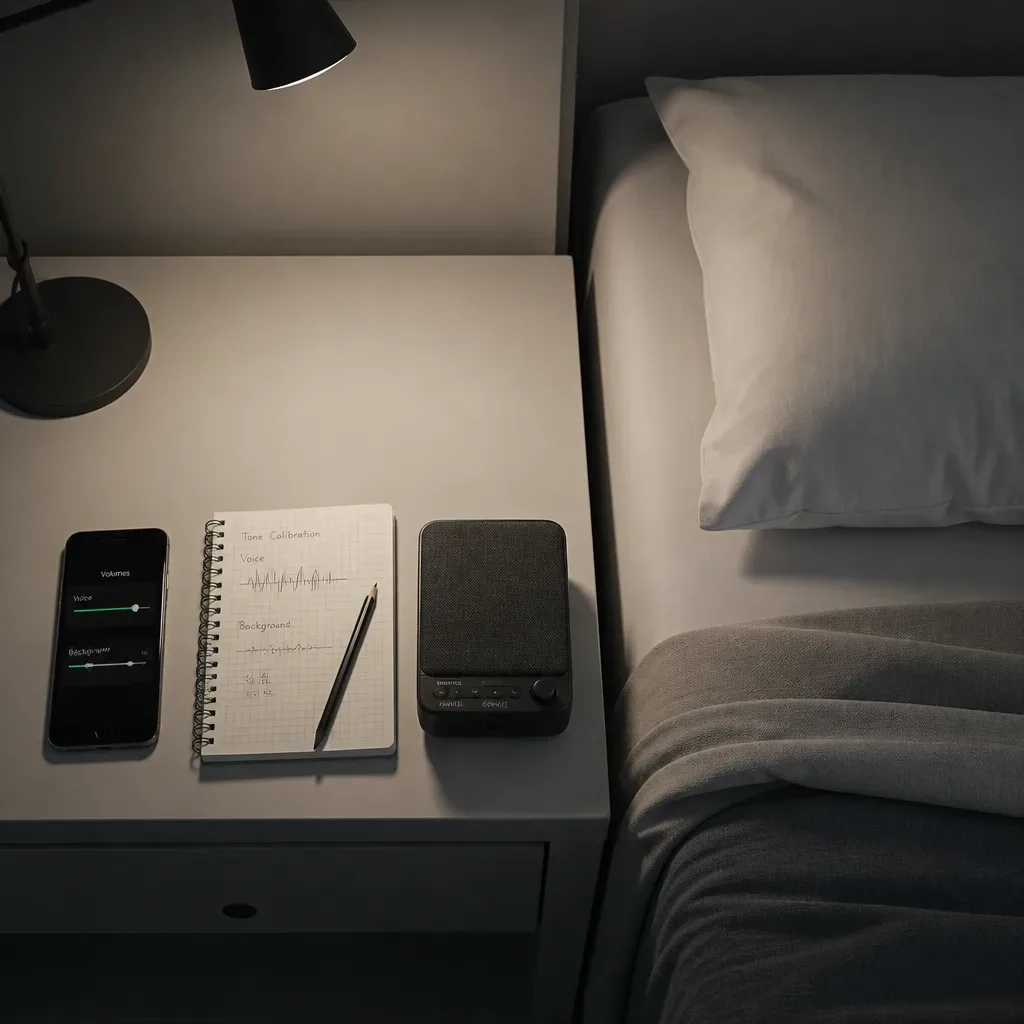
What should you choose if you also like frequencies or tones?
Choose one background layer, not three, especially under spoken audio.
It’s tempting to stack rain, white noise, solfeggio tones, and a voice. The mix may feel rich for the first minute, but the sleeping brain doesn’t need a crowded desk. Every added layer competes for attention. If you like frequency-based practice, let the tone have its own night or keep it far below the voice.
The Solfeggio frequencies guide explains the tradition carefully: the medieval hymn is real, the later numerological readings came much later, and the modern claims are stronger than the evidence. That doesn’t mean a 528 Hz tone is useless. It means the honest claim is smaller. A fixed tone can anchor attention. A ritual can cue rest. Neither needs to be presented as a medical treatment.
For spoken Dream-Self audio, I’d rank backgrounds this way:
| Listener need | First choice | Second choice | Avoid |
|---|---|---|---|
| Clear words | Pink noise low | Light rain low | Bright white noise loud |
| Noisy street | White noise low | Brown noise low | Detailed rain |
| Anxious scanning | Light rain | Pink noise | Thunderstorms |
| Tone ritual | Single low tone | Silence | Stacked tones plus rain |
If you have tinnitus, sleep apnea, chronic insomnia, or sound sensitivity, bring the pattern to a qualified clinician rather than solving it only with audio. Sleep tools are supports. They’re not a diagnosis, and they’re not a substitute for care.
What is the best practical choice tonight?
Start with light rain if your room is quiet, and start with white or pink noise if your room is unpredictable.
The fastest test takes one sleep cycle, about 90 minutes, but you can learn a lot in the first 10 minutes. With rain, notice whether your attention softens or starts counting drops. With white noise, notice whether the hiss relaxes you or makes your jaw slightly busy. The body often gives a small answer before the mind writes a theory.
Use the tools on this site as listening tests, not belief tests. Press play on the White noise generator + guide, then compare it with rain from your usual app at the same perceived loudness. If white feels too bright, try the colored-noise options. If tones interest you, compare a plain tone from the Solfeggio frequencies guide on a separate night rather than stacking everything at once.
A clean routine might look like this:
- 2 minutes: lights low, speaker placed away from the pillow
- 3 minutes: rain or noise set below the voice
- 10–15 minutes: Dream-Self audio, words clear and unforced
- after playback: background fades or stays very low
The best sound is the one you can forget without losing the thread. If rain gives you cover, use rain. If white noise gives you steadiness, use white noise. If silence works, let silence be the instrument.
Set the bed, lower the sound, and let the voice arrive softly.