noise colors
Pink Noise for Deep Sleep Under Dream-Self Audio
Use pink noise for deep sleep under Dream-Self audio with safe volume, simple routing, and a seven-night test that keeps the voice clear.
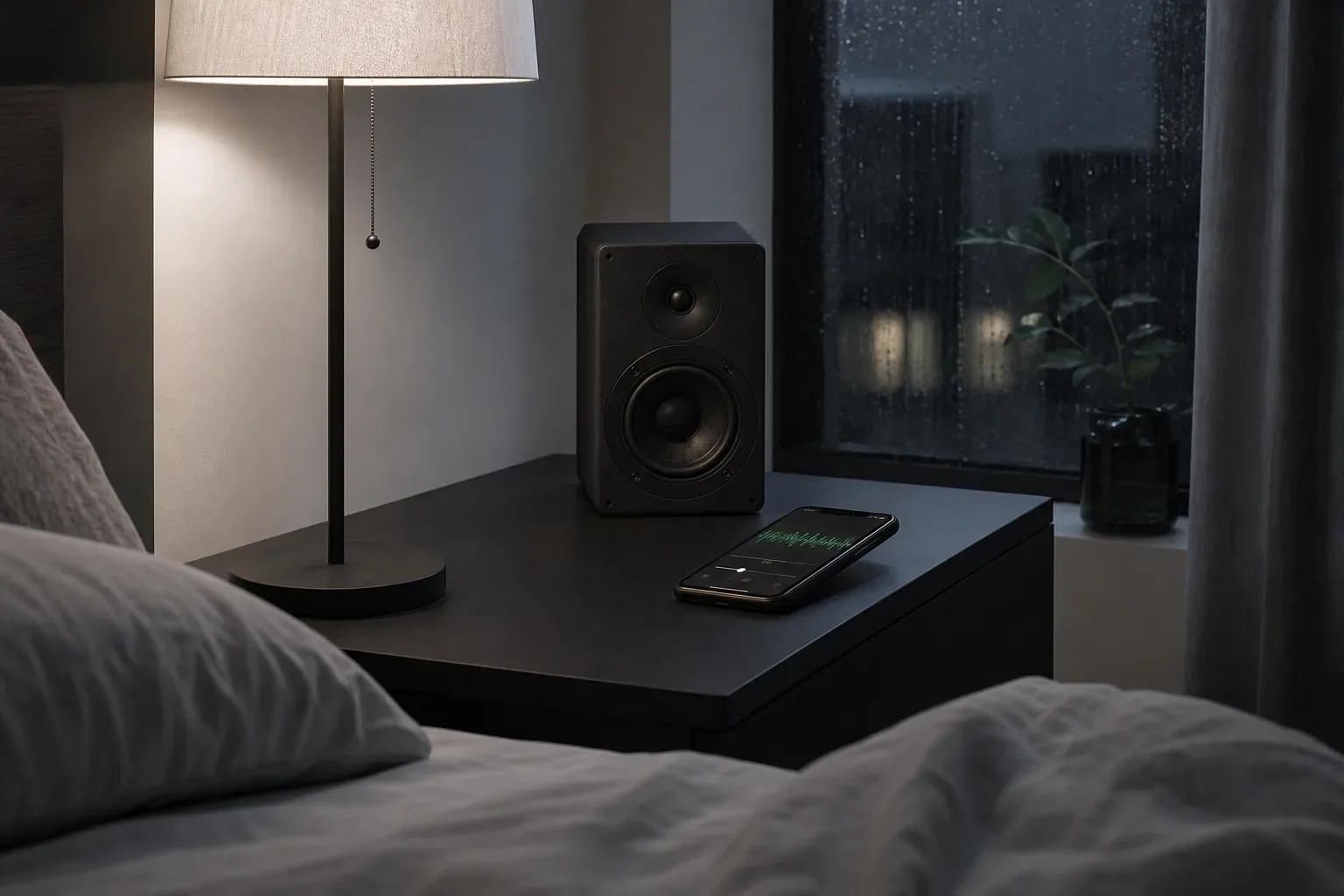
Pink noise for deep sleep works best as a low, steady masking layer under spoken Dream-Self audio. Set the pink noise first, keep it quieter than the voice, and use a conservative volume. The goal isn’t to force deep sleep. It’s to make the room plain enough for the recording to land.
What is pink noise, and why put it under Dream-Self audio?
Pink noise is a broadband sound that drops by about 3 dB per octave, so it sounds steadier and less hissy than white noise.
White noise gives equal acoustic energy to each hertz. Pink noise gives equal acoustic energy to each octave. Your ear hears that as a softer top end and a fuller low-middle band. Rain, distant traffic, and some steady ventilation systems tend to sit closer to pink noise than to the sharp hiss people call static. That is why many sleepers hear pink noise as less bright after 10 minutes.
Under Dream-Self audio, pink noise has a narrow job: it masks the small interruptions that compete with a spoken voice. A heater click at 2 a.m., a hallway footstep, or a motorbike several streets away can be enough to pull attention outward. A steady masking layer reduces contrast. Sound doesn’t need to be loud to be useful; it needs to be consistent enough that the room stops making announcements.
The Dream-Self track should stay primary. The AYA Method is a daily audio manifestation practice. Each day you listen to a short personalized recording, your Dream-Self Moment, narrated from the version of you who has already manifested the life you intend. Listening is the practice. Repetition is the work. The audio is the method.
For timing, keep it modest. The American Academy of Sleep Medicine says most adults need at least 7 hours of sleep per night, but your first wind-down window may be only 20 to 30 minutes. Pink noise can support that window without turning your whole night into a sound test. If you already use the White noise generator + guide, press play below and listen for the difference: pink will usually feel rounder, while white will usually cut more sharply through the room.
What does the evidence say about pink noise and deep sleep?
The evidence suggests pink-noise-like stimulation can support slow-wave sleep in some settings, but the strongest results come from small, timed laboratory protocols.
Deep sleep is often discussed as slow-wave sleep, marked by large, slow brain waves around 0.5 to 4 Hz. In a 2013 Neuron study by Ngo and colleagues, auditory stimulation synchronized to the slow oscillation rhythm increased slow-wave activity and improved memory performance in young adults. The method was not simply a pink-noise track left running all night. It was closed-loop sound, timed to the sleeping brain.
That distinction matters. A steady pink-noise bed at home is not the same as lab-triggered acoustic stimulation. A 2017 Frontiers in Human Neuroscience paper by Papalambros and colleagues tested similar timed stimulation in older adults and reported improved slow-wave activity and memory measures, again in a controlled setting. Sample sizes in this line of work are usually small, often around a few dozen participants, so the signal is interesting but not final.
A separate question is masking. Environmental noise can fragment sleep, even when you don’t fully wake. The World Health Organization’s Night Noise Guidelines describe sleep disturbance as one of the main health effects of night noise, with lower indoor levels preferred. A masking sound doesn’t remove noise. It reduces sudden contrast. Pink noise doesn’t push you into deep sleep; it can make the bedroom less jagged.
Use the evidence plainly: timed sound may influence slow waves in lab conditions, while steady pink noise may help by making the acoustic field more predictable. If you want to compare adjacent tools, the Binaural beats generator + guide explains another sound-based approach with mixed claims and careful setup notes.
How loud should pink noise be at bedtime?
Set pink noise at the lowest level that masks small disturbances while leaving speech easy to understand.
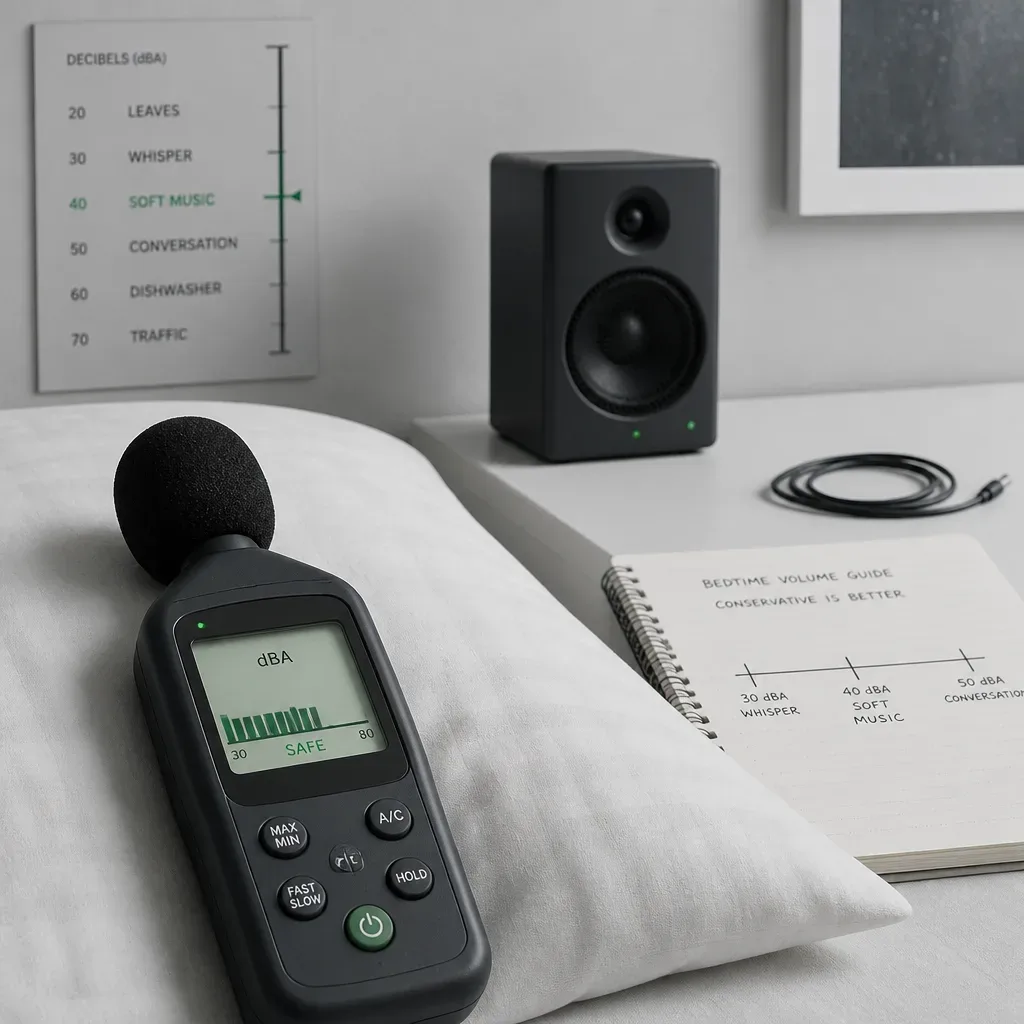
For adults, a practical starting point is about 30 to 40 dBA measured at the pillow. Many quiet bedrooms sit near 30 dBA. A normal conversation is often around 60 dBA at 1 meter. You do not want sleep audio anywhere near conversation loudness all night. If you have a decibel meter, use A-weighting and measure from where your head rests, not beside the speaker.
For children, be stricter. A 2014 Pediatrics study led by Hugh, Wolter, and colleagues measured infant sleep machines and found that some could exceed 85 dBA at 30 cm. The authors advised placing machines at least 200 cm from the infant and using the lowest usable volume. I keep that number in my own notes because gear often fails in the direction parents don’t expect: a power reset, a bumped dial, an app reconnecting at full output.
For headphone use, be careful. The U.S. National Institute for Occupational Safety and Health uses 85 dBA over 8 hours as an occupational exposure limit, but bedtime listening should be far below that. Sleep is not a concert, and ears don’t stop receiving sound because the room is dark. If you have tinnitus, hearing loss, sound sensitivity, sleep apnea, or chronic insomnia, speak with a qualified clinician before using overnight audio.
Use this quick volume check before sleep:
- You can hear every word of the Dream-Self recording.
- The pink noise is noticeable only when you focus on it.
- A door click sounds softened, not erased.
- Your jaw and forehead don’t tighten against the sound.
- The level still feels gentle after 3 minutes, not just at first play.
A good sleep volume is boring after three minutes. That boredom is a feature.
How do you set up the audio chain tonight?
Build the mix in two layers: pink noise first, Dream-Self audio second.
Use one speaker if possible. Two competing devices can drift, fight for Bluetooth priority, or create uneven sound at the pillow. If you’re using a phone, test airplane mode with Wi-Fi or downloaded audio before bed. A login prompt at 11:47 p.m. is bad design, not a discipline problem. Your setup should survive one sleepy hand and one dim room.
Here is the 20-minute setup:
- Choose the source. Use a stable pink-noise generator or a clean loop with no ads, clicks, or sudden fades. The White noise generator + guide is useful if you want to compare masking strength before choosing pink.
- Place the speaker. Put it 1 to 2 meters from your pillow, not directly beside your ear. For a child’s room, follow pediatric caution and keep it farther away.
- Set pink noise low. Start around 30 dBA if the room is already quiet, or closer to 40 dBA if you need to mask traffic or building noise.
- Add the voice. Raise the Dream-Self audio until the words are clear without leaning in. The voice should sit about 5 to 10 dB above the noise if you’re measuring.
- Test from bed. Lie down for 3 minutes. If consonants blur, lower the pink noise before raising the voice.
- Set a timer. Try 45 to 90 minutes for the first night. That covers many first sleep cycles, which are often close to 90 minutes.
A simple routing rule helps: the masking layer should never win over the message layer. The noise prepares the room; the voice carries the practice. If your app allows separate volume sliders, save the setting. If it doesn’t, write down the phone volume notch and speaker volume mark. Design fails less often when you remove memory from the system.
How is pink noise different from white, brown, binaural, and Solfeggio audio?
Pink noise is the middle option: softer than white, brighter than brown, and simpler than tone-based practices.
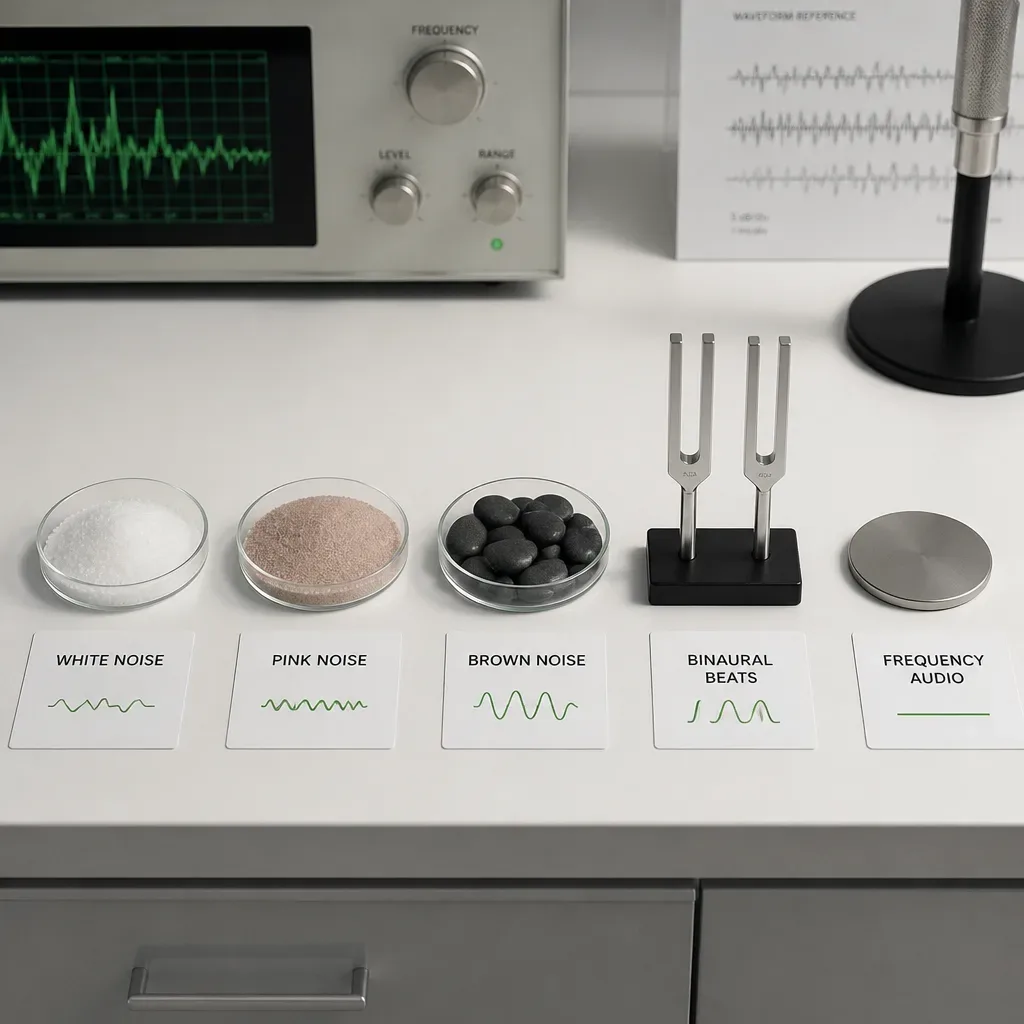
The names can blur when you’re tired, so use the sound, not the label. White noise is useful when you need sharper masking, especially for hiss, speech edges, or high-frequency interruptions. Brown noise places more acoustic energy in the low end, so it can feel like a deeper hum. Pink noise sits between them and often keeps spoken audio clearer than brown noise does.
Binaural beats are different. They require headphones because each ear receives a slightly different tone, and the brain constructs the beat. Claims around relaxation and focus are mixed, and the studies vary in design. If you’re curious, start with the Binaural beats generator + guide before using them under a spoken recording. For many sleepers, binaural tones plus a voice plus room masking is too much information.
Solfeggio frequencies are also different. They come from a tradition that assigns meaning to specific tones such as 396 Hz, 528 Hz, and 852 Hz. People may like these tones for personal or ritual reasons, but strong clinical evidence for specific sleep effects is limited. We cover the lore and the plain evidence in the Solfeggio frequencies guide without treating preference as proof.
| Sound type | What you hear | Best use under voice | Main caution |
|---|---|---|---|
| White noise | Bright, even hiss | Strong masking for sharp sounds | Can feel too sharp above 40 dBA |
| Pink noise | Steady, balanced hush | General sleep masking under speech | Keep it below the voice |
| Brown noise | Low, deep hum | Low-frequency comfort | Can muddy spoken words |
| Binaural beats | Two-tone illusion in headphones | Short tests, not complex mixes | Evidence is mixed |
| Solfeggio tones | Single-note or musical tones | Personal preference or ritual | Tradition is not clinical proof |
The table is not a ranking. It’s a fit guide. The best sleep sound is the one that solves the smallest problem at the lowest safe volume.
What mistakes make pink noise less useful under spoken audio?
The common mistakes are volume creep, crowded mixes, unreliable apps, and changing too many variables at once.
Volume creep is the first. You raise the pink noise to cover a truck, then raise the voice to sit above the pink noise, then wake with your ears feeling tired. Don’t chase every sound. Mask the typical room, not the loudest vehicle of the week. A 10 dB increase is often perceived as roughly twice as loud, so small slider moves matter more than they look.
Crowded mixes are the second. Pink noise, rain, low music, binaural beats, and spoken Dream-Self audio can become a stack with no clear foreground. Your nervous system then has to sort the stack. If you want music, skip the noise. If you want the Dream-Self track, let the voice stay clean. If you want frequency-based tone work, use one layer and learn it first.
Reliability is the third. Test failure modes before bedtime. Does the speaker announce Bluetooth connected at full volume? Does the app insert an ad after 30 minutes? Does the loop click every 47 seconds? Does the timer stop sharply? My rule from newborn nights is simple: a sleep tool should fail quiet. If it fails loud, it doesn’t belong near a bed.
Changing too many variables is the fourth. Sleep varies naturally from night to night. Research and consumer sleep trackers both show meaningful night-to-night variation, and even lab polysomnography uses multiple channels because sleep is not captured by one feeling in the morning. Keep the same pink-noise level, speaker placement, and Dream-Self track for at least 7 nights before deciding.
If the pairing feels busy, remove one layer. Try plain pink noise for 10 minutes, then the spoken track without noise, then both together. The difference will tell you where the friction is.
What seven-night routine should you use?
Use a fixed, quiet protocol for seven nights so you can hear whether pink noise helps or merely adds sound.
Night 1 is calibration. Measure if you can. If you don’t own a meter, use a phone app as a rough guide, but know that phone microphones vary. Set pink noise low, place the speaker 1 to 2 meters away, and keep the spoken audio clearly above it. Write down the settings in plain terms: phone volume 3 of 16, speaker dial at 9 o’clock, timer 60 minutes.
Nights 2 through 4 are stability nights. Don’t adjust unless something is clearly wrong. If you wake after the timer ends, extend by 15 minutes the next night rather than jumping from 45 minutes to 8 hours. If you wake with the sound still playing and feel annoyed, shorten the timer. Many sleep cycles run around 90 minutes, but they vary with age, stress, alcohol, illness, and bedtime.
Nights 5 through 7 are comparison nights. Keep the same bedtime routine and change only one item if needed. You might compare pink noise with no noise, or pink noise with brown noise, or a 60-minute timer with a 90-minute timer. If you want a sharper masking comparison, use the White noise generator + guide for one controlled test, not a full set of random changes.
Track only 3 measures:
- Time it seemed to take to fall asleep, rounded to 5 minutes.
- Number of remembered wakes.
- Morning ear comfort and mood, rated 1 to 5.
That is enough. More data can become another bedtime task. If after 7 nights the spoken audio is clearer, the room feels less interruptive, and your ears feel fine, keep the setup. If not, lower the noise, shorten the timer, or use the Dream-Self audio by itself.
Keep the hum low enough that the words can stay close.