noise colors
White Noise Tinnitus at Night Under Dream-Self Audio
White noise tinnitus guidance for night listening: mask ringing safely, keep Dream-Self audio clear, and choose a steady volume without strain tonight.
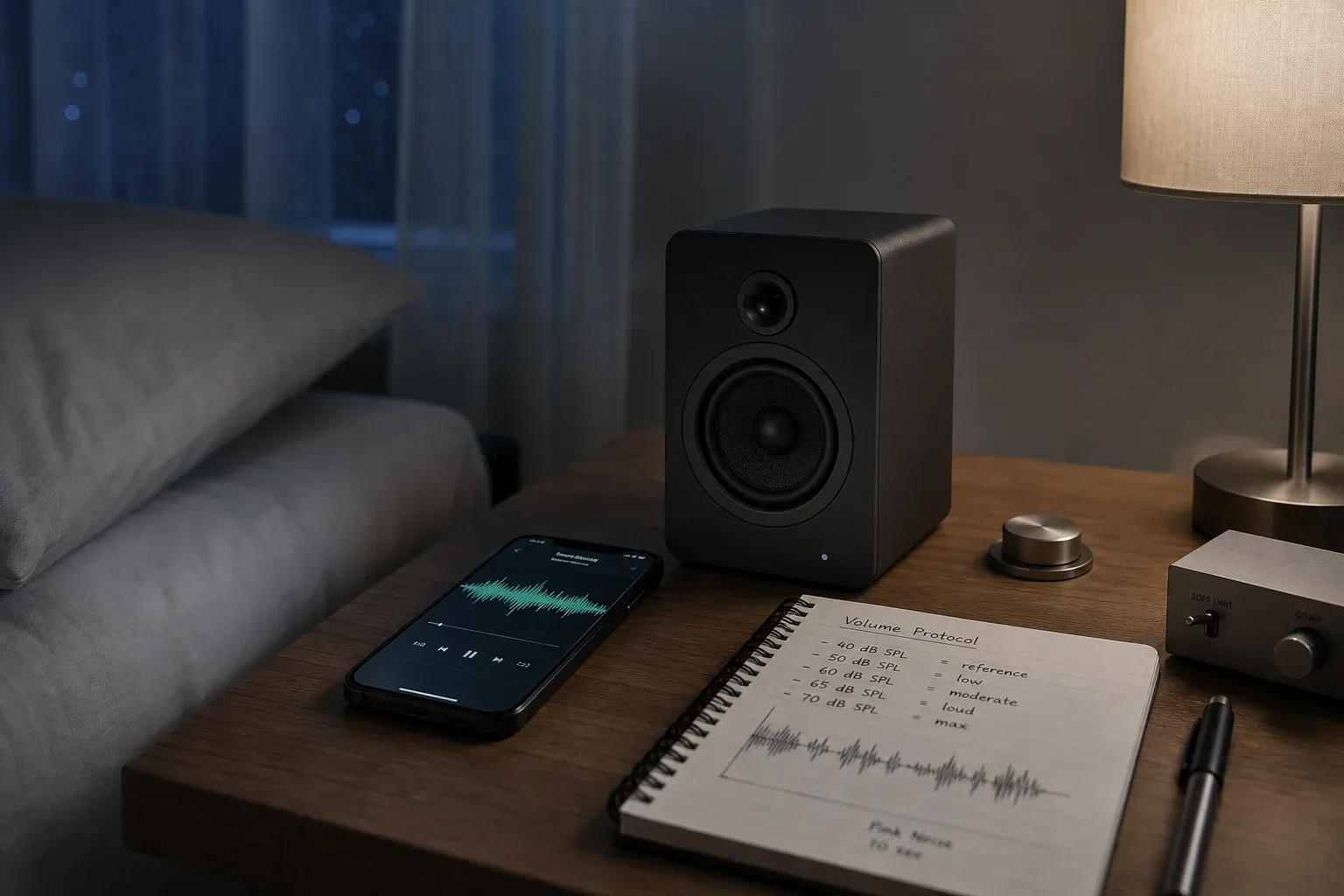
White noise tinnitus masking works by reducing the contrast between internal ringing and a quiet bedroom. It doesn’t treat the tinnitus signal itself, and it shouldn’t be loud. Used under Dream-Self audio, it should sit lower than the voice, soften the edge of the ringing, and leave every word clear.
What does white noise do for tinnitus at night?
White noise gives the ear a steady external reference so tinnitus has less contrast against silence.
Tinnitus often becomes more noticeable at night because the room gets quieter. The U.S. National Institute on Deafness and Other Communication Disorders estimates that about 10% of U.S. adults have had tinnitus lasting at least 5 minutes in the past year. When the refrigerator stops, traffic drops, and conversation ends, the internal tone has fewer competitors. White noise fills part of that empty acoustic space.
Mechanically, white noise contains equal acoustic power per hertz across the audible range. In practice, many small speakers don’t reproduce true white noise evenly from 20 Hz to 20,000 Hz, but the label usually means a broad, hiss-like signal. That broad signal can partially mask high-pitched tinnitus, especially ringing that sits around 4 kHz to 8 kHz after noise exposure.
Masking is not erasing. It is contrast management. A candle looks bright in a dark room and ordinary under a reading lamp; the candle didn’t change. Your tinnitus may feel less central when the room carries a steady sound bed.
The useful target is partial masking. If you cover tinnitus completely, the noise often has to become too loud or too sharp. If you reduce the edge by 20% to 60%, many people can stop checking it as often. NICE guideline NG155, published in 2020, treats sound therapy as one option within tinnitus support, not a stand-alone cure.
For a quick comparison, press play in the White noise generator + guide and listen for the difference between silence, low masking, and full masking. The second setting is usually the one to keep.
The goal is not to defeat tinnitus. The goal is to give attention a quieter place to land.
How loud should white noise tinnitus masking be?
White noise for tinnitus at night should be set at the lowest level that softens the ringing while still letting your body settle.
A safe setup starts below comfort, not at it. Put the speaker or phone at least 1 meter from your head when possible, then raise the level slowly. If you use earbuds or sleep headphones, be more conservative because the driver sits close to the ear canal. NIOSH sets 85 dBA over 8 hours as an occupational exposure limit, but a bedroom masker should normally sit far below that, often closer to a quiet room plus a small fan than to street noise.
There is no universal dB number because phone speakers, rooms, pillows, and hearing thresholds differ. A cheap sound meter app can be inaccurate by 5 dB or more, but it can still teach you relative changes. If the reading jumps by 10 dB, the sound pressure has changed a lot even if the app isn’t lab-grade.
Use this order:
- Start your Dream-Self audio or spoken track first.
- Set the voice to a level where consonants are clear without effort.
- Start white noise at zero.
- Raise it until the tinnitus becomes less sharp.
- Stop before the voice loses detail.
- Set a 30, 60, or 90 minute timer for the first week.
Two checks help. First, if you remove the noise and the room feels startlingly empty, you may have set it too high. Second, if your ears feel tired in the morning, lower the level by one or two steps the next night. Ear fatigue is data.
For children, use extra distance and lower levels, and avoid placing any sound source near the pillow. The World Health Organization has repeatedly linked night noise exposure with sleep disturbance at population level, and although bedroom sound masking is different from traffic noise, the caution is useful: quieter is usually better.
Can white noise sit under Dream-Self audio without hiding it?
Yes, white noise can sit under Dream-Self audio if speech remains the main signal and the noise stays behind it.
The AYA Method is a daily audio manifestation practice. Each day you listen to a short personalized recording, your Dream-Self Moment, narrated from the version of you who has already manifested the life you intend. Listening is the practice. Repetition is the work. The audio is the method.
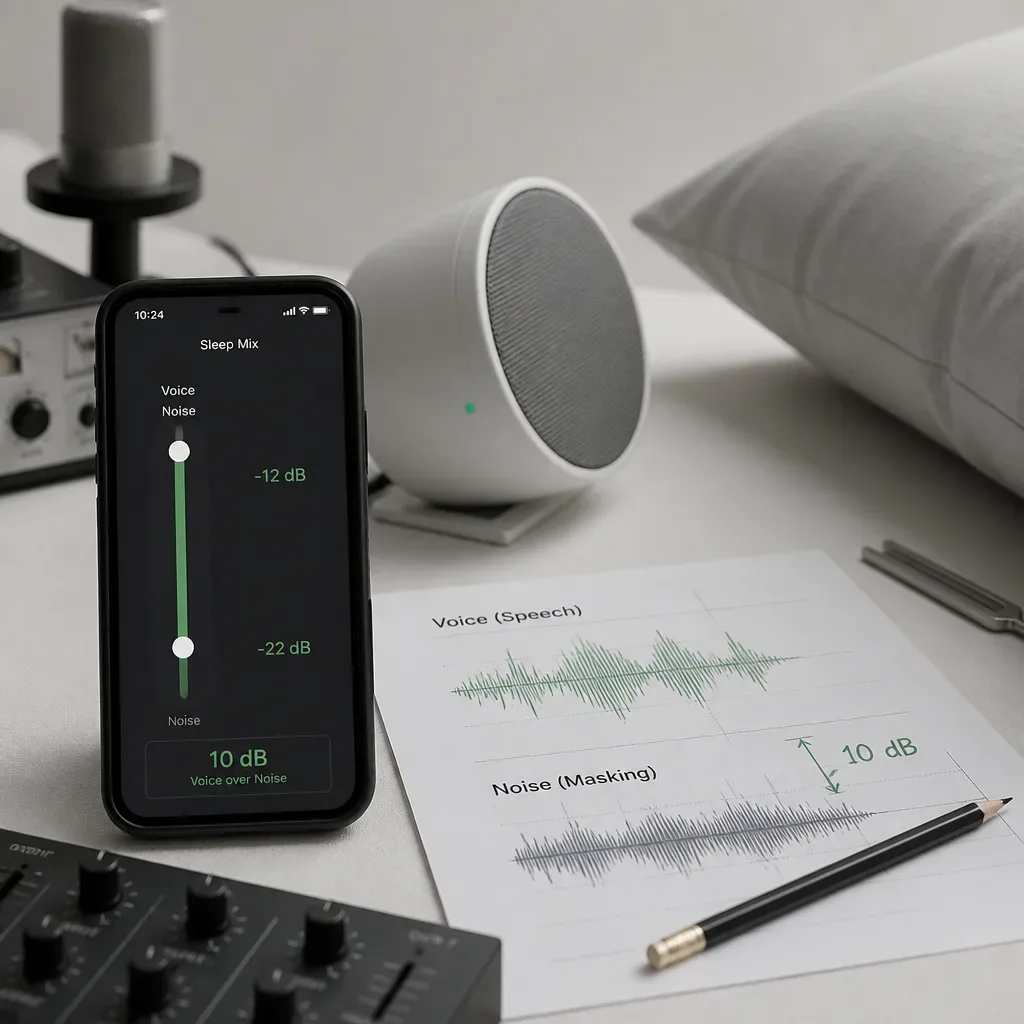
That definition matters acoustically. If the method is audio, then intelligibility is not decorative; it is the carrier. Speech perception often needs a favorable signal-to-noise ratio, and in everyday listening a voice that is roughly 10 dB louder than background sound is much easier to understand than a voice at the same level as the noise. The exact number shifts with hearing, room tone, and the speaker, but the principle is steady.
White noise can help before the recording starts. It lowers the contrast of tinnitus, which may reduce the urge to scan for the ringing. Then the spoken track enters as the foreground. If the hiss competes with s, f, t, and sh sounds, it is too bright or too loud for this use. Try pink noise, brown noise, or a low-pass filtered noise instead.
A simple mix rule works well: set the voice, then set the masker. Don’t reverse the order. When people start with the noise, they often chase full masking and leave no room for speech. When they start with the voice, the noise becomes a support.
| Layer | Role | Practical level |
|---|---|---|
| Dream-Self audio | Foreground meaning | Clear words, no strain |
| White noise | Tinnitus contrast control | Audible but lower than speech |
| Bedroom room tone | Natural background | Allowed to remain present |
| Timer fade | Sleep transition | 30 to 90 minutes to start |
A masker that hides the message is no longer support; it has become the main track.
What type of noise works best when tinnitus is sharp?
The best noise is the quietest sound color that reduces sharpness without irritating the ear.
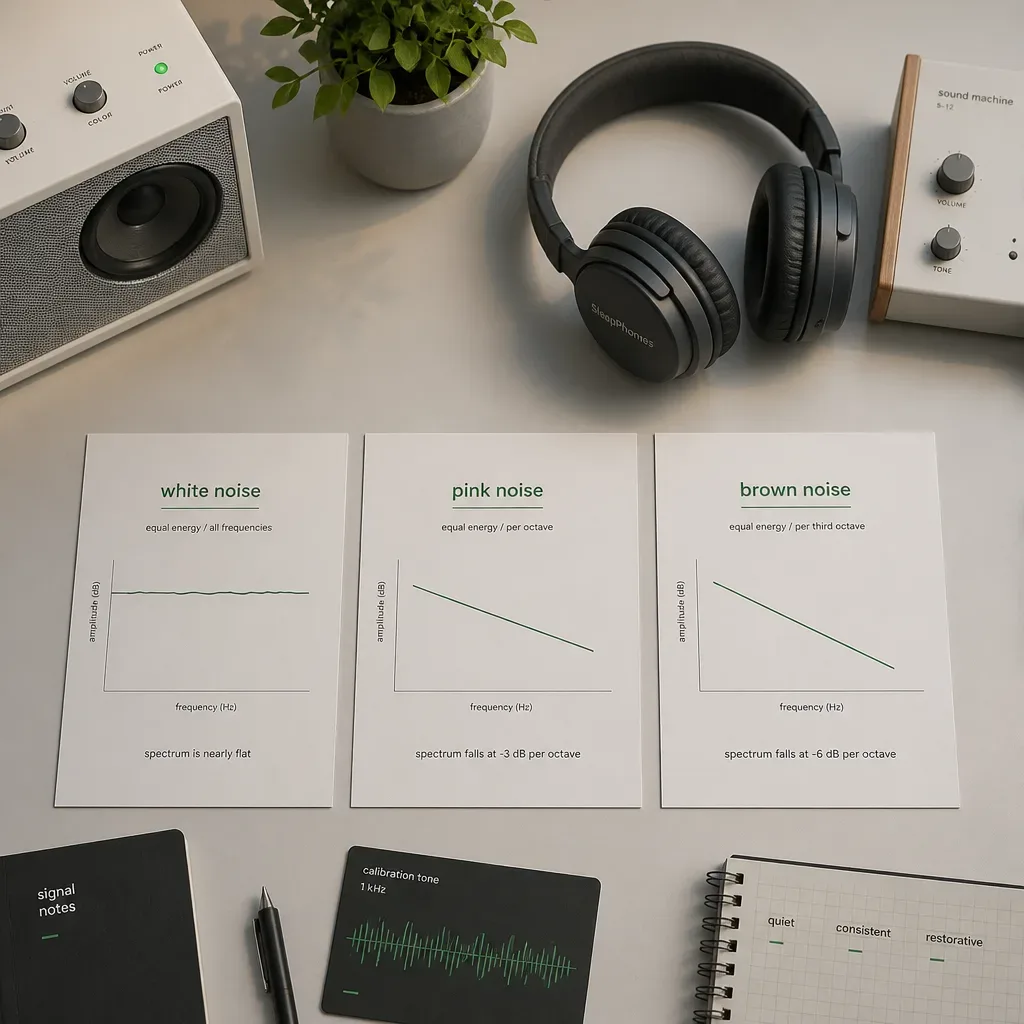
White noise is only one option. It has a bright top end because every hertz gets equal acoustic power. Pink noise reduces level by about 3 dB per octave, which means each octave carries roughly equal power. Brown noise falls by about 6 dB per octave, so it feels lower and less hissy. Many people with high-pitched tinnitus prefer pink or brown because those sounds don’t add as much treble.
The tinnitus pitch matters. A narrow, high ring near 8 kHz may respond to a softer broadband hiss. A lower buzz may settle better with brown noise or fan noise. Some tinnitus has no stable pitch, and some changes with jaw tension, stress, or fatigue. A 2018 Cochrane review led by Sereda and colleagues found limited evidence for sound therapy devices overall, partly because tinnitus itself is not one uniform condition.
Try comparisons instead of labels. Use the White noise generator + guide for a reference hiss. Then test slower, lower sounds from a noise color page such as a noise colors guide, if you want to hear the slope rather than read about it. Keep each trial at the same perceived loudness for 2 minutes.
Binaural beats are different. A binaural beat is an auditory illusion made by feeding each ear a slightly different tone, often separated by 4 Hz to 10 Hz for relaxation claims. The Binaural beats generator + guide is useful for hearing that mechanism, but it is not the same as masking. A thin tone may make tinnitus more noticeable for some listeners.
Solfeggio tracks are different again. The Solfeggio frequencies guide explains the tradition respectfully, including common tones such as 396 Hz and 528 Hz. Tradition can be meaningful. Evidence for tinnitus masking still comes down to audibility, spectrum, level, and whether the sound helps you stop monitoring the ring.
What routine should you use tonight?
Use a short, measured routine that tests comfort first and sleep second.
Begin 15 minutes before you want the lights out. Tinnitus often gets louder in attention when the day stops, so don’t wait until frustration is high. Put the phone or speaker on a bedside table rather than under a pillow. If you use a smart speaker, disable sudden notification sounds. A single alert can be 20 dB louder than the background and undo the softness you built.
Here is a plain 7-night trial:
- Nights 1 and 2: use white noise for 30 minutes under the voice.
- Nights 3 and 4: try pink or brown noise at the same perceived level.
- Night 5: use no masker for the first 5 minutes, then add noise.
- Night 6: use your best sound with a 60-minute timer.
- Night 7: write down sleep onset, morning ear comfort, and speech clarity.
The notes should stay simple. Use a 0 to 10 scale for tinnitus intrusiveness, where 0 means not noticed and 10 means impossible to ignore. Add one sentence about the sound. Don’t turn the log into a second bedtime task. Two numbers and one sentence are enough.
For Dream-Self audio, keep the order consistent: room, body, voice, masking. Dim the room. Let the body get still for about 2 minutes. Start the recording. Add the noise last. If you are using a timer, fade the masker after the recording rather than during the middle of a sentence.
Some people like all-night sound because waking at 3 a.m. into silence makes tinnitus feel abrupt. Others wake more often when any sound continues. Sleep cycles average around 90 minutes, but they vary by age, alcohol, stress, and medication. Test your own pattern instead of adopting a fixed rule.
Good sound masking is boring by design. If you keep noticing it, it is probably too interesting.
What does the evidence actually say about white noise tinnitus relief?
The evidence supports sound as a management tool for some people, but it does not prove white noise cures tinnitus.
Tinnitus research is difficult because outcomes are subjective, causes differ, and devices vary. A person with noise-induced high-frequency hearing loss is not the same as a person with pulsatile tinnitus. A masker, hearing aid, phone app, bedside speaker, and counseling program may all be called sound therapy in studies, which makes clean comparison hard.
The 2018 Cochrane review on sound therapy for tinnitus reported low-certainty evidence and could not show a strong, consistent advantage for sound generators over other approaches. That does not mean sound is useless. It means the research base is mixed, and personal trial under safe limits is more honest than a fixed promise.
Clinical guidelines tend to place sound alongside education, hearing assessment, cognitive behavioral therapy when distress is high, and hearing aids when hearing loss is present. The American Academy of Otolaryngology guideline from 2014 recommended against routine medication for tinnitus alone and supported education and hearing evaluation. NICE NG155 in 2020 also emphasized assessment, support, and tailored management.
For sleep specifically, the mechanism is plausible. Sound can mask tinnitus, reduce sudden acoustic contrast, and give attention a stable object. White noise also masks small household noises: pipes, hallway steps, distant cars. Sleep labs have studied noise effects for decades, but tinnitus-specific white noise sleep trials remain smaller and less uniform than marketing suggests.
A fair sentence is this: white noise may help you care less about tinnitus at bedtime, which can matter even when the tinnitus signal remains.
If anxiety around tinnitus is high, sound alone may not be enough. Cognitive behavioral therapy has better evidence for reducing tinnitus distress than many device-only approaches, including reviews in journals such as the Journal of the American Academy of Audiology and Cochrane summaries. A sound bed can be part of care, not the whole structure.
When should tinnitus be checked by a professional?
Tinnitus should be checked promptly if it is one-sided, pulsing, sudden, linked to hearing loss, or paired with dizziness, ear pain, or neurological symptoms.
Most tinnitus is not an emergency, but some patterns need attention. Pulsatile tinnitus, which beats with your heartbeat, can have vascular causes. Sudden hearing loss with tinnitus should be treated as urgent; many ear specialists use a 72-hour window as a practical reminder to seek care quickly. One-sided tinnitus that persists also deserves assessment, even if it is mild.
If tinnitus keeps you awake for weeks, ask for help. Chronic insomnia is commonly defined as sleep difficulty at least 3 nights per week for at least 3 months, but you do not need to wait 3 months to speak with a clinician. If you suspect sleep apnea, especially with loud snoring, gasping, or daytime sleepiness, get assessed rather than trying to mask the night with more sound.
Hearing tests are useful because tinnitus often travels with hearing loss. An audiogram can show whether certain frequencies are reduced, commonly around 3 kHz to 6 kHz after noise exposure. If hearing loss is present, hearing aids may reduce tinnitus contrast by restoring environmental sound. That is different from adding noise, and for some people it works better during the day.
Also check the basics: recent loud noise exposure, new medication, earwax blockage, jaw clenching, and caffeine or alcohol changes. None of these explains every case, but each gives a professional something concrete to examine. Keep your 7-night sound notes and bring them with you. Specific observations beat vague memory.
White noise at night is a tool, not a test of discipline. If it helps at a low level, use it. If it makes the ring sharper, stop and choose a lower color or silence. Your ear gets a vote.
Tonight, let the softer sound be the one that stays.