noise colors
White Noise Timer: Fade Out After Dream-Self Audio
Set a white noise timer to fade gently after your Dream-Self audio, keeping masking sound low, safe, and steady while your room gets quiet tonight.
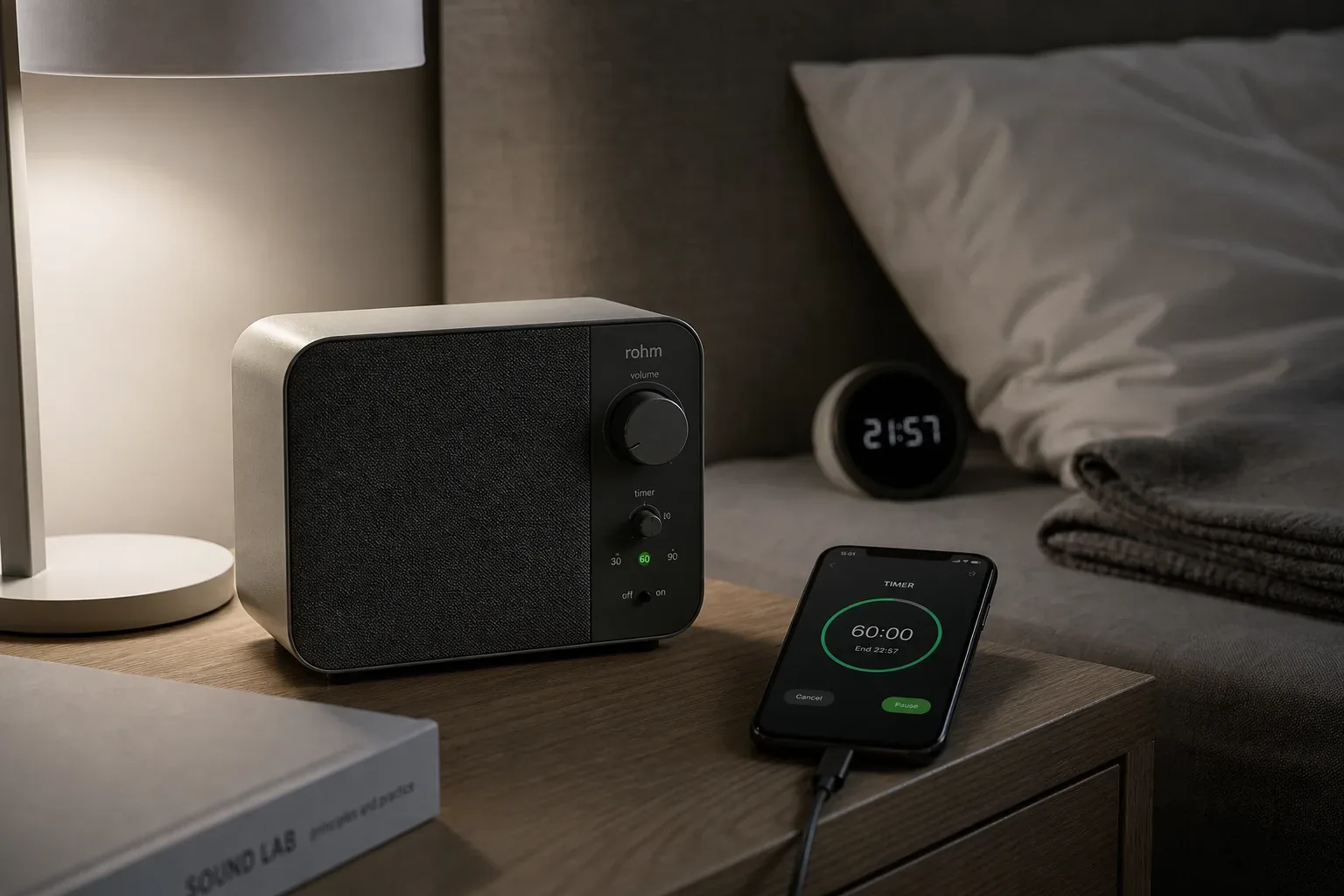
A white noise timer lets masking sound continue briefly after your Dream-Self audio, then fade before it becomes all-night noise. Set the audio first, add 20 to 45 minutes of low white noise, and use a 5 to 15 minute fade. Keep the level quiet enough to hear your room soften.
What is a white noise timer doing after Dream-Self audio?
A white noise timer gives your nervous system a measured bridge from spoken audio to ordinary room tone.
The sequence matters. Spoken audio asks for attention, even when it is calm. White noise asks for less. It is a broadband masking signal, meaning it contains many frequencies at once and can reduce the contrast between a sudden hallway click and the quiet of your bedroom. In acoustic terms, white noise has equal intensity per hertz. In practice, many people hear it as a steady hiss. If that hiss feels too bright, compare it with the lower slope on the White noise generator + guide.
The timer is not there to make sleep happen by force. It is there to remove one avoidable problem: a sudden silence after a voice track. The ear is excellent at noticing change. A 2020 review in Sleep Medicine Reviews noted that environmental noise can fragment sleep through short arousals, sometimes without full waking. A stop button can become one of those changes if it is abrupt.
Think of the timer as a fader, not a sedative. The first 10 minutes after your Dream-Self audio often still carry attention. By 20 to 45 minutes, many adults have moved closer to stable stage N2 sleep, although normal sleep latency varies widely. The National Sleep Foundation commonly describes healthy adult sleep onset as under 30 minutes for many sleepers, not as a rule for every body.
A good timer does three plain jobs:
- holds the acoustic floor steady while attention drops
- masks small room sounds without becoming loud
- lowers slowly enough that silence does not arrive as a signal
A timer is not more sound. It is better timing.
How long should the timer run after the Dream-Self Moment?
Start with 20 to 45 minutes of white noise after the spoken audio ends, then adjust only after 3 nights.
That range is practical because it covers the common sleep-onset window without assuming you need sound for the whole night. A typical adult sleep cycle is often described as about 90 minutes, but the first transition into sleep can happen far earlier. If your Dream-Self audio is 5 to 10 minutes, a 30 minute timer gives you a compact routine that fits within a single wind-down period.
Use the same number for several nights before you judge it. Sleep has night-to-night variance from caffeine timing, light exposure, stress, room temperature, alcohol, and exercise. In behavioral sleep work, clinicians often look for patterns over at least 1 to 2 weeks, but for a timer setting, 3 nights is enough to catch obvious problems without overcorrecting after one bad night.
Here is a measured starting table:
| If this happens | Set the timer to | Fade length |
|---|---|---|
| You fall asleep easily | 20 minutes | 5 minutes |
| You need a longer ramp | 30 minutes | 10 minutes |
| You wake when sound stops | 45 minutes | 15 minutes |
| Your room stays noisy late | 60 minutes | 15 minutes |
If you use the AYA Method, place the timer after the core audio. The AYA Method is a daily audio manifestation practice. Each day you listen to a short personalized recording, your Dream-Self Moment, narrated from the version of you who has already manifested the life you intend. Listening is the practice. Repetition is the work. The audio is the method.
The white noise comes afterward as room support. It is not the practice itself. It is the acoustic handoff.
How do I set the fade so it does not wake me?
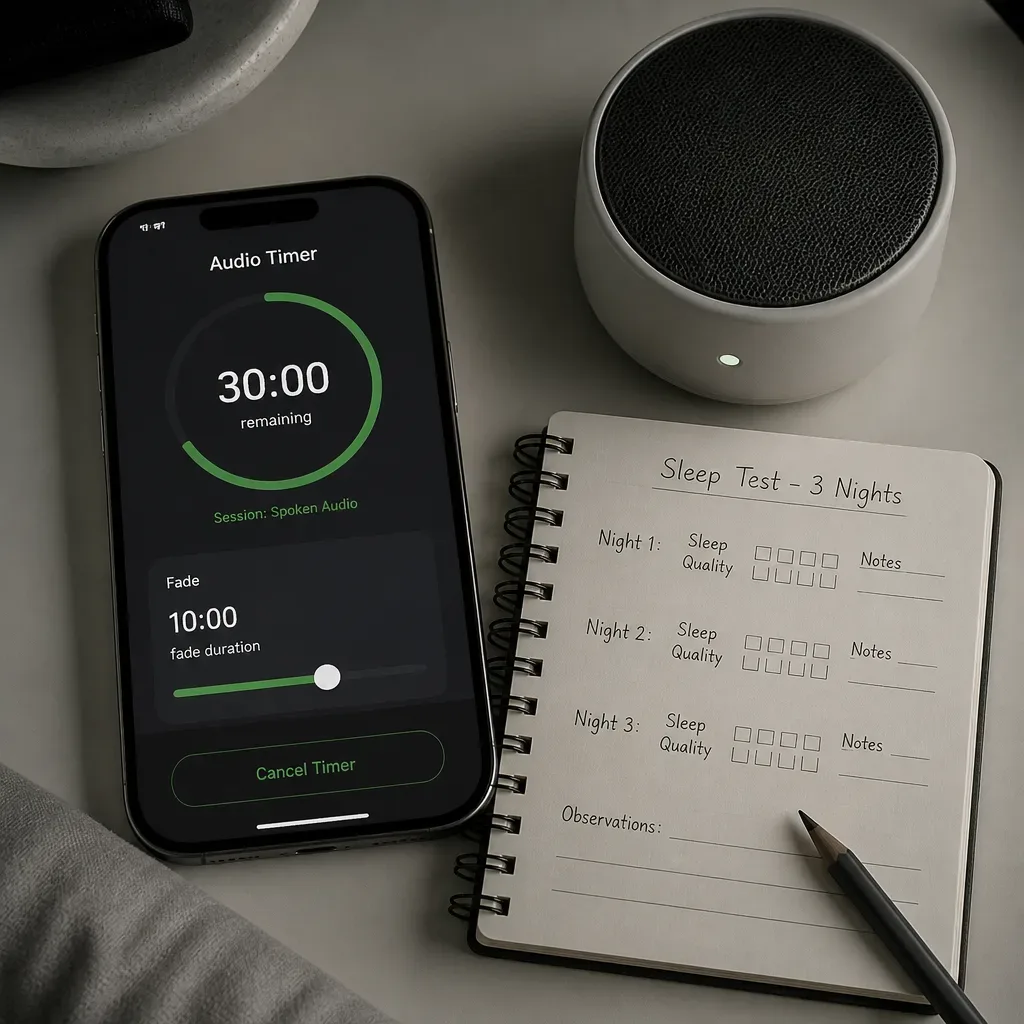
Use a slow fade of 5 to 15 minutes, with the final level dropping below notice rather than cutting to silence.
A hard stop is easy for the auditory system to detect. Our hearing is tuned to change, not just level. A refrigerator switching off can be more noticeable than the same refrigerator running. That is why a 10 minute fade often feels calmer than a perfect loop that stops at one exact second.
Set the fade length by room noise. If you live in a quiet rural room, 5 minutes may be enough. If you sleep near traffic, plumbing, an elevator, or a shared hallway, use 10 to 15 minutes. The World Health Organization has reported that night noise above roughly 40 dB outside can begin to affect sleep for some people, and indoor perception depends on windows, walls, and frequency content.
A simple setup looks like this:
- Play your Dream-Self audio at normal listening level.
- Start white noise automatically or manually after it ends.
- Set total masking time to 30 minutes.
- Set fade out to 10 minutes.
- Place the speaker at least 1 meter from your head.
- Lower the volume until it barely covers the most annoying sound.
If your app lets you choose curve shape, choose a gentle linear or equal-power fade. If it does not, do not worry. The difference is less important than avoiding a sudden stop. A useful fade is boring. Nothing should call attention to itself.
The best sleep timer is the one you do not notice ending.
If you wake as the fade reaches silence, do not raise the volume first. Lengthen the fade or the run time by 10 minutes. Louder sound can solve one problem and create another.
What volume should white noise use at the pillow?
Use the lowest audible level that masks the room, usually about 35 to 50 dBA at the pillow for adults.
Volume is the safety setting. Noise that is useful for masking does not need to be loud. NIOSH uses 85 dBA over 8 hours as an occupational exposure limit, and that number is not a sleep target. Bedroom masking should sit far below it. If you have a basic sound level meter app, use it as a rough tool, not a laboratory instrument. Phone microphones vary, but they can still tell you whether you are closer to 40 dBA or 70 dBA.
Measure from where your ear rests, not from the speaker. Distance matters. A small speaker 20 centimeters from a pillow can be much louder at the ear than it seems from across the room. For children, be especially conservative. The American Academy of Pediatrics has warned that infant sleep machines can produce high levels if placed close to a crib. Keep devices away from the child and use the lowest setting that works.
Here is a quiet calibration method:
- Set the room as it will be during sleep.
- Turn the white noise on low.
- Raise it until the most irritating sound softens.
- Stop before the hiss becomes the main thing you hear.
- Lie down for 2 minutes and check again.
The right setting often feels slightly too low at first. The ear adapts. After 5 minutes, a moderate hiss may feel louder than it did when you pressed play. That adaptation is useful. It means you can often reduce the level and keep the masking benefit.
If you use headphones, be more careful. For sleep, a speaker is usually safer and more comfortable than earbuds. If you have tinnitus, chronic insomnia, sleep apnea, or sound sensitivity, ask a qualified clinician rather than treating sound as a medical tool.
Should I use white noise, pink noise, brown noise, or a beat?
Choose the sound by spectrum and comfort, not by the strongest claim attached to it.
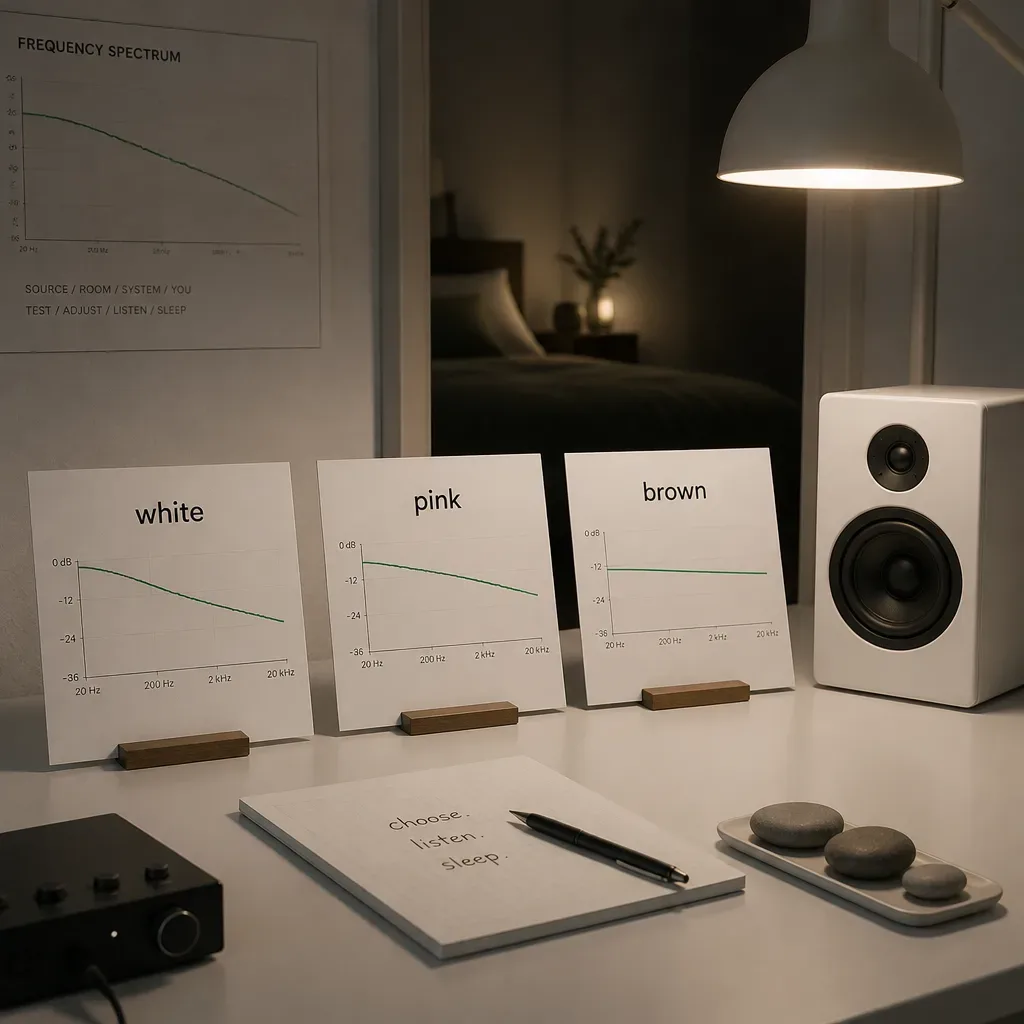
White noise has more high-frequency presence to the ear because equal intensity per hertz gives the upper bands a lot of audible detail. Pink noise drops about 3 dB per octave, so it sounds more balanced to many listeners. Brown noise drops about 6 dB per octave, which makes it lower and less hissy. These are filter shapes, not personality types.
For a post-audio timer, the best sound is the one that masks your specific room at the lowest comfortable volume. A radiator tick may need more high-frequency content. Distant traffic may settle under pink or brown noise. If white noise feels sharp, test alternatives on the White noise generator + guide and compare with steady low sound rather than reading the label as a promise.
Binaural beats are different. A binaural beat is an auditory illusion created when each ear receives a slightly different tone. Some small studies have looked at relaxation and attention, with mixed results and varied methods. If you want to test them, use the Binaural beats generator + guide earlier in the evening rather than under a white noise fade, because headphones are usually required.
Solfeggio tones are also different. The tradition assigns meanings to frequencies such as 396 Hz, 528 Hz, and 852 Hz. Many people like the tones, and liking a tone is a valid listening fact. The scientific evidence for specific manifestation or sleep outcomes remains limited. The Solfeggio frequencies guide labels the tradition plainly and keeps the claims separate from the sound.
A label can guide the first test, but your room decides the final setting.
How do I build the full routine without adding more time?
Keep the routine short by stacking the timer after audio you already planned to hear.
The common mistake is building a 60 minute wind-down routine and then resenting it by Wednesday. A white noise timer works best when it removes decisions. You press play once, hear the spoken audio, and let the fade handle the room. The whole setup can take under 2 minutes after the first night.
Use this 12 minute setup once, then repeat it without tinkering:
- Minute 0 to 2: Choose the sound color and set volume at the pillow.
- Minute 2 to 4: Set the timer duration, starting with 30 minutes.
- Minute 4 to 5: Set a 10 minute fade.
- Minute 5 to 7: Place the speaker away from your head and check doors, windows, and chargers.
- Minute 7 to 12: Play the Dream-Self audio, then let the timer continue.
This order keeps the audio central. The white noise is the technical support layer. The daily affirmation and Manifestation Board can sit elsewhere in your day if you use them, but they are not needed for the sound sequence at night. For this routine, the practical chain is voice, masking, fade, quiet.
If your app cannot start white noise after another audio file, use a simple workaround. Start the white noise first at a low level, then play the Dream-Self audio slightly above it. When the voice ends, reduce nothing. Let the timer fade the noise later. Many phones also allow shortcuts, focus modes, or sleep timers, though exact controls differ by operating system.
Track only 3 things for the first week: estimated time to fall asleep, whether you noticed the fade, and whether you woke before morning. More data can make bedtime feel like a lab test. Three fields are enough to see whether the timer is helping.
What mistakes make a white noise timer less useful?
Most timer problems come from sound that is too loud, too abrupt, too bright, or changed too often.
The first mistake is using volume as the main control. Loudness can mask more, but it also increases stimulation and exposure. A quieter sound placed well often works better than a louder sound near the pillow. Move the speaker before raising the level. Even 50 centimeters of distance can change what reaches the ear.
The second mistake is changing settings every night. If you test white noise Monday, brown noise Tuesday, a 528 Hz tone Wednesday, and rain Thursday, you are not testing sound. You are testing novelty. Use one setting for 3 nights, then change one variable. Good measurement is mostly restraint.
The third mistake is trusting a loop with an audible seam. A click every 30 seconds can train attention. Use long loops or generated noise when possible. The generator approach avoids obvious repetition because the sound is synthesized continuously rather than replayed as a short file.
The fourth mistake is making the room completely dependent on masking. If a loose window latch clicks all night, fix the latch. If a charger whines near your bed, move it. Sound masking is useful, but it should not cover problems that a 5 minute physical adjustment can remove.
Use this quick diagnostic:
| Problem | Likely cause | First adjustment |
|---|---|---|
| Fade wakes you | Stop is too abrupt | Add 10 minutes or longer fade |
| Hiss annoys you | Too much high frequency | Try pink or brown noise |
| Sound feels intrusive | Volume too high | Drop 3 to 6 dB |
| Partner dislikes it | Speaker aim or spectrum | Move source, lower level |
| You wake at 3 a.m. | Not timer-specific | Check light, temperature, caffeine |
A quiet bedroom is engineered in small corrections, not one dramatic setting.
Set the fade, lower the hiss, and let the room do less.