noise colors
White Noise for Snoring That Leaves Voice Audio Clear
Use white noise for snoring without burying Dream-Self audio. Learn volume, placement, noise color, and a simple night setup that protects ears.
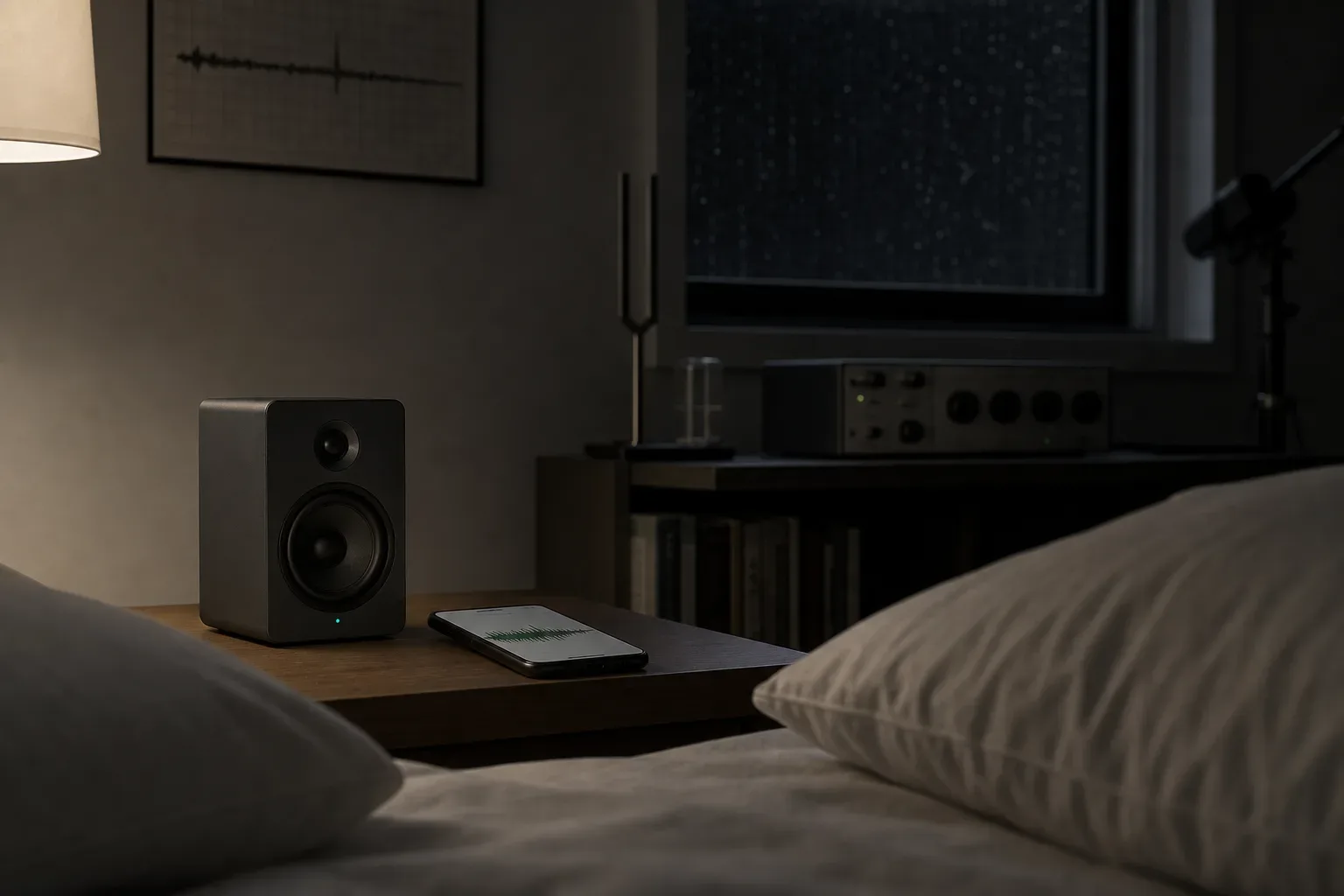
White noise for snoring works by masking the uneven peaks of a snore with a steadier sound, so your brain has less contrast to track. To keep Dream-Self audio clear, keep the noise lower than the voice, place it carefully, and use the quietest level that softens the snore.
How does white noise for snoring actually work?
White noise helps with snoring because it reduces contrast, not because it cancels the snore.
A snore is hard to ignore because it changes. It rises, catches, breaks, and stops. Your auditory system is built to notice change; that was useful long before bedrooms had Bluetooth speakers. White noise is the opposite pattern: steady, broad, and plain. It covers many frequencies at once, so the sudden edges of a snore stand out less against the room.
Acoustically, white noise contains equal sound power per hertz across the audible range, usually described from about 20 Hz to 20,000 Hz. Real speakers don’t reproduce that perfectly, and small phone speakers often lose the low end below about 150 Hz. Still, the hiss can be useful because many snoring sounds carry rough mid and upper components between roughly 200 Hz and 2,000 Hz, the same broad band where speech consonants live.
Masking is not silence. It is camouflage. A 2017 review in the journal Frontiers in Neurology noted that environmental noise affects sleep through arousal and fragmentation, with sudden changes often more disruptive than steady sound. That distinction matters here. A constant signal may be less disturbing than an irregular one, even when both register on a meter.
There is also a threshold problem. If the snore reaches 55 dBA at your pillow and the room sits at 28 dBA, your nervous system hears every peak. If you raise a steady sound to 38 or 42 dBA, the peaks still exist, but they may no longer feel like separate events. A good mask lowers the number of moments you flinch.
Use the White noise generator + guide as a reference before bedtime. Press play, start low, and listen for the point where the snore loses definition. That point is usually quieter than people expect.
The right masking level is not the loudest sound you can sleep through. It is the quietest sound that makes the interruption less interesting.
What kind of noise should you use if a voice track also needs to stay clear?
Use a noise color that masks the snore while leaving the speech band open enough for the voice to remain easy to understand.
Dream-Self audio is voice-first, so speech intelligibility is the constraint. Human speech often spans about 85 Hz to 255 Hz for fundamental pitch, with important clarity cues above 1,000 Hz. White noise can mask consonants if it is too loud, because consonants such as s, f, and t live in the higher bands. If your recording contains a calm spoken voice, the noise should sit behind it, not beside it.
This is where color matters. White noise has a brighter hiss. Pink noise drops by about 3 dB per octave, so it sounds less sharp. Brown noise drops more steeply, about 6 dB per octave, and feels low and round. In practice, pink noise often gives the best compromise for snoring plus speech, while white noise helps when the snore is raspy or nasal.
| Sound type | What you hear | Snoring use | Risk for voice clarity |
|---|---|---|---|
| White noise | Bright, full-band hiss | Good for rough, high-edged snoring | Can cover consonants if loud |
| Pink noise | Softer, balanced hush | Good first adjustment from white | Usually moderate |
| Brown noise | Low, steady hum | Good for low comfort and traffic-like masking | Can thicken low voices |
| Nature noise | Rain, fan, surf, wind | Good if the pattern is steady | Sudden drops can reveal the snore |
Small sleep studies have tested pink noise more often than white noise for slow-wave sleep, but sample sizes are usually modest, often fewer than 50 participants. The evidence does not prove that a color fixes sleep. It suggests that steady sound can change arousal patterns for some people. Your room, speaker, snore, and ears still get a vote.
If you like tone-based tools, compare with the Binaural beats generator + guide, but don’t use binaural beats as the masking layer for snoring. A binaural beat is an auditory illusion made from two nearby tones, often separated by 4 to 12 Hz. It may be pleasant through headphones, but it is not broad enough to hide a rough snore.
Frequency traditions also sit in a different category. The Solfeggio frequencies guide explains tones such as 528 Hz respectfully as a listening tradition, not as a snore mask. A single tone can be meaningful to a listener and still be a poor tool for covering a changing airway sound.
How loud should white noise be when someone is snoring?
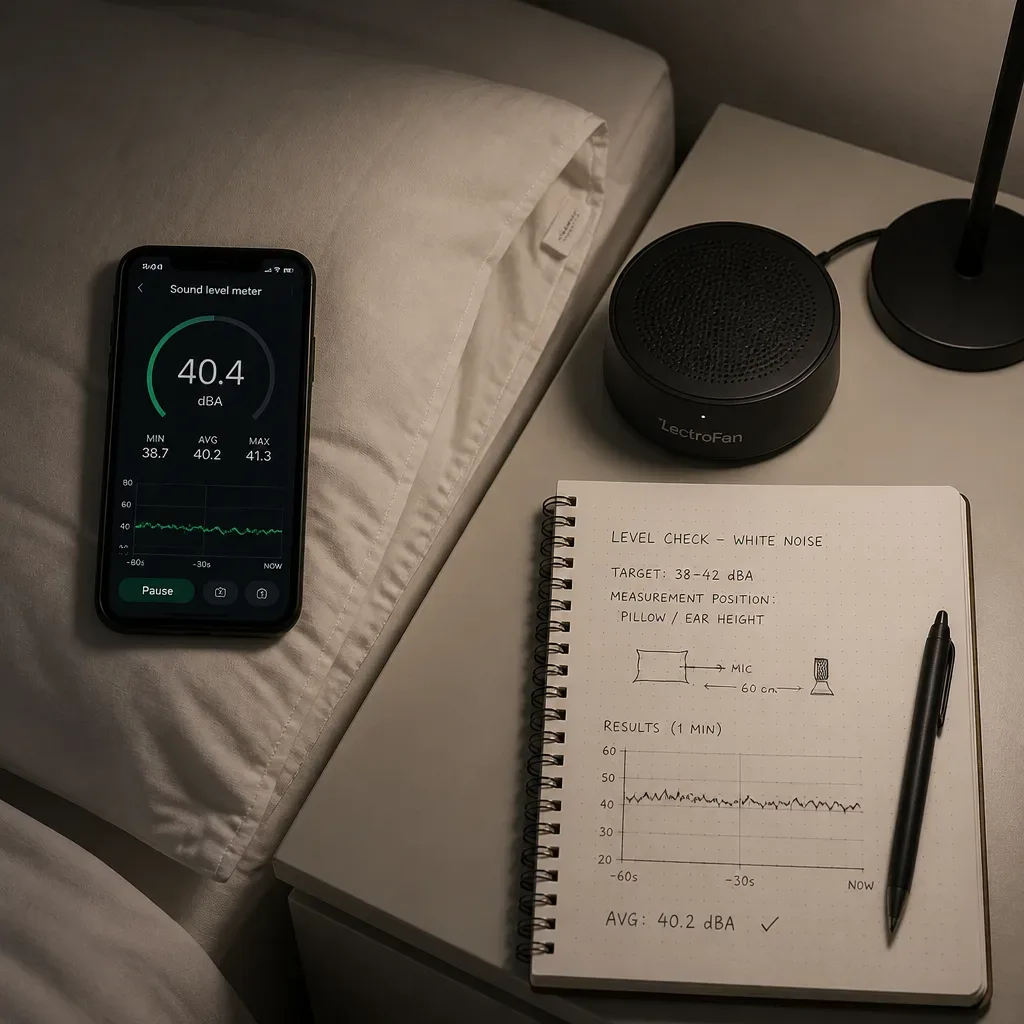
Set the noise as low as possible, usually around 35 to 45 dBA at the pillow, and only raise it if the snore still pulls attention.
Volume is the part people overdo. The World Health Organization’s 2009 night noise guidelines identified 40 dB outside bedrooms as a guideline value for protecting public health, and higher chronic exposure was linked with more sleep disturbance. Indoors, a quiet bedroom often measures around 25 to 35 dBA. A soft masking sound at the pillow does not need to sound like a shower.
NIOSH uses 85 dBA over 8 hours as an occupational exposure limit, with risk rising as level and duration increase. Sleep audio should sit far below that. I keep routine bedroom masking below 50 dBA when possible, and closer to 40 dBA for long play. Children’s ears deserve more caution; lower the level, increase distance, and avoid placing any speaker beside a child’s head.
Phone sound meter apps are not laboratory instruments, but they can keep you honest. Many are within several dB when used carefully, which is good enough for a bedroom adjustment. Measure at the pillow, not next to the speaker. A 6 dB change is clearly audible to most listeners, and a 10 dB increase is often heard as roughly twice as loud.
A simple rule works well: set the Dream-Self voice first, then bring in the noise underneath. If you reverse the order, you may build the room around hiss and then push the voice too high. Speech should feel close, with the masking bed behind it.
Use this order:
- Play the voice audio at a comfortable level.
- Start white or pink noise at zero.
- Raise the noise until the snore softens.
- Stop before consonants blur.
- Wait 2 minutes, then adjust down if possible.
If the voice has to fight, the room is too loud.
How do you set up white noise without covering Dream-Self audio?
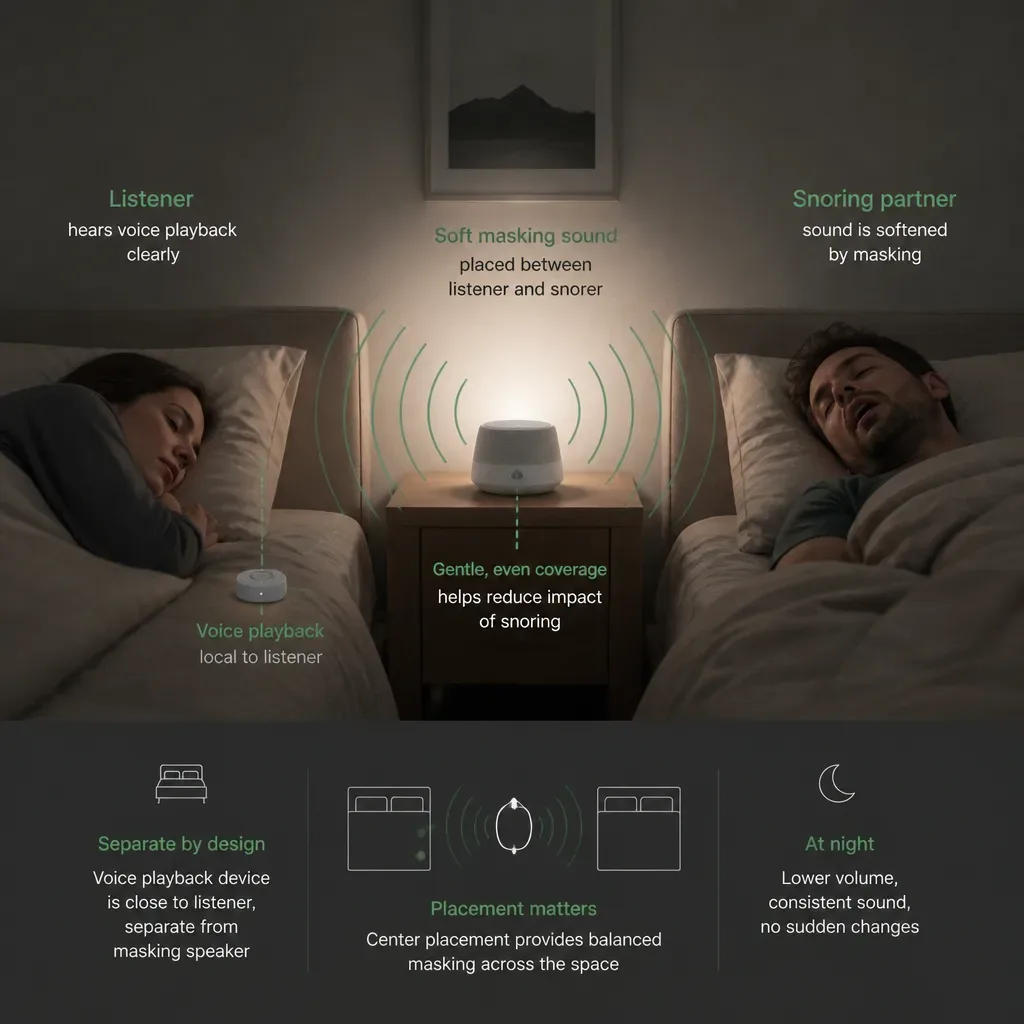
Put the masking sound in the room, keep the voice close to the listener, and separate the two sources when you can.
The cleanest setup uses two layers. The first layer is the voice you intend to hear. For the AYA Method, that means the daily audio manifestation practice in which you listen to a short personalized recording, your Dream-Self Moment, narrated from the version of you who has already manifested the life you intend. Listening is the practice. Repetition is the work. The audio is the method.
The second layer is the mask. It should sit in the room like a fan, not in the center of the voice. If both tracks play from the same tiny phone speaker, they compete for the same limited range. A small speaker can distort when playing full-band noise and spoken audio together, especially above 60 percent volume. Distortion adds sharpness, and sharpness wakes the ear.
If possible, use one device near you for the Dream-Self audio and a separate speaker for the noise. Put the noise between you and the snorer, often on a bedside table, chair, or shelf. A distance change of 1 meter can alter the perceived level by several decibels in a real room, depending on reflections and soft surfaces.
Try these placements before raising volume:
- Noise source halfway between the snore and your pillow.
- Speaker pointed slightly away from your ear, toward a wall or curtain.
- Voice device closer to your side, at low to moderate level.
- Soft furnishings in the path of the snore, such as a curtain or fabric headboard.
- No speaker directly under a pillow, where heat and muffling can cause trouble.
Headphones complicate the setup. They make the voice clear, but they may become uncomfortable during sleep, and sealed earbuds can make internal body sounds louder. If you use sleep headbands or pillow speakers, keep levels lower than you would in open air. A voice delivered close to the ear often needs less volume than a room speaker by 10 dB or more.
A room should have depth. Voice close. Mask farther away. Snore softened before it reaches you.
What routine works tonight, step by step?
Use a 12-minute setup before lights out, then change only one variable after the first night.
A quick routine matters because tired people make loud choices. You want a repeatable setup that can survive 2 a.m. The aim is not to engineer a studio. It is to create a stable sound floor, keep the voice understandable, and remove the need to keep checking the room.
Here is the 12-minute version:
- Minute 0 to 2: identify the snore type. Raspy or nasal snoring often needs white or pink noise. Low chesty snoring may tolerate pink or brown noise better. If there are gasps or breathing pauses, skip the audio experiment as a solution and consider medical advice.
- Minute 2 to 4: choose the masking bed. Start with white noise if the snore has sharp edges. Switch to pink noise if the hiss bothers you after 60 seconds.
- Minute 4 to 6: set the voice. Play your Dream-Self audio at the lowest level that stays clear from your pillow.
- Minute 6 to 8: raise the noise. Bring the mask up slowly until the snore becomes less distinct. Don’t cover the voice.
- Minute 8 to 10: move the speaker. Shift it in 30 cm steps. Placement often fixes what volume cannot.
- Minute 10 to 12: choose duration. Use 45 to 90 minutes if you only need help falling asleep. Use all night only if the snore repeats through the night.
A typical sleep cycle lasts about 90 minutes, though real cycles vary from roughly 70 to 110 minutes. That is why a 90-minute timer is practical. It covers sleep onset and the first cycle without forcing sound through the entire night. If the snorer wakes you at 4 a.m., an all-night low setting may be better than restarting a loud track half-awake.
For the sound itself, avoid loops with obvious seams. After 15 years recording rain, I still listen for the repeat point first. The ear distrusts a loop that never breathes. A small shift in rain, fan tone, or broadband noise can feel more natural than a perfect 8-second repeat.
If you prefer a natural layer, use rain with a steady midrange and few isolated drops. Metal roofs can excite the ear because transients are bright. Canvas, leaves, and distant surf tend to settle more gently. Natural sound is useful only when it behaves steadily enough to mask.
When is snoring a health signal, not just a sound problem?
Treat snoring as a medical signal when it includes breathing pauses, gasping, choking, or strong daytime sleepiness.
White noise can protect a bed partner’s sleep, but it cannot open an airway. The American Academy of Sleep Medicine has estimated that obstructive sleep apnea affects about 30 million adults in the United States, with many cases undiagnosed. Loud chronic snoring, witnessed pauses, morning headaches, and high blood pressure are common reasons to talk with a clinician.
This matters because sound masking can make a room more bearable while leaving the cause untouched. If the snoring person stops breathing for 10 seconds or more, repeatedly, that is not just an acoustic problem. If you hear choking or gasping, don’t solve it only by adding noise. Record a short sample if appropriate, note the pattern, and bring it to a qualified professional.
The bed partner’s sleep also matters. A 2003 study in Mayo Clinic Proceedings found that spouses of people with sleep apnea had improved sleep quality after the apnea was treated with CPAP; the study was small, but the pattern will sound familiar to anyone sleeping beside heavy snoring. Reducing the source can help both people more than masking alone.
There are also cases where white noise is the wrong first tool. Tinnitus, hyperacusis, chronic insomnia, and trauma-linked sound sensitivity deserve care from a clinician or qualified sleep professional. Gentle sound may still be part of a plan, but the plan should not come only from a web article.
Use this plain distinction:
- Occasional snoring after alcohol, congestion, or sleeping on the back: masking may help tonight.
- Nightly loud snoring with no other symptoms: masking can help, but encourage a checkup.
- Snoring with gasping, pauses, or daytime sleepiness: seek medical guidance.
- Snoring plus chest pain, severe breathlessness, or confusion: treat it as urgent.
A mask can protect your sleep, but it should not hide a warning sign.
What should you adjust after the first night?
Adjust one setting at a time: noise color, level, placement, duration, or voice distance.
Morning memory is noisy, so keep notes brief. Use a 0 to 5 scale. How clear was the voice? How intrusive was the snore? How rested do you feel after waking? Three numbers tell you more than a paragraph written with one eye open. Over 3 nights, patterns show up.
Start with volume only if the snore was still distinct. Raise the noise by about 2 to 3 dB, not a big jump. If the voice became blurry, lower the noise or move the voice closer. If the hiss irritated you, change color from white to pink before changing level. If the room felt heavy or boomy, move from brown toward pink.
Placement is often the quiet fix. Move the masking speaker 30 to 60 cm at a time. Corners increase low frequencies. Hard walls reflect brightness. Curtains and bedding absorb some high-frequency sound. A speaker on a wooden bedside table can sound sharper than the same speaker on a folded towel. None of this needs special gear; it needs one patient minute.
For Dream-Self audio, clarity beats volume. If the voice is important, use a better playback source rather than turning everything up. A small speaker aimed toward your pillow at 35 dBA can be clearer than a phone across the room at 45 dBA. If you use a timer, try 45 minutes on the first night, 90 minutes on the second, and all night only if awakenings continue.
A simple log can look like this:
| Night | Noise | Pillow level | Voice clarity | Snore intrusions | Change tomorrow |
|---|---|---|---|---|---|
| 1 | White | 41 dBA | 3/5 | 4/5 | Try pink |
| 2 | Pink | 40 dBA | 4/5 | 2/5 | Keep placement |
| 3 | Pink | 38 dBA | 5/5 | 2/5 | Lower timer to 45 min |
If you want one practical test before bed, compare white and pink noise using the White noise generator + guide, then listen to a speech sample over each one. If you can understand every word without effort, the layer is usable. If the voice feels like it is behind fog, the mask is too loud or too bright.
The best setup is not dramatic. It is measured, repeatable, and quiet enough that you forget the equipment is there.
Leave the room just loud enough to stop flinching.