noise colors
White Noise All Night or Only During Dream-Self Audio?
Should you use white noise all night or only during Dream-Self audio? Learn when masking helps sleep, when silence is better, and safe volume limits.
White noise all night can help if it masks unpredictable sound, but it isn’t required for everyone. Use it through the whole night when the room is noisy, use it only during Dream-Self audio when the room is already quiet, and keep the level conservative: about 40 to 50 dB at the pillow.
Should you play white noise all night or only while the voice plays?
The right choice is the shortest, quietest playback that keeps sleep steady and the spoken audio clear.
White noise is a masking tool, not a sleep medicine. It works by adding a steady broadband signal so sudden sounds stand out less. A door click, truck brake, or upstairs footstep has less contrast against a stable sound bed. The mechanism is simple: less contrast often means fewer micro-awakenings. In sleep labs, even small awakenings can fragment sleep architecture, and the American Academy of Sleep Medicine scores arousals in events as short as 3 seconds.
If your main disturbance is outside noise from 11 p.m. to 6 a.m., white noise all night may be useful. If your room is already quiet and you’re using a short voice recording before sleep, all-night playback may be more than you need. The ear adapts, but it also deserves rest from unnecessary level. A sound that helps on a loud street can be clutter in a quiet room.
The practical split is plain:
| Situation | Better default | Why |
|---|---|---|
| Quiet room, short Dream-Self audio | Only during the audio, or not at all | The voice stays clear, and the room needs little masking |
| Traffic, neighbors, HVAC cycling | White noise all night | A steady mask reduces contrast for irregular sound |
| Sensitive to hiss | Try pink or brown noise | Lower spectral tilt can feel less sharp |
| Partner needs silence | Use pillow speaker or no noise | Shared sleep is part of the system |
A good sleep sound disappears into the room; if you keep noticing it, it’s too loud or too bright.
What does white noise actually do for sleep?
White noise masks changes in the room by filling the audible spectrum with a steady reference signal.
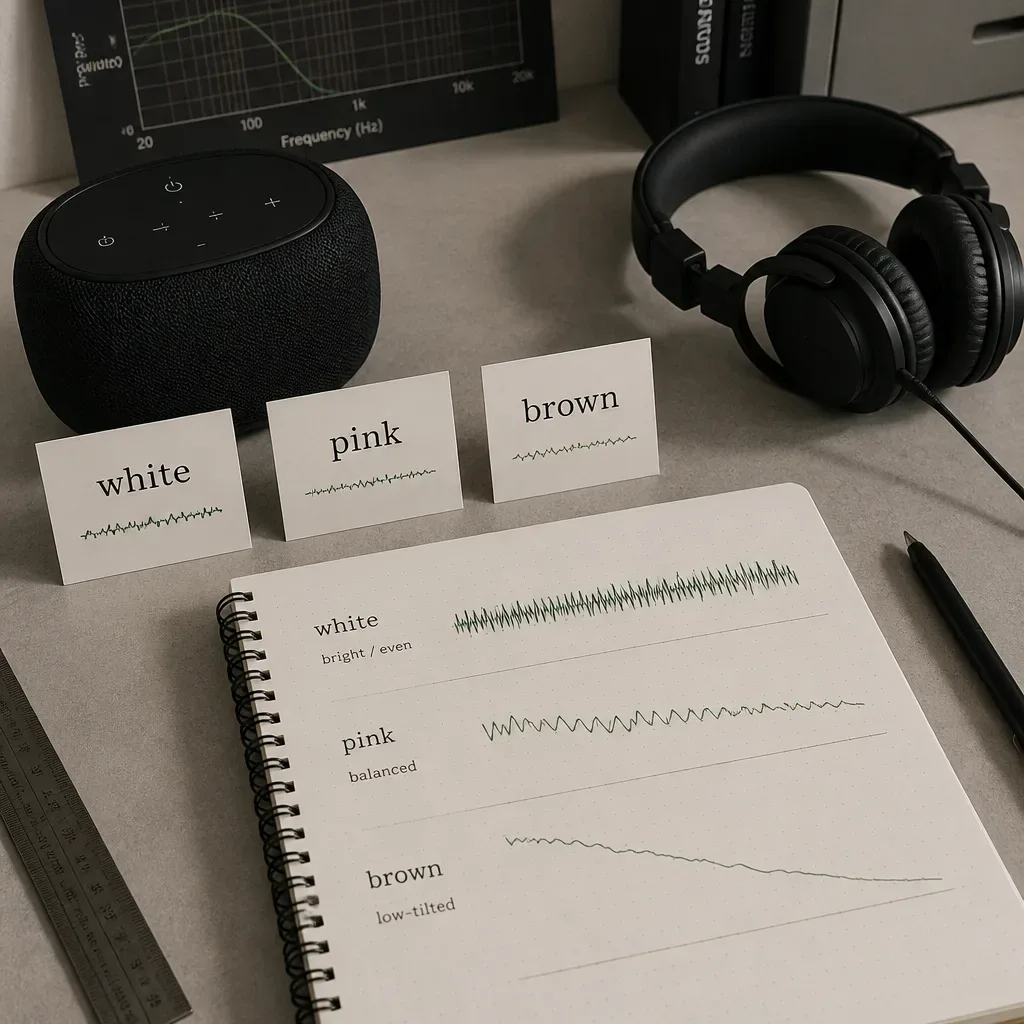
Technically, white noise has equal sound power per hertz across the audible band, commonly described across roughly 20 Hz to 20,000 Hz for young healthy hearing. Because humans hear logarithmically, that can make white noise seem bright or hissy. Pink noise reduces level by about 3 dB per octave, and brown noise drops more steeply, often around 6 dB per octave. That is why brown noise feels lower, even when measured at the same dB level.
The evidence for white noise and sleep is mixed, and that matters. A 2021 systematic review in Sleep Medicine Reviews looked at continuous noise interventions for sleep and found low-quality evidence overall, with studies varying in sound type, timing, and measurement. Some small hospital studies have reported better sleep scores when white noise masked ward sound, but many had fewer than 100 participants and used subjective ratings. That doesn’t make the tool useless. It means we should keep the claim modest.
In practice, white noise helps most when the problem is acoustic: intermittent sound, not racing thoughts, pain, apnea, or caffeine at 4 p.m. If snoring pauses, gasping, chronic insomnia, or tinnitus are part of the picture, talk with a qualified clinician. Masking can comfort tinnitus for some people, but it is not a diagnosis or a treatment plan.
You can test the mechanism tonight with the White noise generator + guide. Press play below the guide, set the level barely above the room, then turn it off for 10 seconds. If traffic or building noise jumps forward when it stops, masking is doing measurable work.
How loud should white noise be overnight?
Set white noise low enough that you could speak over it softly without raising your voice.
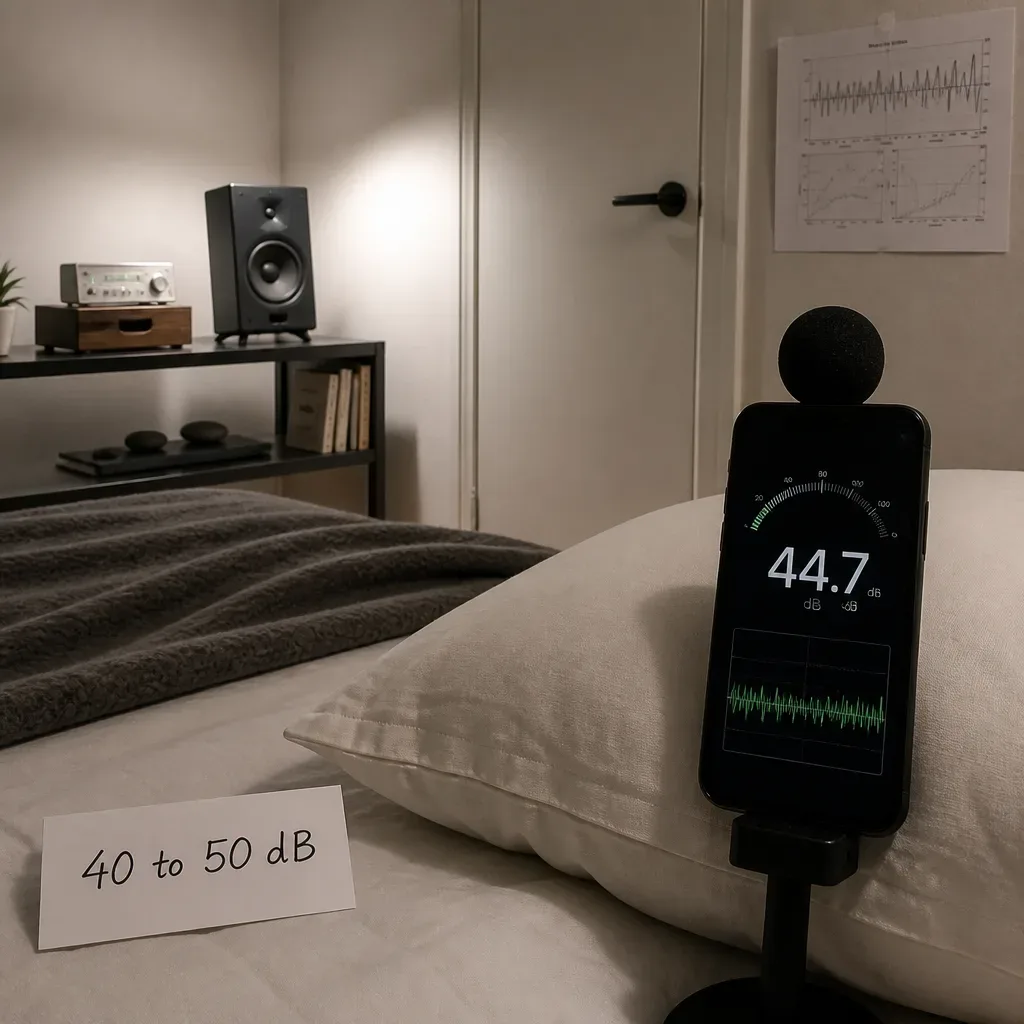
For most adults, a conservative target is about 40 to 50 dB at the pillow. That is not the number on the device. It is the sound level where your ear rests. Phone sound-meter apps are not laboratory instruments, but they are useful for rough checks within several dB when used consistently. Measure where your head will be, not next to the speaker.
The World Health Organization’s 2009 night-noise guidelines identify 40 dB Lnight outside as a level below which substantial health effects are not expected for the general population, while 55 dB is associated with increasing concern. Bedrooms are different from outdoor measurements, and a masking signal is not the same as traffic. Still, the guidance gives us a sober reference: sleep sound should be quiet.
Use this order before raising the level:
- Move the speaker 1 to 2 meters from the pillow.
- Point it away from your head and toward the noisy wall or door.
- Lower treble if your device has tone controls.
- Try pink or brown noise if white noise feels sharp.
- Raise volume only until the disturbing sound softens, not until it disappears.
Children need extra caution. A 2014 study in Pediatrics measured infant sleep machines and found some devices could exceed recommended nursery noise limits at close distance. For a child’s room, keep the device far from the crib, use the lowest useful setting, and avoid treating sound as a way to overpower the room.
Volume is a dose; lower is not just gentler, it is more accurate.
Should white noise sit under Dream-Self audio?
White noise can sit under Dream-Self audio only when the spoken words remain easy to hear.
The AYA Method is a daily audio manifestation practice. Each day you listen to a short personalized recording, your Dream-Self Moment, narrated from the version of you who has already manifested the life you intend. Listening is the practice. Repetition is the work. The audio is the method.
That definition sets the audio priority. The voice is not decoration over a noise bed. If white noise makes consonants fuzzy, especially sounds like s, f, t, and k, it is interfering. Speech intelligibility depends heavily on mid and high frequencies, roughly 1,000 to 4,000 Hz, and white noise occupies that same region. A brighter mask can blur a quiet voice faster than brown noise will.
The best setup is usually one of these:
- Play the Dream-Self audio alone in a quiet room.
- Use low white noise before the voice starts, then pause it.
- Use a softer pink or brown bed under the voice if silence feels too bare.
- Restart all-night masking after the recording ends, using a timer or automation.
For most people, the recording is short enough that silence is workable. If you live near sirens, late trains, or shared walls, a low mask may make it easier to stay with the voice. Keep the voice about 6 to 10 dB louder than the noise if you can estimate it. If you can’t estimate, use the simpler test: every word should be understandable without effort.
A practice built on listening should not make listening harder.
When is all-night playback the better option?
All-night playback is better when noise is irregular, repeated, and outside your control.
The sleeping brain keeps monitoring sound. That is useful biology; parents hear infants, and most people wake to alarms. But the same monitoring can punish a room with random peaks. A steady fan-like signal can reduce the contrast between baseline room tone and sudden events. In field studies of environmental noise, aircraft and road traffic have been linked with awakenings and changes in sleep depth, with the European Environment Agency estimating in 2020 that environmental noise contributes to millions of cases of sleep disturbance across Europe each year.
Choose white noise all night when the disturbance lasts all night: traffic, elevators, hallway doors, plumbing, a partner returning late, or animals outside. Choose a timer when the disturbance is temporary: a nearby restaurant closing at midnight, neighbors active for an hour, or your own settling period. Many machines offer 30, 60, and 90 minute timers. The 90 minute option roughly matches one adult sleep cycle, though cycles vary from about 70 to 110 minutes.
There is also a conditioning issue. If you use white noise only on difficult nights, it stays a tool. If you use it nightly for months, it may become a strong cue. That is not automatically bad. Bedtime cues are common; darkness and a familiar pillow are cues too. The question is whether the cue travels. If you sleep poorly in hotels without your sound, download an offline file or use a small speaker at the same low level.
The goal is not silence at any cost. The goal is fewer meaningful changes reaching the sleeping brain.
Would pink noise, brown noise, binaural beats, or Solfeggio tones work better?
A different sound may work better if it matches the noise you need to mask and the way your ear tolerates the spectrum.
White noise is broad and bright. Pink noise is more balanced to many ears because each octave carries equal sound power, which means high frequencies are less dominant. Brown noise carries still more low-frequency weight and less hiss. For masking low rumbles, brown can be more comfortable. For speech leaking through a wall, white or pink may cover consonants better, though speech masking can require careful level and may disturb a partner.
Some readers ask about binaural beats. A binaural beat is an auditory illusion created when each ear receives a slightly different tone, such as 200 Hz in one ear and 206 Hz in the other, producing a perceived 6 Hz beat. Research is mixed. A 2019 meta-analysis in Psychological Research found small effects across cognition and anxiety outcomes, but protocols varied widely. For sleep, treat it as an optional focus sound, not a guaranteed sedative. Use headphones only if they are comfortable and safe for your sleep position. See the Binaural beats generator + guide for the mechanism and cautious use.
Solfeggio frequencies belong to a different category: tradition and listening preference. Frequencies like 396 Hz, 528 Hz, and 852 Hz are often described in spiritual or musical lore. The evidence does not support precise medical claims for those numbers, but many people like the tones as gentle listening objects. Respect the preference, label the tradition, and keep claims measured. The Solfeggio frequencies guide separates the lore from what can be measured.
Here is the simple comparison:
| Sound | Best use | Watch for |
|---|---|---|
| White noise | Broad masking, speech edges, traffic hiss | Brightness and ear fatigue |
| Pink noise | Softer broadband sleep sound | May mask less sharply than white |
| Brown noise | Low hums, thumps, sensitive ears | May not cover higher sounds |
| Binaural beats | Focused pre-sleep listening | Requires stereo separation |
| Solfeggio tones | Ritual, preference, gentle tone | Claims often exceed evidence |
The label matters less than the measured result: do you wake less, and do your ears feel fine in the morning?
How do you decide what to do tonight?
Use a 3-night test: one night with no noise, one with white noise during the recording only, and one with quiet all-night masking.
Keep the test plain. Change one variable at a time, and write down the result within 10 minutes of waking. Consumer sleep trackers can estimate sleep timing, but they are less reliable for sleep stages; validation studies often show better accuracy for sleep versus wake than for REM or deep sleep classification. Your notes still matter. Number of awakenings, time to settle, and morning ear comfort are useful signals.
Use this small log:
| Night | Sound plan | Volume | Awakenings | Morning note |
|---|---|---|---|---|
| 1 | No noise | 0 dB added | ||
| 2 | Noise only during audio | 40 to 45 dB | ||
| 3 | Noise all night | 40 to 50 dB |
If all three nights are similar, choose the simplest setup. If all-night masking clearly reduces awakenings, keep it low and consider pink or brown if white feels sharp. If the audio-only night works, use that. If silence wins, trust it. A nervous system is an instrument, but it is not improved by turning every knob.
For a practical wind-down, start with the White noise generator + guide at low level for 5 minutes, then play your Dream-Self audio with the mask paused or lowered. If you prefer a lower spectrum, compare it with our brown and pink noise notes inside the white-noise guide. If you want a tonal option before speech, test the Binaural beats generator + guide on a separate night so you know what changed.
The quietest effective sound is usually the most honest one.
Let the room tell you how little it needs.