noise colors
Brown Noise vs Pink Noise Under Dream-Self Audio
Brown noise vs pink noise for Dream-Self audio: hear the difference, set safe volume, and choose the steadier bed for nightly listening.
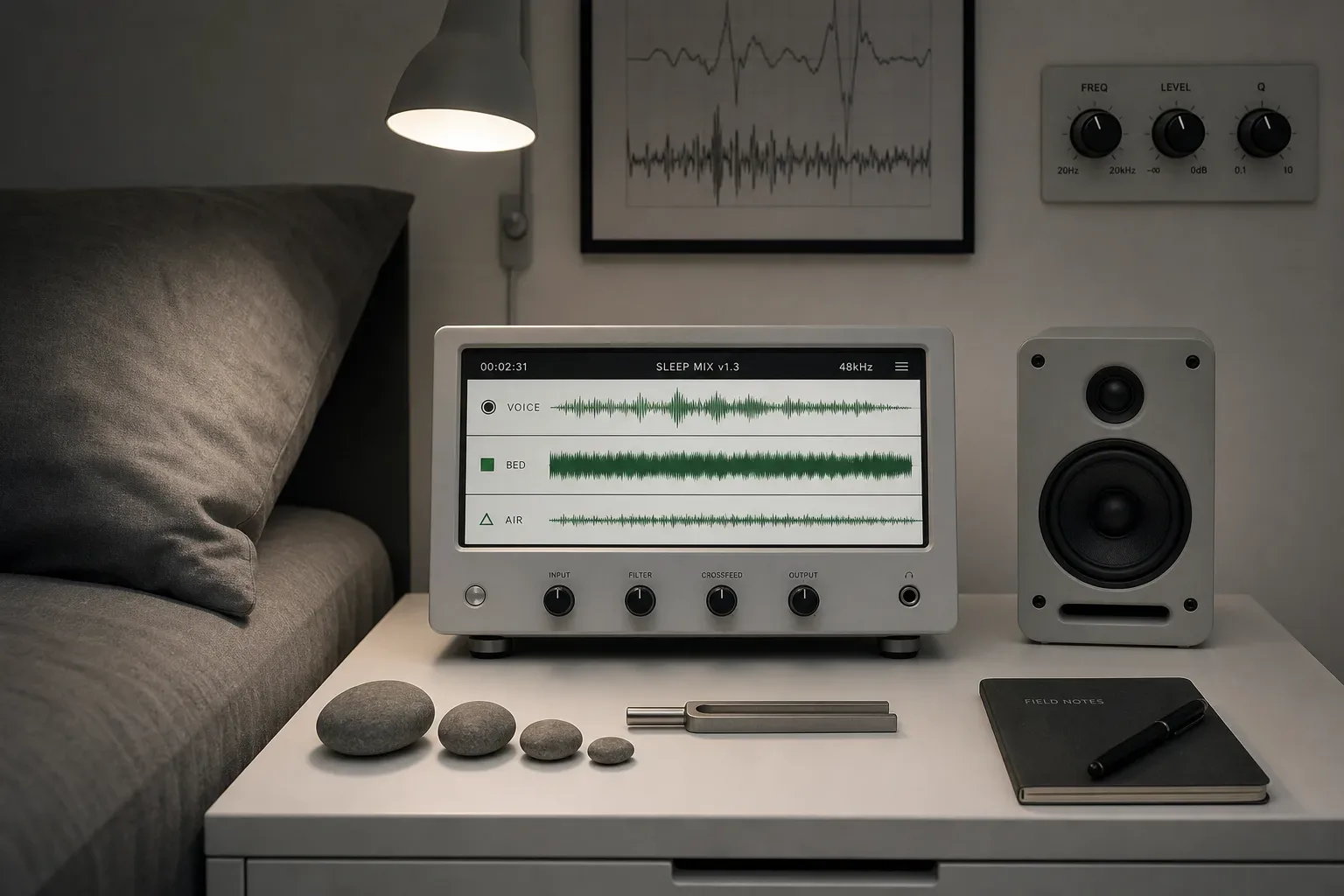
For Dream-Self audio, pink noise is the better default bed because it masks evenly without crowding the spoken voice. Brown noise can work when you need more low-end cover, but it should sit quieter. Choose the noise that disappears first while the narration stays plain, close, and easy to hear.
What is the actual difference between brown noise and pink noise?
Brown noise has a steeper low-frequency tilt than pink noise, so it sounds deeper, rounder, and less hissy.
Noise colors describe how acoustic energy is distributed across the frequency spectrum. White noise has equal energy per hertz, which gives it a bright edge. Pink noise drops by about 3 dB per octave, so each octave carries roughly equal perceived weight. Brown noise, also called Brownian or red noise, drops by about 6 dB per octave, which shifts more weight toward the low end. Human hearing usually spans about 20 Hz to 20,000 Hz, but sleep sounds tend to matter most below about 8,000 Hz because that is where hiss, HVAC noise, traffic, and speech cues compete.
That tilt changes the feel. Pink noise is a balanced shhh with less top-end bite than white noise. Brown noise is a low hum, closer to distant surf, an air handler, or heavy rain behind a wall. Brown noise is not deeper sleep. It is deeper sound, with less high-frequency edge and more low-frequency mass.
Under spoken audio, the spectrum matters because the human voice occupies a wide band. Fundamental pitch often sits near 85 to 255 Hz for adult voices, while consonant clarity can extend from about 2,000 to 5,000 Hz. A noise bed that covers too much of either area can make the voice less distinct. If you want the basic reference point before comparing colors, the White noise generator + guide is useful because white noise makes the high-frequency contrast obvious.
| Noise color | Approximate slope | What you hear | Risk under voice |
|---|---|---|---|
| White noise | 0 dB per octave | Bright hiss | Masks consonants quickly |
| Pink noise | -3 dB per octave | Even, soft shhh | Usually low to moderate |
| Brown noise | -6 dB per octave | Low, steady hum | Can blur low voices |
The best masking sound is the one you stop noticing first.
Which noise sits better under Dream-Self audio?
Pink noise usually sits better under Dream-Self audio because it leaves more room for the voice while still masking the room.
Dream-Self audio asks the ear to follow meaning, not just tone. You are listening to a spoken recording, so clarity matters more than atmosphere. A bed that feels pleasant for sleep can still be wrong if it makes the narration work harder. In practice, pink noise gives a stable floor without putting too much pressure on the low mids, where many recorded voices carry body.
Brown noise can be better when the outside problem is low. Trucks, distant bass, elevator machinery, and some HVAC systems often live below 250 Hz. A pink bed may not cover those interruptions enough unless it is raised, and raising it can make the whole mix busier. Brown noise can mask those intrusions at a lower perceived brightness. The tradeoff is that it may sit on top of a baritone voice or a warm narration chain.
A simple test is to set the voice first. Keep the Dream-Self narration clear at a level you could understand with your eyes closed and no effort. Then bring the noise up from silence until the room becomes less distinct. If you notice the noise as an object, it is too loud. If you miss words, it is too loud or the wrong color. A bed that steals attention from the voice has stopped being support.
For spoken audio, I tend to start with these levels measured at the pillow with a phone meter as a rough guide, not a lab instrument:
- Set narration to a soft but clear level, often around 45 to 55 dBA.
- Add pink noise around 35 to 45 dBA.
- If low outside noise remains, test brown noise around 32 to 42 dBA.
- Keep the noise at least 5 dB below the voice when possible.
- Recheck after 10 minutes, because the ear adapts.
Phone sound meters can be off by several decibels, but they are still better than guessing. The National Institute for Occupational Safety and Health uses 85 dBA over 8 hours as an occupational exposure limit, and sleep listening should sit far below that. For a bedroom, conservative is correct.
What does the research say about noise colors and sleep?
The evidence favors careful masking and timing more than any claim that one noise color is universally best.
Pink noise has more sleep research than brown noise, but the evidence is still modest. A 2012 paper in the Journal of Theoretical Biology modeled pink noise stimulation and reported changes in brain activity patterns during sleep. A 2017 study in Frontiers in Human Neuroscience by Ngo and colleagues used precisely timed auditory stimulation, often discussed with pink-noise-like pulses, and found improved slow-wave activity and memory measures in older adults. That study had 13 participants, so it is interesting, not final.
Brown noise has less direct clinical sleep research. Most claims around brown noise are user reports, acoustic reasoning, and small experimental contexts rather than large randomized trials. That does not make brown noise useless. It means the honest claim is narrow: brown noise may mask certain low-frequency interruptions and may feel less sharp to some nervous systems. Yours gets a vote, but it does not get to overrule safe volume.
There is stronger general support for the idea that environmental noise affects sleep. The World Health Organization’s 2018 Environmental Noise Guidelines report links nighttime noise exposure with sleep disturbance and recommends reducing harmful night noise where possible. Laboratory sleep studies often show that sudden changes in sound are more disruptive than steady sound at the same average level. That is why a constant bed can help: it reduces contrast.
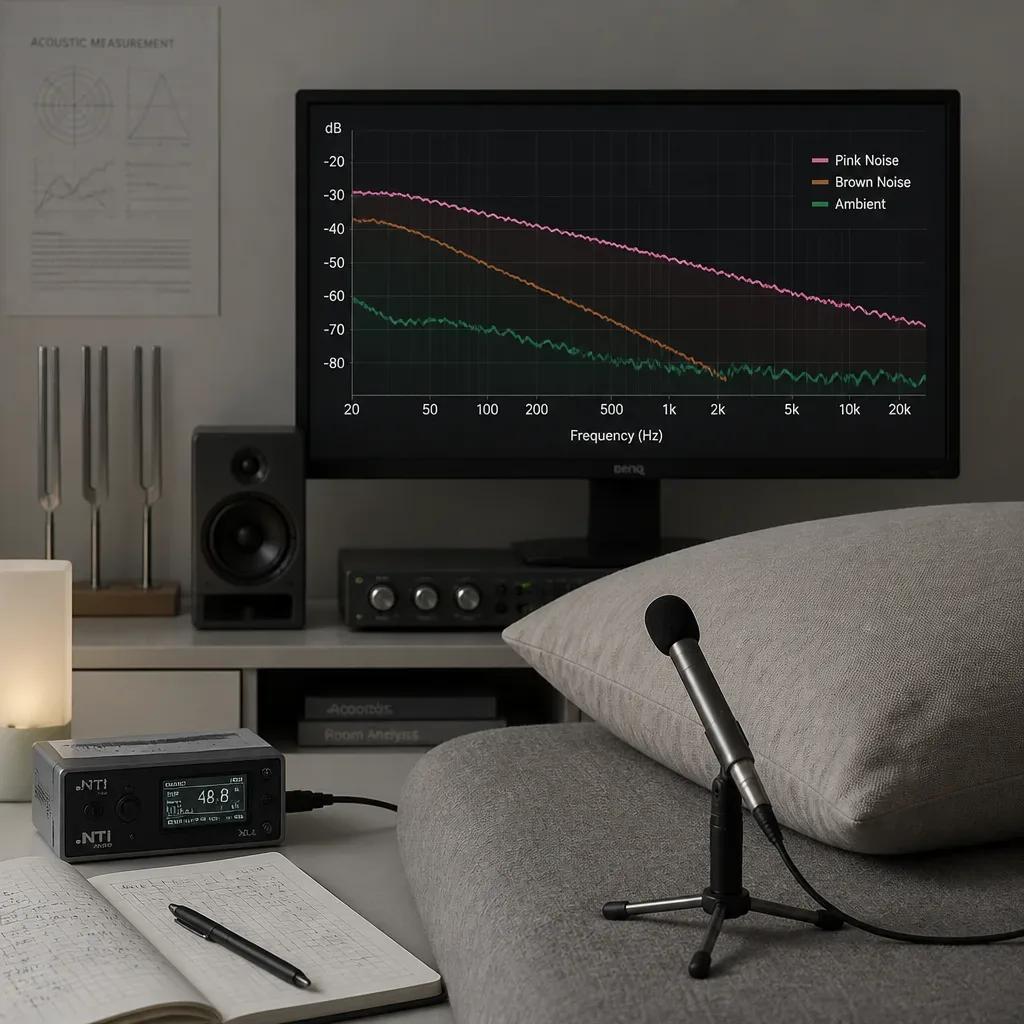
This is also why loop design matters. An eight-second file repeated all night can become a signal. The brain detects the seam, predicts it, and sometimes wakes around it. In app work, I prefer beds of several minutes with slow variation and crossfades below the threshold of attention. A loop that announces itself has stopped being background.
If chronic insomnia, sleep apnea, tinnitus distress, or panic around sleep is present, sound is not the whole answer. Use a clinician, audiologist, or sleep specialist, especially if symptoms last more than a few weeks.
How should you mix noise under spoken audio tonight?
Set the voice first, then add the quietest noise bed that masks interruptions without making the words less clear.
The order matters. People often press play on a noise generator, enjoy the cover, and then raise the voice to compete with it. That creates a louder system than necessary. Start with the spoken track alone. Your Dream-Self narration should feel near but not sharp, as if someone calm is speaking from the bedside rather than across the room. Only then add the bed.
Use speakers if you can. A small speaker 1 to 2 meters from the bed lets the sound mix with the room before it reaches you. Headphones and sleep buds can be useful, but they put the source closer to the eardrum and make level harder to judge. The World Health Organization has warned that unsafe personal listening is a global risk, estimating in 2015 that over 1 billion young people could be at risk from loud recreational listening. Sleep audio should never feel loud enough to prove a point.
Here is the plain setup I would use tonight:
- Put the phone or speaker off the mattress to avoid vibration noise.
- Turn off loudness enhancement, spatial audio, and bass boost.
- Start with pink noise if you do not know your preference.
- Switch to brown noise only if high-frequency hiss bothers you or low outside rumble remains.
- Use a 20 to 45 minute timer if you only need help settling.
- For all-night playback, choose a long file or generator rather than a short obvious loop.
Press play below if you are using an on-site generator and listen for the difference in consonants. With pink noise, words like sleep, self, and steady should keep their edges. With brown noise, words may feel warmer, but the vowels can thicken. If the narration becomes syrupy, lower the brown bed by 3 dB and test again.
Volume is a setting, not a virtue.
When should you choose brown, pink, or another sound?
Choose pink for the most neutral voice support, brown for low rumble and low hiss tolerance, and other tools only when they solve a specific problem.
A comparison is more useful than a rule. The room, the voice, and your ears form the system. One listener may sleep beside a window air conditioner at 48 dBA. Another may have a quiet room at 28 dBA but a partner who turns pages. The first listener may need brown noise. The second may need soft pink noise or no bed at all.
| Situation | First choice | Why it tends to work | Watch for |
|---|---|---|---|
| Dream-Self voice in a fairly quiet room | Pink noise | Masks small sounds evenly | Too much hiss if raised |
| Low traffic, distant bass, HVAC rumble | Brown noise | More low-frequency cover | Muddy voice body |
| Sharp hallway voices or dishes | Pink or white at low level | More high-frequency masking | Consonant masking |
| Ear fatigue from hiss | Brown noise | Softer top end | Excess low pressure |
| Meditation before spoken audio | Binaural or tonal tools | More focused listening object | Use with caution overnight |
If you want to compare tools outside noise color, the Binaural beats generator + guide explains how two slightly different tones can create a perceived beat in headphones. The illusion is real; the claims around it are mixed. Binaural beats are not a better noise bed under narration because they ask for attention and require headphones. They are a separate tool.
The Solfeggio frequencies guide covers another category: traditional frequency lore around tones such as 396 Hz, 528 Hz, and 852 Hz. Some listeners like the ritual and the pitch center. Evidence for specific outcomes is limited, so I would not place a pure tone directly under Dream-Self narration unless it is very quiet. A tone can draw the ear away from words faster than a broad noise bed.
The White noise generator + guide remains useful when the room has sharp, high sounds. White noise is the blunt tool. Pink is the balanced tool. Brown is the low tool. Pick the smallest tool that does the job.
What mistakes make either noise distracting?
The most common mistake is using the noise as a foreground sound instead of a floor.
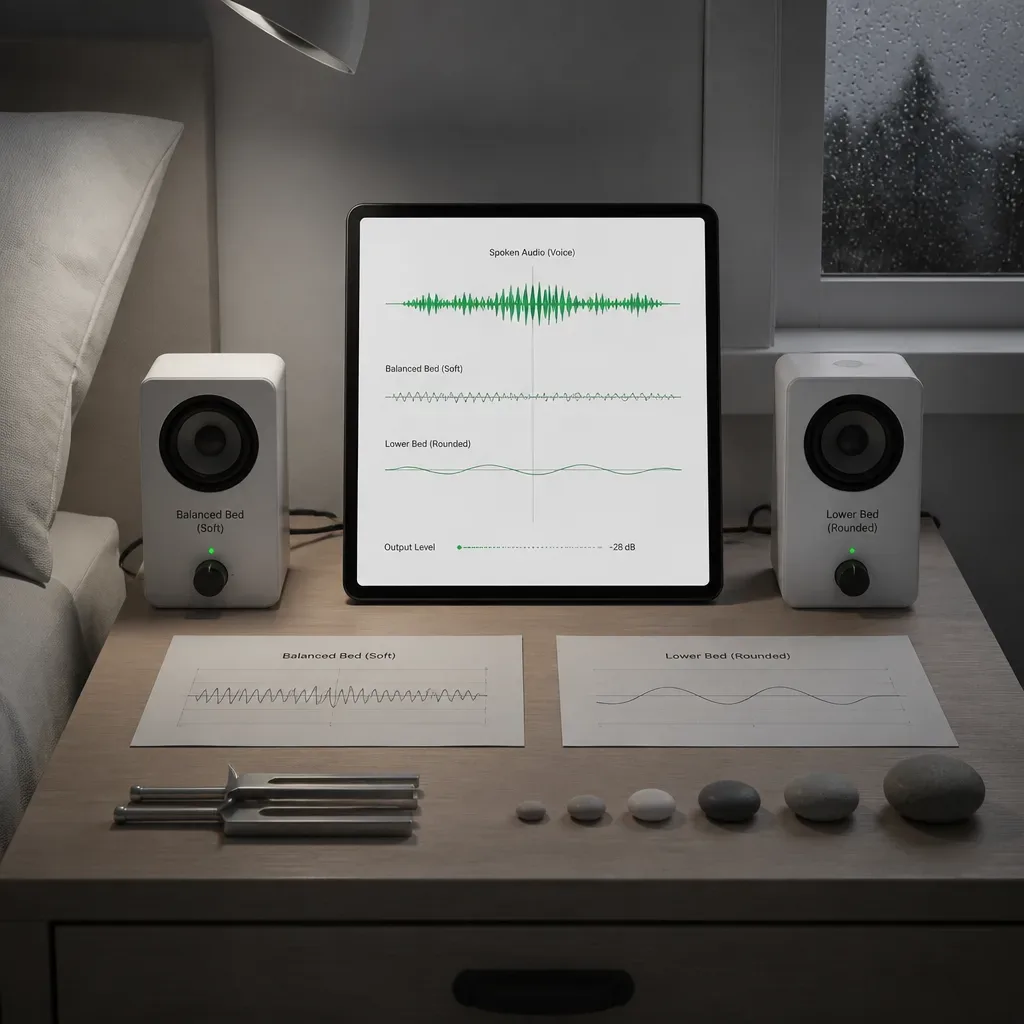
A noise bed should reduce contrast. It should not become the track. If you find yourself judging the tone every few seconds, the level is too high, the spectrum is wrong, or the loop is poor. In sleep audio production, a good bed often sounds slightly unimpressive when soloed. It is built to serve what sits above it. That is also why showroom demos can mislead: a bold low end impresses in 20 seconds and irritates by minute 20.
Compression is another problem. Some apps and Bluetooth speakers add automatic gain control, bass enhancement, or dynamic processing. These can make a steady file breathe in level. A 1 or 2 dB swell may not matter while awake, but during light sleep it can read as change. Sleep is sensitive to change. Many adults cycle through sleep stages about every 90 minutes, with lighter sleep near the edges of those cycles. A bad swell or loop point often finds those edges.
Watch for these faults:
- The voice sounds farther away after adding the bed.
- S, F, and T sounds lose clarity.
- The bed has a repeating wave, thump, chirp, or seam.
- The speaker rattles below about 120 Hz.
- The phone touches a hard surface and buzzes.
- The file fades out too quickly and makes the room jump back.
Brown noise is especially likely to expose small speakers. A phone driver cannot reproduce deep low frequencies cleanly, so it may distort or pump instead. Pink noise is more forgiving on small speakers because it asks less from the lowest band. If you hear vibration, do not raise the volume. Move the speaker, reduce bass, or use pink.
Good background sound is humble engineering. You know it works because there is less to notice.
How does this fit with the AYA Method?
Use brown or pink noise to prepare the room, then let the Dream-Self audio remain the method.
The AYA Method is a daily audio manifestation practice. Each day you listen to a short personalized recording, your Dream-Self Moment, narrated from the version of you who has already manifested the life you intend. Listening is the practice. Repetition is the work. The audio is the method.
That definition matters for mixing. The noise bed is not the practice. It is acoustic housekeeping. Pink noise can hide a radiator click. Brown noise can soften a street rumble. Neither one should compete with the narrated future-self voice. If the bed pulls attention from the words, it is doing too much.
A stable routine can stay very small. Use the same chair or bedside position. Set the same volume. Play the same noise color for a week before changing it. Behavioral sleep research often favors consistency over novelty; cognitive behavioral therapy for insomnia protocols, for example, place heavy emphasis on regular cues and stimulus control. The exact sound is less important than making the cue quiet, repeatable, and safe.
For a first week, I would use this comparison schedule:
- Nights 1 to 3: pink noise under the Dream-Self Moment, voice clearly above the bed.
- Night 4: silence under the same voice, to check whether you need masking.
- Nights 5 to 6: brown noise 3 dB lower than the pink setting.
- Night 7: choose the version where you remember fewer interruptions and fewer mix details.
Do not score the night by drama. Score it by plain function. Did you hear the words? Did the room bother you less? Did the sound vanish after a few minutes? The right bed is rarely the one that sounds best in a preview. It is the one that lets the practice repeat without friction.
Let the room settle before the voice arrives.