noise colors
Brown Noise ADHD: Night Use Under Dream-Self Audio
Brown noise ADHD guidance for using a low hum at night under Dream-Self audio, with volume, timing, evidence, and safety notes.
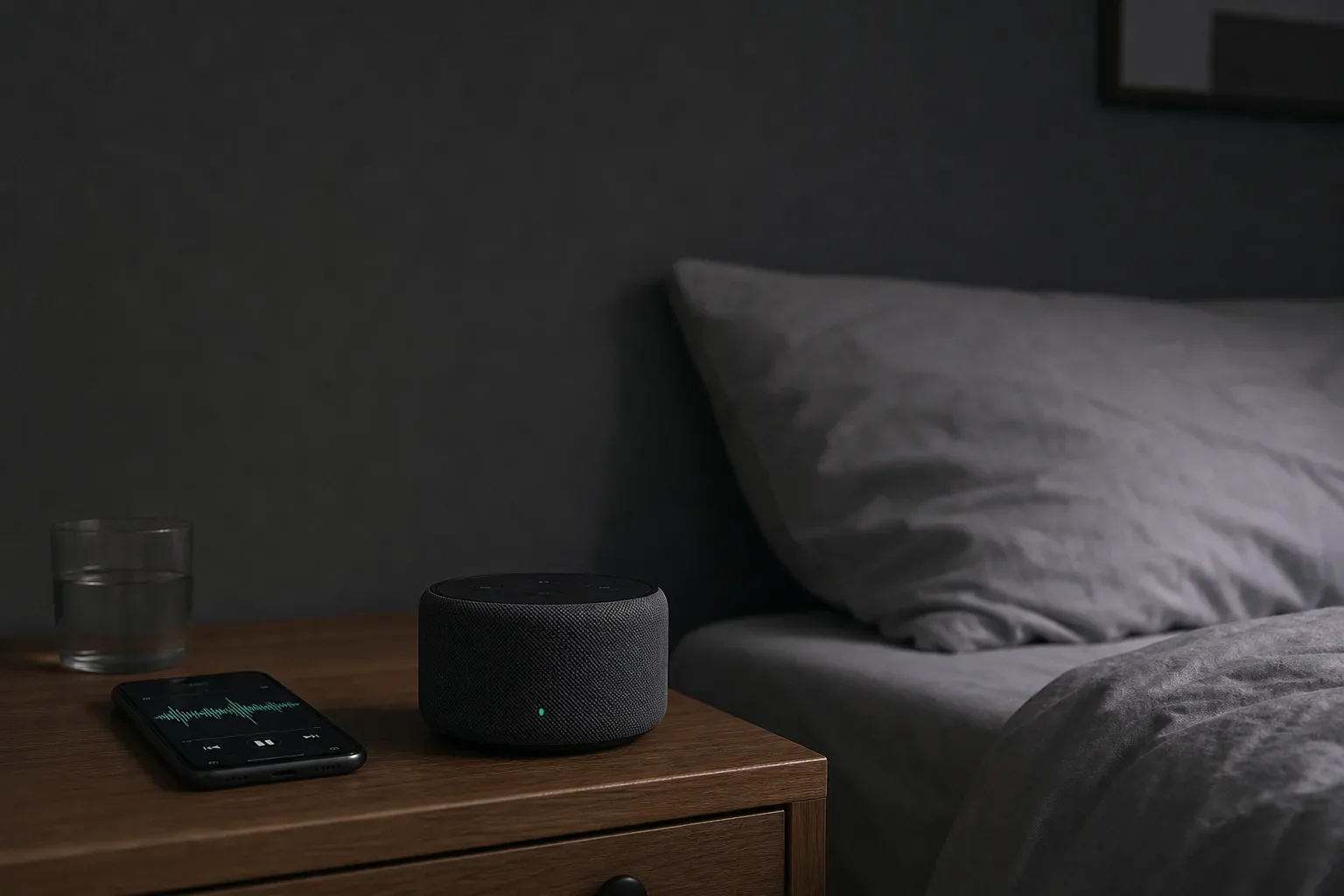
Brown noise ADHD use at night means playing a low, steady noise that may mask interruptions and give attention a simple resting point. It is not an ADHD treatment, and the research is thinner than the social posts suggest. Used quietly under Dream-Self audio, it can make the voice easier to stay with.
Can brown noise help ADHD brains settle at night?
Brown noise may help some ADHD listeners settle because it reduces sudden contrast in the room.
Brown noise is deeper than white noise. Technically, its power drops by about 6 dB per octave as frequency rises, so you hear more low hum and less upper hiss. That matters at night because many bedrooms are not quiet; they are irregular. A pipe clicks once. A car passes. A phone charger whines at 8 kHz. A steady low bed can make those edges less sharp.
ADHD and sleep difficulties often travel together. Reviews commonly estimate that 25% to 50% of children with ADHD have significant sleep problems, and adult ADHD is also linked with delayed sleep timing and restlessness. Those numbers do not mean brown noise fixes the problem. They mean the night is a real part of the ADHD picture, not a side note.
The mechanism is plain: masking lowers the perceived difference between background sound and interruption. Your auditory system still detects the room, but the jump from quiet to sudden sound is smaller. In practice, that can reduce the small orienting response that says, check that, identify that, name that.
A useful sound is not the one that impresses you. A useful sound is the one you stop monitoring.
For ADHD, the second mechanism may be attentional. Some people do better when there is a mild, constant sensory input. Researchers often discuss this through stochastic resonance, where a moderate amount of noise can improve signal detection in some nervous systems. The evidence is mixed, but the idea is reasonable enough to test gently at home.
If brown noise makes your thoughts louder, stop. Some brains hear low noise as pressure, not comfort. Yours gets a vote, and one bad night is enough data to adjust.
How should brown noise sit under Dream-Self audio?
Brown noise should sit below the voice so the words stay easy and the room feels steady.
Start with the spoken audio first. Set the voice at a clear, soft level, similar to a calm conversation across a pillow. Then bring in brown noise until it just begins to mask the room. If the consonants in the voice blur, especially s, t, k, and f, the noise is too loud or too bright for the recording.
This matters because the AYA Method is a daily audio manifestation practice. Each day you listen to a short personalized recording - your Dream-Self Moment - narrated from the version of you who has already manifested the life you intend. Listening is the practice. Repetition is the work. The audio is the method. Brown noise is not the practice; it is the acoustic support underneath it.
I would set the layers in this order:
- Play the Dream-Self audio alone for 30 seconds.
- Adjust the voice until it is clear without effort.
- Add brown noise at the lowest audible level.
- Lower the noise by one small step after it feels comfortable.
- Use a timer for 20 to 45 minutes unless you already know all-night sound helps you.
A 2021 Sleep Foundation survey reported that many adults use sound at night, but survey data cannot tell us which sound works for which brain. The important part is repeatable setup. Same speaker, same distance, same volume, same timing. ADHD nights already contain enough variables.
The voice carries the meaning. The noise carries the room.
If you are using a phone speaker, place it 1 to 2 meters from the pillow when possible. Phone speakers often thin out below 150 Hz, so brown noise may sound more like midrange rumble than a true low bed. A small bedside speaker usually gives a more stable result at a lower volume.
What volume and timing are safe enough for nightly use?
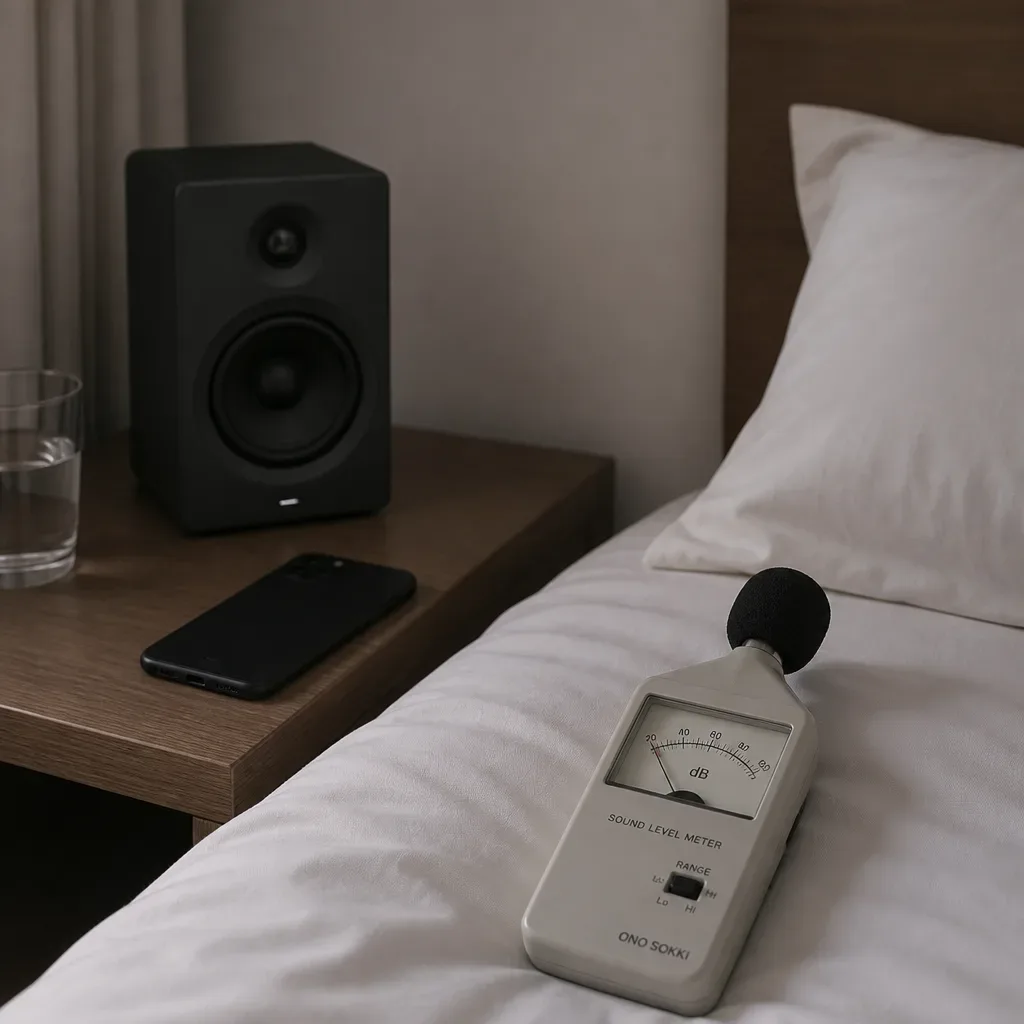
Keep brown noise as low as possible, usually around 35 to 50 dB at the pillow.
The World Health Organization Night Noise Guidelines for Europe use 40 dB Lnight as a recommended target for protecting public health. That figure is for environmental policy, not a bedside prescription, but it gives a useful reference point. Soft rain in a quiet room often measures around 40 dB. Normal conversation is closer to 60 dB.
You do not need a laboratory meter. A phone sound-level app can be off by several dB, especially in low frequencies, but it can still help you avoid obvious excess. Measure at pillow height, not next to the speaker. If the reading sits near 55 to 60 dB, lower it. Sleep sound should not compete with the room like daytime audio.
With children, be stricter. The American Academy of Pediatrics has warned that some infant sleep machines can exceed safe levels when placed close to the crib. ADHD is common in children, but that does not make louder sound safer. Keep speakers away from the head, use timers, and ask a clinician when sleep is persistently poor.
A steady sound should protect the night from spikes, not become the loudest object in the room.
Timing is personal, but a 20 to 45 minute window is a good first test. Sleep onset often happens within that range for many adults, while a full sleep cycle is around 90 minutes. If you wake when the sound stops, try a longer fade. If you wake because the sound is still on, shorten it.
Headphones need extra caution. Earbuds can make 50 dB feel private and harmless, but they also sit close to the eardrum and can encourage higher settings. For sleep, a speaker is usually the safer tool.
How is brown noise different from white noise, pink noise, and beats?
Brown noise is lower and less hissy than white noise, while pink noise sits between them.
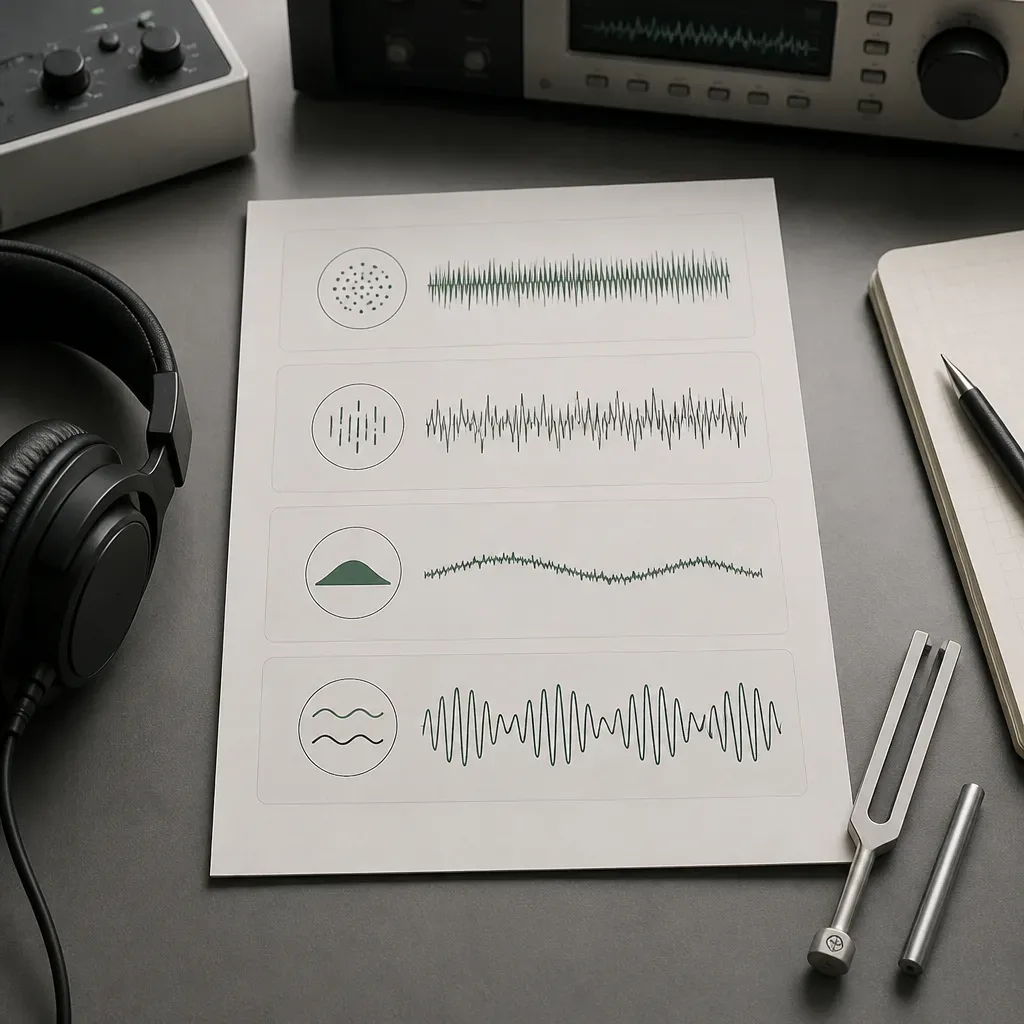
White noise has equal power per hertz, which gives it a bright hiss. Pink noise drops by about 3 dB per octave, so it sounds more balanced to many ears. Brown noise drops by about 6 dB per octave, so it leans low. The names are convenient labels, not moral rankings.
| Sound type | Basic shape | What you hear | Common night use |
|---|---|---|---|
| White noise | Equal power per Hz | Bright hiss, air, static | Masking sharp sounds |
| Pink noise | -3 dB per octave | Even rain-like balance | Sleep and room masking |
| Brown noise | -6 dB per octave | Low hum, surf-like weight | Settling and low masking |
| Binaural beats | Two tones, one per ear | Pulsing illusion | Focus or wind-down tests |
If you want to compare them directly, use the White noise generator + guide and then switch to a brown setting at the same measured volume. Most people choose too quickly when the sounds are not level-matched. Louder often sounds better for the first 10 seconds.
The Binaural beats generator + guide is a different category. A binaural beat is an auditory illusion created when each ear receives a slightly different tone, such as 200 Hz in one ear and 206 Hz in the other. Your brain perceives a 6 Hz beat. Research on mood, anxiety, and attention is mixed, and headphones are required for the effect.
Solfeggio tones are different again. The Solfeggio frequencies guide explains the tradition around numbers such as 396 Hz, 528 Hz, and 963 Hz. Some listeners like the ritual clarity of a single tone. The scientific evidence for specific frequency claims is limited, so I would treat those tones as preference and tradition, not proof.
For brown noise ADHD use, the practical question is not which sound has the most claims. It is which sound makes fewer demands on your attention after 5 minutes.
What does the evidence actually say about ADHD and noise?
The evidence suggests noise can help some ADHD tasks, but brown noise itself has not been well studied.
One often cited line of research comes from Göran Söderlund and colleagues. In a 2007 study in Behavioral and Brain Functions, white noise improved memory performance for children rated as inattentive, while it worsened performance for attentive children. The sample was small, and the task was not sleep. Still, it supports the idea that noise can interact differently with attention systems.
Later studies have tested white noise, auditory stimulation, and classroom performance with mixed results. A 2016 review of ADHD and sleep noted that sleep problems are common across ADHD groups, but it did not identify colored noise as an established therapy. That distinction matters. Evidence for task performance is not evidence for sleep onset. Evidence for white noise is not evidence for brown noise.
Small studies can open a door. They do not build the house.
There is also a broader body of sleep-sound research. Pink noise has been studied for slow-wave sleep in small experiments, including work published in Frontiers in Human Neuroscience in 2013 that used sound synchronized to brain rhythms in older adults. That is not the same as playing brown noise from a bedside speaker, but it shows why timing, volume, and sound shape matter.
The strongest claim we can make is modest: steady sound may help certain people by masking interruptions and giving attention a stable auditory object. ADHD may make that more useful for some listeners and irritating for others. If your mind grabs the sound and starts analyzing it, switch to the white noise guide or try pink noise instead.
Track outcomes for 7 nights, not one. ADHD sleep can vary with caffeine, medication timing, light exposure, stress, and late screens. Dr. Andrew Huberman often emphasizes morning light and circadian timing when discussing sleep, and those basics can matter more than any sound color.
What routine can you try tonight?
Use a short, measured routine that keeps the sound low and the voice primary.
The goal is not to create a perfect sleep lab. The goal is to remove enough friction that you can repeat the setup tomorrow. A 2023 Pew Research Center report found that about 90% of U.S. adults own a smartphone, which means most people can test this with tools already on the bedside table. A speaker is better, but a phone at low volume can still teach you what your ears prefer.
Try this 12-minute setup before the first night:
- Put the speaker 1 to 2 meters from your pillow.
- Set your room as you normally sleep: lights, temperature, charger, door.
- Play Dream-Self audio alone for 30 seconds.
- Add brown noise until the room edge softens.
- Lower the brown noise one step.
- Set a timer for 30 minutes.
- In the morning, write one line: easier, same, or worse.
Do not judge the sound while sitting upright and alert. Judge it lying down, lights low, after 2 minutes of normal breathing. The auditory system changes with posture, pillow contact, and the loss of visual input. Field recordists know this well: a recording that feels calm at a desk can feel too close in bed.
You can also press play below and listen for the difference if your page includes the generator controls. Compare brown noise against pink noise at the same volume. Then compare both with a simple rain recording. Many ADHD listeners prefer a sound with slight natural movement, but loops can become irritating if the pattern is obvious within 20 seconds.
Useful signs:
- You stop checking hallway sounds.
- The voice remains clear.
- Your breathing slows without effort.
- You do not feel pressure in the ears.
- You can imagine using the same level tomorrow.
If the sound feels good only when loud, it is not the right sound for sleep.
When should you not use brown noise for sleep?
Do not use brown noise as a substitute for care when sleep problems are persistent, severe, or medically suggestive.
If you have untreated sleep apnea symptoms, such as loud snoring, choking awakenings, or heavy daytime sleepiness, talk with a medical professional. If tinnitus becomes more noticeable with brown noise, stop and ask an audiologist or clinician for guidance. If insomnia lasts more than 3 months and affects daytime function, cognitive behavioral therapy for insomnia has stronger evidence than sound masking.
Medication timing also matters for ADHD. Stimulant duration varies by formulation, often from about 4 hours for some immediate-release forms to 10 or 12 hours for some extended-release forms. Do not adjust medication because a sound article said so. Bring sleep notes to the prescriber and keep the sound routine simple enough to describe.
There are also practical reasons to skip brown noise:
- You need to hear a child, alarm, or medical device.
- Low rumble makes you tense or watchful.
- You keep raising the volume night after night.
- A partner sleeps worse with it.
- You use headphones and wake with sore ears.
For some rooms, masking is the wrong fix. A door sweep, softer charger, quieter fan bearing, or moving the speaker away from a wall can reduce the problem at the source. Low frequencies travel through walls and corners easily; placing a speaker in a corner can make brown noise boomier by several dB.
The cleanest test is humble: 7 nights, low volume, same timing, one morning note. If the notes say easier at least 4 nights out of 7, keep it. If they say same or worse, choose another sound or silence. The nervous system is allowed to be specific.
Set the hum low enough that the room still feels like yours.