noise colors
White Noise vs Brown Noise for Clear Voice Audio
White noise vs brown noise for voice clarity: learn which bed keeps spoken audio intelligible, how to set volume, and when pink noise is better.
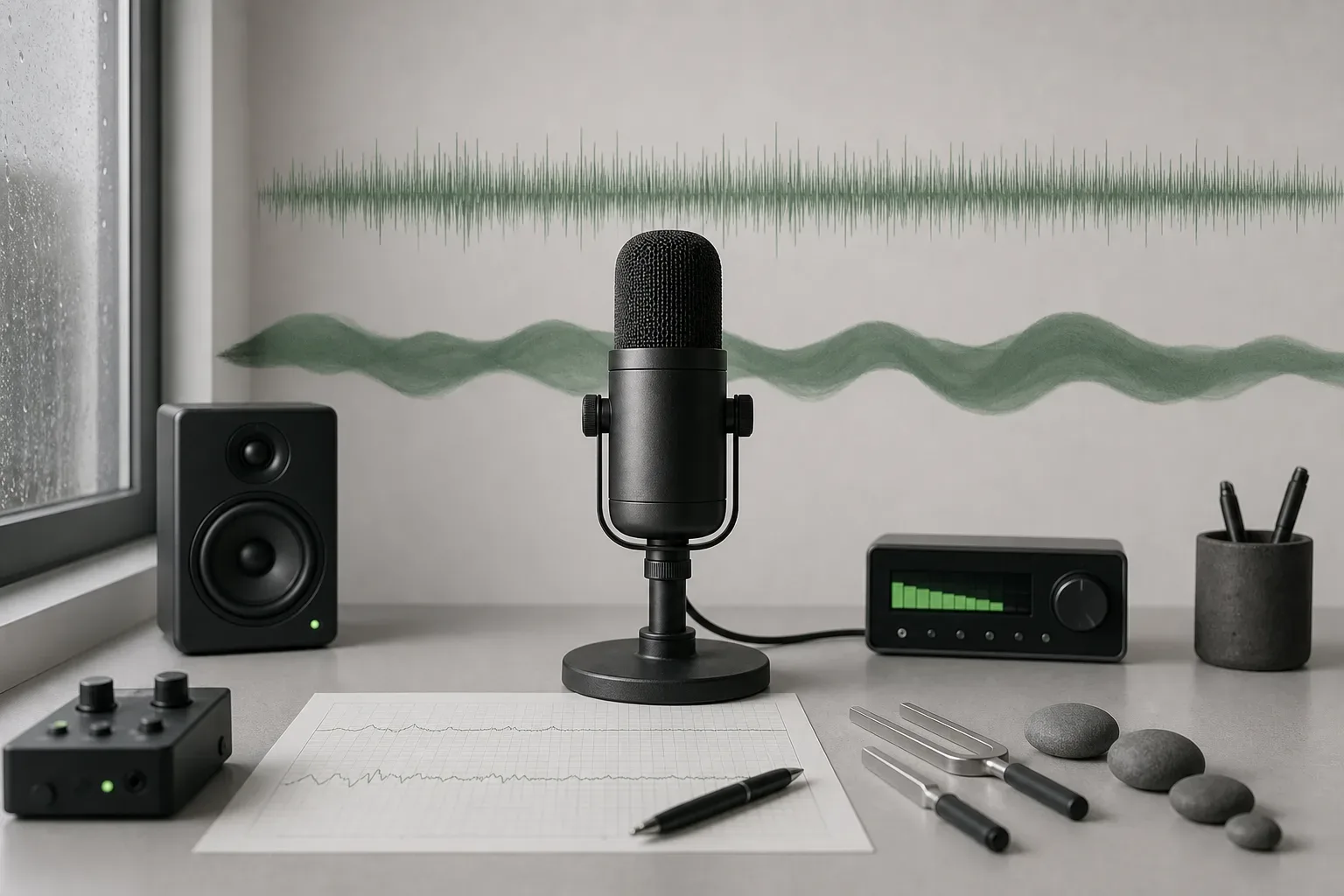
For spoken recordings, brown noise usually keeps voice audio clearer than white noise because it leaves the consonant range less crowded. White noise is better for masking outside speech, but that same hiss can blur narration. Use brown noise quietly, filter the lows, and keep the voice at least 15 dB forward.
What actually changes between white noise and brown noise?
White noise spreads acoustic power evenly by hertz, while brown noise tilts that power downward toward the low end.
That technical difference is the whole story. White noise has the familiar steady hiss because there is just as much power between 7,000 and 8,000 Hz as between 100 and 1,100 Hz when measured per hertz. Brown noise, often described as Brownian or red noise, drops roughly 6 dB per octave as frequency rises. In practice, it sounds lower, rounder, and less sharp.
Speech does not occupy one neat slot. Adult fundamental voice frequencies are often around 85–180 Hz for many male voices and around 165–255 Hz for many female voices, but intelligibility depends heavily on higher information. The Speech Intelligibility Index, standardized as ANSI S3.5, gives strong importance to bands from about 500 Hz to 4,000 Hz, with consonant cues extending higher. A soft bed that crowds those bands will make words less plain.
That is why the same noise can help or hurt depending on the job. If you want to hide a neighbor’s conversation, white noise often masks speech more efficiently because it covers the crisp consonants. If you want your own voice recording to remain clear, that efficiency becomes a problem. A mask is not a cushion; it is a competitor.
Press play on the White noise generator + guide and listen to a sentence over it at low volume. Then compare a brown noise sample if you have one in your library. You will probably hear the white hiss touch the edges of s and t sounds sooner than the brown hum does.
A sound bed is not neutral just because it is steady.
Which noise keeps narration more intelligible?
Brown noise usually keeps narration more intelligible, provided its low frequencies are kept below the voice.
The reason is simple: speech clarity lives in contrast. Consonants are small, fast events. When a noise bed has strong high-frequency content, those events lose their outline. Audiology research has measured this for decades through signal-to-noise ratio, often abbreviated SNR. A 2016 review in the International Journal of Audiology notes that listeners with hearing loss may need several dB more SNR than younger normal-hearing listeners to understand speech in noise. Even for good ears, 3 dB can be the difference between easy and effortful.
White noise can still be useful under voice if it is barely there. Think of it as a room-tone repair tool, not a feature. In a podcast edit, a very low white bed can hide cuts. In meditation audio, it can make silence feel less abrupt. But once the hiss becomes audible as an object, it starts spending the listener’s attention.
Brown noise is more forgiving because it tends to sit under the articulation. It can give a recording a low, steady floor without brushing against the high consonants. The risk is mud. Too much low end around 100–300 Hz can thicken a close microphone and make a soft narrator sound boxed in.
A practical comparison looks like this:
| Bed under voice | Strength | Main risk | Best starting level |
|---|---|---|---|
| White noise | Hides edits and room tone | Masks consonants and breath detail | 18–24 dB below voice |
| Brown noise | Feels low and less hissy | Can cloud low voice fundamentals | 15–22 dB below voice |
| Pink noise | Balanced by octave | Can still crowd mids | 16–22 dB below voice |
For most spoken sleep audio, brown or pink noise wins. For privacy masking in an office, white noise may win. The question is not which sound is calmer; the question is which frequency band you can afford to lose.
How should you set levels so the voice stays forward?
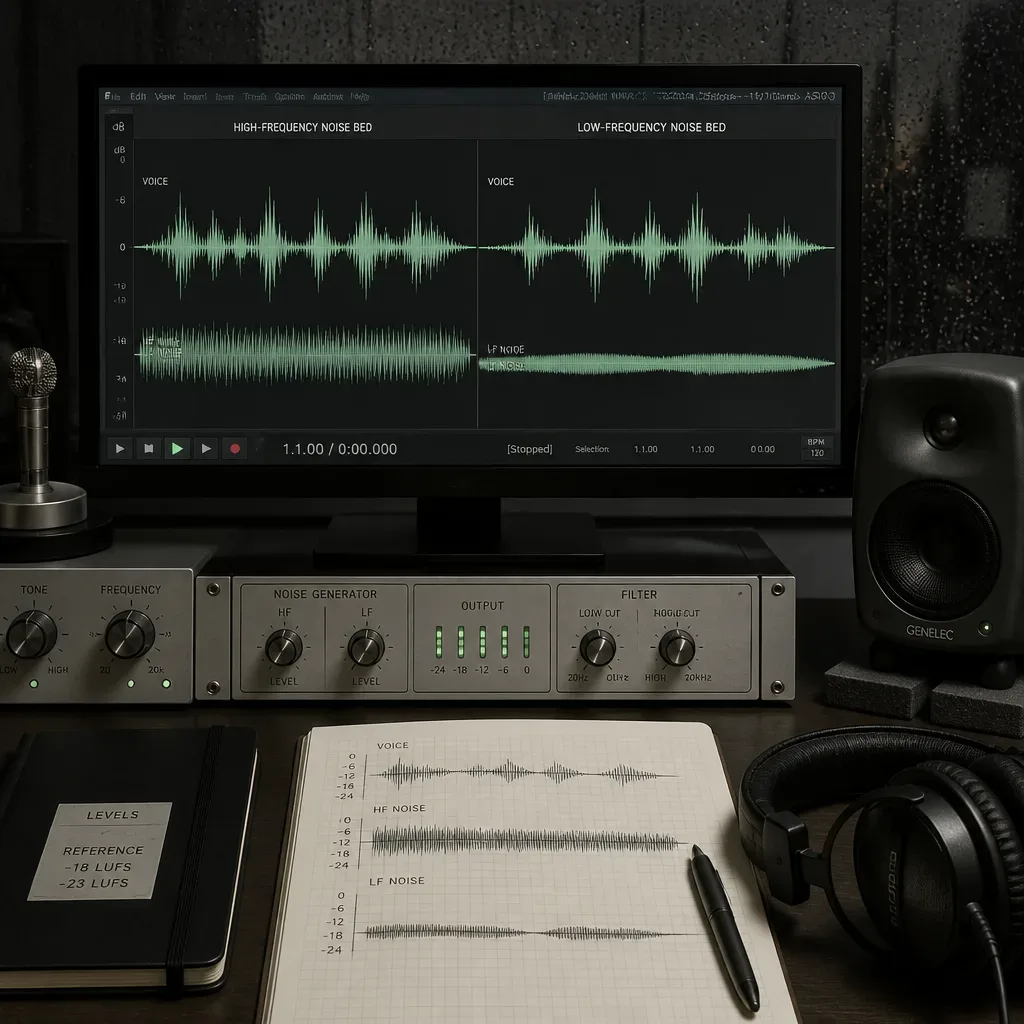
Set the voice first, then raise the noise only until the room steadies, not until the noise becomes impressive.
Start with the spoken track alone. If you are producing audio, normalize speech to a comfortable target, often around -18 to -16 LUFS integrated for intimate spoken content, though platforms vary. If you are only listening, set the voice at a level where you can understand every word without leaning in. Then add noise from silence upward. Stop earlier than you want to. Your first comfortable setting is often 2–4 dB too loud after ten minutes.
Volume safety matters more than style. NIOSH recommends limiting occupational exposure to 85 dBA over 8 hours, with exposure time halving for each 3 dB increase. Sleep listening should sit far below that. A phone sound meter is not laboratory-grade, but it can keep you from using a bedside speaker at 70 dBA when 45 dBA would work.
Here is a plain setup sequence:
- Play the voice alone for 60 seconds and set it comfortably low.
- Add brown noise at minimum volume.
- Raise it until room sounds soften, then reduce it by 2 dB if you can.
- If the voice feels thick, high-pass the noise around 80–120 Hz.
- If consonants blur, lower the noise before changing the voice.
- Check the mix on the device you will actually use in bed.
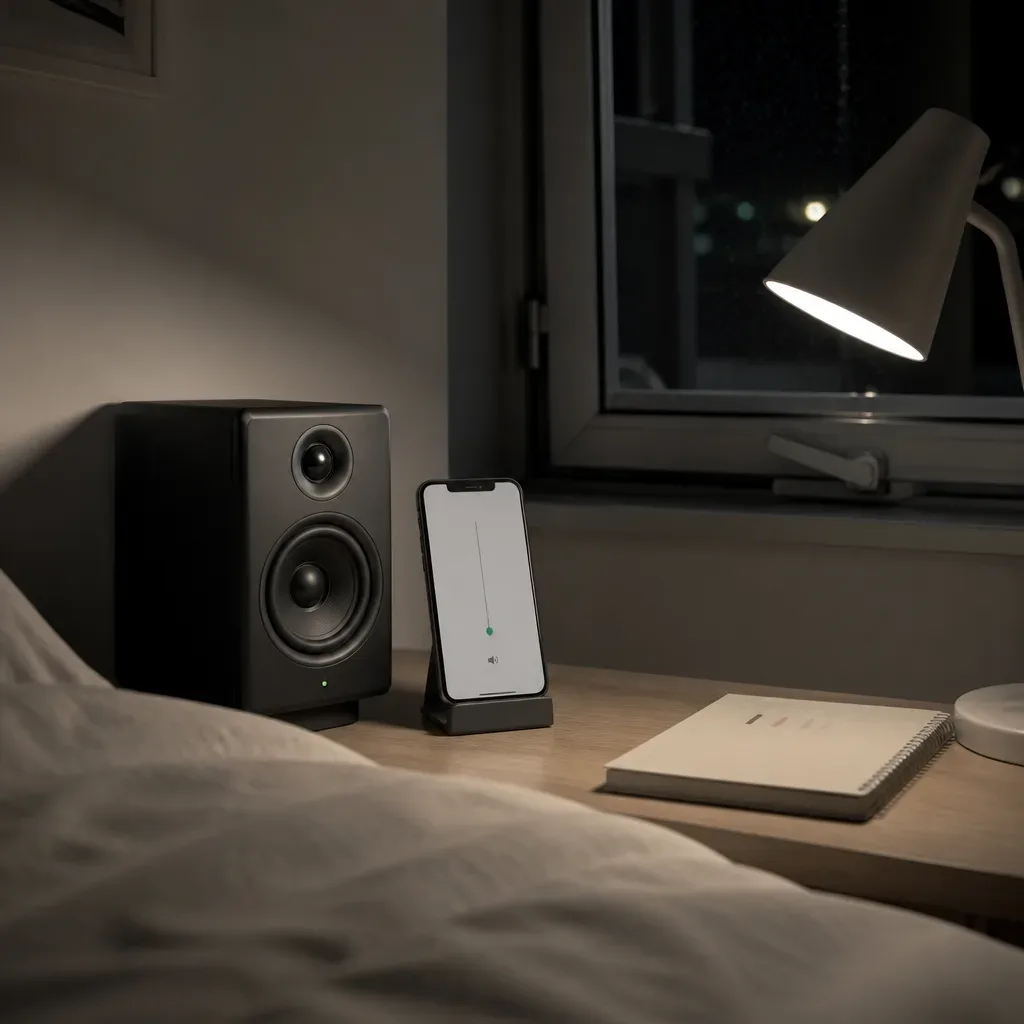
For sleeping, I prefer the noise bed to feel discovered, not noticed. A steady bed around 35–50 dBA at the pillow is enough for many rooms, but a busy street, a partner’s snore, or thin apartment walls may require different handling. If tinnitus, sleep apnea, or chronic insomnia is involved, use sound as support and speak with a qualified clinician.
The Binaural beats generator + guide uses a different mechanism: two tones create a perceived beat when heard through headphones. That can sit behind voice too, but the same level rule applies. If the carrier tone pulls attention away from speech, it is too loud.
The right noise level is the one you can forget while still hearing every word.
When is white noise the better choice?
White noise is better when your goal is masking other voices, not preserving the clarity of your own.
This is the common confusion. People ask for clear voice audio, then choose the noise that is best at covering speech. White noise masks because it has strong content across the range where speech cues occur. In open offices, sound masking systems often use shaped noise rather than raw white noise, but the principle is similar: add a controlled background so nearby speech becomes less intelligible. Studies by Valtteri Hongisto and others have linked speech privacy to distraction, with intelligible speech producing more disruption than less intelligible speech in office tasks.
For a guided audio track, the aim is opposite. You want the listener to stop monitoring the room while still receiving the words without effort. If the content is instruction, affirmation, or sleep narration, clarity is not decoration. It is the channel.
White noise may still be the right tool in three cases:
- The voice track has audible edit gaps that need a continuous bed.
- The listener is in a room with high-frequency interruptions, such as faint TV, hallway voices, or clinking pipes.
- The white noise is shaped with less top end, making it closer to pink noise than true white noise.
The white noise guide is useful here because it lets you hear the masking effect directly. Play speech quietly in another tab, then bring the noise up in small steps. Notice how the first lost details are often word endings. That is not a failure of attention. It is acoustics.
A field recordist learns this quickly with rain. Rain on a metal roof can behave like bright noise, exciting the upper band and cutting across speech. Rain on canvas is softer because the impact is damped and the spectrum tilts lower. The material becomes part of the mix.
Is brown noise always better for sleep voice tracks?
Brown noise is not always better; it is simply the safer first choice for keeping a calm voice readable.
Some rooms already have low-frequency noise: traffic rumble, ventilation, a refrigerator compressor through the wall. Adding brown noise to that can make the whole bed heavy. In small bedrooms, speakers near walls can boost bass by several dB because boundaries reinforce low frequencies. Put the same speaker in a corner and the brown noise may stop being a soft hum and become a thick pressure.
Headphones change the decision again. Many sleep earbuds have limited bass, so brown noise may sound thinner than expected. Larger headphones can deliver more low end but may be uncomfortable for side sleepers. The American Academy of Sleep Medicine has repeatedly cautioned that chronic sleep problems deserve proper assessment; audio can help with routine, but it should not be used to ignore breathing pauses, severe anxiety, or persistent insomnia.
Pink noise deserves a place in the comparison. It falls about 3 dB per octave, between white and brown. A 2017 paper in Frontiers in Human Neuroscience reported that synchronized pink-noise stimulation improved slow-wave activity and memory measures in a small older-adult sample, though that was timed stimulation, not a general claim that any pink noise improves sleep. For voice, pink often gives enough softness without as much bass buildup.
Frequency-based traditions are a separate category. The Solfeggio frequencies guide explains why tones such as 396 Hz and 528 Hz matter to many listeners as tradition, while the controlled evidence remains mixed. If you place a tone under speech, treat it like any other bed: it must not steal intelligibility.
What should you use for manifestation or bedtime voice audio?
Use a low brown or pink bed under the voice, then keep the spoken recording as the main event.
This matters for practices where the words are meant to be heard daily. The AYA Method is a daily audio manifestation practice: each day you listen to a short personalized recording, your Dream-Self Moment, narrated from the version of you who has already manifested the life you intend. Listening is the practice. Repetition is the work. The audio is the method. A noise bed can prepare the room, but it should not become the method.
If you are making your own wind-down track, build it like a small instrument panel. Voice first. Noise second. Music or tone last, if used at all. The more layers you add, the more each layer must earn its place. A 2020 Pew Research Center survey found that about 28% of U.S. adults reported using a smartphone to track health or fitness; the broader point is that many people now bring audio tools into daily self-care. The tools are common. Careful listening is still uncommon.
A simple nightly stack can work like this:
- Ten minutes of brown noise to settle the room.
- Five to eight minutes of spoken practice or narration.
- Optional low noise after the voice ends, fading down over 20–30 minutes.
Keep the spoken section dry enough to understand. Reverb may sound pretty for 15 seconds and tiring after 5 minutes. If you want a steady nonverbal bed before or after the voice, use the Binaural beats generator + guide or the White noise generator + guide as a reference point, but do not stack every tool at once.
Sound prepares the room; speech carries the instruction.
What is the plain recommendation for tonight?
Choose brown noise for voice clarity, choose white noise for stronger masking, and keep either one lower than you think.
If you are listening to a narration, guided practice, or spoken sleep track tonight, start with brown noise at a low level. If the voice feels cloudy, reduce the low end or switch to pink. If outside voices keep pulling you away, test white noise, but expect to lower it when the narration begins. There is no prize for using a louder bed.
Use a quick 3-minute test before bed. Play the hardest sentence in the recording, not the easiest. Names, numbers, and soft consonants reveal masking faster than broad vowels. If you miss a word while relaxed and awake, you will miss more when tired. Speech researchers often test intelligibility with phonetically balanced words for this reason: the weak points show up when the material is controlled.
Here is the compact decision table:
| Your goal | Start here | Adjustment |
|---|---|---|
| Keep a voice clear | Brown noise | Lower bass if the voice thickens |
| Hide outside speech | White noise | Lower during narration |
| Gentle sleep bed without voice | Brown or pink noise | Keep at safe bedside volume |
| Tone-based listening | Single low tone | Keep below the speech, not beside it |
The ear is honest about clutter. If the recording asks you to strain, the mix is wrong, even if the waveform looks tidy.
Keep the voice low, and let the room hear it first.