noise colors
Green Noise for Sleep Under Dream-Self Audio
Green noise for sleep is a mid-frequency masking sound. Learn what it is, how it differs from white or pink noise, and how to layer it safely.
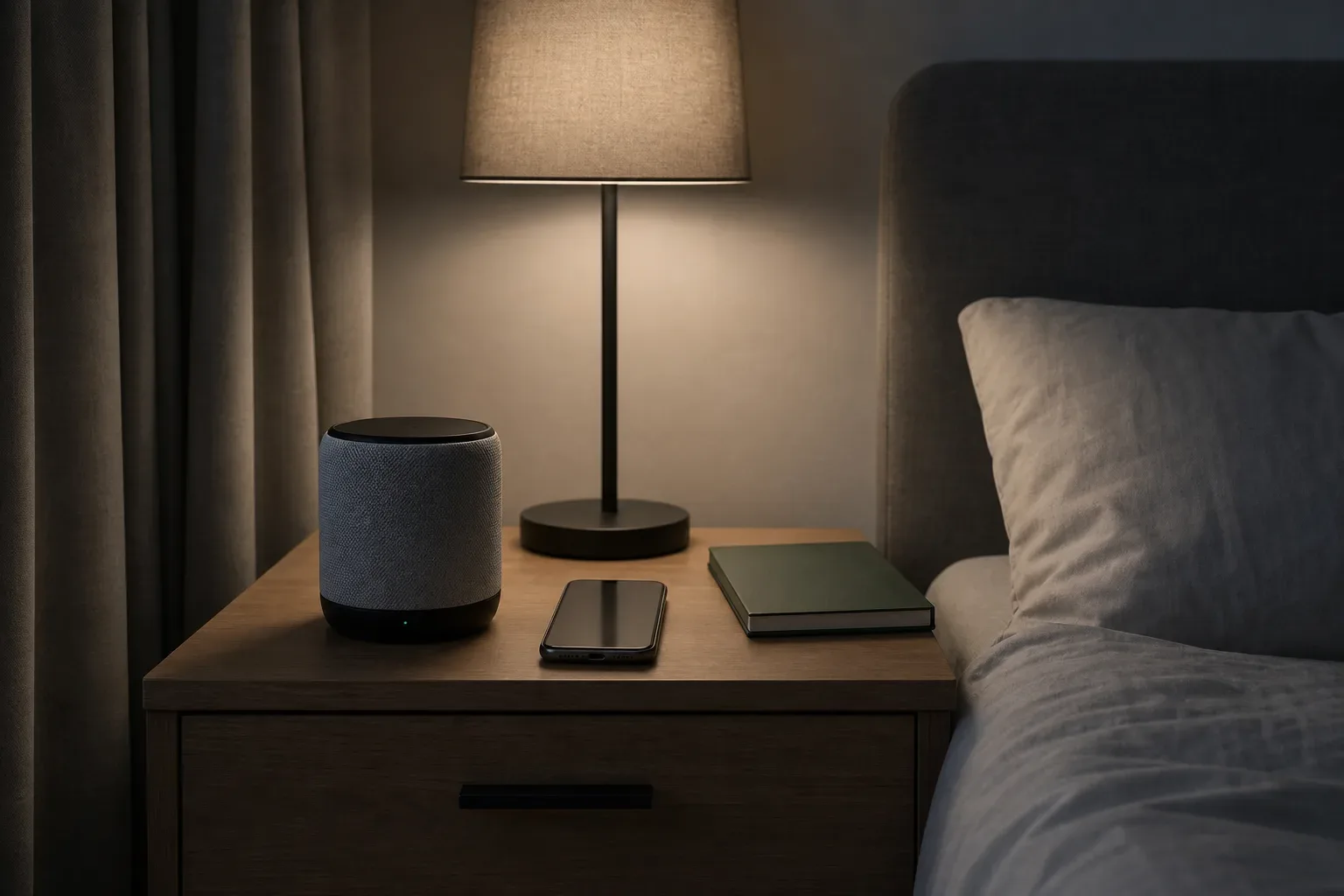
Green noise for sleep is a steady masking sound shaped around the middle of hearing, often softer than white noise and less rumbly than brown noise. Under Dream-Self audio, it should stay low, stable, and secondary, so the spoken recording remains clear while room sounds lose their sharp edges.
What is green noise for sleep, exactly?
Green noise is a practical sleep sound label for mid-weight noise, not a single official acoustic standard.
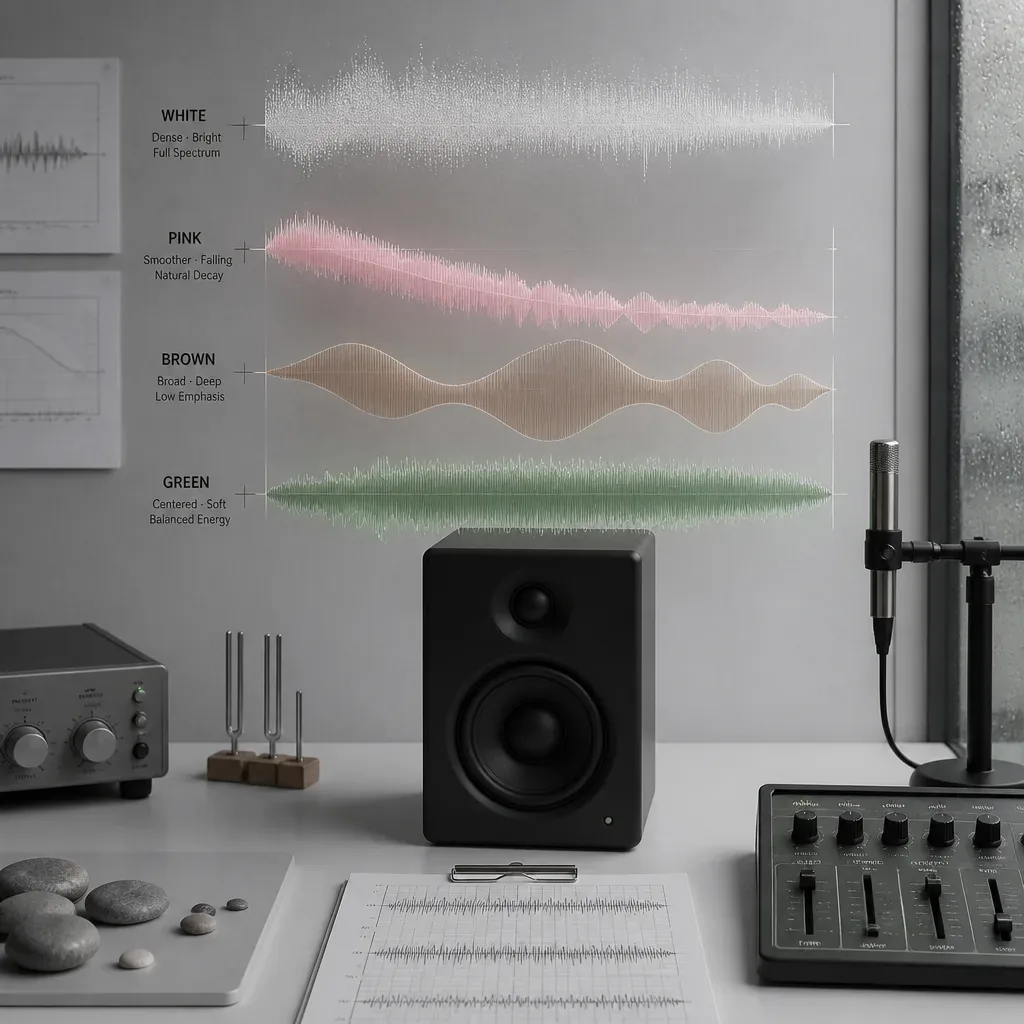
White noise has equal power per hertz. Pink noise drops by about 3 dB per octave. Brown noise drops by about 6 dB per octave. Green noise is less fixed. In most sleep apps and generators, it means a band-shaped noise that keeps attention away from the brightest treble and the lowest rumble. The result often resembles distant leaves, a steady air vent, or water heard through a wall.
The important word is tends. One green noise file may peak around 500 Hz. Another may cover a wider band from roughly 250 Hz to 2,000 Hz. The human ear is especially sensitive between about 2,000 and 5,000 Hz, according to standard equal-loudness research used in audio engineering, so reducing sharp upper frequencies can make a sleep sound feel less prickly at the same measured level.
Green noise for sleep works by masking change. A refrigerator click at 2:00 a.m. is noticeable because it rises out of silence. A soft, steady noise bed narrows that contrast. Basner and McGuire, writing on environmental noise and sleep in 2018, note that sudden sound events can fragment sleep even when the sleeper doesn’t fully wake. The goal isn’t to force sleep. The goal is to make the room less eventful.
A useful definition is plain: green noise is a middle-weight hum that hides small disturbances without filling the whole room with hiss. If white noise is a full spray of sound, green noise is a narrower brush.
How is green noise different from white, pink, and brown noise?
Green noise usually sounds less bright than white noise, less statistically defined than pink noise, and less low-heavy than brown noise.
The names can make the category sound cleaner than it is. White, pink, and brown noise have mathematical meanings. Green noise is often a production choice: filtered noise shaped to feel natural, mild, and listenable at bedtime. If you want a precise reference, press play on a White noise generator + guide, then compare it with a green noise track at the same low volume. White noise will usually sound more like static. Green noise should feel more centered and less sharp.
| Sound color | Typical shape | What you may hear | Sleep use |
|---|---|---|---|
| White noise | Equal power per Hz | Bright hiss, fan-like static | Strong masking, sometimes too sharp |
| Pink noise | About -3 dB per octave | Balanced rain or surf | Gentle masking with less treble |
| Brown noise | About -6 dB per octave | Low roar, deep hum | Masks low traffic or building rumble |
| Green noise | Often mid-band filtered | Soft leaves, distant water, air | Masks small changes under speech |
Pink noise has the stronger sleep research base among color labels. A 2017 Frontiers in Human Neuroscience study by Papalambros and colleagues used pink-noise acoustic stimulation timed to slow-wave sleep in 13 older adults and reported improved slow-wave activity and memory measures that night. That doesn’t prove an ordinary pink noise loop improves everyone’s sleep. It does show why controlled frequency shaping matters.
Brown noise may be useful when the room has low-frequency intrusion, such as traffic or HVAC vibration. The brown noise guide is a better first stop if your bedroom problem feels like a truck idling outside. For lighter household sounds, green or pink often asks less from the speaker and less from your ear.
The best noise color is not the one with the nicest name. It is the one you forget within five minutes.
Why would green noise sit well under Dream-Self audio?
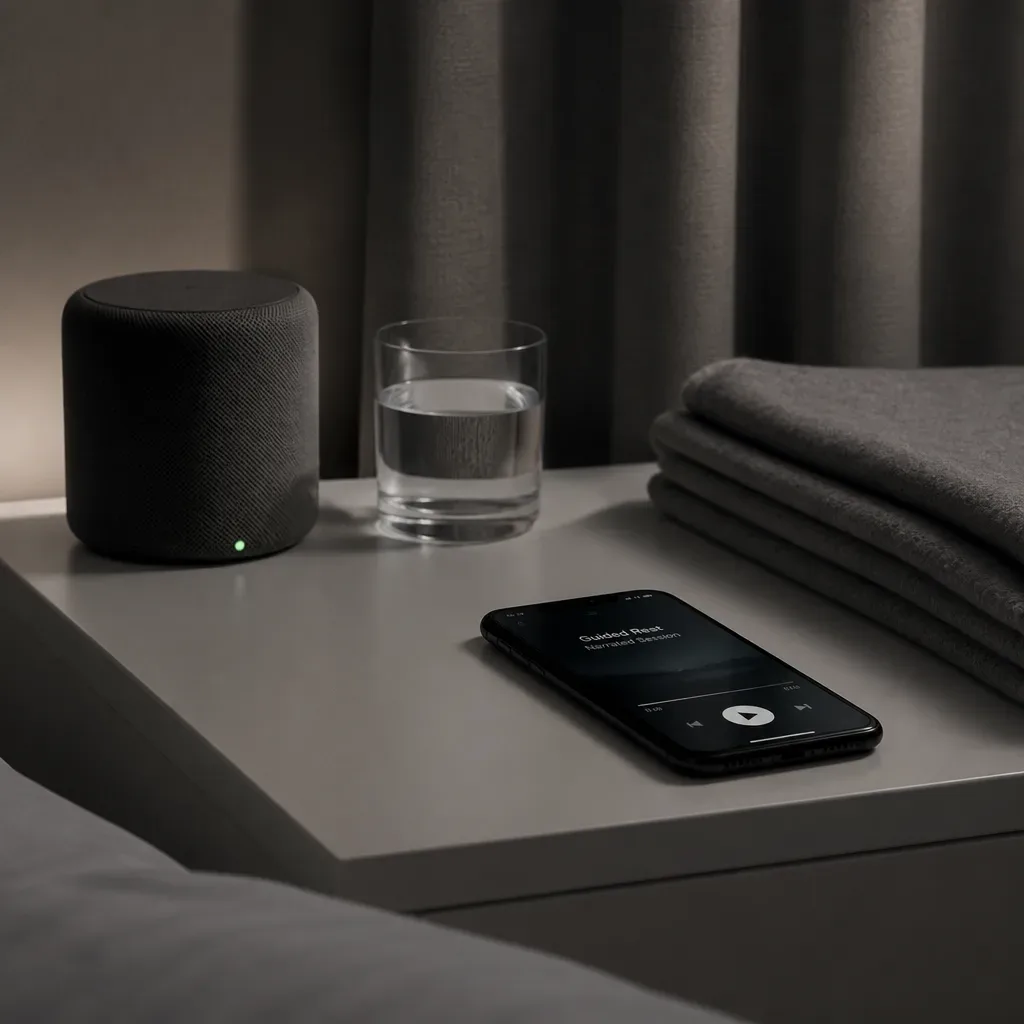
Green noise can sit well under Dream-Self audio because it fills silence while leaving the voice intelligible.
Spoken audio depends on consonants. The edges of words live partly in higher frequencies, often from about 2,000 Hz upward. If a noise bed is too bright, it competes with those edges. If it is too low and loud, it can mask the warmth of the voice and make the recording feel thick. A restrained green noise layer can leave the center of the voice clear while covering door clicks, plumbing ticks, and distant street changes.
This matters because the AYA Method is a daily audio manifestation practice. Each day you listen to a short personalized recording, your Dream-Self Moment, narrated from the version of you who has already manifested the life you intend. Listening is the practice. Repetition is the work. The audio is the method. The noise should never become the method.
In studio terms, think of green noise as room tone. Film editors use room tone to prevent silence from sounding cut or exposed. In sleep listening, a quiet noise bed can make a spoken practice feel less isolated against the room. A 2021 review in Sleep Medicine Reviews found that sound interventions for sleep are varied and hard to compare, partly because volume, timing, and sound type differ across studies. That is a warning against big claims and a permission to test gently.
I compose sleep music with the same rule: anything under the voice must give up the foreground. A pad that asks to be admired is already too busy. A noise bed that pulls attention away from the sentence is too loud.
Use green noise when your room is inconsistent, not when your audio is unclear. If you strain to hear the Dream-Self words, lower the noise by one or two phone volume clicks and try again.
How should you set volume and layering tonight?
Set the voice first, then bring green noise up only until the room stops interrupting.
Start with conservative sound levels. The World Health Organization’s Night Noise Guidelines for Europe recommend that average outdoor night noise stay below 40 dB to protect public health, and NIOSH uses 85 dBA over 8 hours as an occupational exposure limit, not a sleep target. Your bedroom sound should be far below workplace limits. If you can measure at the pillow, many listeners aim roughly between 40 and 50 dBA for a background sound, but phone meters vary.
Use this simple order:
- Play the Dream-Self audio alone at a comfortable, intimate level.
- Start green noise on a separate speaker or app.
- Raise the noise until small room sounds soften.
- Lower it one step after you think it is right.
- Check whether every word still lands without effort.
Speaker placement matters. Put the noise source between you and the disturbance when possible, not directly beside your ear. A small speaker on a dresser can cover a hallway better than a phone on the pillow. Avoid sleeping in earbuds. For children, use lower levels and place the device farther from the bed; pediatric hearing guidance is cautious because small ears and long exposure deserve extra margin.
If you use our Binaural beats generator + guide, don’t stack too many layers. Binaural beats require separate tones delivered to each ear, usually through headphones, while sleep noise works well in open air. Combining headphones, green noise, and spoken audio can become crowded. A quiet room, one speaker, and one steady layer often works better than a clever chain.
A good sleep mix sounds slightly underdone. The ear should not feel managed.
What does the evidence say and what should stay modest?
The evidence supports masking and relaxation for some people, but it does not prove green noise is a medical sleep treatment.
Noise and sleep research is strongest on the harm of unwanted noise. Large public health reviews link aircraft, road, and rail noise with sleep disturbance and cardiovascular stress markers. The WHO 2018 environmental noise guidelines reviewed hundreds of studies across transport sources. That doesn’t mean adding noise is automatically good. It means unpredictable or intrusive sound can be a real sleep problem.
Research on added sound is smaller and more mixed. Some ICU studies have tested white noise, nature sounds, or music to reduce awakenings in noisy hospital settings. Sample sizes are often modest, sometimes under 100 participants, and the setting is not a normal bedroom. Music studies show similar caution. A 2015 Cochrane review on music for insomnia found potential benefit, but study quality varied and the music itself differed widely.
For green noise specifically, there is no large clinical category with a settled definition. Treat it as a masking texture. If it helps you settle and doesn’t raise volume too high, it may be useful. If it annoys you, stop. The nervous system gets a vote, and preference is not a failure of discipline.
Tradition-based frequency listening belongs in a separate box. The Solfeggio frequencies guide explains the lore around tones such as 396 Hz, 528 Hz, and 852 Hz with respect and plain evidence boundaries. Green noise is different: it is broadband or band-limited sound, not one sacred pitch or one fixed tone.
If you have chronic insomnia, sleep apnea symptoms, tinnitus distress, ear pain, or sudden hearing changes, speak with a qualified clinician. Sound can support a routine, but it should not be asked to diagnose or treat what needs care.
When should you choose green noise instead of music or frequency tones?
Choose green noise when you need masking without melody, rhythm, or tonal focus.
Music can be beautiful and still be too informative for sleep. Melody creates prediction. Harmony creates small questions. Rhythm measures time. For rest, I often write below a resting heartbeat, around 50 to 65 beats per minute, and then remove anything that announces itself. Green noise goes further. It removes the composition and leaves a steady surface.
Frequency tones are different again. A single tone at 432 Hz or 528 Hz is easy to notice because the ear can hold it as an object. Binaural beats add another mechanism: two close tones, one per ear, creating a perceived beat inside the auditory system. Claims around entrainment are mixed, and study designs vary. If tones help you, use them softly. If you are listening to words, a wide gentle noise often competes less than a pure tone.
Here is a practical choice list:
- Use green noise for light masking under spoken audio.
- Use pink noise when you want a balanced bed and don’t need speech on top; see the pink noise guide.
- Use brown noise for low building rumble or traffic.
- Use white noise for strong masking, especially fans, office noise, or sharper interruptions.
- Use sleep music when you want emotional warmth but can tolerate slow musical movement.
The American Academy of Sleep Medicine says most adults need at least 7 hours of sleep per night. That number is useful because it reminds us that sound is not a trophy. It is a condition. If green noise helps you stop checking the room, it has done enough.
The quietest useful sound is usually the correct one.
How do you know if your green noise setup is working?
Your setup is working if it reduces startle, keeps speech clear, and becomes easy to ignore.
Test it over three nights, not one. Sleep is noisy data. Caffeine, stress, temperature, alcohol, light exposure, and bedtime can all change the result. Keep the sound variables simple for 72 hours: same noise, same speaker position, same approximate volume, same Dream-Self audio level. If you change five things at once, you won’t know what helped.
Use a small note rather than a complicated tracker. Rate three items from 1 to 5 in the morning: how easy it was to settle, how often sound woke you, and whether the voice felt clear. Consumer sleep trackers estimate sleep stages from movement and heart-rate patterns; they can be useful for trends, but they are not polysomnography. A plain note often catches what a wrist sensor misses.
Good signs include fewer reactions to hallway sound, less urge to adjust volume, and no ear fatigue on waking. Poor signs include irritation, pressure in the ears, trouble hearing words, or the feeling that the noise has become the main object of attention. In that case, lower it, switch to pink noise, or return to silence.
A sleep sound should behave like good lighting. You notice it when you set it, then it stops asking for credit.
For a clean comparison, spend one night with green noise under the recording, one night with the recording alone, and one night with a low White noise generator + guide. Keep the bedtime within about 30 minutes across all three nights. Small tests are imperfect, but they respect the only bedroom that matters: yours.
Let the hum stay simple, and let the voice be heard.