noise colors
White Noise Noisy Neighbors: Hear Dream-Self Audio
Use white noise noisy neighbors masking without burying your Dream-Self audio, with safe volume, speaker placement, and a 10-minute setup.
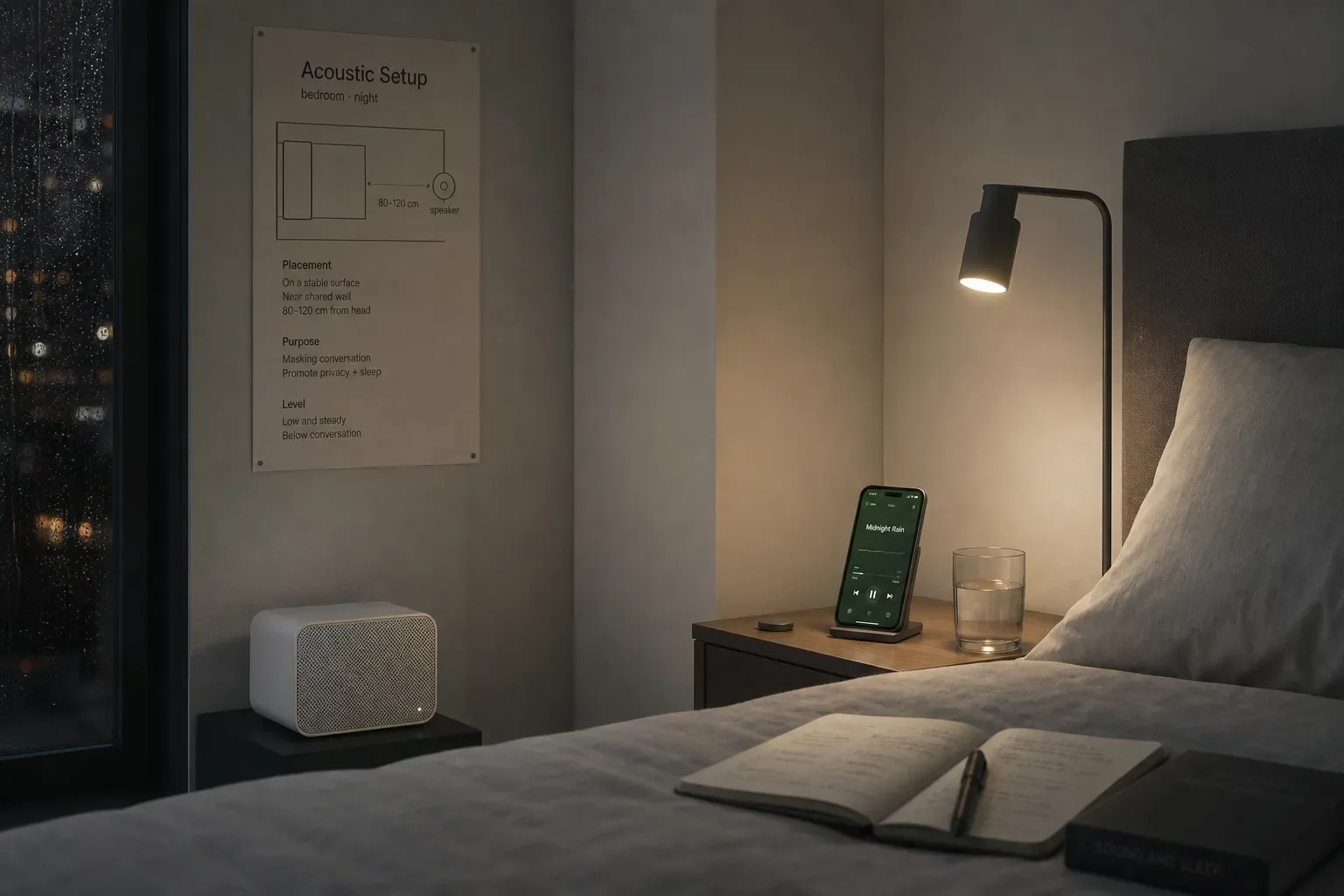
White noise noisy neighbors masking works best when the noise bed is steady, low, and placed near the interruption, while your Dream-Self audio stays closer and clearer. You are not trying to drown out the building. You are building two layers: room masking underneath, spoken intention above.
What kind of white noise masks noisy neighbors without swallowing the voice?
The best mask for neighbor noise is the quietest broadband sound that covers the interruption while leaving the spoken track intelligible.
White noise contains equal acoustic power per hertz, which is why it can sound bright or hissy. That brightness is useful for thin walls, hallway chatter, television spill, and clinking dishes because speech has important consonant detail between roughly 2,000 and 6,000 Hz. If the mask is too bright, though, it competes with the consonants in your Dream-Self audio. A voice without consonants becomes a warm blur.
For most apartments, start with a gentler white noise or a pink-leaning white noise. Pink noise drops by about 3 dB per octave, so it keeps the masking width but reduces the upper hiss. Brown noise drops about 6 dB per octave and can help with footsteps, but it may not cover speech well unless you raise it too much. The White noise generator + guide is a good place to press play and hear the difference before you commit to a whole night.
Sleep research is mixed but useful here. A 2021 review in Sleep Medicine Reviews found that many environmental-noise studies are small and methods vary, so white noise should be treated as a practical masking tool, not a guaranteed sleep treatment. The World Health Organization Night Noise Guidelines also treat nighttime sound as a measurable exposure, with 40 dB outside as a protective target and 55 dB as a level where adverse effects become more likely in populations.
The right mask is not the loudest sound. It is the least sound that makes the interruption stop mattering.
Use the spectrum like a tool:
- Neighbor voices: white noise, or white noise softened slightly toward pink
- Footsteps above: pink noise or brown noise, with the speaker near the ceiling-side wall if possible
- Bass music: brown noise may help, but structure-borne bass often needs building-level solutions
- Door slams: no steady noise fully removes the transient, but it can reduce the startle
- Plumbing or radiators: pink noise usually feels less sharp over 6 to 8 hours
How loud should white noise be when Dream-Self audio is playing?
Set the masking sound just below attention, then set the spoken audio clearly above it without making either layer loud.
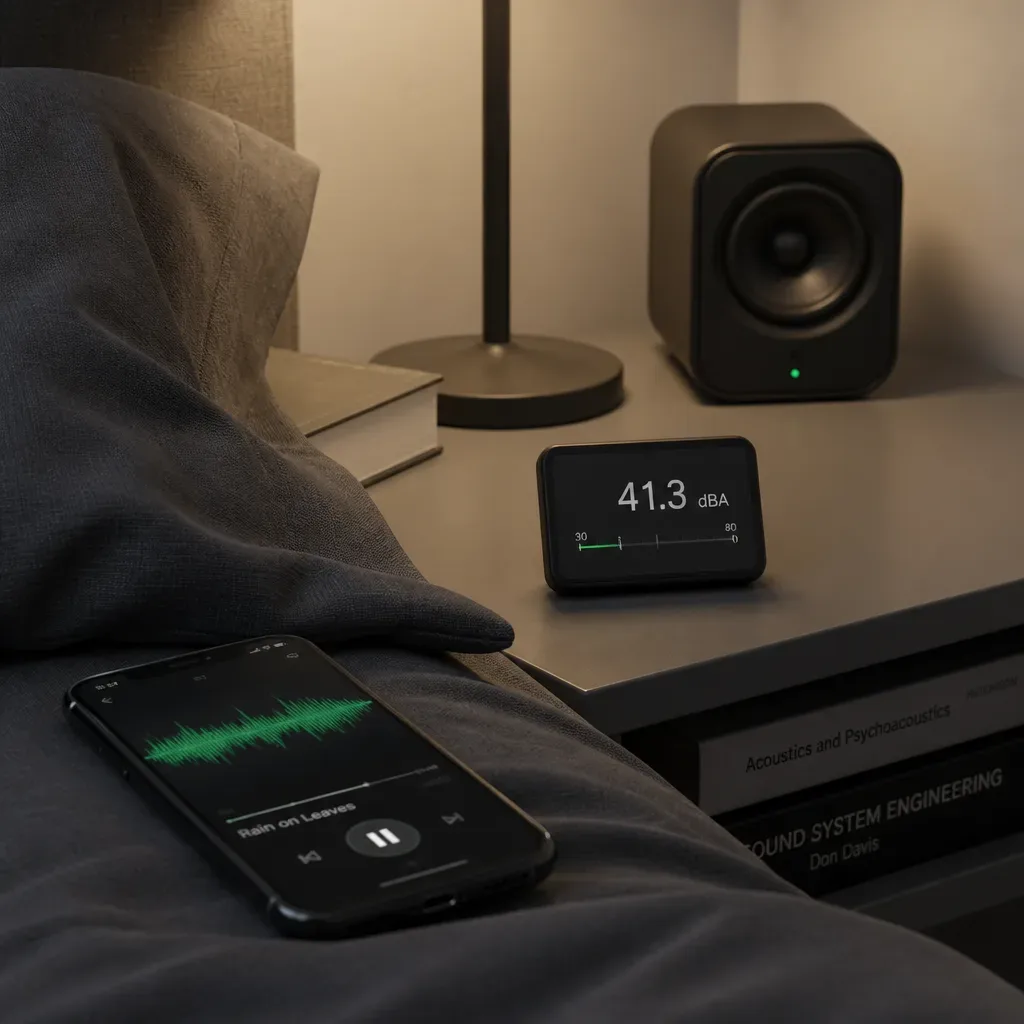
A practical target is 35 to 45 dBA at the pillow for the masking layer, measured with a phone app if you have one. Phone meters are not laboratory instruments, but they are useful for repeatable home checks within a few decibels. Normal conversation is often around 60 dBA at 1 meter, and NIOSH uses 85 dBA over 8 hours as an occupational exposure limit, not a bedtime goal. For sleep, lower is better if it works.
For narration, try a level difference of about 6 dB above the noise bed. A 6 dB increase is clearly audible without feeling like a jump. If your Dream-Self audio is playing from your phone on the nightstand and the mask is on a speaker near the wall, you may not need much volume at all. Distance does some of the mixing for you.
| Layer | Starting level at pillow | Main job | Adjustment rule |
|---|---|---|---|
| White or pink noise | 35 to 45 dBA | Masks neighbor detail | Raise only until words blur |
| Dream-Self audio | About 6 dB above mask | Keeps the voice clear | Lower if it feels forward |
| Room noise after masking | Variable | What remains | Accept low hum, fix sharp peaks |
If you use earbuds, be more conservative. Apple and WHO listening guidance often reference keeping long-duration headphone exposure around or below 70 dBA to reduce hearing risk. For sleep, I prefer open air speakers when possible because earbuds can trap level close to the ear for hours. Children need still lower levels and more distance from speakers.
If the voice needs to fight the mask, the mask is too loud.
Where should the speaker and phone sit in the room?
Put the masking source near the noise path and the Dream-Self source near you, so each sound does one job.
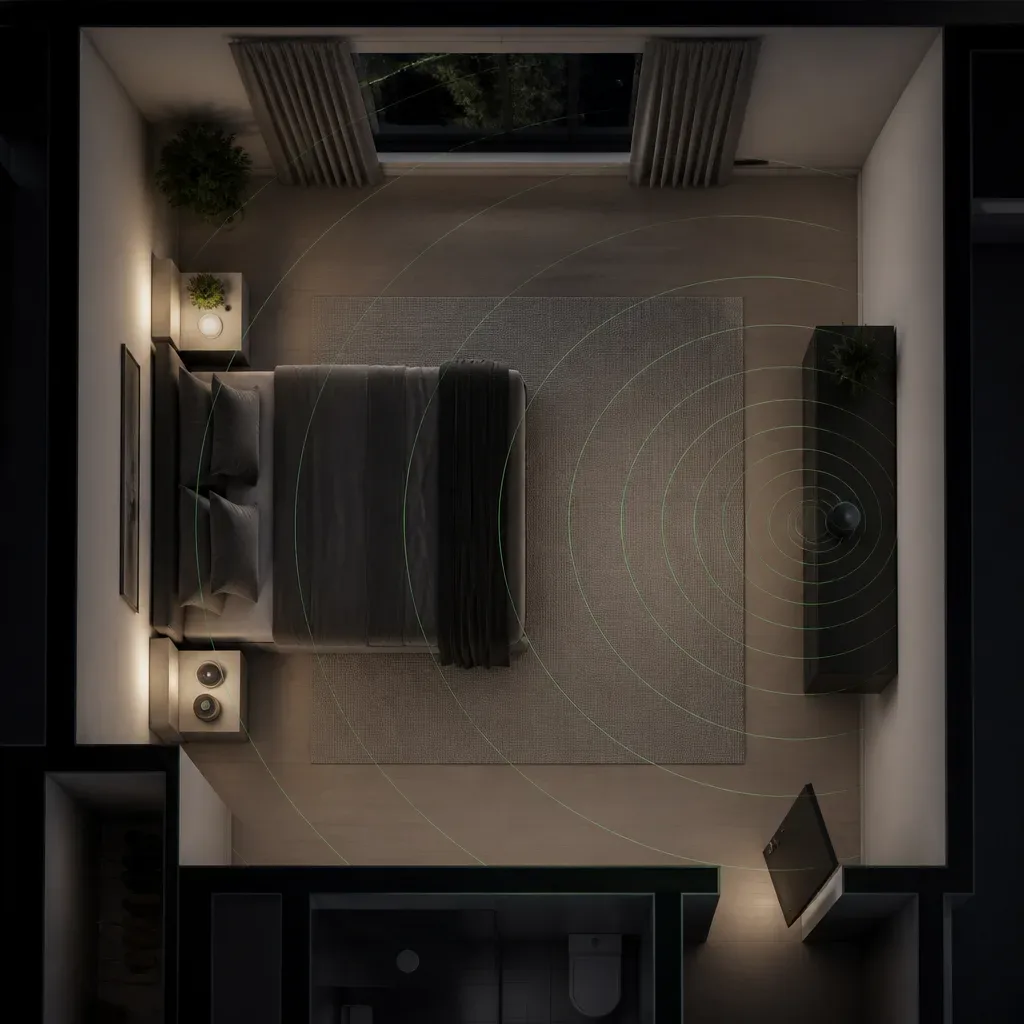
Most people make the same mistake: they put the white noise machine on the bedside table because that is where outlets live. That can work for a snoring partner, but it is often wrong for neighbors. If the disturbance comes through a shared wall, a hallway door, or a window, the mask should sit between that surface and your ears. You are trying to cover the first audible detail before it crosses the whole room.
Sound level changes with distance. In a simple free-field model, doubling the distance drops level by about 6 dB. Bedrooms are reflective, so the math is not perfect, but the principle holds enough to use tonight. Put the white noise speaker 1 to 2 meters from the shared wall, aimed across the room. Put the spoken audio within arm’s reach, aimed softly toward your pillow. That gives narration a distance advantage without extra loudness.
Try this placement sequence:
- Stand where the neighbor sound enters, usually a wall, door, ceiling line, or window.
- Place the masking speaker within 30 to 90 cm of that surface if safe and practical.
- Aim it across the room, not directly at your ear.
- Put the Dream-Self audio closer to the bed, ideally 50 to 100 cm from your head.
- Lie down and adjust only one thing at a time: placement first, volume second.
A soft surface behind a speaker can reduce harsh reflections. Thick curtains, a rug, or a bookcase can also tame flutter and room brightness. The U.S. Environmental Protection Agency has noted for decades that reducing noise at the source is usually more effective than trying to treat it after it spreads. In an apartment, you rarely control the source, so you control the path.
How do you set the levels in 10 minutes tonight?
Use a short calibration routine: measure the room, set the mask, add the voice, then test from the pillow without touching anything for 10 minutes.
First, make the room honest. Turn off the television, pause fans you do not plan to use, and listen for 60 seconds. Name the interruption. Is it speech, a footfall, a door, a bass line, or a mixed wash from the hallway? Naming it prevents you from using one over-loud sound for five different problems.
Second, start the mask low. Use the White noise generator + guide if you want repeatable playback, or use a dedicated machine with a non-looping or long-loop file. Raise it until neighbor speech loses word edges. Do not raise it until you cannot tell anyone exists. In many bedrooms, the useful range is a small 5 to 10 dB window.
Third, start your Dream-Self audio. The AYA Method is a daily audio manifestation practice. Each day you listen to a short personalized recording, your Dream-Self Moment, narrated from the version of you who has already manifested the life you intend. Listening is the practice. Repetition is the work. The audio is the method. The daily affirmation and Manifestation Board can support the practice, but here the voice is the part that must remain audible.
Use this 10-minute protocol:
- Minute 0 to 1: listen to the room with no added sound.
- Minute 1 to 3: bring in the mask until neighbor detail softens.
- Minute 3 to 5: bring in the spoken audio until every word is easy.
- Minute 5 to 10: lie still and do not adjust unless something hurts or startles.
If you keep adjusting, your nervous system learns that the room is a control panel. One careful setup is usually better than 14 micro-corrections. Behavioral sleep guidance often treats consistency as a cue; even in cognitive behavioral therapy for insomnia, stable wind-down routines and stimulus control are central pieces.
What if voices, footsteps, or bass still break through?
Change the spectrum or placement before you raise the volume.
Voices need upper-mid masking. If you can still understand words through the wall, choose a brighter white noise or move the speaker closer to the shared surface. Understanding is the key test. You do not need to erase the neighbor’s voice completely; you need to remove semantic content. The brain is sticky with words. Once language becomes non-language, sleep has less to solve.
Footsteps are different. They often travel through structure, not air, so a bedside speaker cannot fully cancel them. Try pink or brown noise, and add physical damping where you can: a rug by your bed, felt pads on your own furniture, or moving the bed away from the shared wall by even 10 to 20 cm. Small geometry changes matter in rooms because standing waves and reflections create hot spots.
Bass music is the hardest case. Low-frequency sound below 100 Hz passes through many walls easily, and masking it with more low sound can make the room feel heavier without hiding the pulse. If bass continues after quiet hours, document times and levels, then use building rules or local noise ordinances. The CDC notes that sleep deficiency is associated with poorer health and attention, so chronic nighttime noise is not just an annoyance.
Use this troubleshooting map:
| Problem | First change | Second change | Avoid |
|---|---|---|---|
| Understandable speech | Brighter mask near wall | Add soft furnishings | Blasting bedside noise |
| Footsteps | Pink or brown noise | Move bed 10 to 20 cm | Expecting full cancellation |
| Bass thumps | Document and address source | Brown noise at low level | Matching bass with loud bass |
| Door slams | Mask plus door sweep | White noise near hallway | Sudden loud masking |
If tinnitus, sleep apnea, panic at night, or chronic insomnia is part of this, bring a clinician into the picture. Sound can help the room feel steadier, but it is not medical care.
When should you use brown noise, binaural beats, or Solfeggio tracks instead?
Use other sound types when they fit the job, but keep the Dream-Self voice as the clear foreground if that is the practice for the night.
Brown noise is deeper sound, not deeper sleep. It has more low-frequency weight and less high hiss, which some people prefer when a white-noise track feels sharp. It can make a bedroom feel less exposed. The tradeoff is that it may leave speech consonants uncovered, so neighbor conversations can still peek through. If words are the problem, brown noise alone may be too soft at the top.
Binaural beats are different again. A binaural beat is an auditory illusion created when each ear hears a slightly different tone, such as 200 Hz in one ear and 206 Hz in the other. The perceived 6 Hz beat is constructed by the brain. Evidence is mixed; small studies have reported changes in relaxation or attention, while reviews note varied methods and modest certainty. If you want to test them, use the Binaural beats generator + guide with headphones at a low level before sleep, not as a loud mask for neighbors.
Solfeggio frequencies belong to a tradition of tone use, with 396 Hz, 528 Hz, and 963 Hz among the commonly named frequencies. The tradition matters to many listeners, and preference matters too. The evidence for specific frequency claims is not strong in the clinical sense, so use them as intentional listening, not as proof of a fixed biological effect. The Solfeggio frequencies guide explains the lore and the listening options plainly.
A tone can be meaningful without needing to be a medical claim.
For neighbor masking, steady broadband sound usually wins. For settling, a tone or beat may be pleasant. For Dream-Self audio, intelligibility wins. The spoken words should not have to climb through a thick fog of sound.
What should the nightly routine sound like from start to sleep?
A good routine moves from masking to listening to rest, with no sudden level changes after you lie down.
Start 20 to 30 minutes before sleep if you can. The National Sleep Foundation commonly describes adult sleep cycles as roughly 90 minutes, but the first step is much smaller: give the room a stable cue before the first cycle begins. Turn on the mask while you brush teeth or dim the room. This makes the sound ordinary before you ask it to support sleep.
Then play the Dream-Self audio once at a clear, low level. If you repeat it, keep the same level. Do not chase every neighbor sound. A stable noise bed teaches the ear that the room has one steady floor. The voice sits above it, then leaves. After that, the mask continues as plain cover.
Here is the compact version for tonight:
- Choose white noise for speech, pink for mixed apartment sound, brown for low rumble.
- Put the mask near the wall, door, or window where noise enters.
- Keep the mask around 35 to 45 dBA at the pillow when possible.
- Keep spoken audio about 6 dB clearer than the mask.
- Prefer speakers over overnight earbuds when you can.
- Recheck only after 10 minutes, not every 30 seconds.
If you want to compare noise colors before bed, use the White noise generator + guide first, then keep the chosen sound unchanged for the night. If you want a tone-based wind-down on a different evening, test the Binaural beats generator + guide or the Solfeggio frequencies guide before your main practice, not on top of it.
The room gets quieter when every sound has a job.