sleep science
Bedtime Routine for Sleep: 10-Minute Audio Cue
A bedtime routine for sleep using 10 minutes of low audio, breath timing, and safe volume cues to help your nervous system settle tonight.
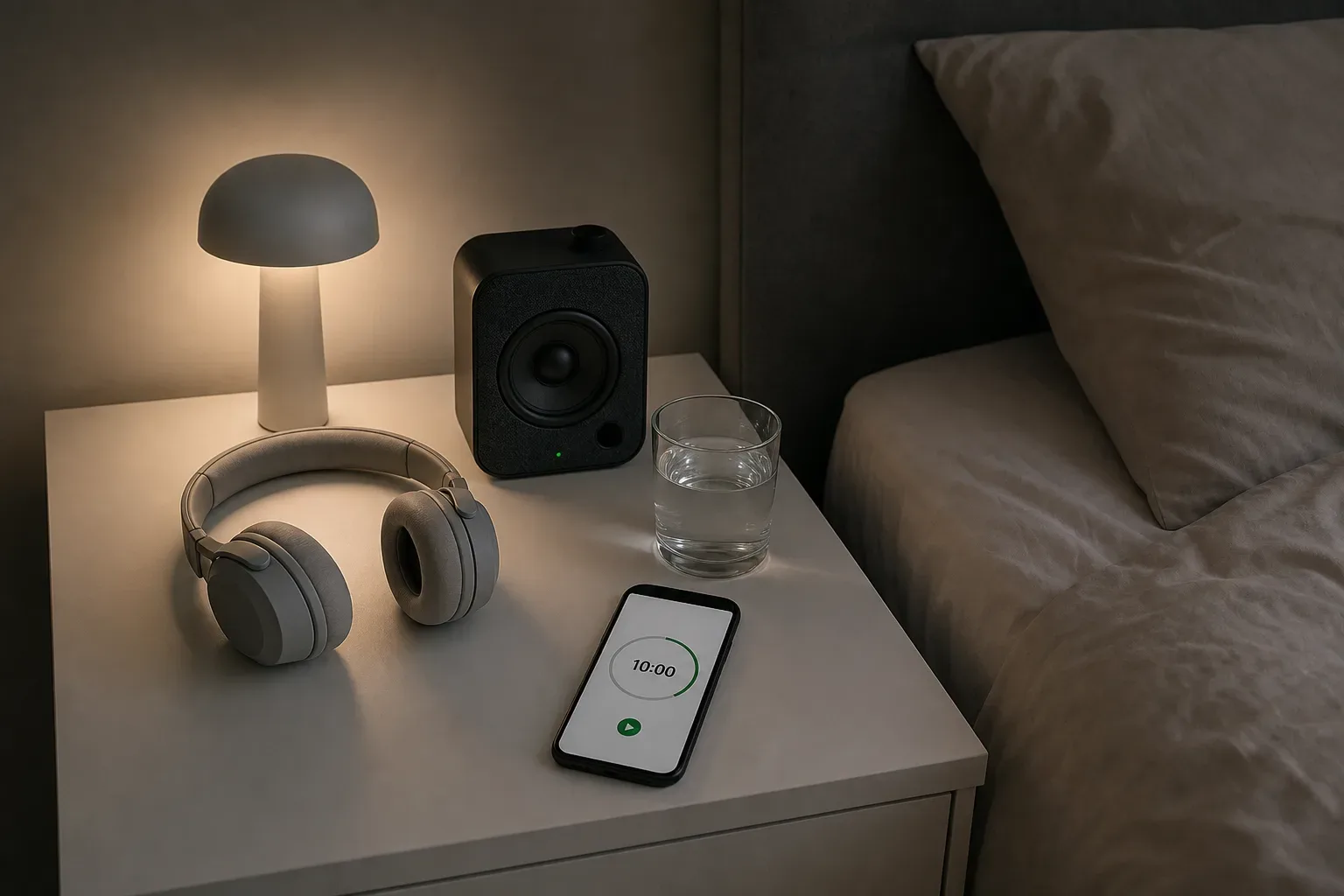
A bedtime routine for sleep can be as short as 10 minutes if it uses the same cue every night: low light, low sound, slower breathing, and no new decisions. The audio does not make you sleep. It teaches your brain that the room is now safe, boring, and closed for the day.
Why can 10 minutes of audio cue sleep?
Ten minutes can help because sleep onset is sensitive to repeated cues, especially when the cue is quiet, predictable, and paired with darkness.
The brain is good at learning sequence. If the same sound arrives after brushing teeth, dimming the lamp, and putting the phone down, the sound becomes part of the sleep context. In cognitive behavioral therapy for insomnia, stimulus control is a core technique: the bed is reserved for sleep and sex, and wakeful activities move elsewhere. The American Academy of Sleep Medicine recommends CBT-I as first-line treatment for chronic insomnia in adults, a position reaffirmed in clinical guidance across the 2010s and 2020s.
Sound is useful because it reaches you without asking for much movement. A steady hum can mask small events: a pipe, a car door, a neighbor’s step. The masking is mechanical. If the background sound fills the same frequency area as the disturbance, the disturbance is less distinct. The White noise generator + guide lets you hear this directly: press play softly, then notice how edges in the room become less sharp.
Sound does not force sleep; it gives the brain a repeatable cue to stop scanning.
There is also a timing reason to keep this routine short. Adults are generally advised to get at least 7 hours of sleep per night, according to the CDC, yet about 1 in 3 U.S. adults report not getting enough. A 45-minute ritual can become another task. Ten minutes is small enough to repeat, and repetition is what makes a cue work.
The target is not instant sleep. The target is a cleaner transition: fewer inputs, fewer choices, a lower sound floor, and a body that has practiced the same descent before.
What should you play in the first two minutes?
Start with steady broadband noise because it masks interruption without asking the mind to follow a melody or a story.
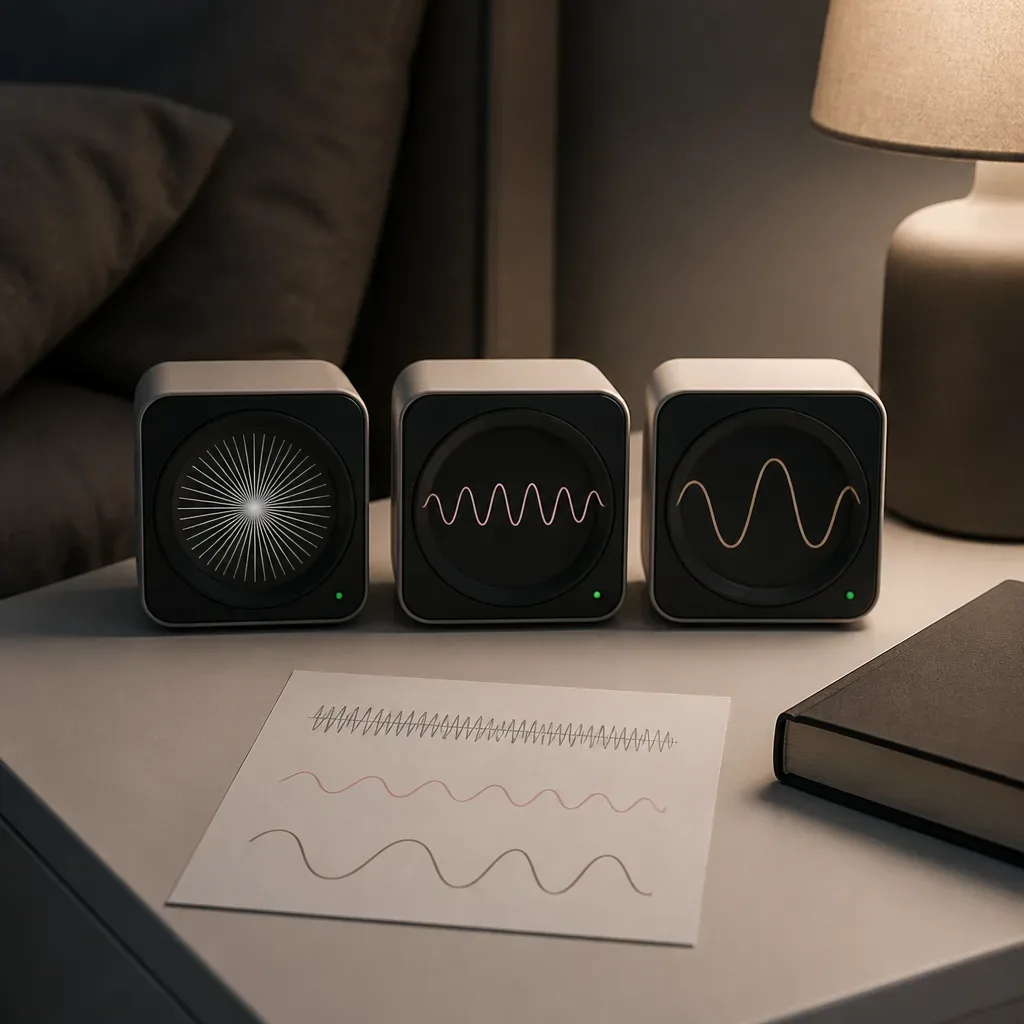
For the first two minutes, choose one sound and keep it low. White noise has equal acoustic power per hertz, so it can sound bright or hissy. Pink noise reduces level as frequency rises, which many people hear as smoother. Brown noise leans lower again, with more low-frequency weight and less high hiss. None of these is inherently better for sleep. The better sound is the one your nervous system stops noticing.
| Sound | What you hear | Best use | Caution |
|---|---|---|---|
| White noise | Bright, even hiss | Masking sharp sounds | Can feel too crisp at bedtime |
| Pink noise | Softer, balanced noise | General sleep masking | Still keep it quiet |
| Brown noise | Low, steady hum | Traffic or distant building noise | Small speakers may distort |
| Sleep music | Slow tones or pads | People who dislike noise | Avoid sudden changes |
Small studies on pink noise and sleep have reported changes in slow-wave activity, but sample sizes are often modest and methods vary. One widely cited 2017 study in Frontiers in Human Neuroscience used timed pink-noise stimulation in older adults and found improved slow-wave activity and memory measures under lab conditions. That does not mean a phone speaker plays you into deep sleep. It means the auditory system can interact with sleep timing in measurable ways.
Bedtime audio works best when it is boring on purpose.
Keep the device away from your hand. If you adjust the track 8 times, the routine becomes a listening session. If silence feels better, use silence. If a low hum helps, use the hum. The point is not to find the perfect frequency; the point is to remove novelty.
How should breath and binaural beats fit in the middle?
Use the middle three to four minutes for slower breathing, and add binaural beats only if they help you settle without strain.
Breathing is the simplest metronome in the room. A comfortable pattern might be inhaling for 4 seconds and exhaling for 6 seconds, repeated for 3 minutes. That gives you about 18 breaths. You do not need breath holds. You do not need to count perfectly. Longer exhalation tends to support parasympathetic activity, though responses vary, and people with respiratory conditions should keep the pattern easy.
Binaural beats are different from ordinary music. When one ear receives a tone at 200 Hz and the other receives 206 Hz, the brain can perceive a 6 Hz beat that is not present in either ear alone. This requires headphones. The Binaural beats generator + guide explains the mechanism and lets you test the difference between theta, alpha, and delta ranges at a low level.
The evidence is mixed. A 2019 meta-analysis by Garcia-Argibay and colleagues in Psychological Research reviewed 22 studies on binaural beats and outcomes such as anxiety, memory, attention, and pain perception. Some effects appeared, especially when exposure happened before or during a task, but the field was heterogeneous. Sleep-specific claims are weaker than many track titles suggest.
A binaural beat is a measured acoustic trick, not a sleep switch.
Here is a plain middle sequence:
- Keep the noise from the first two minutes playing softly.
- Start a 4-second inhale and 6-second exhale.
- If using binaural beats, place them under the noise or music, not above it.
- Stop counting when counting becomes effort.
If the beat makes you alert, remove it. Your sleep routine is allowed to be simpler than your curiosity.
Where does a spoken audio track belong?
A spoken track belongs after the body has already settled, not at the start when the mind is still sorting the day.
Voice is more demanding than noise. Language pulls attention; even a calm sentence invites meaning. That is useful when the words are deliberately chosen and familiar, but it can be too active in the first minutes of a bedtime routine. Put spoken audio around minute 6 or 7, after the room is dim and the breath has slowed.
This is where a short practice can fit. The AYA Method is a daily audio manifestation practice. Each day you listen to a short personalized recording, your Dream-Self Moment, narrated from the version of you who has already manifested the life you intend. Listening is the practice. Repetition is the work. The audio is the method. In a sleep routine, it works best as one known recording, played softly, not as a menu of options.
Keep the spoken portion short. Research on pre-sleep cognitive arousal has long found that worry and mental rehearsal can delay sleep onset; Harvey’s cognitive model of insomnia, published in 2002, remains a common reference point. A familiar voice track should reduce rehearsal, not add a new script to analyze.
If you prefer nonverbal sound, use slow sleep music instead. Choose tracks with a stable level, no bright percussion, and no sudden key changes. The Solfeggio frequencies guide covers the traditional meanings attached to tones such as 396 Hz and 528 Hz, while keeping the evidence plain. If one frequency feels pleasant, that is enough. It does not need a medical claim to be useful at bedtime.
The rule is simple: spoken audio should be familiar enough that you can stop listening to every word.
How loud should bedtime audio be for safe sleep?
Bedtime audio should sit below normal conversation, just loud enough to soften interruptions and quiet enough to forget.
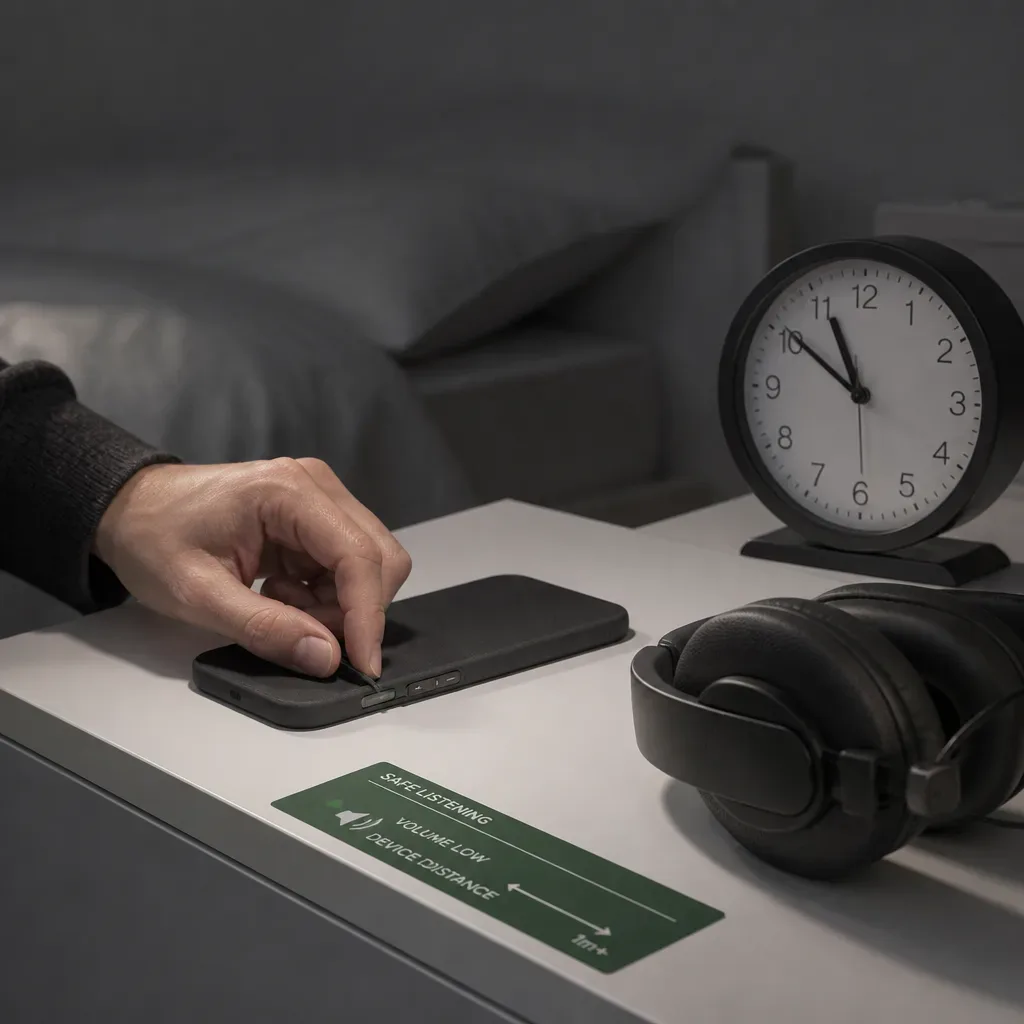
Volume is the part of sleep audio people under-measure. Normal conversation is often around 60 dB at about 1 meter. A quiet bedroom may sit near 30 dB. Many sleepers do well with audio somewhere around 40 to 50 dB at the pillow, but the right number depends on the room and the speaker. A phone decibel app is not a laboratory meter, yet it can keep you from drifting louder night after night.
Occupational limits are not bedtime goals. NIOSH recommends 85 dBA as an 8-hour exposure limit for workers, with allowable time decreasing as volume rises. Sleep listening should be far below that, especially if audio may loop for several hours. Children’s ears deserve extra caution, and headphones in bed should be kept very low.
The safest volume is the one you can forget.
If you have tinnitus, hyperacusis, ear pain, or sudden hearing changes, speak with an audiologist or clinician before building a nightly headphone habit. If you snore loudly, wake gasping, or feel sleepy during the day despite enough time in bed, ask about sleep apnea. Audio can mask a room; it should not mask a medical signal.
Use these checks tonight:
- You can hear your own breathing over the track.
- The sound does not leak clearly into the next room.
- You would not need to raise your voice over it.
- If using headphones, the track feels softer than daytime listening.
- The final level still feels comfortable after 5 minutes.
The low setting is not a compromise. Low volume is part of the cue.
What is the exact 10-minute routine to try tonight?
Use a fixed 10-minute sequence: two minutes of steady noise, three minutes of slower breathing, three minutes of settling audio, and two minutes of fade.
Set it up before you are tired. Decision-making late at night is expensive, and sleep routines fail when they require taste-testing at 11:40 p.m. Choose the track in daylight, set the volume, and save it. If you use the White noise generator + guide, note whether white, pink, or brown noise feels easiest. If you use the Binaural beats generator + guide, choose one beat range and keep it for a week.
Here is the routine:
- Minute 0 to 2: mask the room. Dim the light. Start brown, pink, or white noise below conversation level. Put the device down.
- Minute 2 to 5: slow the breath. Inhale for about 4 seconds. Exhale for about 6 seconds. Keep the jaw loose.
- Minute 5 to 8: play one settling layer. Use a quiet binaural beat, slow music, or one familiar spoken recording.
- Minute 8 to 10: reduce input. Fade the track, or leave only the same low noise if silence wakes you.
- After minute 10: stop managing. No checking, no improving, no searching for a better version.
A 2021 Sleep Foundation review notes that sleep hygiene alone is not a full treatment for chronic insomnia, but consistent timing, light control, and reduced stimulation remain practical supports. This routine sits in that category. It is a cue, not a cure.
Repetition is quieter than effort.
Run the same version for 7 nights before judging it. One night tells you about that night. A week tells you whether the cue is starting to take.
What if the routine does not work after a week?
If it does not help after a week, change one variable at a time and check whether wakefulness is being reinforced in bed.
Start with the simplest edits. Lower the volume. Remove lyrics. Remove spoken audio. Switch from white noise to brown noise if hiss feels sharp. Stop using headphones if they make your ears feel warm or confined. Keep the 10-minute length. Changing five parts at once makes the result hard to read.
Track only three numbers for 7 more nights: lights-out time, estimated sleep-onset time, and number of awakenings you remember. Do not turn this into a sleep surveillance project. The American Academy of Sleep Medicine and Sleep Research Society recommend at least 7 hours for most adults, but quality and regularity matter too. A rough note is enough.
If you are awake for about 20 minutes and becoming frustrated, many CBT-I protocols advise getting out of bed for a quiet, dim activity until sleepiness returns. The bed should not become a place where the brain practices struggle. This is especially relevant if you have spent months trying harder at sleep.
Consider removing audio entirely for a few nights if it becomes the object of attention. Some people sleep best with no added sound once the house is quiet. Others need masking because of traffic, partners, pets, or apartment noise. Yours gets a vote.
Use professional help when the pattern is bigger than a routine: insomnia lasting more than 3 months, panic at bedtime, regular gasping, restless legs, pain, medication effects, or daytime sleepiness that affects driving or work. Audio can support sleep hygiene. It is not a substitute for care.
Keep the room simple, and let the sound grow plain.