sleep science
Guided Sleep Meditation vs Dream-Self Audio Order
A plain comparison of guided sleep meditation and Dream-Self audio: what to play first, when to switch, and how to protect sleep.
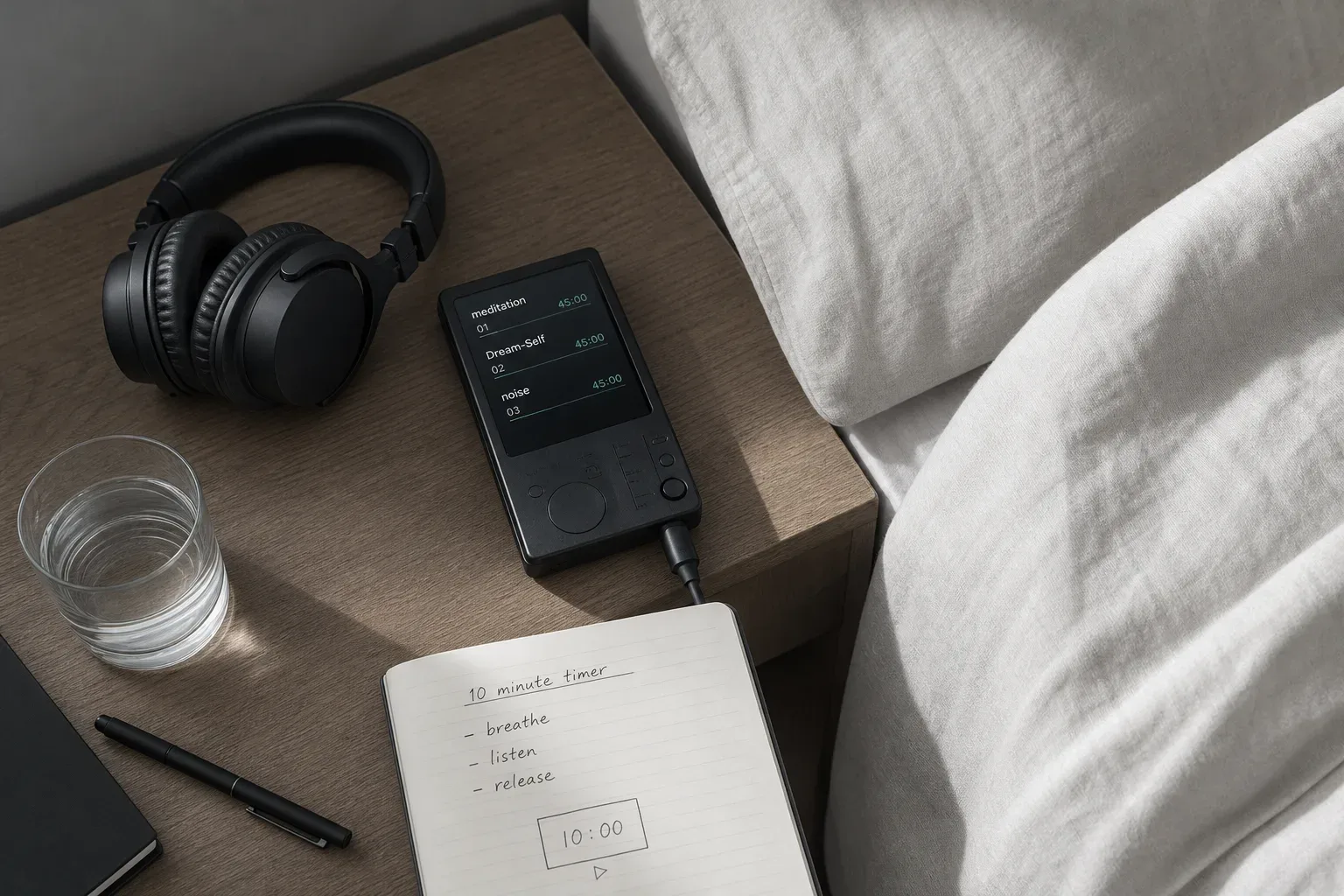
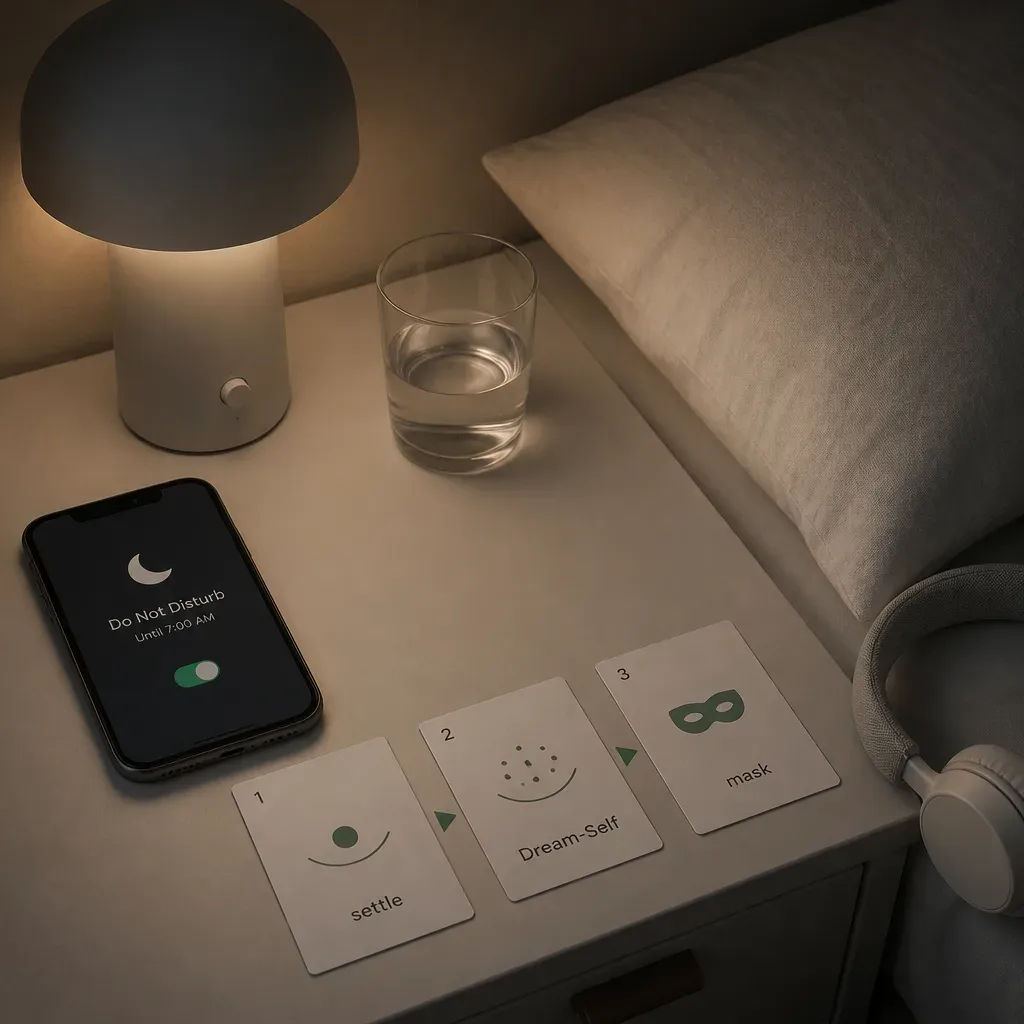
Guided sleep meditation should usually play before Dream-Self audio because it helps the body settle first, then leaves a quieter mental field for intention. Use meditation for 5 to 15 minutes, follow with the Dream-Self recording, and finish with steady background sound only if silence feels too exposed.
Which audio should play first at bedtime?
Guided sleep meditation should usually play first, because it reduces arousal before the more personal Dream-Self audio begins.
A guided sleep meditation is a voice-led track that directs attention toward breathing, body sensation, or a simple image. Its job is not to convince you of anything. Its job is to lower the number of decisions your nervous system is making. The American Academy of Sleep Medicine and Sleep Research Society recommend at least 7 hours of sleep for most adults; a useful audio routine is one that protects that window, not one that expands into it.
Dream-Self audio asks for a different kind of listening. The mind hears future-tense identity language, usually short and specific, and that can be meaningful. Meaning is useful, but it is also more activating than a body scan for some listeners. If your track says something that matters to you, your brain may briefly wake up to inspect it. That is normal. Personal language has more signal than neutral instruction.
The clean order is simple: downshift first, then imprint. In practice, that means guided sleep meditation, then Dream-Self audio, then either silence or a masking sound. If you use the AYA Method, keep its definition plain: The AYA Method is a daily audio manifestation practice. Each day you listen to a short personalized recording, your Dream-Self Moment, narrated from the version of you who has already manifested the life you intend. Listening is the practice. Repetition is the work. The audio is the method.
A quiet routine should have a narrow job description. Sleep audio fails when every track tries to relax you, teach you, inspire you, and carry the night at the same time.
What does guided sleep meditation do that Dream-Self audio does not?
Guided sleep meditation gives the body procedural instructions, while Dream-Self audio gives the self a repeated identity cue.
The mechanism is different. Meditation tracks often cue slow breathing, progressive muscle relaxation, or attentional narrowing. These are measurable behaviors. A 2015 randomized clinical trial in JAMA Internal Medicine studied 49 older adults with sleep disturbance and found that mindfulness awareness practices improved sleep quality more than sleep hygiene education after 6 weeks. That does not mean every sleep meditation works. It does mean a simple attention practice can change bedtime physiology for some people.
Dream-Self audio works less like a relaxation exercise and more like a repeated autobiographical script. It may include calm pacing, but the useful part is the content you return to daily. Neville Goddard wrote about imaginal scenes decades before sleep apps existed; modern listeners often use recorded narration instead of silent rehearsal. Joe Dispenza’s work also popularized future-self rehearsal, though the strongest scientific support is for mental imagery and repetition in narrower behavioral contexts, not for sweeping claims.
Here is the practical split:
| Audio type | Primary job | Best length | Main risk |
|---|---|---|---|
| Guided sleep meditation | Downshift attention and breath | 5 to 20 minutes | Too much talking late at night |
| Dream-Self audio | Repeat a personal future-self script | 2 to 8 minutes | Too activating if played too late |
| White or brown noise | Mask sudden sound changes | Continuous or timer-based | Too loud or too hissy |
| Binaural beats | Provide a steady perceived beat | 10 to 30 minutes | Claims outrun the evidence |
The table matters because order follows function. You do not need all four. You need the smallest set that makes bedtime easier to repeat.
A good sleep stack is not more spiritual or more scientific because it has more layers. It is better when each layer has one job and does it quietly.
How should you build a clean play order tonight?
Build the order around arousal: settle the body, play the personal audio, then remove words.
A reliable bedtime sequence can be short. The National Sleep Foundation commonly frames sleep latency of about 10 to 20 minutes as typical for healthy sleepers, though individuals vary. If your whole audio routine takes 45 minutes before your head even reaches the pillow, it may be solving the wrong problem. The routine should fit inside the time you already have.
Try this 4-part order for 7 nights before changing it:
- Set one device and one timer. Choose airplane mode or Do Not Disturb. Avoid browsing for a better track after lights out.
- Play guided sleep meditation for 5 to 15 minutes. Use a body scan, breath count, or simple relaxation script.
- Play Dream-Self audio once. Keep it short enough that you can hear the full recording without effort.
- Finish with silence, white noise, or brown noise. If the room has traffic, a fan, or hallway sound, use masking at a low level.
For the final layer, use a steady tool rather than more speech. The White noise generator + guide is useful when sound changes are the main problem. Press play and listen for the difference between flat white noise and lower brown noise. Brown noise is not deeper sleep. It is deeper sound, with more low-frequency weight and less hiss.
Volume matters more than the label on the track. Normal conversation is often measured around 60 dB at 1 meter. Bedtime audio should usually sit below that, especially through headphones. If the words are clear at a lower level, lower is the correct setting.
When should Dream-Self audio come before meditation?
Dream-Self audio can come first when meditation makes you sleepy too quickly or when the personal recording is your main daily practice.
Some people fall asleep in the first 3 minutes of a guided sleep meditation. That can be a good sign for sleep and a bad fit for hearing a short personal recording. If you consistently miss the Dream-Self audio, move it earlier. The order is not moral. It is mechanical. Put the track that requires the most awareness before the track that removes awareness.
There is also a memory reason to consider earlier playback. Sleep research has long distinguished between encoding, consolidation, and retrieval. A cue heard while you are fully asleep is not the same as a cue heard while drowsy but awake. Targeted memory reactivation studies often use learned sounds during sleep, but those are controlled lab designs with prior training, not a guarantee that any spoken track will enter memory during the night.
Use Dream-Self audio first if one of these is true:
- You fall asleep before the personal recording starts.
- The recording is 3 minutes or shorter.
- The wording calms you rather than stimulates you.
- You use meditation as a sleep switch and lose awareness quickly.
- You want the same recording at roughly the same time every day.
Then follow with guided sleep meditation only if you still need it. A sleep routine is allowed to be asymmetrical. Some nights need language. Some nights need a low hum.
The right order is the one that preserves both sleep and repetition. If a perfect routine costs you 30 minutes of sleep, it is not perfect.
What role do binaural beats and frequencies play in the order?
Binaural beats and frequency tracks belong after speech or underneath it only when they do not compete with the words.
A binaural beat is an auditory illusion. If one ear receives a 200 Hz tone and the other receives a 206 Hz tone, the listener may perceive a 6 Hz beat. The auditory system tracks the mismatch. The larger claims are mixed. A 2019 meta-analysis by García-Argibay and colleagues in Psychological Research reviewed 22 studies and reported small to moderate effects depending on frequency, duration, and outcome, with substantial variation across designs.
That is why I treat beats as a texture, not a command. A theta-labeled track may help you lie still with headphones on for 20 minutes. That is already a useful behavioral result. It does not prove that your whole cortex has entered a single theta state. Dr. Andrew Huberman has also drawn a useful distinction in public sleep education: tools that shift state are not the same as proof that a specific mechanism did all the work.
If you want to test beats, use the Binaural beats generator + guide before bed on a night when you are not forcing sleep. Headphones are required for true binaural presentation. Keep the level low, and stop if tones feel irritating. For many people, a beat is most useful after guided meditation and before silence, not underneath a spoken Dream-Self track.
Solfeggio tones are different. They come from a modern frequency tradition with numbers such as 396 Hz, 528 Hz, and 852 Hz. Many listeners like them as ritual sounds. The evidence does not support precise claims that one frequency repairs one emotion, but preference is still allowed. The Solfeggio frequencies guide explains the lore and the limits without mocking the listener.
A frequency can be meaningful without being medically proven. The honest question is not “Does this number fix me?” It is “Does this sound help me repeat the practice at a safe volume?”
How do you choose between silence, white noise, and more spoken audio?
Choose silence when the room is stable, white noise when the room changes, and more spoken audio only when rumination is louder than the voice.
After a guided sleep meditation and Dream-Self audio, the safest default is fewer words. Speech keeps the language network engaged. That can be helpful during anxiety or rumination, but it can also keep a tired brain lightly online. A 2021 Pew Research Center report found that 31% of U.S. adults said they were online “almost constantly,” which is one reason bedtime needs fewer prompts, not more.
Masking sound works by reducing contrast. A car door outside is less startling when the room already contains a steady sound bed. White noise contains equal intensity per frequency, which can feel bright. Pink noise reduces intensity as frequency rises. Brown noise tilts lower still. None of these guarantees sleep, but each can make sudden changes less sharp.
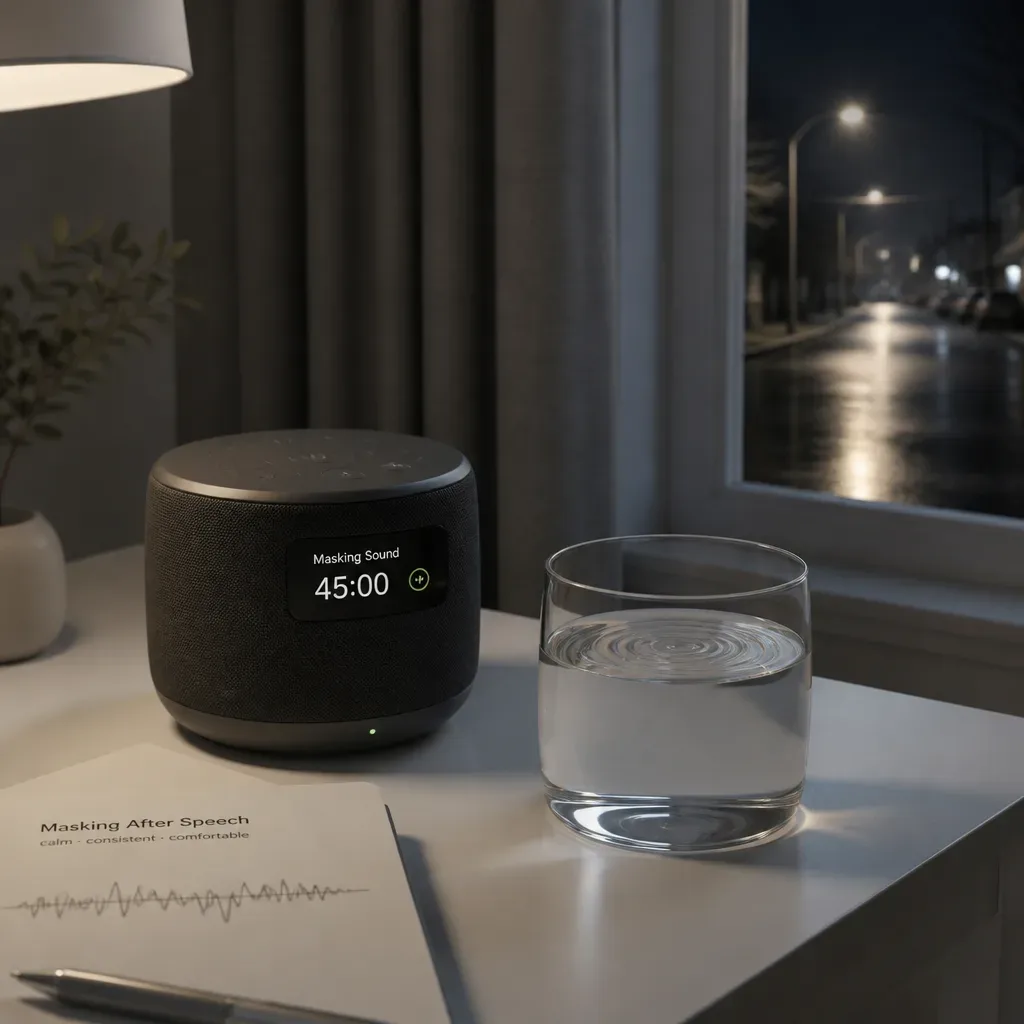
Use this decision rule:
| If your problem is… | Try this after Dream-Self audio | Timer |
|---|---|---|
| Sudden hallway or street sounds | White, pink, or brown noise | 30 to 90 minutes |
| Racing thoughts | A short non-narrative meditation or breath count | 5 to 10 minutes |
| Ear focus or tone sensitivity | Silence or a fan at distance | No timer needed |
| Needing a ritual cue | Same low sound nightly | 20 to 60 minutes |
The White noise generator + guide is a clean place to compare these textures because you can change one variable at a time. Press play below and listen for the difference before you are half asleep. Your nervous system gets a vote, and it often votes by irritation or relief within 30 seconds.
If you have tinnitus, sleep apnea, chronic insomnia, ear pain, or worsening sound sensitivity, use audio conservatively and speak with a qualified clinician. Sleep tools should support care, not replace it.
What is the best order for different kinds of nights?
The best order changes with the night, but it should change by rule rather than mood.
A fixed rule prevents bedtime shopping. The more tracks you audition at 11:40 p.m., the more alert you become. In behavioral sleep medicine, stimulus control is built around consistency: bed is for sleep and sex, not long problem-solving sessions. The exact protocol varies by clinician, but the principle is stable. Reduce the number of awake behaviors paired with bed.
Use these play orders as starting points:
| Night type | Recommended order | Why it works |
|---|---|---|
| Normal tired | Guided sleep meditation → Dream-Self audio → silence | Settles first, then repeats the personal cue |
| Too alert | Longer body scan → Dream-Self audio → brown noise | Adds more downshift before personal language |
| Nearly asleep | Dream-Self audio → 5-minute breath track | Protects the recording before sleep onset |
| Noisy room | Guided sleep meditation → Dream-Self audio → white noise | Ends with masking, not more speech |
| Headphone fatigue | Dream-Self audio on speaker → silence | Reduces ear pressure and device contact |
Keep the test period long enough to learn from it. Seven nights is a practical minimum because a single bad night may reflect caffeine, stress, alcohol, menstrual cycle phase, room temperature, or a late screen. Many sleep studies use multiple nights because first-night effects are real; people often sleep differently when conditions change.
A routine is data if you keep it steady long enough. Change one variable at a time: order, length, voice, volume, or background sound. If you change all five, you will only learn that bedtime became complicated.
The quietest method is often the most repeatable one. Play what helps you return, not what impresses you at midnight.
Let the room get simple before sleep has to arrive.