sleep science
Wake Back to Bed: Where Dream-Self Audio Fits
Use wake back to bed without wrecking sleep: learn when to play Dream-Self audio, how low to set volume, and how to return to rest.
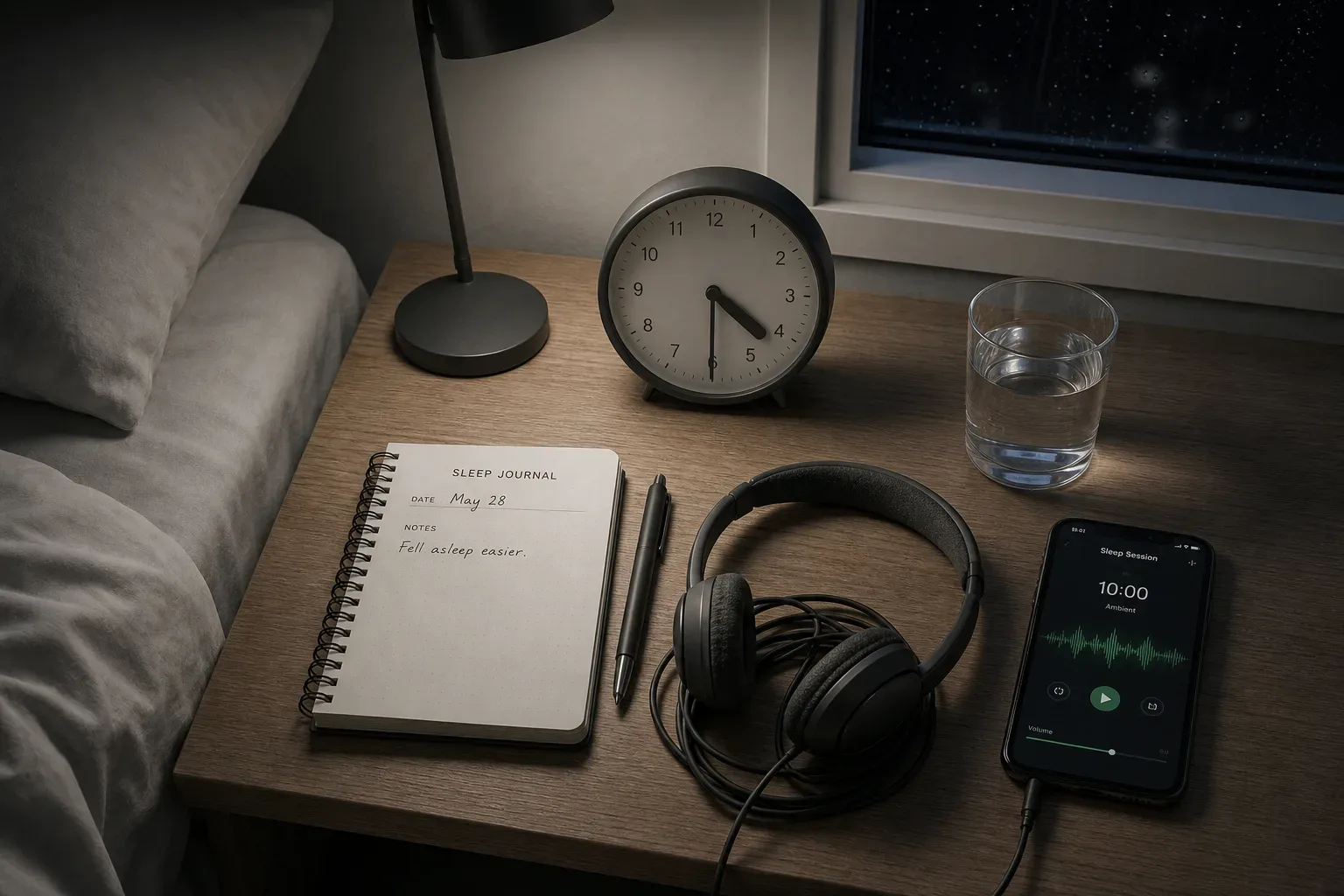
Wake back to bed is a night practice where you wake after several sleep cycles, stay up briefly, then return to sleep with a clear cue. Dream-Self audio belongs at the end of that wake window: one low-volume listen, then lights out again. The goal is placement, not more stimulation.
What is wake back to bed, exactly?
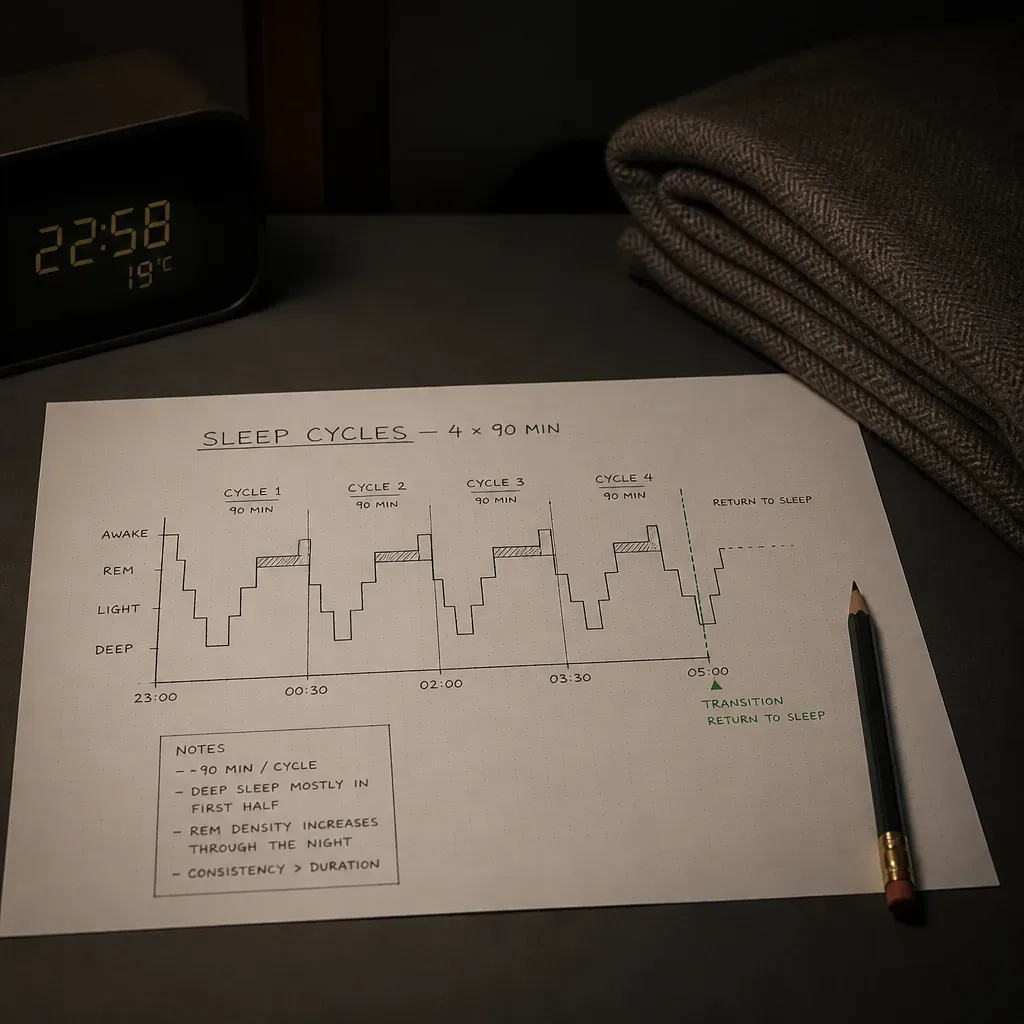
Wake back to bed means interrupting sleep on purpose after about 4.5 to 6 hours, then returning to bed while REM sleep is more available.
The method comes from lucid dream practice, but the sleep timing is ordinary physiology. A full sleep cycle averages about 90 minutes, though studies show normal adult cycles can range roughly from 70 to 120 minutes. Early night sleep tends to hold more slow-wave sleep. Later night sleep tends to hold longer REM periods, which is why dream recall often rises near morning.
In Stephen LaBerge’s lucid dream research at Stanford, planned awakenings were used to increase the chance of remembering intention before re-entering REM sleep. A 2022 review in Consciousness and Cognition described wake back to bed as one of the better-known lucid dream induction tools, though evidence is still mixed and sample sizes are often small. That matters: this is a practice to test, not a guarantee.
Dream-Self audio changes the purpose slightly. You’re not trying to force a lucid dream. You’re placing a short identity cue into a softer state of mind. The AYA Method is a daily audio manifestation practice. Each day you listen to a short personalized recording — your Dream-Self Moment — narrated from the version of you who has already manifested the life you intend. Listening is the practice. Repetition is the work. The audio is the method.
Use wake back to bed only if it doesn’t damage your sleep. The American Academy of Sleep Medicine notes that most adults need at least 7 hours of sleep per night. If a midnight practice cuts that below your baseline, it stops being skillful.
A night practice has to respect the night first.
When should you set the wake back to bed alarm?
Set the alarm after 3 to 4 sleep cycles, usually 4.5, 5, or 6 hours after sleep onset.
If you go to bed at 10:30 p.m. and usually fall asleep by 11:00 p.m., your first test alarm might be 4:30 a.m. That places the wake near the end of the fourth 90-minute cycle. If you wake naturally around 5:00 a.m., use that instead. Natural awakenings are cleaner than alarms because they often occur at cycle boundaries.
The National Sleep Foundation’s public guidance often describes 90 minutes as a useful planning average, not a personal clock. Your body may run shorter or longer. A sleep tracker can give rough hints, but consumer devices still infer sleep stages from movement and heart-rate patterns. In a 2020 validation review, consumer wearables were generally better at estimating sleep versus wake than exact stages.
Use this table as a plain starting point:
| Bedtime sleep onset | First test alarm | Why it may work |
|---|---|---|
| 10:00 p.m. | 3:30 a.m. | About 5.5 hours, later REM more likely |
| 11:00 p.m. | 4:30 a.m. | About 5.5 hours, common work-night fit |
| 12:00 a.m. | 5:30 a.m. | Late enough for dream recall, still before morning |
| 1:00 a.m. | Skip it | Too little sleep for most schedules |
Keep the alarm quiet. A vibration under the pillow or a soft chime is better than a sharp tone. Sound pressure is measured in decibels; for night practice, lower is better. The World Health Organization’s 2018 environmental noise guidance treats sleep as sensitive to noise events, especially repeated ones. If your alarm startles you, it has already done too much.
A good wake back to bed alarm is barely an alarm. It opens the door and leaves quietly.
Where does Dream-Self audio fit during the wake window?
Place Dream-Self audio after any practical tasks and immediately before you return to sleep.
The sequence is simple: wake, stay dim, use the bathroom if needed, write one line of dream recall, play the Dream-Self audio once, then lie down. Don’t play it first if you still need to walk around. Don’t play it three times because you liked the tone. Repetition belongs across days, not inside one fragile wake period.
A brief audio cue works because the mind is already partially primed. Sleep inertia can last from a few minutes to more than 30 minutes, according to controlled laboratory studies on waking performance. In that state, complex planning is poor, but simple cues can be sticky. Your recording should be clear enough to hear without demanding analysis.
The same principle applies to sound preparation. If your room is noisy, use a steady masker before the alarm period, not during the Dream-Self listen. Our White noise generator + guide explains how broadband noise masks sudden sounds by covering a wide range of frequencies. Brown noise may feel lower and softer because it holds more low-frequency content. Pink noise sits between the two.
Use this order for a 12-minute version:
- Minute 0 to 1: Wake and turn off the alarm without checking messages.
- Minute 1 to 3: Use the bathroom or sip water if needed.
- Minute 3 to 4: Write one sentence: dream fragment, mood, or body sensation.
- Minute 4 to 10: Play Dream-Self audio once at low volume.
- Minute 10 to 12: Turn the sound off, lie down, and let the last phrase fade.
For volume, choose the lowest setting where consonants are understandable. As a conservative rule, keep bedside audio below normal conversation level, which is often around 60 dB at 1 meter. If you use earbuds, go lower. Children’s ears need extra caution, and no child needs a wake back to bed routine for manifestation practice.
How long should you stay awake before returning to sleep?
Stay awake for 5 to 20 minutes at first, and only extend the window if sleep remains easy.
Lucid dreaming protocols sometimes use longer wake periods. The well-known MILD technique, tested by LaBerge and later researchers, asks the dreamer to rehearse intention while returning to sleep. Some studies and field reports combine MILD with 30 to 60 minutes awake. That may help recall, but it also raises the cost. A practice that keeps you awake until sunrise is no longer a sleep practice.
For Dream-Self audio, the wake window can be shorter because the recording carries the cue for you. You’re not building a long mental script at 4:30 a.m. You’re listening once, then letting the nervous system settle. The body likes repetition, but it doesn’t like negotiation in the dark.
If you tend toward insomnia, use an even smaller version: wake naturally, play 2 to 4 minutes of audio, and stop. The Journal of Behavioral Medicine has published many studies on relaxation and self-regulation, and a consistent practical theme is that adherence improves when the behavior is small enough to repeat. A tiny night practice done 3 nights a week is more informative than a heroic one that breaks after 2 attempts.
Watch these signs:
- You fall asleep again within about 10 to 20 minutes.
- You remember more dream fragments without feeling strained.
- You wake in the morning within 15 minutes of your usual time.
- Your next-day mood and attention remain steady.
- You don’t start dreading the alarm.
If those signs are absent after 7 attempts, change the placement. Play the Dream-Self audio at bedtime instead, or in the morning after waking. The daily listen matters more than the exotic hour.
Should you add noise, binaural beats, or solfeggio tones?
Add only one support sound, and use it to settle the room rather than compete with the voice.
Layering can become the problem. A Dream-Self recording already contains language, rhythm, and emotional salience. Adding rain, brown noise, 6 Hz theta beats, and 528 Hz underneath may feel ceremonial, but the sleeping brain still has to process sound. In polysomnography labs, researchers score sleep in 30-second epochs because small changes in arousal matter.
If you use binaural beats, understand the mechanism. A binaural beat is an auditory illusion created when each ear receives a slightly different pure tone. The brainstem and auditory cortex register the difference as a perceived pulse. Our Binaural beats generator + guide lets you test that difference directly. Evidence for mood and attention effects is mixed; a 2019 meta-analysis found small effects across studies, with high variation in methods.
Solfeggio tones are different. They come from a modern sound tradition tied to specific numbers such as 396 Hz, 417 Hz, 528 Hz, and 852 Hz. The medieval hymn often named in the genealogy is real; many of the frequency claims were added much later through numerological interpretation. If you like the ritual, use it honestly. Our Solfeggio frequencies guide separates the tradition from the evidence.
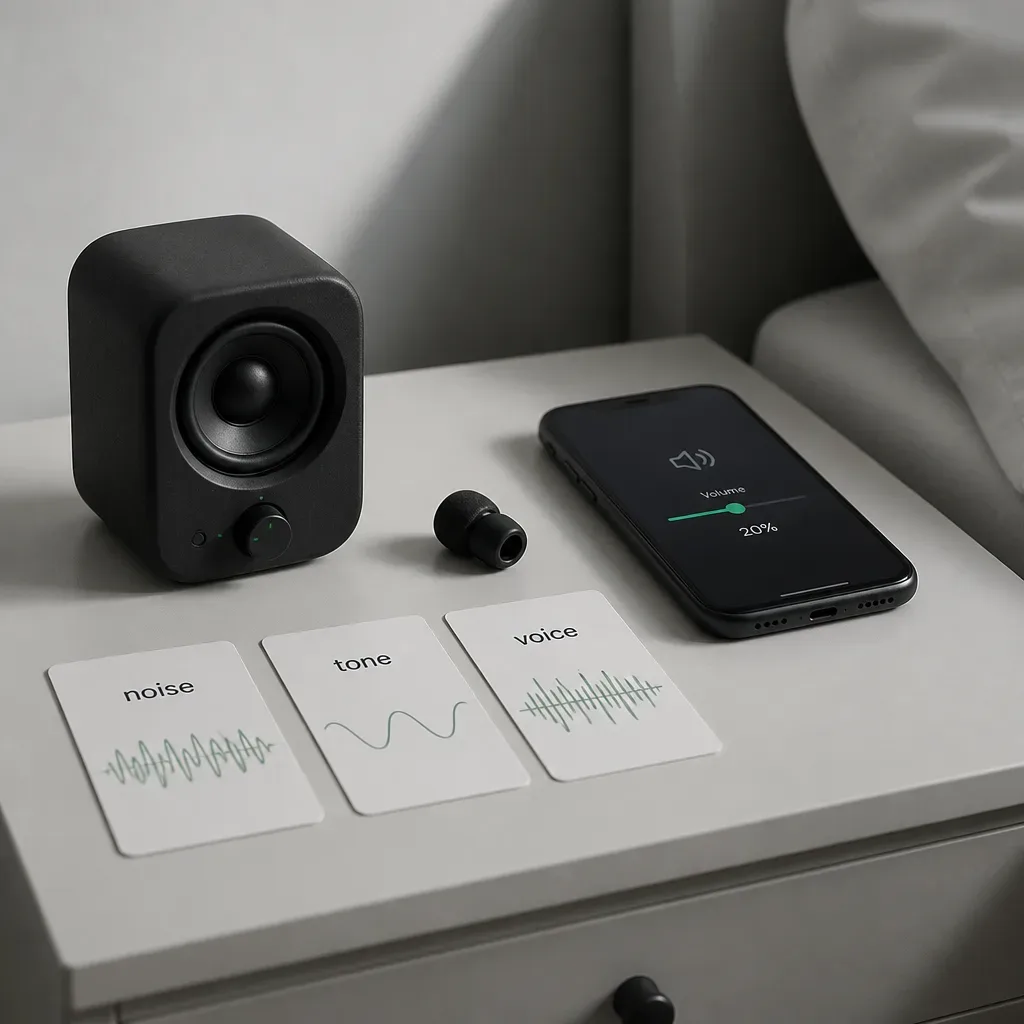
Here is the clean comparison:
| Support sound | Best use in wake back to bed | Caution |
|---|---|---|
| White or pink noise | Before waking, to mask traffic or household sounds | Can hide the Dream-Self voice if left too loud |
| Brown noise | Low hum for people who dislike hiss | Bass can travel through walls |
| Binaural beats | Short test while awake, with headphones | Not ideal if headphones disturb sleep |
| Solfeggio tone | Ritual anchor at very low volume | Claims are traditional, not medical evidence |
| Silence | Best default after the audio ends | May reveal room noise if you’re sensitive |
Press play below the relevant guide and listen for the difference before using it at night. Testing sounds at 2:00 p.m. protects the 4:30 a.m. version of you.
What if the audio wakes you up too much?
If the audio makes you alert, shorten it, lower it, or move it out of the wake back to bed window.
Voice is stimulating for some people. It carries meaning. A phrase about your future self may bring images, plans, and emotion. That can be useful at bedtime or morning, but at night the threshold is narrow. Dr. Andrew Huberman often describes sleep as sensitive to light, temperature, and alerting cues; the same practical idea applies here, even when the cue is positive.
Start by removing the obvious irritants. Turn off autoplay. Disable notifications. Download the recording so the screen doesn’t stay bright. Use night mode and the dimmest possible display. Light exposure in the blue range can suppress melatonin; classic work by Brainard and colleagues in 2001 showed strong wavelength sensitivity around 460 nm. You don’t need perfect darkness for one tap, but you do need less light than a phone usually gives.
Then adjust the recording itself. A Dream-Self Moment for night use should be slower than a morning version. Leave space between sentences. Keep the total under 8 minutes. If your personal audio is 12 minutes or longer, use a trimmed night cut and save the full version for daytime listening.
Try this troubleshooting ladder for 7 nights before abandoning the method:
- Lower volume by 2 phone steps.
- Shorten the wake window by 5 minutes.
- Use only one earbud or a bedside speaker instead of sealed headphones.
- Move the alarm 30 minutes later.
- Play the audio at bedtime and use wake back to bed only for dream recall.
If you’re awake for more than about 30 minutes, stop practicing and return to normal sleep hygiene. Chronic insomnia, tinnitus, sleep apnea symptoms, or panic on waking deserve professional support, not more nighttime experiments.
How do you test wake back to bed for one week?
Test one version for 7 nights, track 3 measures, and change only one variable at a time.
The first measure is sleep return time: how long it takes to fall asleep again. You don’t need a precise number; use ranges such as under 10 minutes, 10 to 20 minutes, 20 to 30 minutes, and over 30 minutes. The second measure is dream recall: none, fragment, clear scene, or lucid moment. The third is next-day steadiness: low, medium, or good.
This small tracking method matters because night memory is unreliable. Pew Research Center has reported that many adults already use phones for health information and tracking, but more data doesn’t always mean better practice. For this, 3 hand-written marks are enough. The Manifestation Board and daily affirmation can support your daytime orientation, but for this protocol the audio is the method and the night data stays plain.
Use a weekly sheet like this:
| Night | Alarm time | Audio length | Return to sleep | Dream recall | Next-day steadiness |
|---|---|---|---|---|---|
| 1 | 4:30 | 6 min | 10–20 min | Fragment | Good |
| 2 | 4:30 | 6 min | Under 10 min | Clear scene | Medium |
| 3 | 4:30 | 6 min | Over 30 min | None | Low |
After 7 nights, read the pattern without drama. If return to sleep is easy on at least 5 nights and next-day steadiness is mostly good, the placement is viable. If 3 or more nights are poor, move the practice to bedtime or morning.
For a softer room, compare steady noise options before bed with the White noise generator + guide. For tone-based curiosity, test the Binaural beats generator + guide in the afternoon, not during your first week of wake back to bed. Keep variables quiet. The fewer moving parts, the clearer the signal.
The best night practice is the one your morning self can forgive.
A small sound, placed well, can be enough.