sleep science
Best Sleeping Position to Hear Dream-Self Audio Clearly
Find the best sleeping position for hearing Dream-Self audio clearly at bedtime, with pillow, headphone, volume, and room-noise guidance.
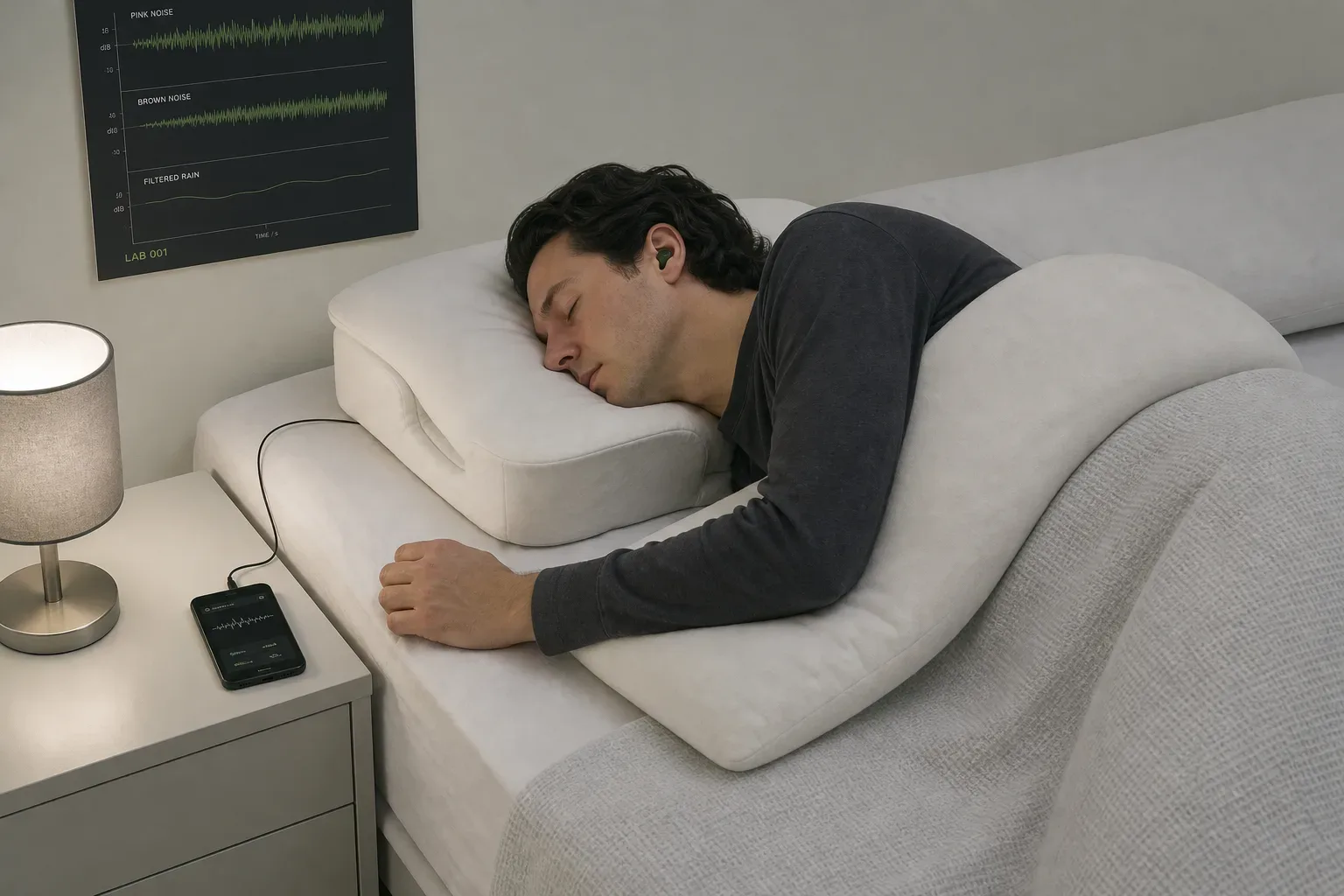
The best sleeping position for hearing Dream-Self audio is usually supported side lying with the listening ear uncompressed, the device stable, and volume low enough for safe sleep. Back sleeping can work better with pillow speakers. The practical target is simple: clear words, relaxed breathing, and no pressure in the ear canal.
What position gives the clearest Dream-Self audio in bed?
Supported side lying is the clearest position for most people because it keeps the body still while letting one ear face the audio source.
For a short personalized recording, clarity depends on three ordinary variables: distance from the speaker, pressure on the ear, and room noise. A 2021 survey from the Better Sleep Council reported that side sleeping is the most common adult sleep posture in the United States, with roughly 60 percent of adults preferring one side. That matters because your best setup should serve the position you already use, not the posture you wish you used.
If you use earbuds, the upper ear is usually the better listening ear. Lie on your left side and listen through the right ear, or reverse it. This avoids pressing the earbud into the pillow, which can change fit, reduce treble detail, and irritate the ear canal. A voice recording lives heavily between about 100 Hz and 4 kHz, with speech intelligibility relying on consonants in the higher part of that band. When fabric or pressure dulls those frequencies, the words may sound present but not precise.
Back sleeping can be clean if you use a pillow speaker, low-profile sleep headphones, or a phone on the bedside table. It is less reliable with standard earbuds because the head may turn during sleep. Stomach sleeping is usually the least useful for bedtime audio because the neck rotates, one ear compresses, and cables or devices shift more often.
A good position is not dramatic. It is repeatable. The body settles faster when the setup asks for fewer corrections.
| Position | Best device | Audio clarity | Main caution |
|---|---|---|---|
| Side lying, upper ear listening | Single earbud or open-ear band | High | Avoid pressure on lower ear |
| Back lying | Pillow speaker or sleep headphones | High | Keep volume low and timer on |
| Side lying, pillow speaker | Flat speaker under pillow edge | Medium to high | Fabric can soften consonants |
| Stomach lying | Usually not ideal | Low to medium | Neck rotation and device movement |
How should you set up the pillow, ear, and device?
Place the pillow and device so the audio path stays open without pushing hardware into your ear.
Start with the pillow. A medium-height pillow often works better than a high, firm one because it supports the neck without folding the ear. Cervical position matters: in a 2017 review in the Journal of Physical Therapy Science, pillow height and neck angle were linked to sleep comfort and morning stiffness, even though the research base was not large. Comfort is not a luxury here. If the neck is tense, attention keeps returning to the body instead of the recording.
Use this sequence tonight:
- Lie in your normal starting position for 30 seconds without audio.
- Notice which ear is free and which ear is compressed.
- Put the audio source near the free ear, not under the compressed one.
- Press play and reduce volume until the words require slight attention.
- Move the device 10 to 20 cm at a time until consonants are clear.
- Stop adjusting once the voice is plain enough to follow.
For earbuds, shallow fit is safer than a deep seal at bedtime. Deep insertion can increase occlusion, the low booming sound of your own breathing or jaw movement. For pillow speakers, place the speaker near the pillow edge rather than directly under the center of the head. A few centimeters can change the sound more than one volume notch.
If you combine a Dream-Self recording with masking sound, keep the voice in front. Our White noise generator + guide is useful for testing this: set the noise first, then add the voice only as loud as needed. Noise should soften the room, not cover the sentence.
What volume is clear enough without being too loud?
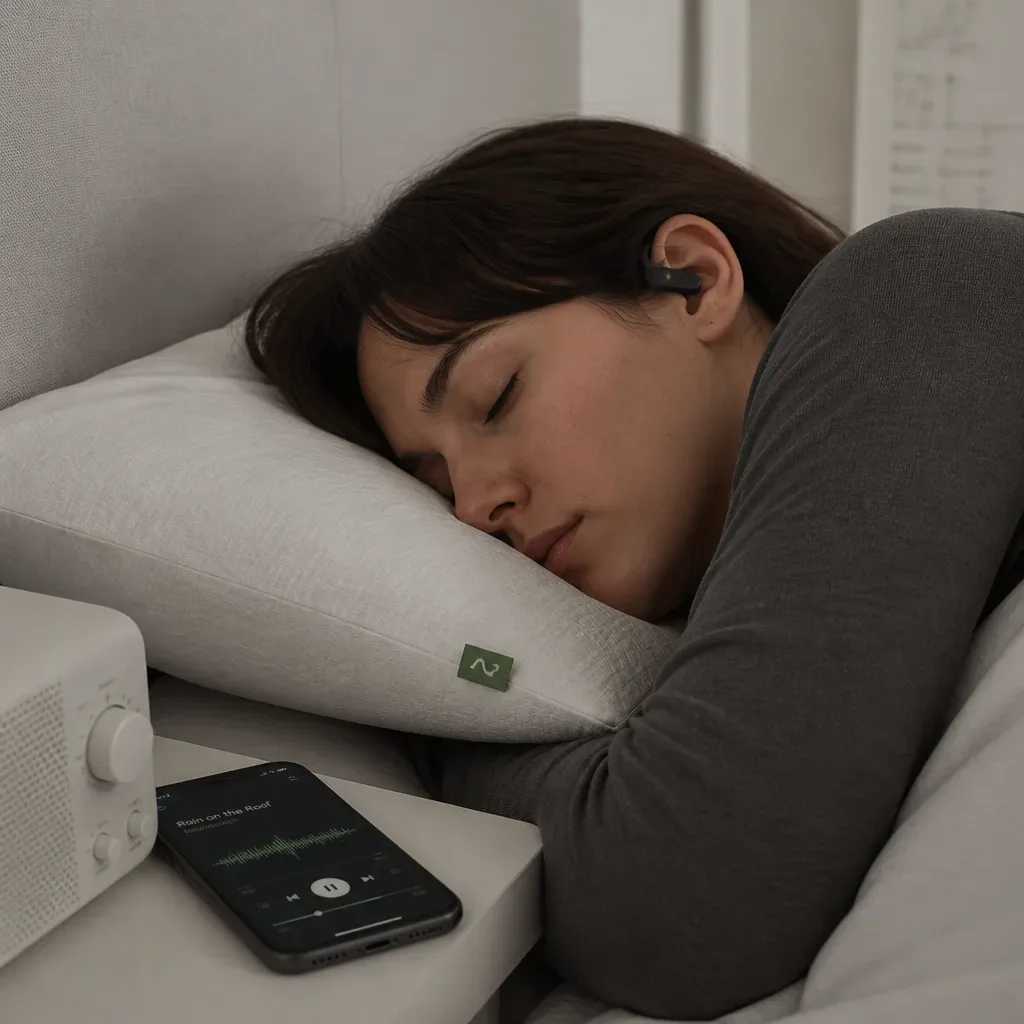
Use the lowest volume that lets you understand every word while lying still, then set a sleep timer.
A useful anchor is ordinary conversation, often measured around 60 dB at about 1 meter. Bedtime audio does not need to compete with a train platform or gym. The World Health Organization’s 2019 safe listening guidance discusses weekly exposure limits near 80 dB for adults and 75 dB for children, depending on duration. Sleep listening should sit well below that when possible, especially because you may stop monitoring the sound once you drift off.
Clarity is not the same as loudness. A quiet voice with clean consonants is easier to follow than a louder voice buried under fan noise. If you keep raising the volume, fix the room first: close the window, move the phone closer, lower the masking track, or switch to one clear ear. The ear should not have to work hard at midnight.
Use a conservative test:
- If you can hear the recording from across the room, it is probably too loud for bedside use.
- If the words blur when you breathe normally, move the speaker before increasing volume.
- If the sound feels sharp after 2 minutes, lower the treble or volume.
- If you wake with ear tenderness, change the device before the next night.
The National Institute for Occupational Safety and Health uses 85 dBA over 8 hours as an occupational exposure limit, not a bedtime target. That number is often misunderstood. For sleep, the better principle is softer, closer, and shorter.
The right bedtime volume is the level you can forget without losing the words.
If you have tinnitus, ear pain, sudden hearing changes, sleep apnea, or chronic insomnia, ask a qualified clinician rather than trying to solve it with louder audio.
Should you use one ear or both ears for Dream-Self audio?
One clear ear is usually enough for spoken Dream-Self audio, while both ears can feel more balanced if the device is comfortable.
Speech is highly redundant. The brain can understand a familiar voice with one ear if the signal is clean and the room is quiet. Audiology tests often measure speech recognition separately by ear for this reason. For Dream-Self audio, where the recording is short and repeated daily, the main job is not stereo imaging. The main job is intelligibility.
Two ears become more important when you add spatial music, binaural beats, or layered sound design. A binaural beat requires separate tones delivered to left and right ears; speakers generally will not create the same effect. If your wind-down includes tones before the voice, read our Binaural beats generator + guide and use proper stereo headphones at a low level. Then, for the spoken Dream-Self Moment, you can switch to the most comfortable clear setup.
There is a tradeoff. Two earbuds may improve balance, but side sleeping can press one earbud into the pillow. One earbud in the upper ear may be less symmetrical, but it is often kinder to cartilage and more stable over 5 to 10 minutes. The better choice is the one you will repeat without irritation.
The AYA publication network defines the AYA Method precisely: it is a daily audio manifestation practice. Each day you listen to a short personalized recording, your Dream-Self Moment, narrated from the version of you who has already manifested the life you intend. Listening is the practice. Repetition is the work. The audio is the method.
That definition has a practical consequence. You do not need an elaborate sound rig. You need a position that lets you hear the recording clearly enough to return to it tomorrow.
How do room noise and masking sounds change the best sleeping position?
Room noise can make a different position better because it changes which ear receives the cleanest signal.
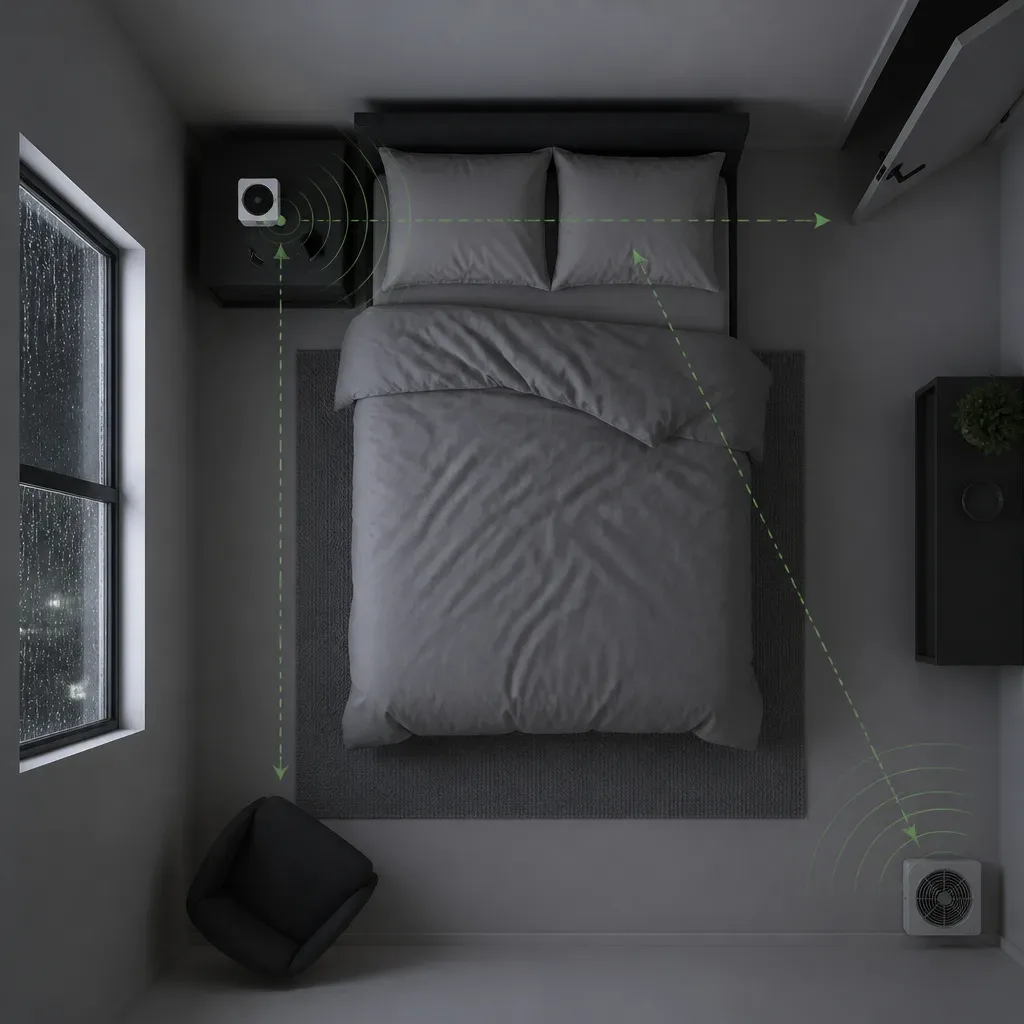
If traffic is on the left side of the room, lying on your right side may put the pillow between your exposed ear and the noise. If a fan sits near your head, the opposite may be true. Small acoustic changes matter. Sound level drops by about 6 dB each time distance doubles in a free field, though bedrooms are more reflective than lab spaces. Moving a phone from 80 cm to 40 cm can make speech clearer without raising device volume.
Masking sound works best when it is steady and lower than the voice. White noise spreads energy across frequencies and can hide hiss, speech from another room, or small clicks. Brown noise has more low-frequency weight and often feels softer to people who dislike high hiss. Neither is deeper sleep by itself. It is a tool for reducing contrast.
If you use frequency-based tracks, keep the evidence plain. Solfeggio frequencies are a listening tradition with named tones such as 396 Hz, 528 Hz, and 639 Hz. Some people like them for ritual and tone color; strong medical claims are not established. Our Solfeggio frequencies guide separates the tradition from the evidence so you can use the sound without pretending it has been proven to do more than it has.
Try this room map for 3 nights:
| Noise source | Better first adjustment | Why it helps |
|---|---|---|
| Street outside one wall | Turn free ear away from window | Pillow and head add mild shielding |
| Partner breathing or snoring | Use low masking noise near your side | Steady sound reduces contrast |
| HVAC vent above bed | Move phone closer by 20 cm | Improves voice-to-noise ratio |
| Neighbor bass | Brown noise at low level | Low hum may cover fluctuations |
A steady room is easier to hear than a silent room that keeps breaking.
What is the 12-minute bedtime setup for clear listening tonight?
The simplest clear-listening routine takes about 12 minutes and changes only one variable at a time.
First, separate preparation from listening. Spend 2 minutes arranging the room: close the door, set the phone to do-not-disturb, and choose whether you need masking noise. If you do, press play below or use the White noise generator + guide before the voice. Keep the masking layer low enough that whispered speech would still be understandable.
Second, spend 3 minutes finding position. Lie in your usual posture, not the posture from a sleep article. If you are a side sleeper, use the upper ear. If you are a back sleeper, use a pillow speaker or low-profile headphones. If you roll often, avoid anything that can wedge into the ear canal. A 2019 paper in Nature and Science of Sleep noted that sleep position can influence snoring and breathing events in some people, which is one reason comfort and airway ease should come before perfect audio geometry.
Third, spend 2 minutes setting volume. Use the speech test: every word should be clear, but the voice should not feel close or bright. If you are using stereo music first, keep it separate from the spoken track. For tone-based settling, you can compare options in the Binaural beats generator + guide, then return to the voice once the body is quiet.
Fourth, listen once. Do not restart the recording because one sentence drifted past. Daily repetition does the repair. Neville Goddard wrote about entering sleep with a chosen inner scene; Joe Dispenza often emphasizes rehearsal and repetition in meditative practice. Those are not sleep-audio trials, but they point to the same behavioral fact: repeated cues become easier for the nervous system to recognize.
Use this 12-minute order:
- Minutes 0 to 2: quiet the room and choose masking only if needed.
- Minutes 2 to 5: settle into side or back position and check ear pressure.
- Minutes 5 to 7: set volume for clear speech, not loud speech.
- Minutes 7 to 10: listen to the Dream-Self audio once.
- Minutes 10 to 12: remove uncomfortable devices or let a timer fade the sound.
The method should leave less to manage, not more.
How do you know your position is working after a week?
Your position is working if you hear the words clearly, feel no ear pressure, and fall asleep without repeated adjustments on most nights.
Track only a few signals. Sleep diaries are used in cognitive behavioral therapy for insomnia because simple self-report patterns can reveal what the night felt like, even when they are not as precise as polysomnography. You do not need lab precision. You need enough information to stop guessing. For 7 nights, write down position, device, volume level, and whether the words were clear.
A simple scoring system helps:
| Signal | 0 | 1 | 2 |
|---|---|---|---|
| Word clarity | Mostly missed | Some effort | Clear enough |
| Ear comfort | Pain or pressure | Mild awareness | No issue |
| Body settling | Restless | Some shifting | Still within 5 minutes |
| Morning memory | None | One phrase | Main idea |
A total of 6 to 8 usually means the setup is serviceable. A score below 5 for two nights in a row means change one thing only: device, side, pillow height, or masking level. Do not change all four. The nervous system learns repeated conditions, and the data becomes useless when every night is a new experiment.
If the audio is clear but sleep worsens, shorten the routine. If sleep improves but words blur, move the sound source closer before raising volume. If one ear gets sore, stop using in-ear hardware for a few nights. Pillow speakers, open-ear bands, or a bedside speaker may be less precise, but comfort often wins at 11:30 p.m.
Precision at bedtime is not perfection. It is the removal of small irritations.
The best sleeping position is the one quiet enough to repeat.
Stay with the hum that lets the words arrive.