sleep science
Waking Up at 3am: Use Dream-Self Audio Without Resetting
Waking up at 3am can be handled without checking the clock or restarting bedtime. Use Dream-Self audio softly, briefly, and screen-free.
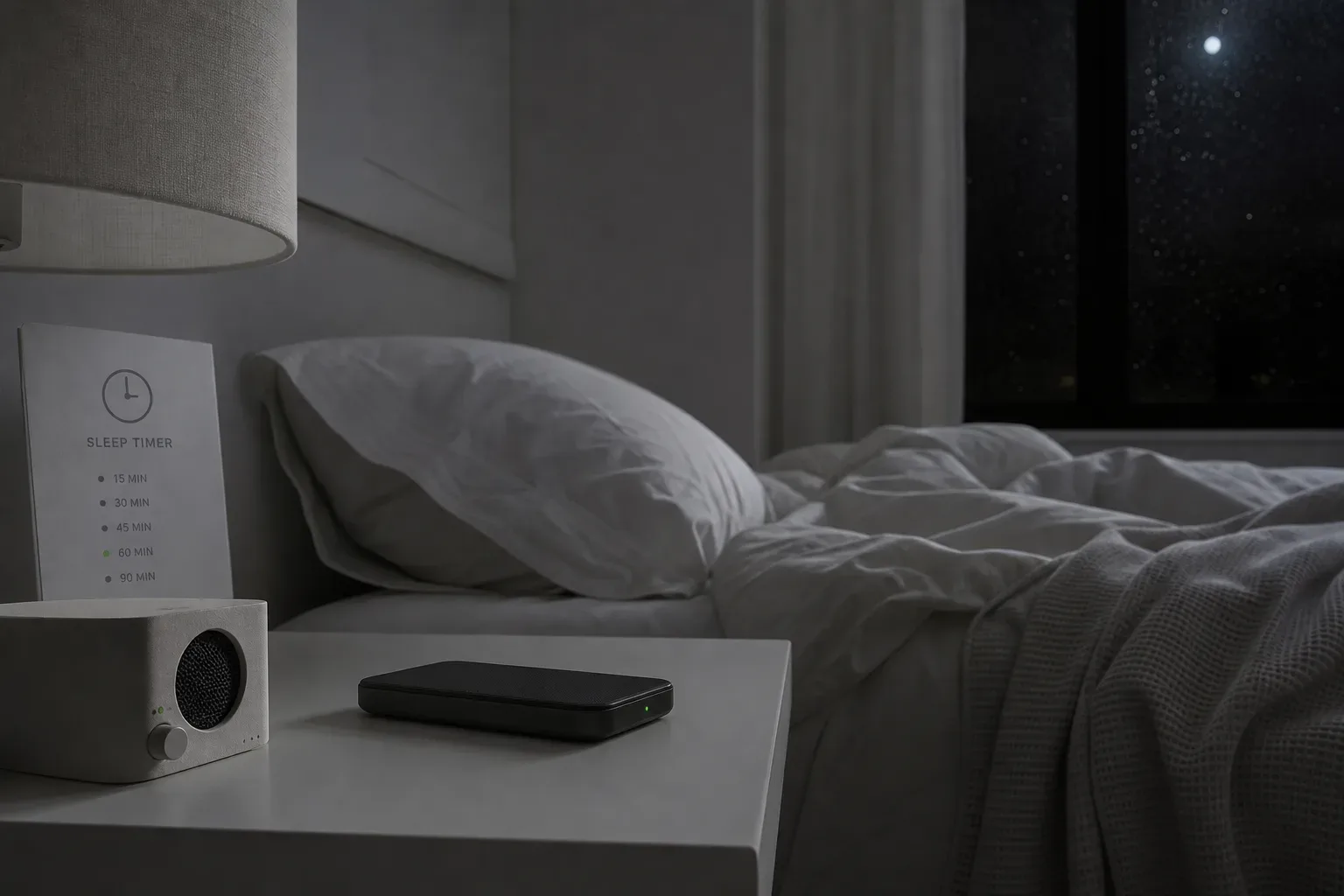
Waking up at 3am is usually a normal night waking that becomes disruptive when you add light, clock-checking, or effort. Use Dream-Self audio only if it is already queued, quiet, and familiar. The aim is not to restart bedtime. It is to stay inside the night signal and let sleep return.
What is happening when you are waking up at 3am?
Waking at 3 AM often means you have surfaced between sleep cycles, not that something has gone wrong.
Adult sleep runs in cycles of roughly 90 minutes, though real cycles vary from about 70 to 110 minutes. In the second half of the night, rapid eye movement sleep tends to lengthen, body temperature begins to rise, and cortisol starts its normal early-morning climb. The American Academy of Sleep Medicine and Sleep Research Society recommend at least 7 hours of sleep for most adults, but those hours are rarely one unbroken block.
A 3 AM wake-up becomes memorable because the room is quiet and the thinking brain comes online quickly. You may notice one thought, then the thought notices the clock, then the clock becomes a problem. A 2018 review in Sleep Medicine Clinics describes nocturnal awakenings as common across insomnia presentations, but the distress around the waking often matters as much as the waking itself.
A 3 AM wake-up is a threshold, not a verdict. If you stay low, dark, and uninteresting, the nervous system often has less to solve. If you add a bright screen, calendar math, or an emotionally charged audio choice, you teach the body that this wake-up deserves full attention.
There are exceptions. If waking is paired with choking, gasping, chest pain, severe anxiety, restless legs, or daytime sleepiness despite enough time in bed, treat it as health information and speak with a clinician. Sleep apnea affects an estimated 10 to 30 percent of adults in many population studies, and it is not solved by a better playlist.
Should you play Dream-Self audio during a 3 AM wake-up?
Yes, but only when the audio is familiar, short, and easy enough to start without waking yourself further.
The AYA Method is a daily audio manifestation practice. Each day you listen to a short personalized recording, your Dream-Self Moment, narrated from the version of you who has already manifested the life you intend. Listening is the practice. Repetition is the work. The audio is the method.
At bedtime or after a gentle waking, that can be useful because voice gives attention a place to rest. At 3 AM, the rules are stricter. The recording should not ask you to plan, visualize intensely, revise goals, read affirmations, or build a Manifestation Board. Those can be helpful complements at another hour. They are too active for the middle of the night.
The safest test is simple: can you start it in under 10 seconds with your eyes mostly closed? If the answer is no, use neutral sound instead. Cognitive behavioral therapy for insomnia, or CBT-I, often teaches stimulus control and reduced wakeful effort; the American College of Physicians recommended CBT-I as first-line treatment for chronic insomnia in 2016. Your audio choice should support that same principle: less effort, not more.
If the audio makes you care about the outcome, it is too active for 3 AM. The words should feel known enough that you do not chase them. You are not trying to perform belief in the dark. You are giving the mind a quiet rail to hold while the body decides whether sleep is available again.
How should you set up the audio before bed?
Set up everything before sleep so the 3 AM version of you has almost nothing to operate.
The practical preparation takes about 5 minutes, and it matters more than the perfect track. The National Institute for Occupational Safety and Health sets 85 dBA as an 8-hour occupational exposure limit, but sleep audio should sit far below that. Near the pillow, many people do well around 40 to 50 dB, roughly softer than ordinary conversation. If you cannot measure, choose the lowest level where the voice is just clear.
Use this pre-sleep checklist:
- Put the recording in the first position of a playlist or shortcut.
- Turn off autoplay so another track does not begin by surprise.
- Set the screen to the dimmest possible mode, then avoid opening it.
- Place the device where you can reach one button without lifting your head.
- Test the volume while lying down, because pillow distance changes loudness.
- Set a sleep timer for 5 to 15 minutes if the app allows it.
If you need masking first, use a steady sound before the voice. The White noise generator + guide is useful when traffic, neighbors, or a refrigerator click keeps pulling attention outward. White noise has equal intensity per hertz, so it can sound bright; many sleepers prefer pink or brown noise because the low bands feel less sharp.
Binaural tracks are different. A binaural beat is created when each ear receives a slightly different tone, and the brainstem tracks the difference. The Binaural beats generator + guide explains why headphones are required and why evidence for mood or sleep effects remains mixed. For 3 AM use, do not add headphones unless they already feel normal.
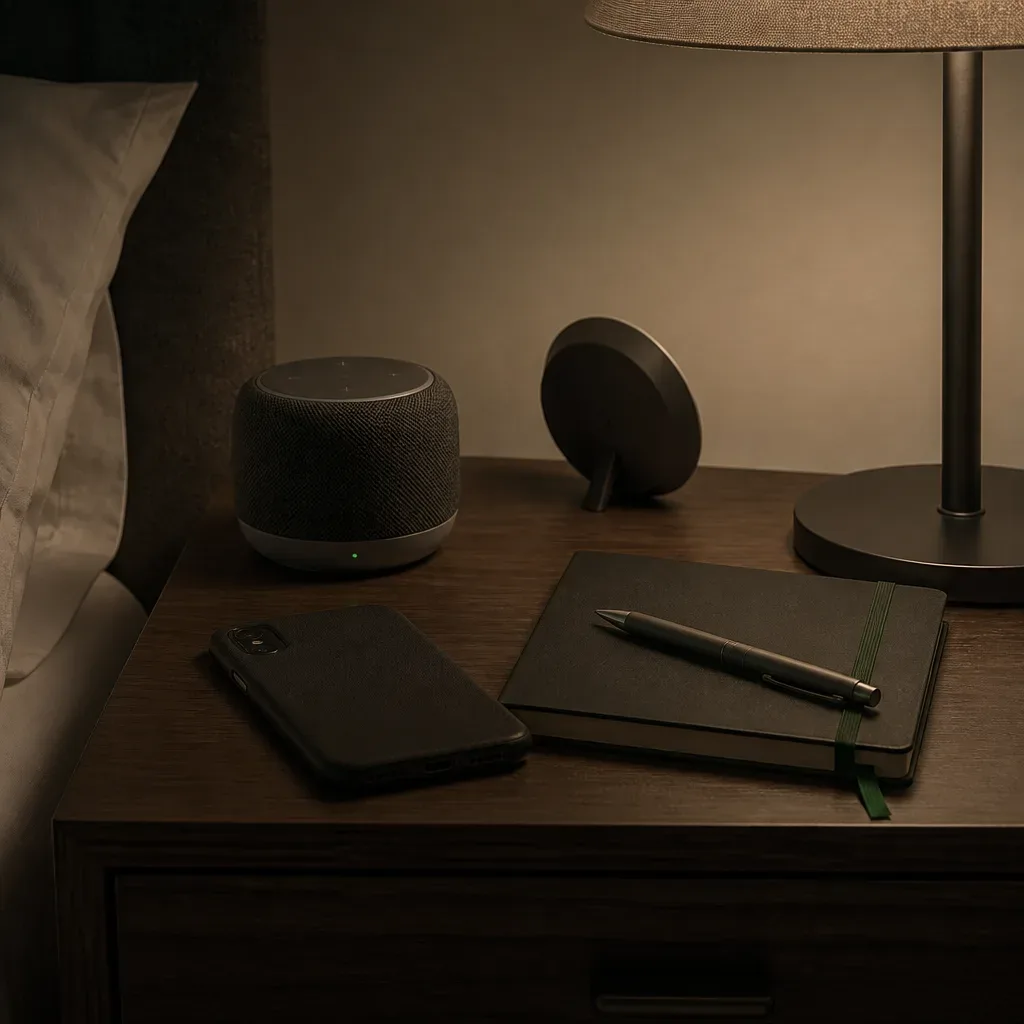
What should you do in the first 10 minutes after waking?
Keep the first 10 minutes boring, dark, and physically small.
The goal is not to win sleep; the goal is to stop negotiating with wakefulness. If you wake and know you are awake, do not check the exact time. Clock-checking turns a body sensation into a calculation. In sleep research, worry about sleep is a known maintaining factor for insomnia; CBT-I protocols often reduce clock visibility for this reason.
Use this sequence when you notice the wake-up:
| Minute | Action | Why it helps |
|---|---|---|
| 0 to 1 | Keep eyes closed or half-closed | Less light reaches the retina |
| 1 to 2 | Exhale slowly 3 times | Longer exhales can lower arousal |
| 2 to 3 | Press play if audio is ready | One movement is better than searching |
| 3 to 8 | Let the voice run without analysis | Familiar speech holds attention lightly |
| 8 to 10 | If more alert, stop and switch to neutral sound | The method should not become effort |
Dr. Andrew Huberman often summarizes the light mechanism plainly: light exposure in the middle of the biological night can shift circadian timing. The strongest laboratory work on circadian phase shifting comes from controlled light studies, where intensity, timing, and wavelength are measured. Your phone is not a lab device, but it is bright enough to matter when your pupils are dark-adapted.
If you do play Dream-Self audio, listen as if it is rain with language in it. You do not need to agree with every sentence. You do not need to picture anything. Repetition works best when it stays boring enough for the body to trust it.
After about 10 minutes, make one clean decision. If you are drifting, leave the track alone. If you are more alert, stop it and use a simpler layer: fan sound, brown noise, or quiet room tone. Do not turn a soft practice into a second bedtime.
What should you avoid because it resets the night signal?
Avoid anything that adds light, novelty, strong emotion, or problem-solving.
The brain treats novelty as information. New songs, new guided tracks, social feeds, unread messages, and goal editing all increase the chance that the wake-up becomes a full waking. A 2022 Pew Research Center report found that 31 percent of U.S. adults said they go online almost constantly; the habit matters because the phone is often the closest object to the bed.
Avoid these common reset triggers:
- Checking the clock more than once.
- Searching for a better audio track.
- Opening messages, email, or social apps.
- Turning on overhead light.
- Sitting up to revise goals or intentions.
- Using caffeine after a poor night as the only recovery plan.
- Raising volume because your anxious mind wants certainty.
Sound choice matters too. The Solfeggio frequencies guide explains the tradition around tones such as 528 Hz and 432 Hz with respect, while keeping the evidence plain. If a frequency has become personally calming, that is fine. At 3 AM, the question is not whether a tradition is meaningful. The question is whether the sound keeps you sleepy.
For some people, silence is too exposed. For others, any audio becomes a hook. The White noise generator + guide can help you compare steady masking with spoken audio on a different night, not during the wake-up itself. Change one variable at a time. Sleep data gets noisy quickly when you change volume, content, light, and timing all at once.
Use conservative ear rules. If a child is in the room, keep speakers quiet and distant from the pillow. If you use earbuds, keep levels lower than you think you need. If you have tinnitus, hyperacusis, ear pain, or new hearing changes, ask an audiologist or physician before making nightly audio a habit.
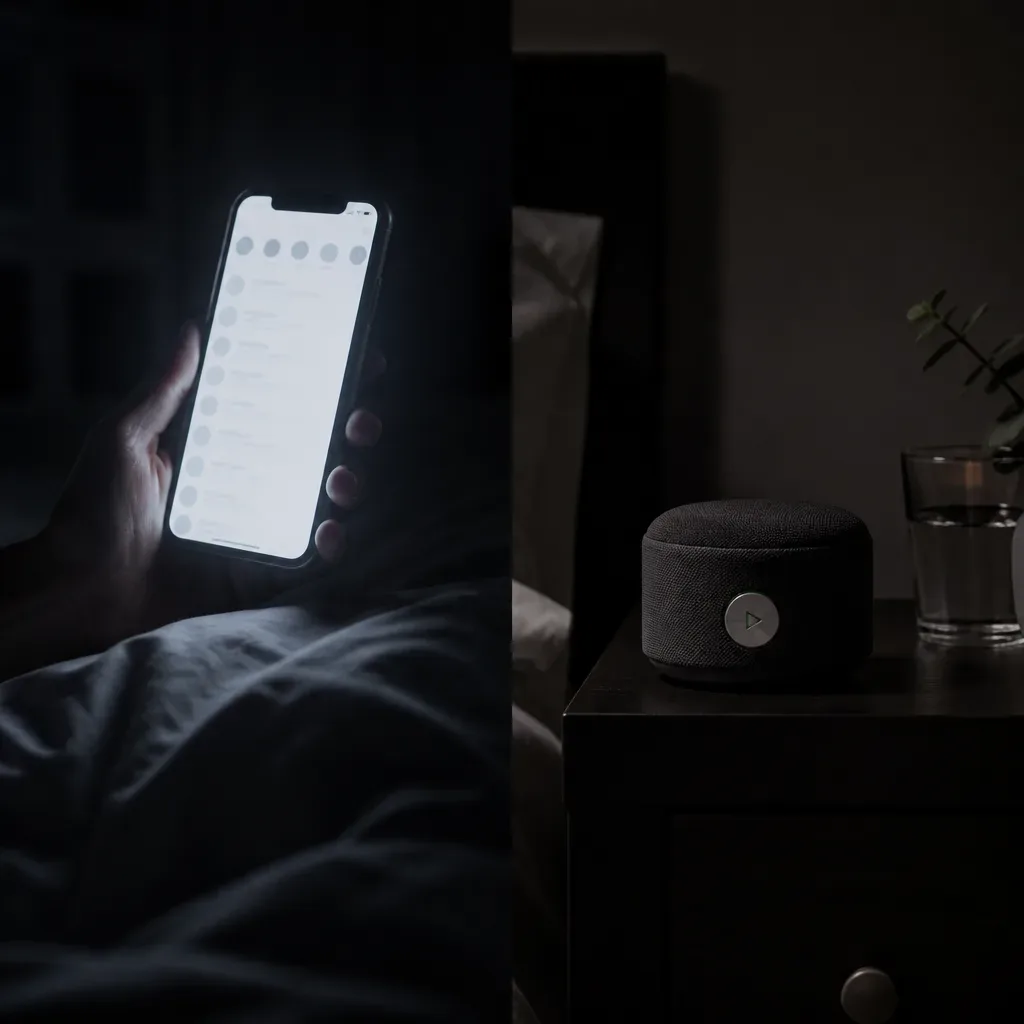
How do you know if the 3 AM audio routine is helping?
Track the routine for 7 nights and judge it by return-to-sleep, not by whether you woke up.
A single night is a poor instrument. Sleep varies with alcohol, illness, menstrual cycle, stress, room temperature, travel, meals, and exercise timing. The Centers for Disease Control and Prevention notes that about 1 in 3 U.S. adults reports not getting enough sleep, but the causes are broad. Your own pattern needs a small log, not a harsh verdict at dawn.
Keep the log plain:
| Measure | How to record it | Useful range |
|---|---|---|
| Wake noticed | Yes or no | Do not estimate exact clock time if it triggers worry |
| Audio used | Dream-Self, noise, or none | One label only |
| Return-to-sleep | Under 10, 10 to 30, over 30 minutes | Rough is enough |
| Morning state | Clear, heavy, or tense | One word |
| Volume | Same, lower, or higher | Avoid constant adjustment |
If the Dream-Self track helps you return to sleep within roughly 10 to 30 minutes and mornings feel steadier, keep it. If it increases alertness on 3 or more nights in a week, move it earlier: bedtime, wind-down, or morning. The practice can still belong to your day without occupying the biological low point of the night.
You can also compare it with nonverbal sound. Try 3 nights with your Dream-Self recording, then 3 nights with steady masking, keeping bedtime, volume, and device position the same. If you want a gentle tone-based comparison, the Binaural beats generator + guide can help, but remember that binaural beats add headphone requirements and may not be ideal at 3 AM.
The cleanest result is not dramatic. It is quieter behavior. Fewer clock checks. Less bargaining. A shorter path back into sleep. That is enough data to respect.
What if waking up at 3am keeps happening?
If it keeps happening and affects your days, treat it as a sleep pattern worth assessing, not a personal failure.
Start with the variables that have numbers attached. Adults generally need 7 or more hours. Many bedrooms sleep best around 60 to 67 degrees Fahrenheit, according to common sleep medicine guidance, though comfort varies. Caffeine has an average half-life around 5 hours, and it can be longer in some people. Alcohol may shorten sleep onset while worsening second-half sleep continuity.
Then look at timing. Morning outdoor light, consistent wake time, regular meals, and a stable wind-down all give the circadian system clearer signals. If your bedtime changes by 2 hours across the week, a 3 AM waking may be partly scheduling noise. If your room is quiet until a radiator clicks at 3:10, masking sound may be more relevant than manifestation audio.
For chronic insomnia symptoms, CBT-I has stronger evidence than supplements, soundtracks, or sleep hygiene alone. A 2015 meta-analysis in Annals of Internal Medicine found CBT-I improved sleep onset latency and wake after sleep onset in adults with chronic insomnia. You can still use audio as a support, but do not ask it to do the whole clinical job.
Here is the quiet rule: if the audio helps you stay close to sleep, use it; if it asks you to become someone who manages sleep at 3 AM, stop. Your night routine should make fewer demands than the day made.
Leave the track ready, then let the room stay dark.