sleep science
Phone Before Bed: Park It Before Dream-Self Audio
Phone before bed keeps the nervous system checking. Use this quiet parking routine before Dream-Self audio so the screen leaves the room first.
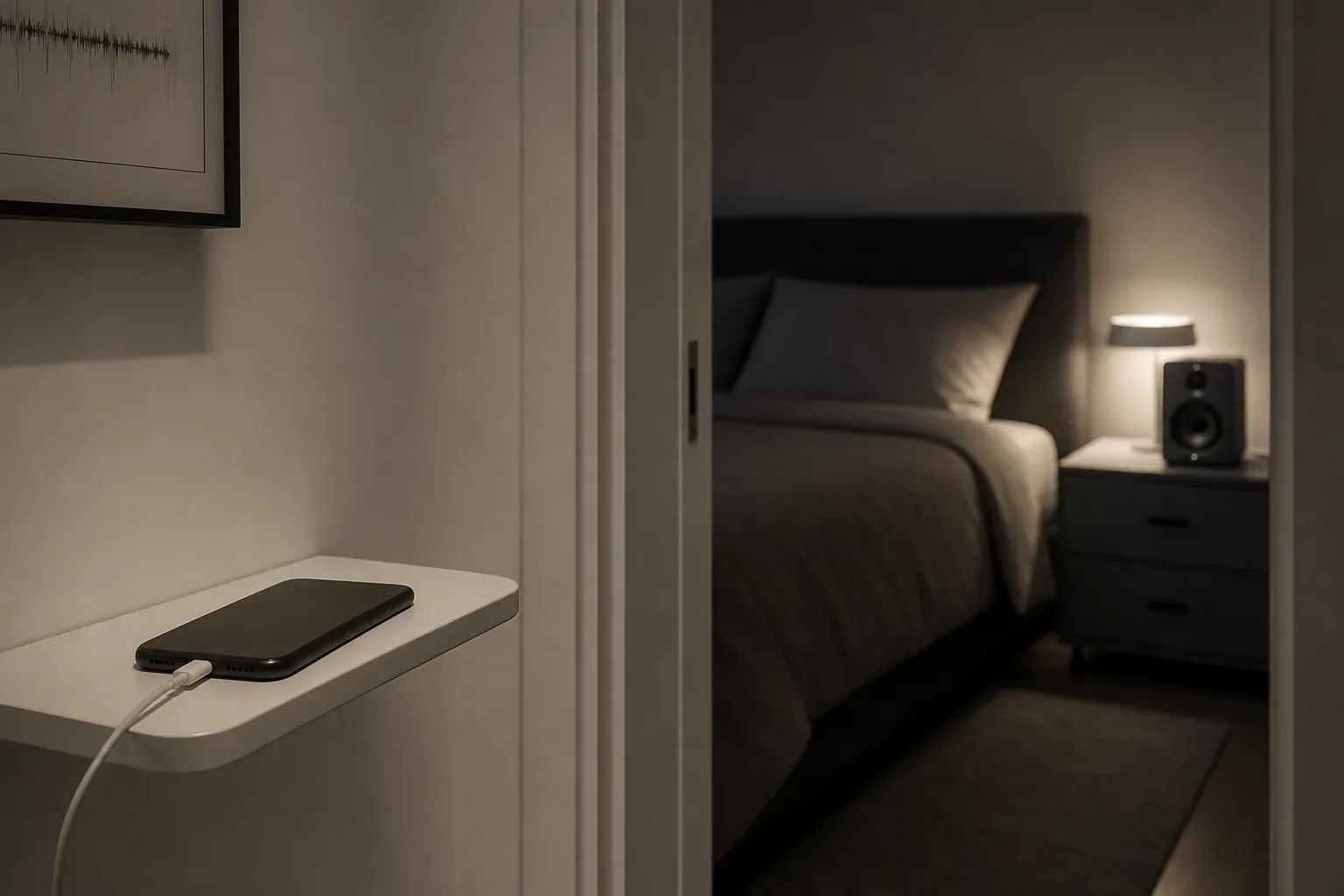
Phone before bed is not only a light problem. It is a checking problem, a novelty problem, and a proximity problem. The cleanest fix is to queue your Dream-Self audio, start playback, then park the phone outside arm’s reach before your head meets the pillow.
Why does your phone before bed keep pulling you awake?
Your phone keeps you awake because it combines light, reward, social alertness, and choice at the exact hour sleep needs low input.
Light is the part most people know. In a small but careful 2015 PNAS study, Chang and colleagues found that evening use of a light-emitting e-reader suppressed melatonin and delayed circadian timing compared with a printed book. The study had 12 adults, so it was not huge, but the mechanism is plain: bright, short-wavelength light tells the clock that night has not fully arrived.
The larger issue is behavioral. A 2015 systematic review by Hale and Guan in Sleep Medicine Reviews looked at 67 studies of screen time and sleep in school-aged youth; about 90% found an association between screen use and delayed bedtimes or shorter sleep. Association is not proof of cause, but the direction is consistent enough to respect at bedtime.
A phone is designed to ask for one more decision. One more message. One more clip. One more check of tomorrow’s weather. Sleep, by contrast, tends to arrive when the room stops asking questions. A phone in the hand is a tiny control room; sleep needs you to stop managing the night.
For adults, the American Academy of Sleep Medicine recommends at least 7 hours of sleep per night. If a phone delays sleep by even 20 minutes, five nights a week, that is 100 minutes of rest displaced by a device that may not have given you anything you remember in the morning.
Where should the phone go before Dream-Self audio starts?
The phone should go in one fixed parking place at least 2 meters from the bed, preferably outside the bedroom if your audio setup allows it.
Distance matters because habits are physical. If the phone is under the pillow, checking requires almost no effort. If it is across the room, checking requires sitting up, uncovering, standing, and making a clearer choice. Behavioral sleep clinicians often use stimulus control for insomnia: keep the bed linked with sleep, not alert tasks. The phone is one of the most common alert tasks we bring into that space.
Use a parking place that does not change. A dresser works. A hallway shelf works better. A charging tray outside the bedroom is best if you can still hear the audio through a small speaker. The National Sleep Foundation commonly recommends a 30-minute device-free wind-down; if that feels unrealistic, start with the last 7 minutes and make them exact.
Here is a simple comparison:
| Phone location | Friction to check | Best use case | Risk |
|---|---|---|---|
| In bed | 0 seconds | None for sleep | Highest scrolling risk |
| Bedside table | 2 seconds | Alarm only | Easy half-awake checking |
| Dresser, 2+ meters away | 10–20 seconds | Audio and alarm | Moderate |
| Outside bedroom | 20–60 seconds | Speaker playback | Lowest |
The parking place should be boring. No decorative ritual is needed. Plug in cable, screen down, sound on low, hands away. The best sleep tool is often the one that removes a choice before you’re tired enough to lose to it.
How do you set up the audio without keeping the screen in bed?
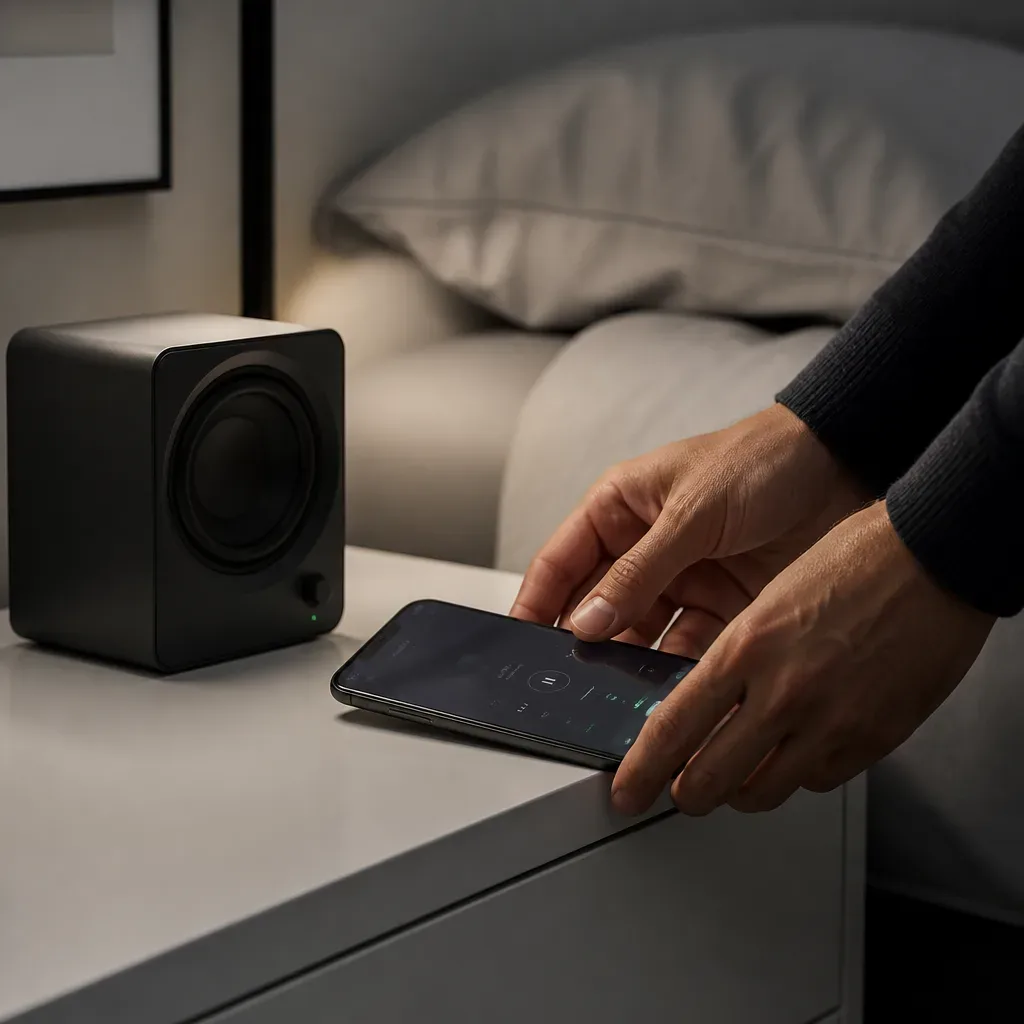
Set the audio before you enter bed, then make the phone behave like a playback device instead of a handheld feed.
If your Dream-Self audio plays from your phone, build the order carefully. First, open the track. Second, set the volume. Third, turn on Sleep Focus or Do Not Disturb. Fourth, start playback. Fifth, park the phone. The order matters because every extra unlock is an invitation to check something else.
Keep volume conservative. For sleep listening, quiet is usually enough: think around 30–45 dB at the pillow, similar to a quiet room or soft library. The World Health Organization’s safe listening guidance focuses on limiting loud exposure over time; sleep audio should sit well below conversational loudness, especially for children. If you use earbuds, lower the volume further and avoid pressure that makes you notice your ears.
If you use the AYA Method, treat the phone as the delivery tool, not the practice. The AYA Method is a daily audio manifestation practice. Each day you listen to a short personalized recording — your Dream-Self Moment — narrated from the version of you who has already manifested the life you intend. Listening is the practice. Repetition is the work. The audio is the method.
You can make the setup cleaner with one of these routes:
- Phone outside the room, audio through a small Bluetooth speaker.
- Phone on dresser, speaker near the bed at low volume.
- Phone in airplane mode with Wi-Fi off, if the audio is downloaded.
- Phone screen face down, brightness low, no notifications visible.
The screen is not the ceremony. The listening is.
What should you play after the phone is parked?
Play the least interesting sound that still supports the state you want: Dream-Self audio for the practice, steady noise for masking, or simple tones for a narrower focus.
Different sounds do different jobs. White noise masks sudden changes by filling a broad range of frequencies. Brown noise has more low-frequency weight and less high hiss, so some listeners find it easier to keep low in the room. You can press play and compare the difference in the White noise generator + guide, then choose the one that makes the room feel less jumpy.
Binaural beats are more specific. A binaural beat is an auditory illusion created when each ear receives a slightly different tone; the brain perceives a third pulsing rate. Claims around binaural beats are mixed. Small studies have reported changes in anxiety or attention, but effects vary by frequency, headphone use, and listener. If you test them, use the Binaural beats generator + guide at low volume and stop if the pulsing feels too noticeable.
Solfeggio tones belong to a tradition, not a settled medical claim. Many listeners like 528 Hz or 432 Hz because the tone gives the mind a simple place to rest. That preference is valid as preference. The evidence for specific health claims is limited. The Solfeggio frequencies guide explains the lore plainly, so you can use the sound without asking it to be more than sound.
A practical order works well: Dream-Self audio first, then masking noise if needed. If the voice is the practice, the noise is the room treatment. Noise masks the world; a chosen voice gives the night its single line.
How do you handle alarms, messages, and the fear of missing something?
You handle night access by deciding the exceptions before bedtime, not while you are tired.
Most people do not need every notification overnight. Pew Research Center reported in 2024 that 91% of U.S. adults owned a smartphone; the device is common enough that social norms now assume reachability. Sleep does not have to accept that assumption. Decide which people can break through: a partner, a child, a caregiver, or a true emergency contact.
Use the phone’s built-in focus settings. On iPhone, Sleep Focus can allow calls from selected contacts and silence everything else. On Android, Bedtime mode and Do Not Disturb offer similar controls. Test the alarm once in the afternoon so you are not negotiating trust with the device at 11:40 p.m.
If your reason for keeping the phone nearby is the alarm, buy friction instead of willpower. Put the phone across the room. Set one alarm, not five. Repeated snoozing can fragment the last sleep period, and the final 90 minutes of sleep often contain more REM-rich sleep for many adults. You do not need a perfect morning to protect a decent night.
For genuine safety needs, keep the phone in the room but out of reach. A medical condition, caregiving role, or on-call work changes the setup. If insomnia, panic at night, tinnitus distress, or suspected sleep apnea is part of the pattern, speak with a qualified clinician. Audio can support a routine; it should not replace care.
What is the seven-minute phone parking routine?
The seven-minute routine is a short sequence that queues the audio, removes notifications, parks the phone, and gives your hands something quieter to do.
Use the same sequence for 7 nights before you judge it. Habit research varies, but a 2009 study by Lally and colleagues in the European Journal of Social Psychology found that automaticity took a median of 66 days across new habits. You do not need 66 perfect nights. You need enough repetition that the order starts to feel expected.
- Minute 0: choose the track. Open Dream-Self audio, white noise, or your sleep track before you sit on the bed.
- Minute 1: set the volume. Aim for soft, steady sound. If you notice the sound more than your breathing, lower it.
- Minute 2: set the phone mode. Turn on Sleep Focus, Do Not Disturb, or airplane mode if appropriate.
- Minute 3: start playback. Let the first seconds confirm that the output is correct.
- Minute 4: park the phone. Place it screen down in the chosen spot, at least 2 meters away.
- Minute 5: return to bed without bargaining. No final weather check. No final message check.
- Minute 6: give the hands a cue. Rest one palm on the ribs and take six slow breaths.
If masking sound helps after the voice recording, keep a simple fallback ready. The White noise generator + guide can help you test white, pink, and brown noise in minutes rather than guessing for a week.
What if you still reach for the phone at night?
If you still reach for it, increase friction and reduce shame; the behavior is trained, so the replacement must be trained too.
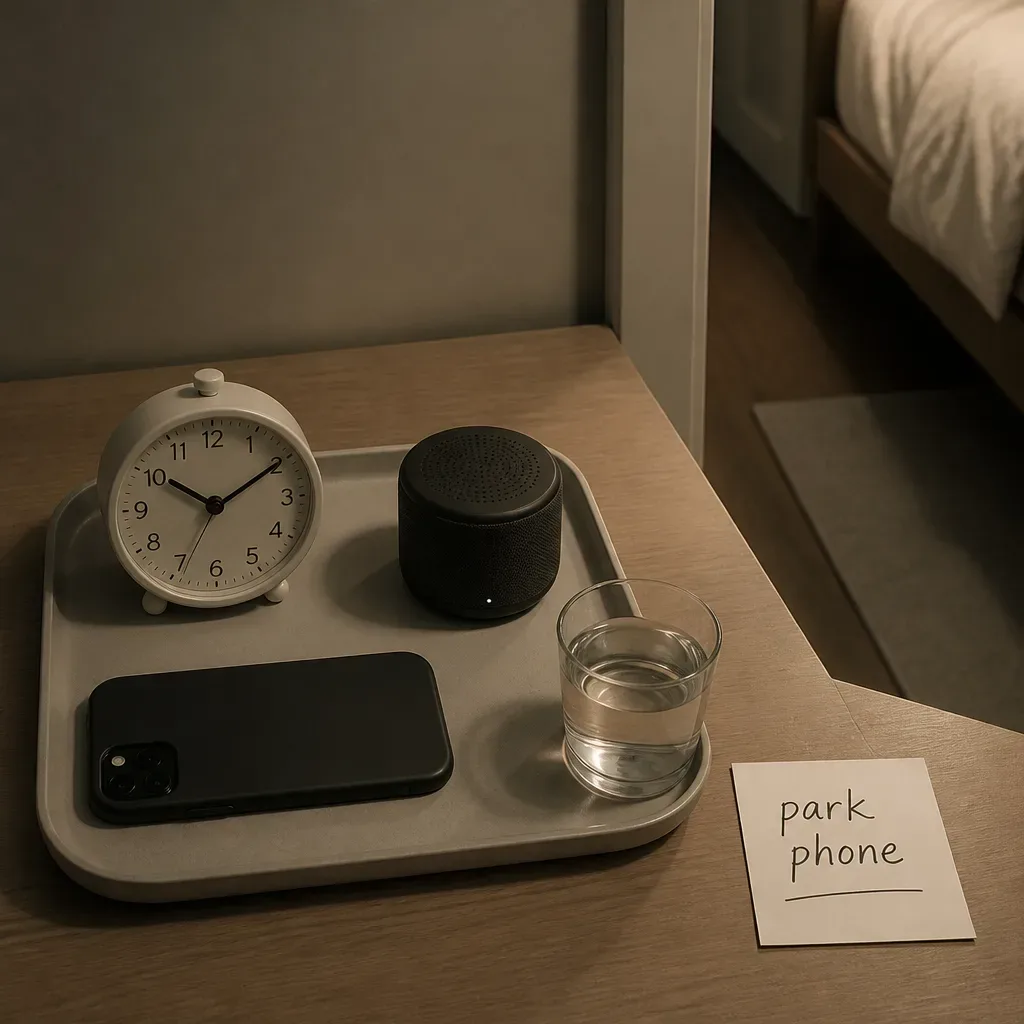
Start with the environment. Move the charger. Put a book where the phone used to sit. Use a physical alarm clock. Leave the bedroom door slightly open if the phone is in the hallway and you need to hear it. Small design changes beat late-night self-criticism because they work before the craving becomes verbal.
Then make the replacement smaller than the habit. Do not promise to meditate for 30 minutes when the old habit took 12 seconds. Try one of these instead:
- Name three sounds in the room.
- Take six breaths with a longer exhale than inhale.
- Put both feet on the floor, then lie down again.
- Restart the same audio track without opening any other app.
- Write one sentence on paper if a task is genuinely urgent.
There is also a useful threshold. If you are awake for roughly 20 minutes and becoming frustrated, many cognitive behavioral therapy for insomnia protocols suggest getting out of bed briefly and doing something quiet in dim light until sleepiness returns. Keep the phone out of that reset. Paper is dull in the right way.
The goal is not to become someone who never wants the phone. The goal is to become someone whose night has a design. A parked phone is not a moral victory; it is a room arranged for sleep.
Place the phone down, and let the room stay plain.