sleep science
Best Time to Wake Up: 90-Min Sleep Cycles Guide
Find the best time to wake up using 90-minute sleep cycles, realistic alarm math, safe sound, and Dream-Self audio before bed.
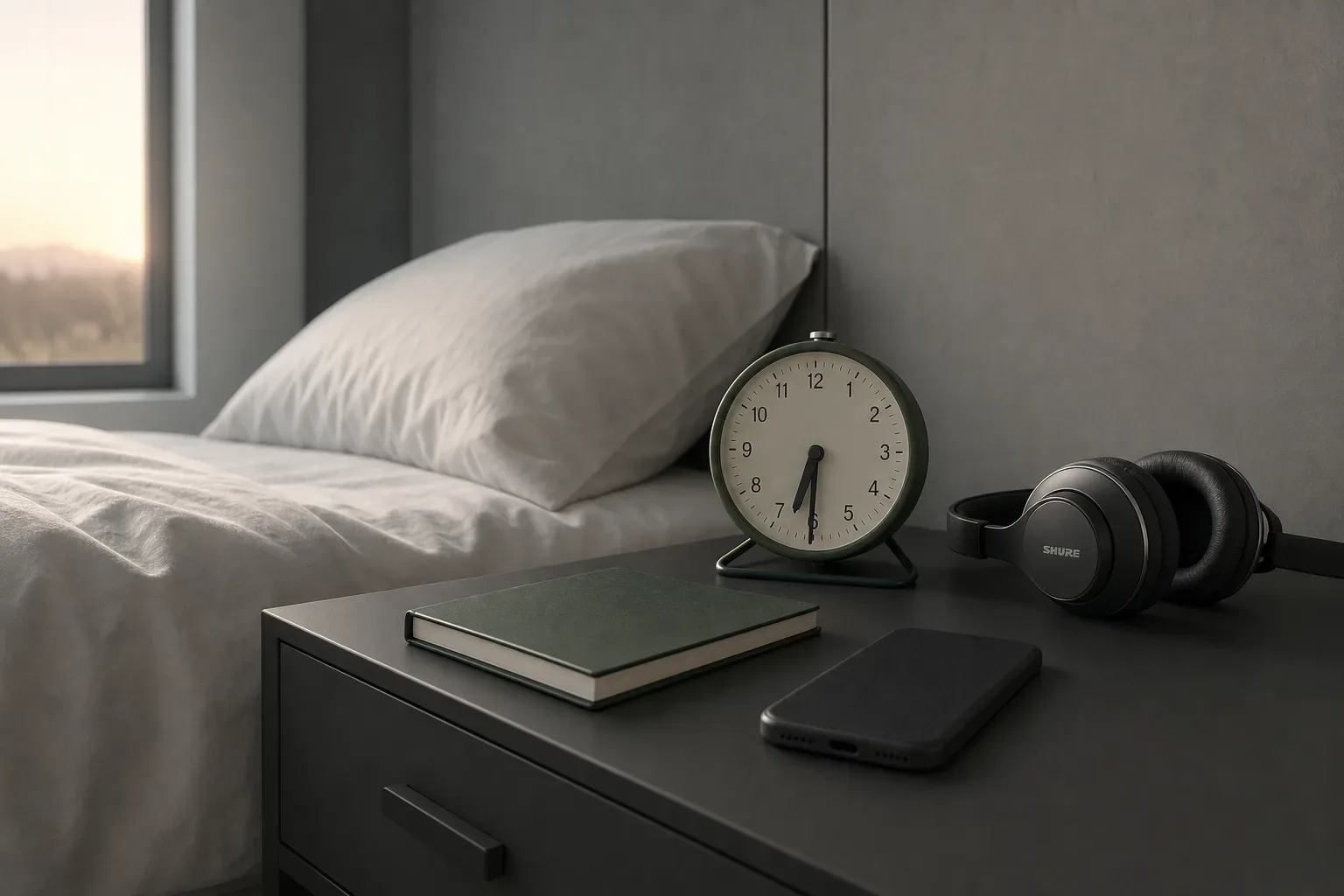
The best time to wake up is near the end of a sleep cycle, usually after about 7.5 or 9 hours of sleep for adults. Count backward from your required alarm in 90-minute blocks, add 10 to 20 minutes to fall asleep, then protect the routine with quiet audio before bed.
What does the best time to wake up actually mean?
The best time to wake up means the time your alarm meets lighter sleep, enough total sleep, and a schedule you can repeat.
A sleep cycle is not one uniform state. The National Institute of Neurological Disorders and Stroke describes sleep as moving through non-REM and REM stages, with a typical cycle lasting about 90 minutes. Early cycles carry more deep non-REM sleep. Later cycles tend to carry more REM. When an alarm lands in the wrong place, it can feel like being pulled out of wet cement.
That groggy state has a name: sleep inertia. A review in Sleep Medicine Reviews has described sleep inertia as impaired alertness after waking, often lasting 15 to 30 minutes and sometimes longer after short sleep or deep-sleep awakenings. The clock matters, but the stage matters too.
The simple rule is useful because it gives the night a shape. If you wake at 6:30 a.m., 5 cycles means being asleep at 11:00 p.m. Six cycles means being asleep at 9:30 p.m. Add sleep-onset time before that, because bed is not sleep. The American Academy of Sleep Medicine recommends at least 7 hours of sleep for most adults, so 5 cycles is the practical lower edge, not a luxury target.
A good wake time is not early. It is well-placed.
This is why a 5:00 a.m. alarm can be steady for one person and brutal for another. Chronotype, work hours, children, light exposure, and sleep debt all push on the same system. The 90-minute model does not replace your body. It gives you a ruler.
How do 90-minute sleep cycles change the alarm time?
Ninety-minute cycles change the alarm by asking you to wake after a completed block rather than at a random minute.
Most people use the alarm as a deadline. Cycle math treats it as a landing point. The difference is small on paper and large at 6:17 a.m. A 2020 American Academy of Sleep Medicine statement notes that healthy adults need 7 or more hours, while many national surveys find that roughly one-third of adults report sleeping less than that on work nights. Cycle timing cannot repair chronic short sleep, but it can reduce the number of rough landings.
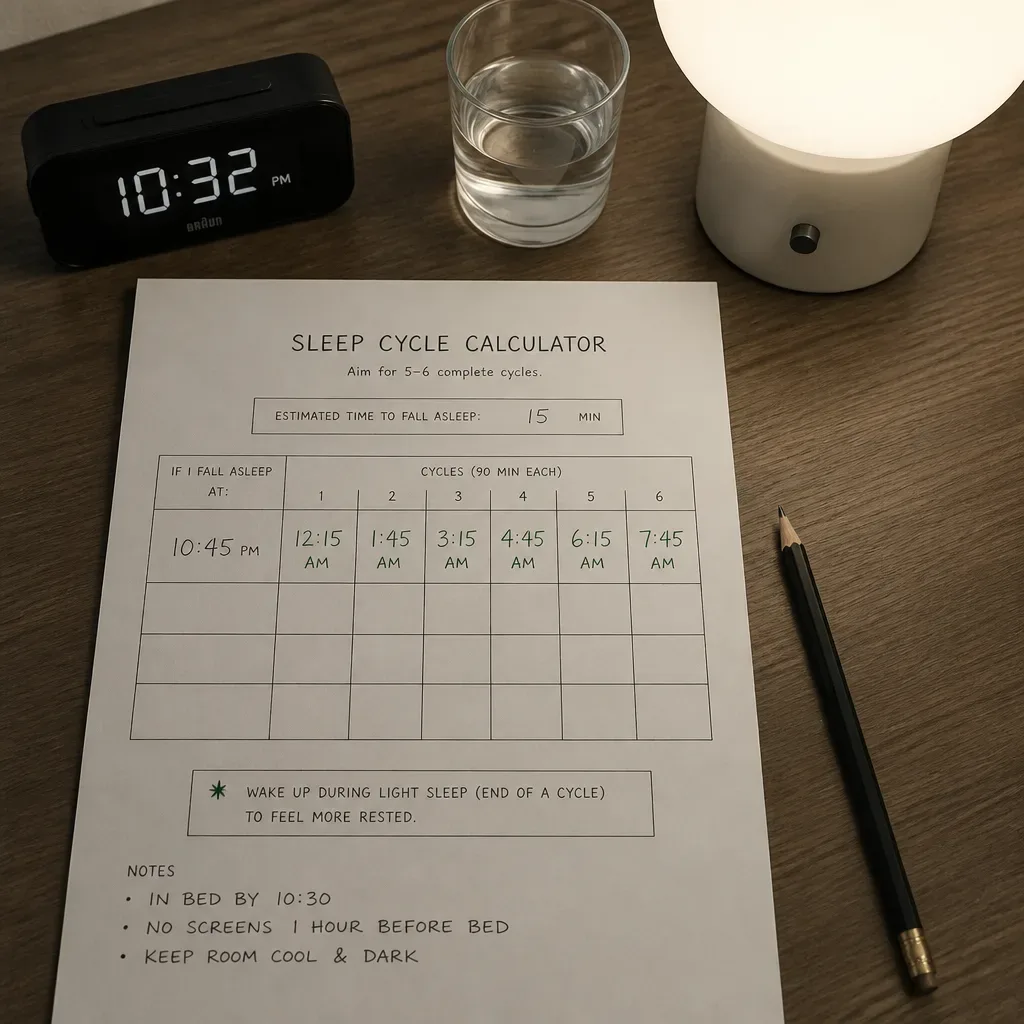
Here is the plain calculation for adults using a 15-minute sleep-onset buffer:
| Required wake time | 5 cycles asleep | Get in bed around | 6 cycles asleep | Get in bed around |
|---|---|---|---|---|
| 5:30 a.m. | 10:00 p.m. | 9:45 p.m. | 8:30 p.m. | 8:15 p.m. |
| 6:00 a.m. | 10:30 p.m. | 10:15 p.m. | 9:00 p.m. | 8:45 p.m. |
| 6:30 a.m. | 11:00 p.m. | 10:45 p.m. | 9:30 p.m. | 9:15 p.m. |
| 7:00 a.m. | 11:30 p.m. | 11:15 p.m. | 10:00 p.m. | 9:45 p.m. |
| 7:30 a.m. | 12:00 a.m. | 11:45 p.m. | 10:30 p.m. | 10:15 p.m. |
The table uses 90 minutes because it is memorable, not because humans are metronomes. Sleep cycles can run closer to 70 or 110 minutes, especially under stress, illness, alcohol, shift work, or newborn care. I learned this with a decibel meter in one hand and a baby monitor in the other: the schedule can be mathematically clean and still lose to a 3 a.m. feed.
The cycle model is a compass, not a court order.
If your alarm is fixed by school, caregiving, or work, change the bedtime first. If bedtime cannot move enough, use the best available cycle and keep the wake time consistent. Dr. Andrew Huberman often emphasizes consistent morning light and wake timing as major circadian signals; the exact minute is less important than repetition across 7 days.
How can you calculate your wake time tonight?
Calculate tonight by choosing the wake time first, counting backward in 90-minute blocks, and adding a realistic buffer for falling asleep.
Do not start with an ideal bedtime. Start with the real alarm. If the first meeting is 8:00 a.m. and the commute takes 45 minutes, your true wake time may be 6:20 a.m., not 6:45 a.m. Snooze math is usually bad math. One 9-minute snooze rarely becomes clean sleep; it often becomes fragmented sleep with repeated stress signals.
Use this 5-step method:
- Write down the time you need to stand up.
- Count backward 7.5 hours for 5 cycles.
- Count backward 9 hours for 6 cycles.
- Add 10 to 20 minutes before each time for sleep onset.
- Pick the option you can repeat for at least 7 nights.
For a 6:20 a.m. wake time, 5 cycles puts sleep at 10:50 p.m., so bed is around 10:30 to 10:40 p.m. Six cycles puts sleep at 9:20 p.m., so bed is around 9:00 to 9:10 p.m. If you usually take 30 minutes to fall asleep, use 30 minutes. The Journal of Clinical Sleep Medicine has published insomnia guidance that treats sleep-onset latency above about 30 minutes as clinically relevant when persistent.
Your test should be simple. Track three numbers for one week: lights-out time, final wake time, and morning heaviness on a 1 to 5 scale. If the heaviness score stays at 4 or 5, shift bedtime by 15 minutes. Do not redesign the whole night after one bad alarm.
What should you listen to before sleep if wake timing is the goal?
Listen to steady, low-volume audio that reduces sound changes without pulling attention into analysis.
Sound before sleep has one job: make the room more predictable. A fan, rain bed, or shaped noise can mask small interruptions from traffic, doors, pets, and heating systems. The White noise generator + guide is useful here because you can press play and hear the difference between a hiss, a low hum, and a balanced mask. Keep the level quiet. For babies and children, be especially conservative with volume and distance; a Pediatrics study in 2014 measured some infant sleep machines above 85 dB at close range, which is not a safe nightly setup.
Noise color matters less than fit, but the fit is real. White noise has equal acoustic power per hertz and can sound bright. Pink noise softens the top end. Brown noise has more low-frequency weight and less hiss. Some nervous systems settle with the low hum because it feels less sharp. Yours gets a vote.
Binaural beats are different. They use two slightly different tones, one in each ear, and the brain perceives a third rhythmic beat. Evidence is mixed. A 2019 meta-analysis in Psychological Research found small-to-moderate effects across studies for anxiety and cognition, but protocols varied widely. If you test them, use the Binaural beats generator + guide at a low level and avoid sleeping in tight headphones.
Solfeggio frequencies sit in a different category: tradition plus personal preference, not settled sleep medicine. Many listeners like 528 Hz or 432 Hz because the tone gives the mind one clean object. That is allowed. The Solfeggio frequencies guide explains the lore plainly while keeping the evidence separate.
Sound does not force sleep. Good sound removes a few reasons to stay awake.
Where does Dream-Self audio fit without disturbing sleep?
Dream-Self audio fits best near the end of wind-down, before sleep, at a level that feels like quiet speech in the room.
The AYA practice belongs before the alarm math is tested, not after you are already rushing. The AYA Method is a daily audio manifestation practice. Each day you listen to a short personalized recording, your Dream-Self Moment, narrated from the version of you who has already manifested the life you intend. Listening is the practice. Repetition is the work. The audio is the method.
That matters for wake timing because the final 20 minutes before bed often decide whether the 90-minute plan starts cleanly. If you scroll for 25 minutes after lights-out, your cycle chart is fiction. If you listen to a short recording, place the phone down, and let the room go steady, the planned bedtime has a better chance of becoming actual sleep.
Keep the audio short. Five to 10 minutes is enough for most nights. Use a volume you could comfortably ignore. If the recording makes you mentally busy, move it earlier in the evening, perhaps before brushing teeth. The goal is not to squeeze more content into the sleep window. The goal is to give attention one quiet track, then stop.
A practical stack looks like this:
- 30 minutes before bed: dim lights and stop work messages.
- 15 minutes before bed: play Dream-Self audio once.
- 5 minutes before bed: switch to a neutral noise bed if the room needs masking.
- During sleep: keep sound steady, low, and boring.
- On waking: get light within the first hour when possible.
The audio prepares intention. The noise protects continuity. The alarm tests the cycle.
What if the math does not match your real life?
If the math does not match your real life, keep the fixed wake time and adjust the smallest variable first.
Sleep advice often assumes a clean evening. Parents, shift workers, students, and people with pain do not always get one. I have tested sound machines in hallways at 2 a.m.; the most important feature is not the prettiest loop. It is whether the system fails quiet, restarts gently, and can be operated in the dark. Your wake-time plan needs the same tolerance for failure.
Start with the constraint you cannot move. That might be a 6:10 a.m. train, a toddler, or medication timing. Then choose one adjustable variable: bedtime, evening light, caffeine cutoff, or audio setup. The Sleep Foundation and many clinical sleep programs point to caffeine lasting 5 hours or more in the body, with some people feeling it longer. A 3 p.m. coffee can still be part of a midnight problem.
If you miss the ideal bedtime, do not chase perfection by setting a complicated new alarm series. Pick the nearest cycle that protects at least 7 hours when possible. If you get only 6 hours, a cycle boundary may feel better than a random alarm, but it is still short sleep. There is no clever alarm that turns 5.5 hours into 8.
Use a plain fallback rule:
| Night goes wrong | Better response | Why it helps |
|---|---|---|
| Bedtime slips by 45 minutes | Keep wake time fixed | Protects circadian rhythm |
| You wake at 4 a.m. | Stay quiet, lights low | Reduces full alerting |
| Noise stops suddenly | Restart low, not louder | Avoids a spike in arousal |
| Alarm feels brutal for 3 days | Shift bedtime 15 minutes | Tests cycle placement |
If you snore heavily, gasp during sleep, have chronic insomnia, or feel dangerously sleepy during the day, ask a qualified professional for help. Timing and audio are tools, not medical care.
How do you keep the routine safe, steady, and easy to repeat?
Keep the routine safe by using conservative volume, simple controls, and a wake time you can hold most days.
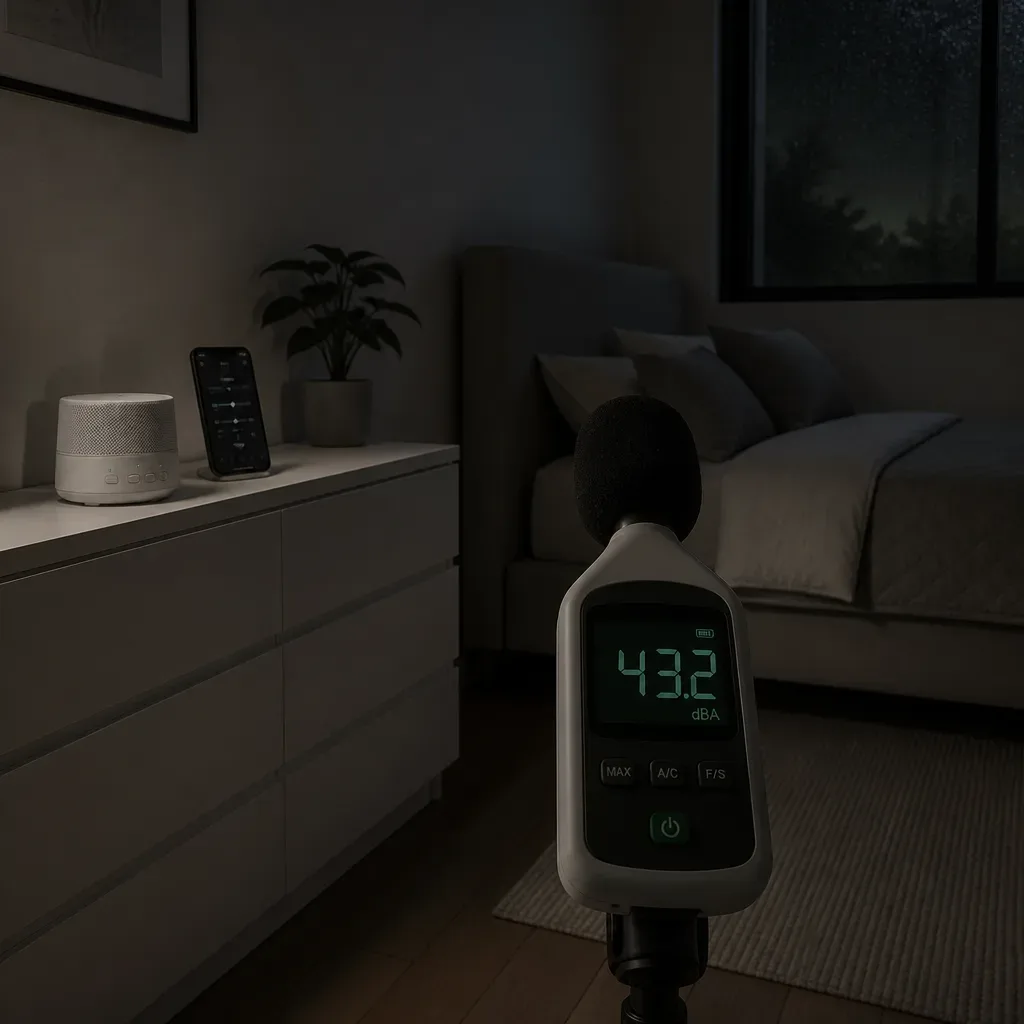
Volume is the place where taste stops being the main question. For adult bedside sound, many people keep masking audio around the level of a quiet room to soft conversation, often roughly 40 to 55 dB depending on distance and room noise. For children, place the machine away from the bed, keep it low, and avoid all-night high output. The 2014 Pediatrics measurements are the reason I still check machines with a meter when I review them.
Use tools that do not punish you at 3 a.m. If an app needs a login after an update, it is not a reliable sleep tool. If a machine resets to maximum volume after a power cut, it fails loud. If a loop has a click every 47 seconds, a light sleeper will eventually hear it. Good sleep design is mostly the removal of small problems.
The same applies to wake timing. A routine you can repeat 5 nights out of 7 beats a perfect plan you quit by Wednesday. Research on circadian rhythms consistently shows that light is a strong timing cue; morning outdoor light, even for 5 to 10 minutes, can help anchor the day. If the sky is dark, use bright indoor light and keep the habit simple.
Press play below when you are choosing sound, and listen for the difference rather than reading about it for another hour. Test a low mask from the White noise generator + guide, compare it with a gentle tone from the Binaural beats generator + guide, then choose the least interesting sound that works.
Here is the compact version for tonight:
- Set one real wake time.
- Choose 5 or 6 sleep cycles.
- Add your honest sleep-onset buffer.
- Play Dream-Self audio once before bed if it settles attention.
- Use low, steady masking only if the room needs it.
- Track the result for 7 mornings before changing the plan.
The quietest routine is the one you do not have to negotiate with at night.
Set the alarm gently, then let the room stay plain.