sleep science
Sleep Hygiene Checklist Before Dream-Self Audio
Use this sleep hygiene checklist to lower light, sound, temperature, and device friction before your Dream-Self audio, in about 20 minutes.
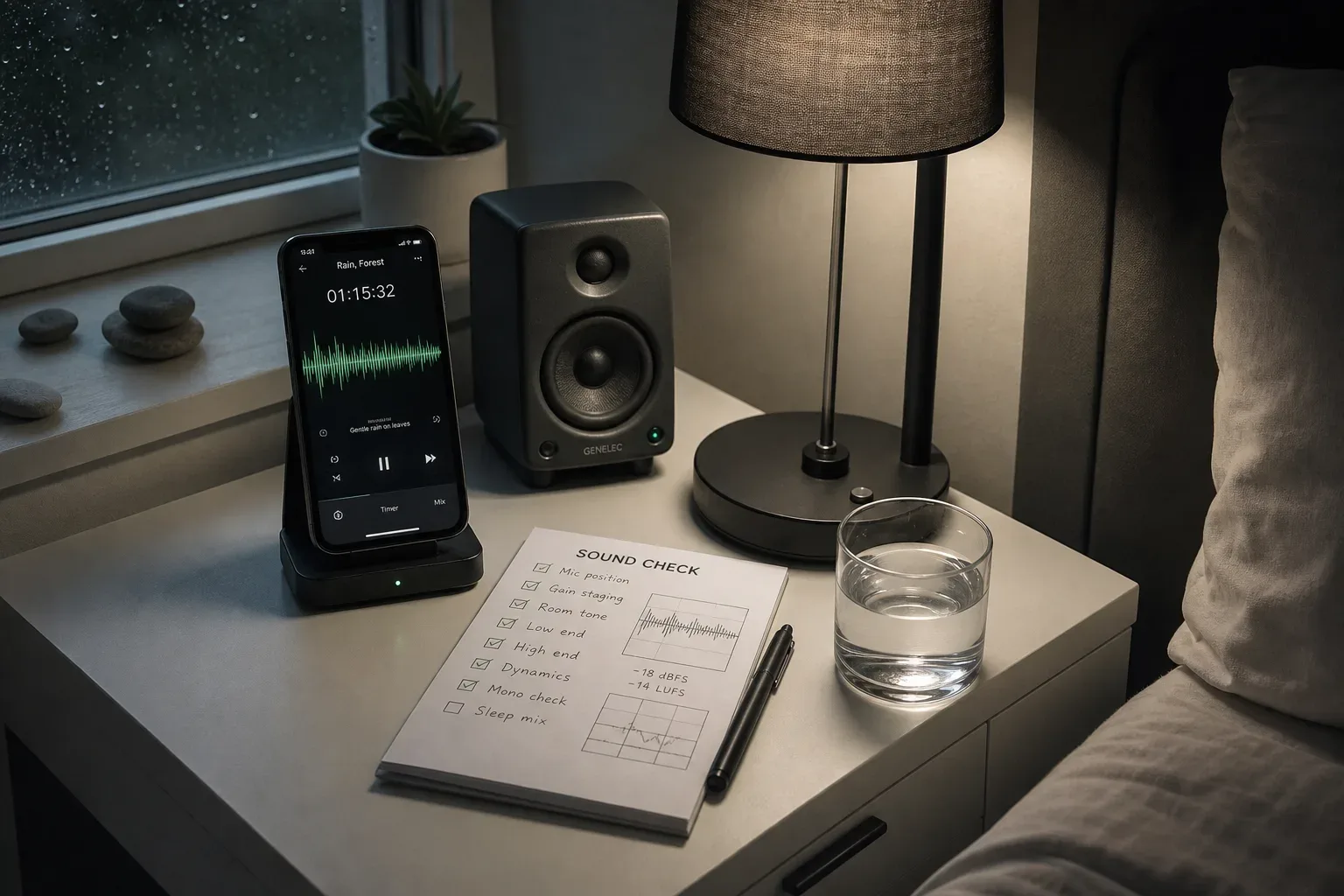
A sleep hygiene checklist is a practical pre-listening routine: reduce light, cool the room, lower noise spikes, remove device friction, and prepare your Dream-Self audio before you’re tired. Use it for 15 to 20 minutes. The point isn’t to force sleep; it’s to make daily listening easier to repeat.
Why use a sleep hygiene checklist before Dream-Self audio?
A checklist works because sleep is sensitive to small cues, and audio practice is easier when those cues are predictable.
The American Academy of Sleep Medicine recommends at least 7 hours of sleep for most adults, yet the CDC has reported that roughly 1 in 3 U.S. adults sleeps less than that on a regular basis. A checklist won’t solve shift work, newborn care, anxiety, or an untreated sleep disorder. It will catch the controllable failures: a room that’s too bright, a phone that’s still notifying, a speaker that starts too loud, or a bed that has become an office.
Sleep hygiene is not moral purity; it’s friction removal for a nervous system that needs fewer decisions. The phrase can sound like a lecture, but in practice it means you put the same few levers in the same order each night. In product design, the best interface is the one you can use when you’re half-awake. A bedtime routine deserves the same standard.
This matters before the AYA Method, because the AYA Method is a daily audio manifestation practice. Each day you listen to a short personalized recording, your Dream-Self Moment, narrated from the version of you who has already manifested the life you intend. Listening is the practice. Repetition is the work. The audio is the method.
Your checklist is not a second method. It’s the setup. The audio works best when the room has stopped arguing with it. If your light is bright, your speaker is unpredictable, or your mind is still holding tomorrow’s errands, the recording has to compete for attention. Settle the room first, then press play.
What should you change in the room first?
Start with the bedroom signals your body reads fastest: light, temperature, noise, and device behavior.
Light is the first lever because the circadian system is especially sensitive to it. Research led by Harvard and other sleep labs has shown that light exposure in the evening can delay melatonin timing, and blue-rich light from screens tends to be more alerting than dim warm light. You don’t need a perfect darkroom at 8 p.m. You do need a clear drop in brightness during the final 30 to 60 minutes.
Temperature is next. The National Sleep Foundation commonly gives a bedroom range near 60 to 67°F, or about 15.5 to 19.5°C, for many adults. That’s not a law. Some people sleep better warmer, and parents often keep nurseries within pediatric guidance rather than adult preference. The principle is plain: your body temperature naturally falls as sleep begins, and an overheated room can make that harder.
Noise is less about silence and more about jumps. A steady hum can be easier to sleep through than a quiet room interrupted by pipes, scooters, doors, or a dog collar. If your room is unpredictable, test a low sound bed with the White noise generator + guide. Press play below that guide and listen for the difference between masking a sound and covering it too loudly.
Use this order when the room feels messy:
- Dim overhead lights or turn them off.
- Set the thermostat, fan, or window before you’re in bed.
- Remove sudden sound sources where possible.
- Put the phone into a mode that won’t interrupt playback.
- Set the audio volume while you’re still alert.
A good night routine should fail quiet. If the Wi-Fi drops, the app closes, or the timer ends, the safest failure is silence or a soft stop, not a loud restart.
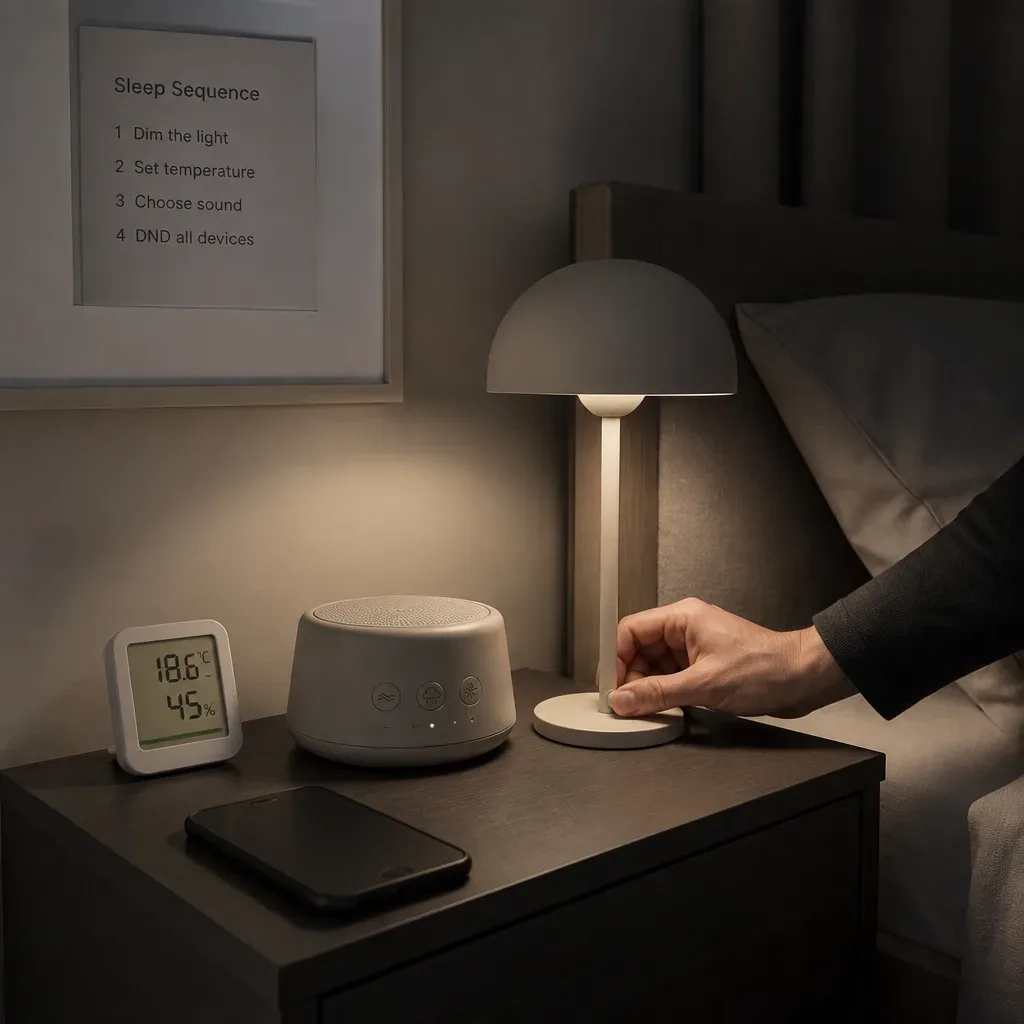
How do you set light, temperature, and sound without overbuilding the routine?
Use rough, repeatable targets instead of chasing perfect conditions.
A 20-minute routine is usually more durable than a 60-minute routine. Behavioral sleep researchers often emphasize stimulus control and regularity over elaborate rituals; the bed should be associated with sleep and rest, not with problem-solving. If your checklist takes so long that you skip it 3 nights out of 7, it’s too ornate.
Here’s a simple target table you can adjust tonight:
| Lever | Practical target | Why it helps |
|---|---|---|
| Light | Dim for 30 to 60 minutes | Supports the natural evening drop in alertness |
| Temperature | About 60 to 67°F for many adults | Supports the body’s normal cooling pattern |
| Sound | Low, steady, no sharp loops | Masks interruptions without becoming the main event |
| Phone | Do Not Disturb or airplane mode | Prevents alerts during the recording |
| Volume | Comfortable, below conversation level | Protects ears and keeps the voice clear |
Volume deserves more care than most people give it. Normal conversation is often around 60 dBA at close range. For babies and children, conservative pediatric discussions often point toward keeping sound machines at least 7 feet from the crib and near or below 50 dBA. A 2014 Pediatrics study measured some infant sleep machines above safe nursery levels at maximum volume, which is the kind of detail parents remember at 3 a.m.
For adults, the same design rule applies: put the speaker farther away and turn it down. If you can’t hear the Dream-Self audio over the sound bed, the masking layer is too loud. Volume is sleep hygiene, not decoration.
If you like tones, use them gently. The Binaural beats generator + guide explains that a binaural beat is an auditory illusion created when each ear receives a slightly different frequency. Some small studies suggest effects on relaxation or attention, but the evidence is mixed and depends on frequency, duration, and listener. Keep claims modest and the volume modest too.
Which sound should play before or under the Dream-Self audio?
Choose the sound that masks your actual room without pulling attention away from the voice.
White noise contains equal acoustic energy per frequency and can sound hissy. Pink noise reduces higher frequencies and often feels softer. Brown noise has more low-frequency weight, which some nervous systems prefer because it sounds like a deeper hum. None of these is universally best. The best one is the quietest sound that makes interruptions less noticeable.
In small sleep studies, pink noise has been associated with changes in slow-wave sleep or memory measures, but the samples are often small, sometimes fewer than 30 people, and methods vary. That doesn’t make pink noise useless. It means you should treat it as a tool to test, not a prescription. Try one sound for 3 nights before switching, because one bad night is not data.
If you use a sound bed under the Dream-Self audio, set the bed first, then set the voice 1 small step above it. The voice should remain intelligible at all times. If you’re using earbuds, keep the level especially low; the World Health Organization has warned for years about unsafe listening levels from personal audio devices, particularly with long duration and high volume.
A short comparison helps:
- White noise: useful for sharp, broad masking, but can feel bright.
- Pink noise: smoother for many ears, with less high-frequency edge.
- Brown noise: lower and heavier, useful if hiss bothers you.
- Binaural beats: only with headphones, and better treated as optional.
- Solfeggio tones: meaningful to some listeners as a tradition, with limited clinical evidence.
The Solfeggio frequencies guide covers frequencies such as 396 Hz, 528 Hz, and 963 Hz as part of a modern listening tradition. If 528 Hz helps you settle, you don’t need anyone’s permission to like it. Just don’t confuse liking a tone with proof that it changes biology in a specific way.
How do you prepare the Dream-Self audio itself?
Prepare the audio before bed so the practice stays audio-first, simple, and repeatable.
Open the recording before you get under the blanket. Confirm the title, output device, volume, and timer. If you use Bluetooth, connect it before the lights go low. Anyone who has fought a pairing menu at 11:47 p.m. knows that a tiny device problem can become a full alertness spike in under 60 seconds.
The Dream-Self Moment should be the main audio event, not one layer in a pile of content. If you want a sound bed, keep it steady and lower than the narration. If you use a timer, choose one that ends gently. If your speaker has a startup chime, test it once in daylight. My own rule from parenting is simple: never trust a device at bedtime until you’ve heard how it fails.
This is also where you protect tomorrow’s repetition. A routine that depends on perfect motivation won’t survive a hard day. A routine that depends on a prepared button might. Joe Dispenza, Neville Goddard, and other manifestation teachers use different language around mental rehearsal and identity, but the practical overlap is repetition. In audio practice, repetition depends on reducing the cost of starting.
Use this 5-point audio check:
- The correct recording is open.
- The volume starts low, then rises only if needed.
- Notifications are off for the listening window.
- The sound bed, if used, sits behind the voice.
- The device is placed where you won’t reach for it again.
Repetition is the work; the room is just the runway. If the checklist helps you listen daily without negotiation, it’s doing its job.
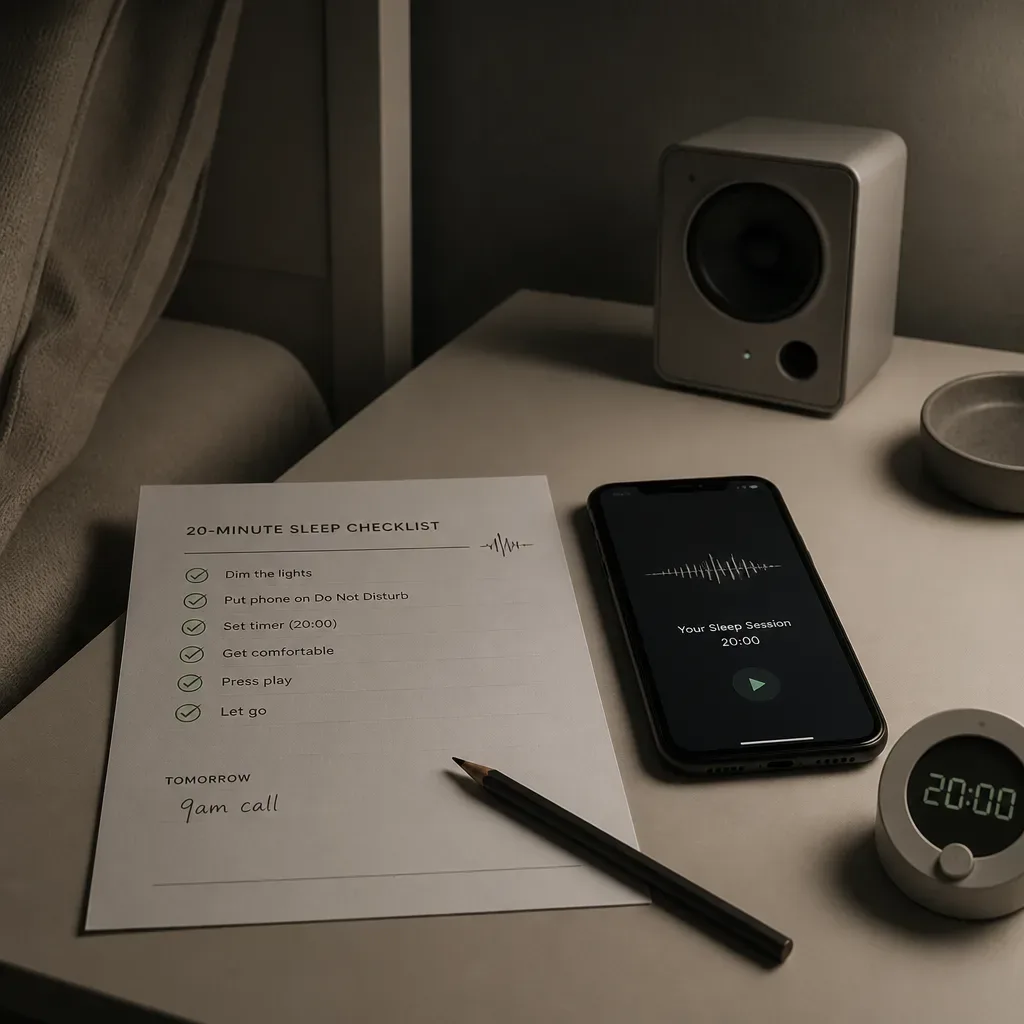
What is the 20-minute sleep hygiene checklist?
The checklist is a timed sequence that lowers stimulation, prepares the audio, and leaves only listening.
Use it as written for 7 nights, then edit one item at a time. The Journal of Behavioral Medicine and related habit research often return to the same finding: stable cues make repeated behavior easier. You’re not trying to create a cinematic ritual. You’re trying to make the next correct action obvious when you’re tired.
Minute 0 to 3: reset the room. Dim the main lights. Close curtains if streetlight enters the room. Set the thermostat or fan. Move laundry, work items, or bright chargers out of your direct view. If you can see it from the pillow and it asks for action, remove it.
Minute 3 to 6: set sound safely. If you need masking, start white noise, pink noise, brown noise, or another steady layer. Keep it low. For a child’s room, use conservative placement and volume guidance: distance from the crib, low output, and no speaker near the ear.
Minute 6 to 9: prepare the device. Open the Dream-Self audio. Turn on Do Not Disturb. Check that autoplay won’t continue into unrelated audio afterward. If you use headphones, check that the cable or case won’t wake you later. If you use a speaker, make sure it won’t reset to maximum after power loss.
Minute 9 to 12: close one open loop. Write one sentence about tomorrow. Not a full plan. One sentence. A Baylor University study published in 2018 found that writing a specific to-do list before bed helped some participants fall asleep faster than writing about completed tasks. The sample was modest, 57 adults, but the mechanism is plausible: the mind stops rehearsing.
Minute 12 to 15: reduce body activation. Wash, stretch lightly, or breathe slowly. Dr. Andrew Huberman often discusses physiological sighs and extended exhales as downshifting tools; the broader point is that slower breathing can influence autonomic state. Keep it gentle. Bedtime is not a performance test.
Minute 15 to 20: listen. Get into position. Press play once. Let the Dream-Self Moment occupy the foreground. If thoughts come in, notice them and return to the voice. You don’t need to feel anything dramatic for the repetition to count.
What should you do if the checklist does not work tonight?
If the checklist doesn’t lead to sleep, keep the routine calm and avoid turning the bed into a problem-solving station.
Sleep hygiene is supportive, not medical treatment. If you’ve been awake for about 20 to 30 minutes and feel more alert, many cognitive behavioral therapy for insomnia protocols recommend leaving the bed briefly and returning only when sleepy. Keep lights dim. Read something plain. Sit in a chair. Don’t start a task that rewards wakefulness.
Track patterns for 2 weeks before making large changes. Note bedtime, wake time, caffeine timing, alcohol, naps, exercise, room temperature, and audio use. Specific numbers beat vague impressions. For example, “coffee at 3 p.m., bed at 10:40 p.m., awake until 12:10 a.m.” is more useful than “bad night.”
Watch the medical flags. If you snore loudly, wake gasping, have morning headaches, or feel dangerously sleepy during the day, ask a clinician about sleep apnea or another sleep disorder. If tinnitus changes with sound use, lower the level or stop and speak with an audiologist. If insomnia lasts 3 months or more, CBT-I has stronger evidence than general sleep tips, with multiple clinical guidelines recommending it as a first-line treatment.
The final adjustment is kindness toward the routine itself. A checklist that works 5 nights out of 7 is not broken. A sound that helps in winter may irritate you in summer. A device that was fine before a software update may need to be replaced by something with physical buttons. Measure what matters, then simplify.
Turn the room down, then press play.