sleep science
REM vs Deep Sleep: Time Dream-Self Audio
REM vs deep sleep matters for audio timing: learn when to play Dream-Self recordings, masking noise, and tones without disturbing sleep.
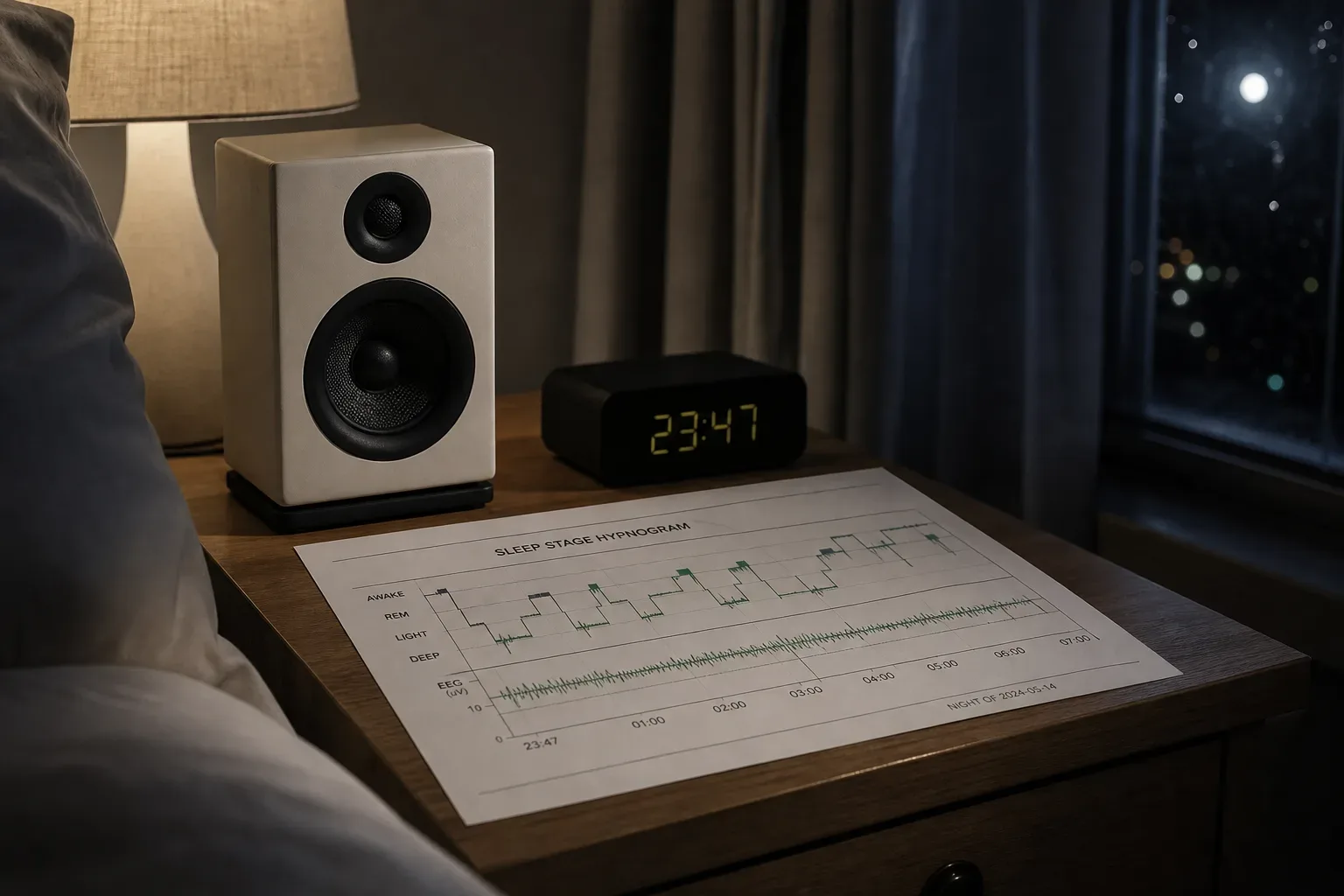
REM vs deep sleep is a timing question, not a contest. Deep sleep is the low-arousal stage you usually protect; REM is the dream-rich stage that often sits closer to waking. For Dream-Self audio, the safer choice is simple: listen before sleep, then let the night run quiet.
What is the plain difference between REM and deep sleep?
REM sleep is a lighter, dream-rich state with active brain patterns, while deep sleep is slow-wave sleep with high arousal threshold and slower cortical rhythm.
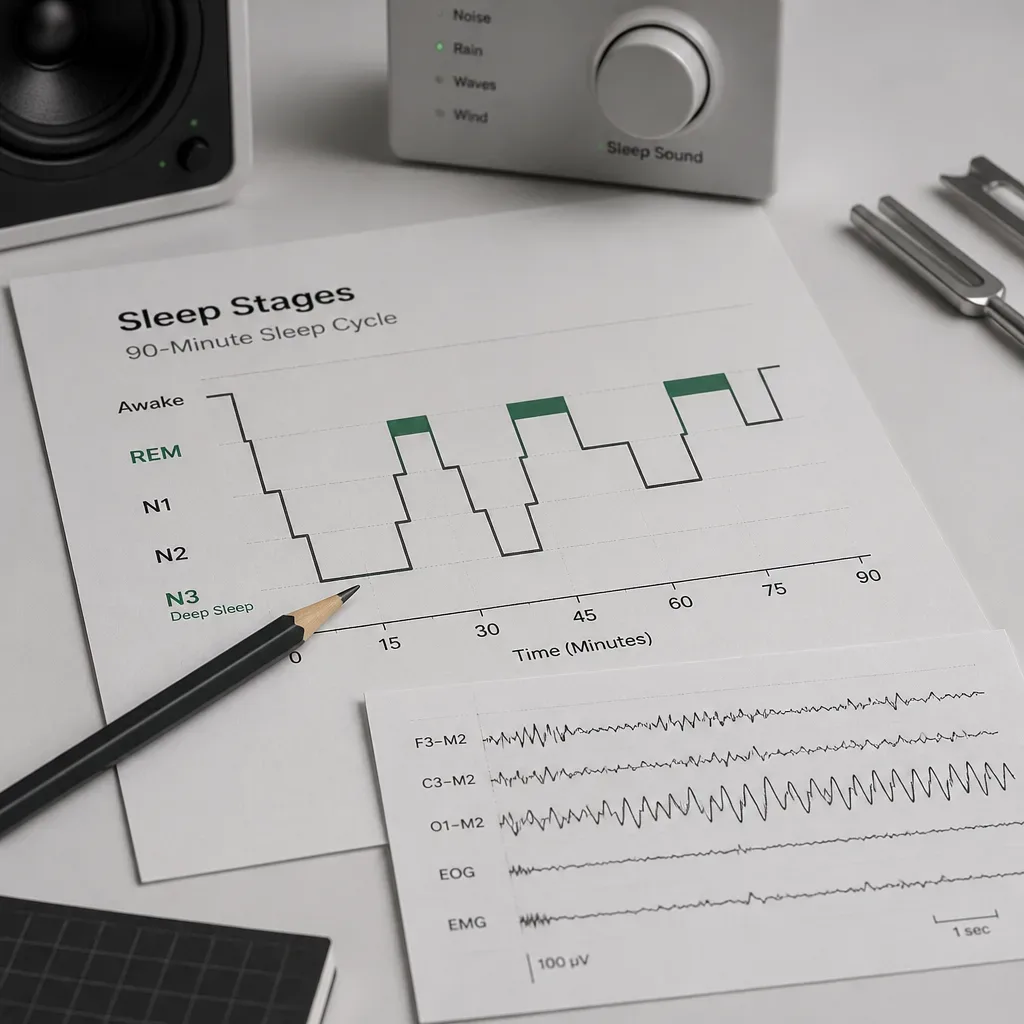
Sleep is usually described in four stages: N1, N2, N3, and REM. N3 is what most people mean by deep sleep. The American Academy of Sleep Medicine scoring manual defines these stages by EEG, eye movement, and muscle tone, not by how rested you feel in the morning. Consumer watches infer the same labels from heart rate, movement, and temperature, which is useful but indirect.
A typical adult sleep cycle runs about 90 minutes, though normal cycles can vary from roughly 70 to 120 minutes. Early in the night, N3 tends to be more common. Later in the night, REM periods tend to stretch longer. That’s why a sound that feels harmless at 10:30 p.m. can become noticeable near 5:30 a.m., when your sleep is already closer to waking.
Deep sleep is not better sleep by itself. REM is not lesser sleep because it’s lighter. The body uses different rooms in the same house. Large sleep summaries often place adult REM around 20 to 25 percent of total sleep, with N3 commonly lower and more variable across age. Older adults usually get less N3 than teenagers.
| Feature | Deep sleep, N3 | REM sleep |
|---|---|---|
| Brain pattern | Slow waves, low frequency | Fast mixed activity |
| Muscle tone | Present but reduced | Very low muscle tone |
| Dream recall | Less common | More common |
| Arousal threshold | Higher | Lower, especially late night |
| Best audio posture | Protect with quiet masking | Avoid sudden speech |
A sleep stage is not a mood. It is a measured pattern of nervous system behavior.
Which stage should you protect from spoken audio?
Protect deep sleep first, because speech can create arousal even when you don’t fully wake up.
The sleeping brain still hears. In lab work, the brain can respond to names, tones, and meaningful sounds during sleep, but response strength changes by stage. Speech has edges: consonants, syllable stress, and semantic surprise. Those edges are useful for a podcast and poor for stable sleep. Even a 2-second word can be enough to create a small autonomic response.
Deep sleep is the stage where interruption is usually most costly. Slow-wave sleep is linked with memory consolidation, immune function, and physical restoration in many studies, including work summarized in the Journal of Neuroscience and Sleep Medicine Reviews. That doesn’t mean one noise ruins the night. It means repeated speech cues are a bad default if your goal is steady sleep.
REM has a different problem. It is closer to waking in the second half of the night, and the brain is already making dream imagery. A familiar voice may fold into a dream, or it may wake you. In lucid dreaming research, auditory cues sometimes work, but they also fail often. The useful lesson is modest: timing speech into REM is possible in a lab, but fragile in a bedroom.
For most people, the comparison is plain:
- Use steady sound to mask the room when needed.
- Use spoken Dream-Self audio while awake and relaxed.
- Don’t chase REM with a voice track unless you accept lighter sleep.
- If apnea, chronic insomnia, parasomnia, or severe tinnitus is present, speak with a clinician before experimenting.
The best sleep audio is sometimes the one that knows when to stop speaking.
Should Dream-Self audio play before sleep or during the night?
Dream-Self audio should usually play before sleep, because attention is still available and sleep architecture is not being disturbed.
The AYA Method is a daily audio manifestation practice. Each day you listen to a short personalized recording, your Dream-Self Moment, narrated from the version of you who has already manifested the life you intend. Listening is the practice. Repetition is the work. The audio is the method.
That definition matters for timing. A spoken practice needs enough wakefulness to hear the words. If you play it after lights out and drift before the second paragraph, you may still like the ritual, but the main listening window has moved. A 3 to 7 minute recording usually fits better at the end of a wind-down, after brushing teeth and before the room goes fully dark.
There is a research-adjacent reason for this. Memory and intention are often strengthened by repetition plus emotional salience. Joe Dispenza and Neville Goddard both used future-self rehearsal language in different traditions, while behavioral psychology would call part of it mental simulation. The claim we can stand behind here is smaller: repeating a personally meaningful audio cue at the same time each day makes it easier to remember and inhabit.
If you want sound after the Dream-Self Moment, switch from speech to steady audio. Use a low, plain mask like the White noise generator + guide, or a gentler low-spectrum option if hiss bothers you. Keep it below conversation level. Speech asks the brain to parse. Noise asks the room to disappear.
How can you estimate sleep stages without a lab?
You can estimate sleep stages from timing and patterns, but only a sleep study measures them directly.
Polysomnography uses EEG, electro-oculography, and muscle tone sensors. That is the reference method. Watches and rings use proxies such as pulse rate, movement, skin temperature, and heart-rate variability. A 2019 review in Sleep Medicine Reviews found consumer wearables generally estimate sleep versus wake better than specific stages. That is not useless. It is just less exact than the labels imply.
For home timing, start with sleep onset. If you usually fall asleep at 11:00 p.m., the first REM window may arrive around 12:10 to 12:40 a.m. Deep sleep will often be concentrated before 2:00 a.m. if your schedule is stable. After 4:00 a.m., REM and lighter N2 sleep are more likely. Alcohol can suppress early REM and fragment later sleep; even one or two drinks can change the curve.
Use a 7-night average, not a single night. One bad meeting, late meal, or warm room can shift timing. The National Sleep Foundation notes that adults generally need 7 to 9 hours, but within that range the distribution changes by person. A 6-hour sleeper who cuts the last 90 minutes may lose a lot of REM; a person with frequent awakenings may lose continuity instead.
A plain home method looks like this:
- Record bedtime, estimated sleep onset, and wake time for 7 nights.
- Note caffeine after 2 p.m., alcohol, naps, and late exercise.
- Mark when you naturally wake during the night.
- Compare those times to the 90-minute cycle estimate.
- Place speech before sleep, not inside the estimated cycles.
Your tracker can suggest a pattern. Your body still gets a vote.
What audio belongs near each sleep stage?
Use speech while awake, steady masking near sleep onset, and avoid novelty once you’re likely asleep.
Audio design for sleep is mostly removal. Remove sharp attacks. Remove obvious loop points. Remove sudden stereo movement. In app work, a bad 8-second loop can become visible to the ear by minute 3. The sleeper may not name the seam, but the body hears the repetition. A 10-minute loop with careful crossfades is usually safer than a short decorative phrase.
Different tools serve different jobs. The Binaural beats generator + guide can be useful for focused listening before bed if you like the sensation of two close tones. Evidence for binaural beats is mixed; small studies report changes in mood or attention, but effects vary by frequency, headphone use, and expectation. Don’t run tones all night at high volume.
Solfeggio tones sit in a more traditional category. The Solfeggio frequencies guide explains the lore around numbers like 528 Hz with respect and with plain evidence limits. If 528 Hz helps you settle, that preference is valid. It doesn’t need a medical claim to be useful in a bedtime ritual.
| Use case | Better tool | Timing | Volume note |
|---|---|---|---|
| Personal intention | Dream-Self audio | Before sleep | Clear but quiet |
| Noisy hallway | White or pink noise | All night if needed | Lowest masking level |
| Mental settling | Binaural beat | 5 to 20 minutes awake | Avoid loud headphones |
| Symbolic tone ritual | Solfeggio tone | Wind-down | Keep simple and steady |
Sound prepares the room; a voice fills it. Use the voice while you can still hear it.
What if your tracker says you’re low on REM or deep sleep?
Treat tracker stage scores as clues, not diagnoses, because stage detection at home is approximate.
A low REM score after one night often reflects shortened sleep, late alcohol, stress, medication, or simple device error. REM clusters toward morning, so waking 60 to 90 minutes early can reduce measured REM more than you expect. Deep sleep can look low after hard stress or irregular timing, but it also declines with age. A 55-year-old and a 19-year-old should not expect the same N3 graph.
The better question is not “How do I force more REM?” It is “What keeps my sleep continuous enough for REM and deep sleep to occur?” Continuity is the quiet foundation. The CDC has reported that about 1 in 3 U.S. adults sleep less than 7 hours per night. For many people, total sleep opportunity is the first bottleneck, not a missing frequency.
If your tracker flags low deep sleep for 2 weeks and you also feel unwell, treat it as a prompt to look at schedule, light, caffeine, room temperature, and breathing. Loud snoring, gasping, morning headaches, or heavy daytime sleepiness deserve medical attention. Audio can mask a doorway conversation. It should not mask a breathing disorder.
For Dream-Self timing, a poor tracker report does not mean you should push speech into a stage you think is missing. Keep the spoken practice stable before sleep. Then improve the sleep container: darker room, cooler air, quieter sound bed, regular wake time. The stage graph often follows the basics better than it follows experiments.
A graph is not the night. It is a sketch made after the body has already done the work.
What is the safest routine to use tonight?
The safest routine is a short spoken practice while awake, followed by low-volume steady sound only if the room needs masking.
Start with volume. If you can measure at the pillow, aim roughly for 35 to 45 dB for masking sound, lower if the room is already quiet. Phone decibel apps are not laboratory meters, but they can stop you from drifting into 60 dB all-night playback. For children, keep levels lower and avoid earbuds for sleep unless a clinician has advised otherwise.
Then set the order. The order matters because it respects attention and sleep depth. Spoken audio belongs before sleep onset. Masking audio can continue because it has fewer changes for the brain to parse. If you need a tool, press play on the White noise generator + guide and listen for the lowest level that covers the room, not the level that covers your thoughts.
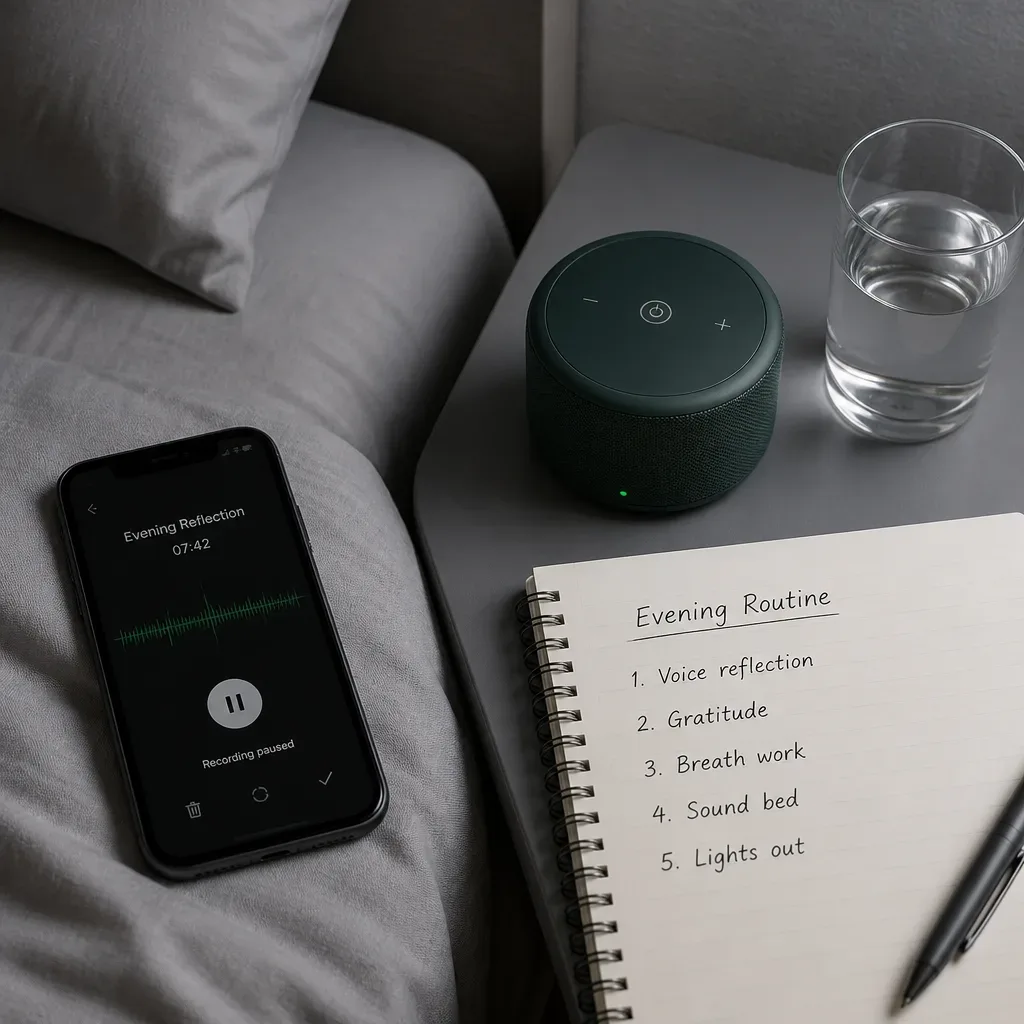
A simple 20-minute routine:
- Dim lights for 10 minutes and put the phone face down.
- Play the Dream-Self Moment once, seated or lying down, with speech clearly audible.
- Stop speech when the recording ends.
- If the room is noisy, start steady masking sound at the lowest useful level.
- Keep the same wake time tomorrow, within about 30 minutes if possible.
This is not an attempt to hack REM or command deep sleep. It is a way to avoid putting language where the sleeping brain is trying to reduce interruptions. If you want a tone before bed, keep it brief. If you want a full-night bed, keep it plain. If you want the method, listen daily while awake enough to receive it.
Let the voice end, and let the room keep breathing.