sleep science
Chronotype Sleep Schedule for Dream-Self Audio
Build a chronotype sleep schedule that fits your body clock, then time Dream-Self audio when your nervous system is most ready to settle.
A chronotype sleep schedule times your evening practice to your body clock rather than to an ideal bedtime. Use your natural sleepiness pattern to choose when to dim lights, play masking sound, and listen to Dream-Self audio. The aim is not earlier at any cost; it is steadier timing that your nervous system can believe.
What is a chronotype sleep schedule?
A chronotype sleep schedule is a sleep plan matched to whether your body tends to run early, late, or somewhere between.
Chronotype is the behavioral face of circadian timing. It shows up as the hour you feel most alert, the hour you naturally fade, and how hard it is to wake without an alarm. The Munich Chronotype Questionnaire, developed by Till Roenneberg and colleagues, often estimates chronotype from the midpoint of sleep on free days, corrected for sleep debt. That sounds dry, but it gives a useful number: if you sleep from 00:30 to 08:30 on free days, your midpoint is around 04:30.
Most adults are not pure larks or pure owls. In population work using chronotype questionnaires, people distribute across a wide middle, with smaller early and late tails. Age matters too. Adolescents and young adults tend to shift later, while older adults often shift earlier. The American Academy of Sleep Medicine recommends at least 7 hours of sleep for adults, but the clock position of those 7 hours is not identical for everyone.
A schedule built against chronotype often feels clean on paper and noisy in the body. A late type told to sleep at 21:30 may lie awake long enough to teach the bed a bad association. An early type who forces late-night audio may fall asleep before the first sentence lands.
A good sleep schedule is not a moral schedule. It is a repeatable agreement with your biology.
For Dream-Self audio, the timing matters because attention has a narrow door. Too early, and the mind is still sorting the day. Too late, and you may drift before hearing the recording. The useful window is the quiet edge: sleepy enough to soften, awake enough to listen.
How do you find your chronotype without guessing?
You find your chronotype by measuring your natural sleep timing for at least 7 days, with special attention to work-free mornings.
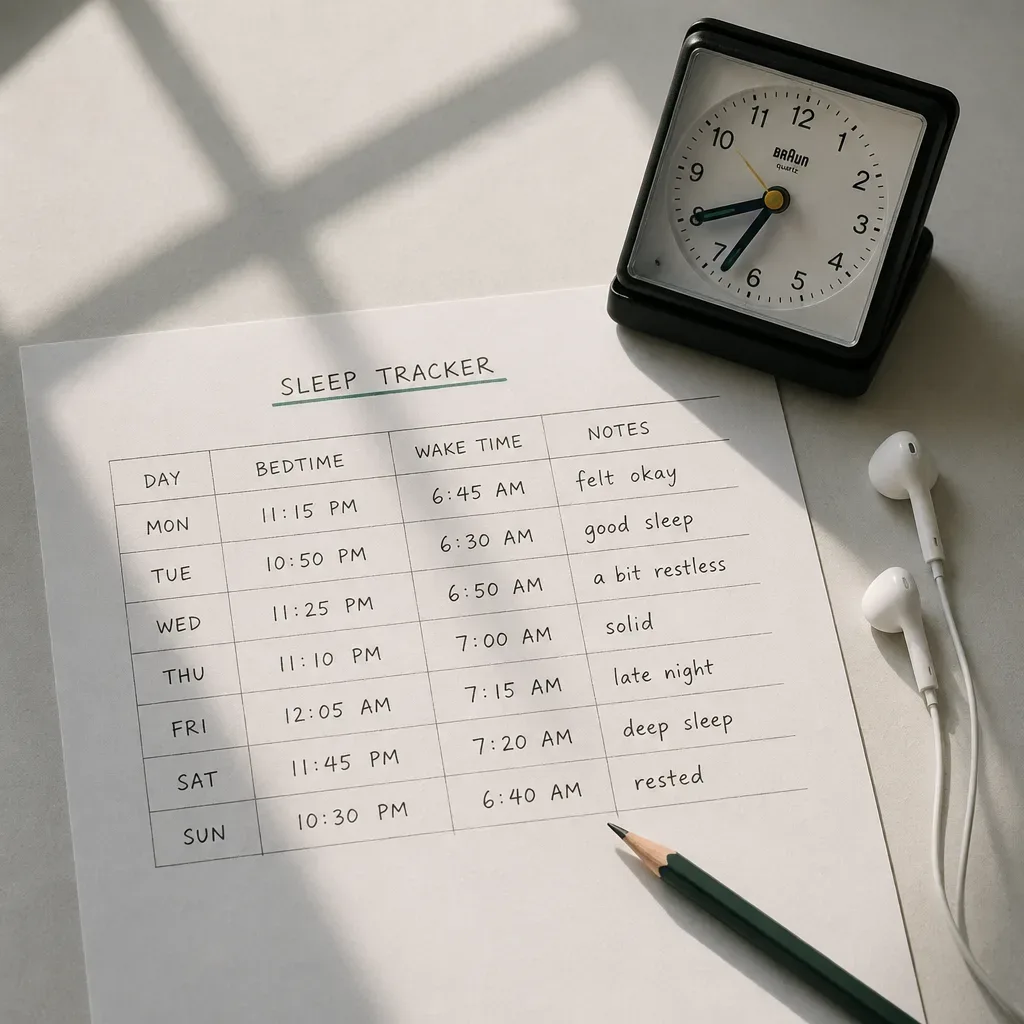
Start plain. For one week, write down when you get into bed, when you think you fall asleep, when you wake, when you get out of bed, and when you feel your first clear alertness. A paper card by the bed is often better than an app because it doesn’t invite a screen at 23:40. The Centers for Disease Control and Prevention has reported that roughly 1 in 3 U.S. adults sleep less than the recommended amount, so the first measurement may reveal sleep debt as much as chronotype.
Use free days carefully. If you sleep much later on weekends, that may be your chronotype speaking, or it may be recovery from a too-short workweek. Roenneberg’s social jetlag research named the mismatch between social time and biological time; a 2-hour difference between weekday and free-day midpoint is common enough to matter. It feels like flying from Paris to Istanbul every Monday without leaving the bedroom.
Try this 7-day measurement:
- Record lights-out time and final wake time each day.
- Mark caffeine after 14:00, alcohol, late exercise, and naps.
- Note outdoor light exposure within 60 minutes of waking.
- On free days, calculate your sleep midpoint.
- Compare your best alertness hour with your sleep midpoint.
A simple guide is enough for practice:
| Pattern | Free-day sleep midpoint | Common feel |
|---|---|---|
| Early type | Before 03:30 | Alert early, fades early |
| Intermediate type | 03:30–05:00 | Flexible, depends on sleep debt |
| Late type | After 05:00 | Slow mornings, later clarity |
These are not medical cutoffs. They are working ranges. If your sleep is broken by loud snoring, gasping, restless legs, or months of insomnia, ask a clinician before treating timing as the only issue.
When should you play Dream-Self audio for each chronotype?
Play Dream-Self audio in the last alert pocket before sleep, usually 10 to 30 minutes before your natural sleep onset.
This is where the AYA Method fits naturally. The AYA Method is a daily audio manifestation practice. Each day you listen to a short personalized recording, your Dream-Self Moment, narrated from the version of you who has already manifested the life you intend. Listening is the practice. Repetition is the work. The audio is the method.
The audio should not compete with email, teeth brushing, kitchen lights, or a half-finished conversation. It should follow the small closing of the day. In sleep research, consistency is one of the more reliable behavioral signals. Cognitive behavioral therapy for insomnia often uses regular wake time and stimulus control because the brain learns from repeated pairings.
Use the table as a starting point, then correct by listening to your actual nights:
| Chronotype | Best starting audio window | If you fall asleep too soon | If you feel too alert |
|---|---|---|---|
| Early | 20:30–21:30 | Move 10 minutes earlier | Dim lights 30 minutes sooner |
| Intermediate | 21:30–22:45 | Sit slightly upright | Add a 10-minute sound cue |
| Late | 22:45–00:15 | Play before bed, not in bed | Shift by 10 minutes every 3 nights |
| Shift worker | Before main sleep episode | Use blackout and low volume | Anchor to wake time, not clock time |
Volume matters. Keep spoken audio at a comfortable low level, below normal conversation if you’re using earbuds or a bedside speaker. The World Health Organization has warned about unsafe listening levels in personal audio devices; sleep routines should be quieter than daytime media, not louder.
The right time is not the earliest time. It is the time when attention can stay warm without becoming effort.
If you share a room, use one earbud at low volume or a small pillow speaker. If you have tinnitus, sound sensitivity, or ear pain, skip earbuds and get personal guidance.
What should you play before and after the audio?
Use simple sound before the audio to mask disturbances, then leave either silence or a steady low sound after it.
Sound is not decoration here. It is a cue. A short bed sequence might be 10 minutes of soft rain, then Dream-Self audio, then brown noise or silence. Natural recordings work for many people because they contain small variations without demanding interpretation. In a 2021 systematic review and meta-analysis in Proceedings of the National Academy of Sciences, Rachel Buxton and colleagues found that natural sounds were associated with reduced stress and improved mood outcomes across 36 publications, though study methods varied.
If you use noise, choose the color by the room problem. White noise contains equal acoustic power per hertz and can sound hissy. Pink noise rolls off high frequencies and often feels more balanced. Brown noise has more low-frequency weight and less top-end bite. You can compare these directly in the White noise generator + guide. Press play below that guide and listen for which sound masks your room without pulling attention toward itself.
Binaural beats are different. A binaural beat is an auditory illusion created when each ear receives a slightly different tone, such as 200 Hz in one ear and 206 Hz in the other. The perceived 6 Hz beat is constructed by the brain. Research is mixed; small studies and reviews report possible effects on anxiety or attention, but protocols vary a lot. If you’re curious, use the Binaural beats generator + guide at low volume and treat it as a focus cue, not a guarantee.
Solfeggio frequencies belong to a different category: tradition, music culture, and personal meaning. Many listeners like 528 Hz or 432 Hz because the tone feels pleasant or familiar. The direct biological claims are not well established. The Solfeggio frequencies guide is useful if you want the lore named respectfully while keeping the evidence plain.
Good pre-audio sound has three traits:
- It masks the most irritating part of the room.
- It doesn’t carry lyrics or sharp changes.
- It can be repeated nightly without becoming interesting.
A sleep sound has done its job when you stop studying it.
How do you adjust the schedule without fighting your body clock?
Adjust a chronotype sleep schedule in small steps, usually 10 to 15 minutes every 2 or 3 nights.
Large timing changes often fail because circadian rhythm shifts slowly. Light is the stronger lever. Dr. Andrew Huberman often explains this in public teaching through the timing of retinal light exposure, and the underlying circadian literature supports the broad principle: morning light tends to advance the clock, while bright evening light tends to delay it. The exact phase-response curve depends on timing and intensity, but the practice is simple enough to test.
If you want to move earlier, start with wake time. Get outdoor light within 30 to 60 minutes of waking, even on cloudy mornings. Keep evenings dimmer for the final hour. Many indoor lights are far weaker than daylight, but phones held close to the face still add alerting stimulation. A 2015 study in PNAS by Chang and colleagues found that evening light from e-readers could delay circadian timing and reduce next-morning alertness compared with print reading.
If you want to move later, which some early types need for social or family reasons, protect the morning from too much pre-dawn activation and place brighter light later in the day. Still keep the final wind-down predictable. The goal is not to make yourself wired at night; it is to place sleep where life can actually support it.
A 14-day adjustment plan:
- Keep one fixed wake time within a 30-minute range.
- Move Dream-Self audio by 10 minutes toward the target every 3 nights.
- Move dim-light time with it, not after it.
- Stop caffeine 8 hours before target bedtime if caffeine affects you.
- Review sleep latency and morning alertness on days 7 and 14.
Caffeine timing is individual, but the half-life is often cited around 5 hours, with wide variation. For sensitive sleepers, a 15:00 coffee can still be audible in the body at 22:00.
What mistakes make a chronotype sleep schedule less reliable?
The most common mistake is changing the audio time while leaving light, work, caffeine, and noise exactly the same.
A schedule is a system. If a late chronotype tries to play Dream-Self audio at 21:45 while the room is bright, the inbox is open, and the body expects sleep at 00:30, the recording has to push against too many signals. In practice, the weaker cue loses. Sleep medicine often uses the phrase “sleep hygiene,” but the better word is signal. Your brain measures the pattern.
Another mistake is using sound too loudly. Masking works through contrast, not force. If traffic outside sits around 45 dB in a bedroom, a masking sound doesn’t need to be 70 dB. Many people do better with the lowest volume that blurs the edges of the disturbance. For children, keep volume especially conservative and place speakers away from the pillow.
Loop quality matters too. As a field recordist, I hear this quickly. A rain file with a visible 18-second loop can become irritating once the ear finds the seam. A long take with tiny irregularities tends to settle better: a softer gust, a distant tire on wet road, the brief thickening of drops on leaves. The ear distrusts a loop that never breathes.
Watch for these faults:
- Audio starts before the room is actually quiet.
- The sound is loud enough to notice, not soft enough to disappear.
- Bedtime shifts by 90 minutes on weekends.
- The recording is used to compensate for too little sleep.
- You change five variables and can’t tell what helped.
One more plain point: Dream-Self audio is not a treatment for chronic insomnia, apnea, panic, or depression. If sleep loss is persistent or dangerous, get clinical help. A good sound routine can support care; it should not replace it.
How do you know if your timing is working?
You know the timing is working when sleep becomes more predictable and the audio feels easy to receive.
Track only a few measures. More data can make the bed feel like a lab bench. Use sleep latency, number of awakenings, final wake time, and morning steadiness. Wearables can be useful for trends, but consumer sleep staging is imperfect. The American Academy of Sleep Medicine has noted that consumer devices should not be treated as diagnostic tools. Your own pattern across 14 nights is often more useful than one impressive graph.
Give the schedule two weeks before judging it. Circadian cues need repetition, and so does audio practice. Joe Dispenza and Neville Goddard are often discussed in manifestation communities for rehearsal, identity, and imagined future states; those ideas sit outside standard sleep medicine, so keep the categories clear. The sleep part is timing, light, and nervous system settling. The Dream-Self part is daily listening.
Use this review table after 14 days:
| Measure | Good sign | Adjustment if not |
|---|---|---|
| Sleep latency | Often under 30 minutes | Move audio later or dim earlier |
| Morning alertness | Clearer within 60 minutes | Strengthen morning light cue |
| Audio recall | You remember the main tone | Play slightly earlier or sit up |
| Night waking | No clear increase | Lower volume or use silence after |
| Schedule fit | Weekends within 60 minutes | Reduce social jetlag gently |
The body clock doesn’t need persuasion. It needs consistent evidence.
If the audio becomes a pressure point, simplify. One sound cue, one short recording, one low volume, one review date. That’s enough. The method should feel like placing a microphone in the right position: small adjustment, large difference in what can be heard.
Tonight, listen where your clock is already beginning to lower its voice.