sleep science
How Long to Fall Asleep With Dream-Self Audio?
How long to fall asleep with Dream-Self audio? Use the 10 to 20 minute range, softer volume, and a steady routine to read your body clearly.
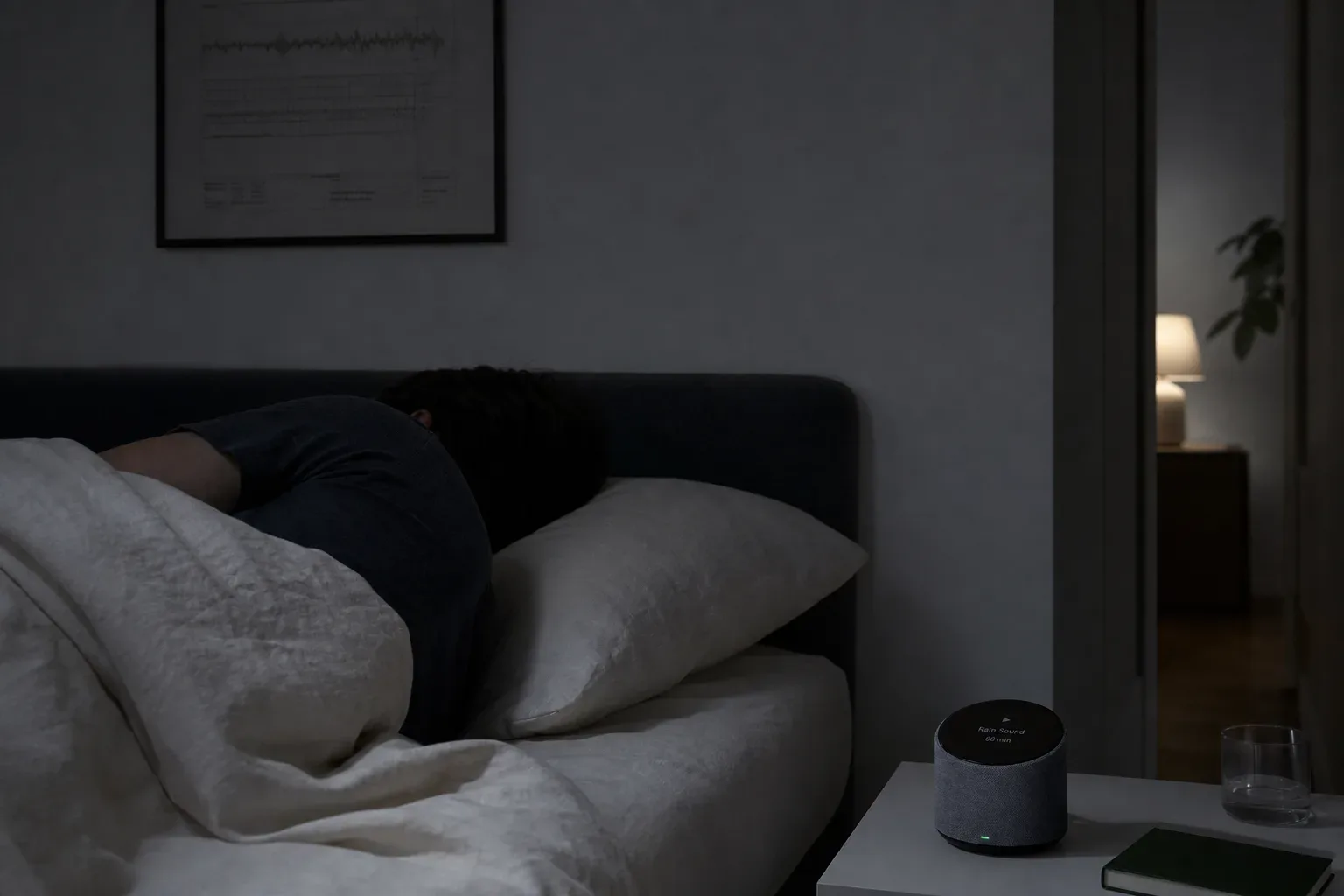
With Dream-Self audio, a typical target is falling asleep within 10 to 20 minutes after lights out. If it takes longer than about 30 minutes most nights, treat that as information, not failure: adjust timing, volume, light, caffeine, and the recording itself before you judge the practice.
What is a normal sleep latency with audio?
A normal sleep latency for a rested adult is usually about 10 to 20 minutes, whether audio is playing or not.
Sleep latency simply means the time between trying to sleep and actually entering sleep. The National Sleep Foundation often uses 10 to 20 minutes as a plain reference range for healthy sleep onset, while clinical insomnia definitions look at repeated difficulty over weeks, not one restless night. Sleep latency is not a moral score; it is a measurement.
Audio changes the setting, not the biology. A voice, hum, or tone can reduce the number of sharp things competing for attention, but your brain still has to move through wakefulness, drowsiness, and stage N1 sleep. In lab scoring, N1 is light sleep and can be brief, sometimes only 1 to 7 minutes in a healthy night, according to standard polysomnography descriptions from the American Academy of Sleep Medicine.
If Dream-Self audio is part of your routine, start the clock from the moment you stop doing tasks, not from the moment you press play while still brushing teeth or answering messages. In sleep research, timing matters. A 2020 review in Sleep Medicine Reviews noted that pre-sleep arousal, especially cognitive arousal, is one of the stronger predictors of insomnia symptoms.
The useful question is not whether you disappeared by minute 3. The useful question is whether your average over 7 to 14 nights moves toward a steadier range. One night is weather. Two weeks is closer to climate.
Does Dream-Self audio make sleep faster?
Dream-Self audio may help some people fall asleep faster by giving attention a single, repeated object, but it should not be treated as a sedative.
In the AYA Method, the AYA Method is a daily audio manifestation practice. Each day you listen to a short personalized recording, your Dream-Self Moment, narrated from the version of you who has already manifested the life you intend. Listening is the practice. Repetition is the work. The audio is the method.
That matters for sleep because repetition teaches the nervous system what usually comes next. Sleep researchers call this conditioning. Cognitive behavioral therapy for insomnia, often shortened to CBT-I, uses stimulus control partly because the bed can become linked with either rest or effort. The American College of Physicians recommended CBT-I as first-line treatment for chronic insomnia in a 2016 guideline, which is a useful reminder: cues are real, but they work through practice, not force.
A Dream-Self recording can become a cue if it stays consistent: same approximate hour, same low volume, same listening posture, same end of the day. The point is not to hear every word. The point is to give the mind a safe sentence to stop gripping.
There is a caution. If the content is emotionally bright, too detailed, or too new each night, it may increase attention instead of reducing it. A 2018 paper in the Journal of Experimental Psychology found that writing a specific to-do list for 5 minutes helped participants fall asleep faster than journaling completed tasks, likely because mental loops were parked. Your recording should park the loop, not open 12 new tabs.
When is falling asleep too fast or too slow?
Falling asleep in under 5 minutes can suggest sleep debt, while taking more than 30 minutes repeatedly may signal that your routine needs attention.
People often worry only about taking too long, but very short sleep latency can also say something. In the Multiple Sleep Latency Test, used clinically for disorders of sleepiness, average latencies under 8 minutes can indicate excessive daytime sleepiness in the right context. That does not diagnose you at home, but it gives the number some shape.
Use ranges gently. Caffeine at 2 p.m., a hard conversation at 9 p.m., alcohol, pain, menstrual cycle changes, jet lag, and room temperature can all move the number. The ideal bedroom temperature is often cited around 18.3 degrees Celsius or 65 degrees Fahrenheit by sleep clinicians, though comfort varies.
| Time to fall asleep | What it may mean | What to try tonight |
|---|---|---|
| Under 5 minutes | Possible sleep debt or exhaustion | Move bedtime earlier for 3 nights |
| 10 to 20 minutes | Common healthy range | Keep the routine stable |
| 20 to 30 minutes | Mild arousal or timing mismatch | Lower light 60 minutes before bed |
| Over 30 minutes often | Conditioned effort or insomnia pattern | Leave bed briefly, return sleepy |
| Over 60 minutes often | Needs closer review | Consider CBT-I or medical advice |
If you are awake after roughly 20 to 30 minutes, many CBT-I protocols suggest leaving the bed for a quiet, dim activity until sleepiness returns. Do not watch the clock to enforce that rule. Clock-checking can raise arousal; one small experimental study from 2007 found that monitoring time increased worry and made perceived sleep worse.
How should you set volume and length tonight?
Set the recording low, short, and predictable, then let the room do less work.
Volume is the first safety setting. For adults, keep sleep audio comfortably below conversation level, often around 40 to 50 dB if you can measure it, and avoid headphones when possible if you tend to fall asleep in them. The World Health Organization has warned that long exposure above 70 dB over 24 hours can carry hearing risk. Children need even more conservative levels.
Length is the second setting. If your normal sleep latency is 15 minutes, a 6 to 12 minute Dream-Self track may be enough. If you use a longer ambient bed, keep it steady and low. A sleep track should be interesting enough to trust and boring enough to lose.
Try this 4-night adjustment before changing the whole method:
- Night 1: Measure plainly. Press play, turn the screen face down, and estimate sleep onset in the morning.
- Night 2: Lower by one step. Reduce volume 10 to 20 percent if you remember too much of the track.
- Night 3: Start earlier. Begin the audio 10 minutes before lights out if the words keep you alert.
- Night 4: Add masking sound. Use a quiet neutral bed if outside noise keeps cutting through.
For masking, press play below and listen for the difference with the White noise generator + guide. White noise has equal acoustic power per Hz, while pink and brown noise tilt lower. Some nervous systems settle better with low hum than with hiss.
If you prefer tonal material, keep claims modest. The Binaural beats generator + guide explains how two nearby tones can create a perceived beat in the brain, but evidence for sleep outcomes is mixed and study sizes are often small. The Solfeggio frequencies guide covers the tradition respectfully; liking 528 Hz is allowed, but it is not a guaranteed sleep switch.
What should you notice as sleep approaches?
You should notice less precision, fewer complete thoughts, and a softer sense of where the recording is in time.
Sleep onset rarely feels like a door closing. It often feels like losing your place. You may hear a sentence, miss three, return at a word that seems unrelated, then drift again. In stage N1, people can still respond to sound and may deny being asleep if awakened. In sleep lab scoring, that boundary is measured in 30-second epochs, which tells you how fine and unstable the edge can be.
Good signs are plain:
- The words stop asking for analysis.
- Your breathing slows without being managed.
- Your jaw or hands release a little.
- You forget the exact topic of the recording.
- You stop caring whether the method is working.
If the audio becomes a test, the test is louder than the audio. That is why I prefer Dream-Self recordings that are short, familiar, and dynamically narrow at night. As a composer, I think of sleep music as music with a curfew: no bright arrivals, no sudden resolution, no gesture that asks the listener to applaud.
A normal sleep cycle lasts about 90 minutes, though it varies by person and by night. Your job at bedtime is not to manage the cycle. Your job is to make the first descent less crowded. If voice alone is too exposed, place a very quiet layer from the White noise generator + guide underneath and keep the voice just clear enough to recognize.
What if you wake after the audio ends?
If you wake after the audio ends, keep the response boring and repeatable.
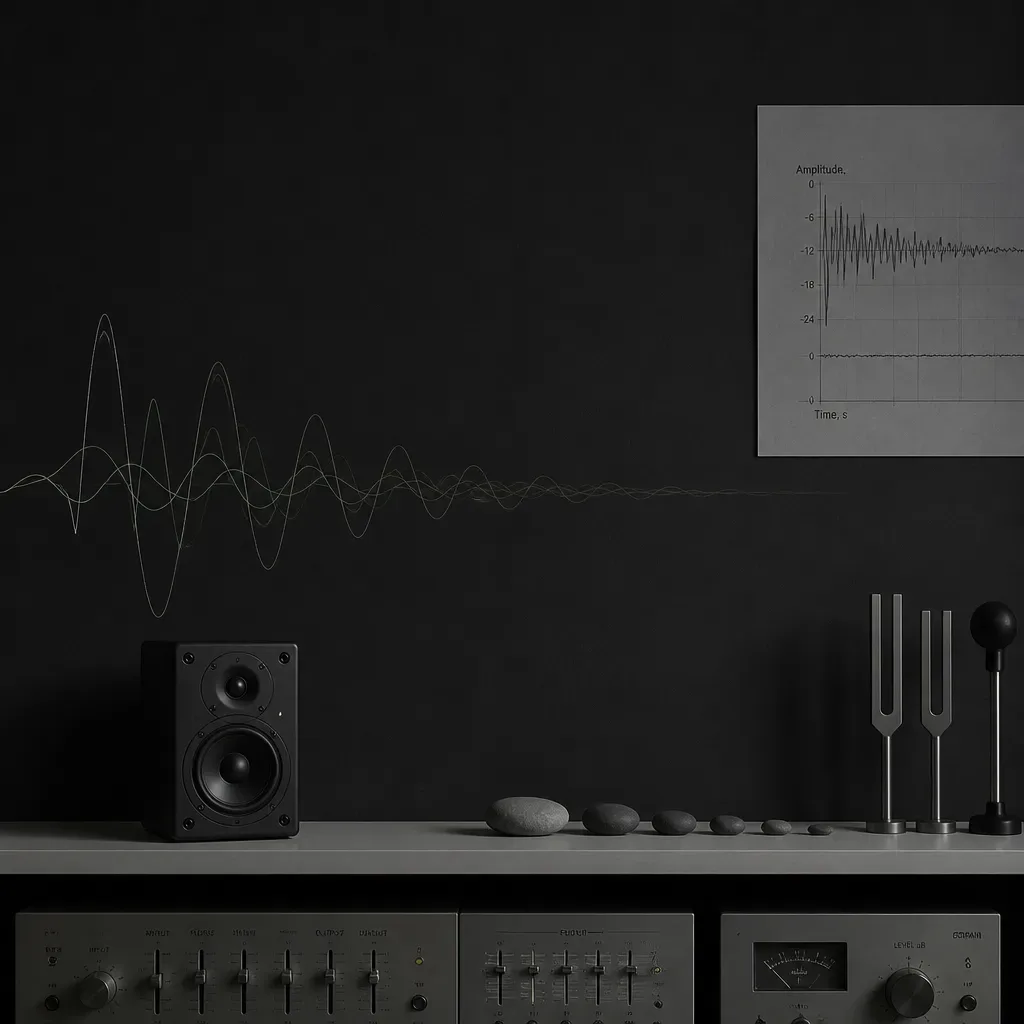
First, check whether the ending is too noticeable. A click, app stop sound, sudden silence, or change in room tone can pull the ear back online. In audio editing, a 10 to 30 second fade is not decoration; it is courtesy. The sleeping ear still detects change. Research on auditory processing during sleep shows that meaningful or unusual sounds can be processed differently from neutral tones, even when they do not fully wake a person.
Second, decide whether you need a bed of sound after the voice. Some people do best with silence after the Dream-Self Moment. Others need a low mask for traffic, neighbors, or a partner turning over. Pink or brown noise can help because lower-frequency sound tends to feel less sharp than white noise at the same perceived loudness.
Third, do not restart the recording again and again with effort. Once is the practice. If you wake at 3 a.m., use a simpler cue: one low sound, no screen, no new content. The more decisions you make at night, the more awake your frontal cortex becomes. Even 5 minutes of bright phone light can delay melatonin timing in sensitive people, and many phones exceed 100 lux close to the face.
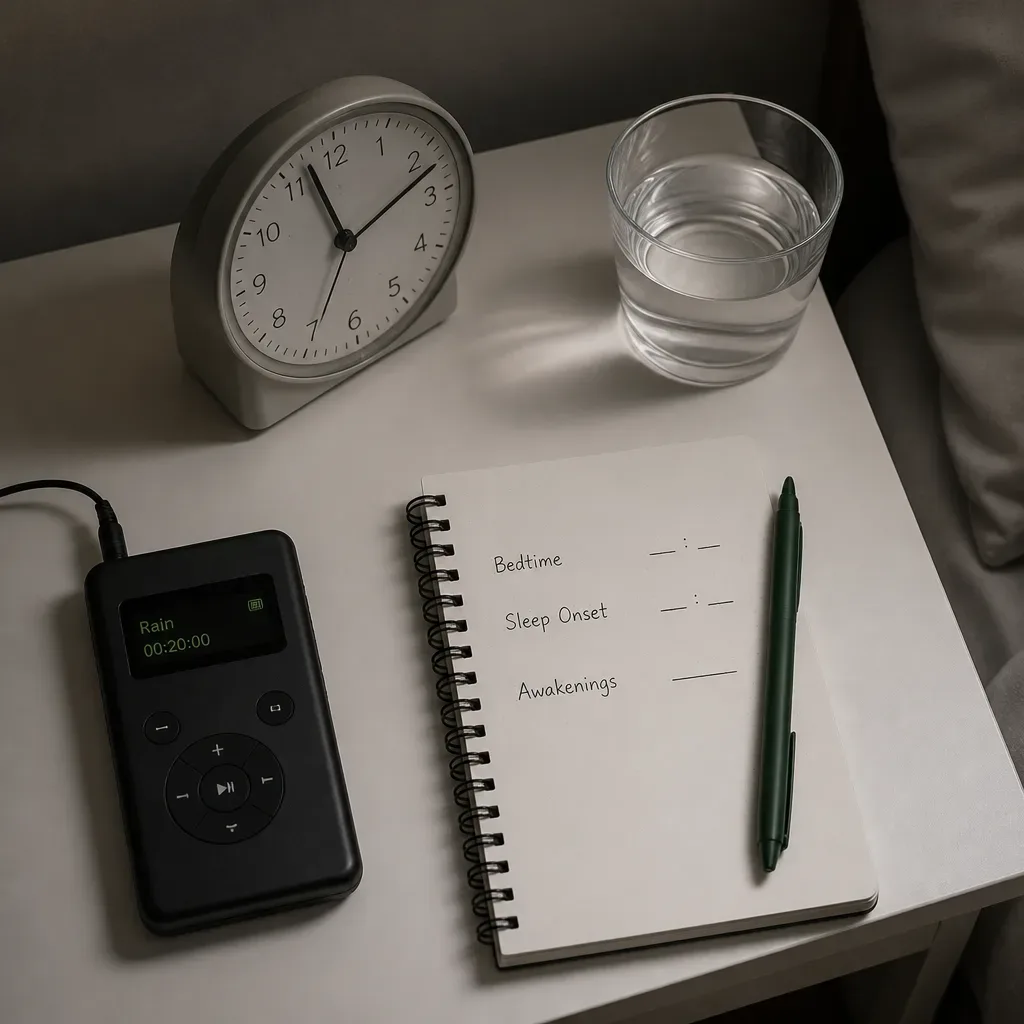
If you wake often, track only three data points for 7 nights: bedtime, estimated sleep onset, and number of awakenings. More tracking can become surveillance. Enough tracking gives you a pattern.
When should you ask a professional instead of adjusting audio?
Ask for help when sleep difficulty is frequent, impairing, or paired with symptoms that audio cannot evaluate.
The International Classification of Sleep Disorders describes chronic insomnia around difficulty sleeping at least 3 nights per week for at least 3 months, with daytime impairment. You do not need to wait in distress for a label, but that 3-month mark is a useful boundary. If your sleep latency is often over 30 minutes and your days are shrinking around it, a CBT-I clinician can help you change the pattern more directly than another track can.
Some signs deserve medical attention sooner: loud snoring, gasping, witnessed pauses in breathing, morning headaches, restless legs, sudden sleep attacks, chest discomfort, severe anxiety at night, or depression symptoms. Audio can support rest, but it cannot rule out sleep apnea, iron deficiency, medication effects, or other causes.
Also be careful with children. Keep volume low, avoid earbuds during sleep, and do not use spoken manifestation content as a substitute for bedtime connection or clinical support. The American Academy of Pediatrics has cautioned about noise exposure from infant sleep machines when they are too loud or too close; distance and volume matter.
For most adults, the simple plan is this: aim for 10 to 20 minutes, adjust if you are often past 30, and protect the quiet more than you chase a number. The body does not fall asleep because it was persuaded. It falls asleep when the conditions stop arguing.
Let the recording become easy to forget.