sleep science
Sleep Schedule Reset With a 3-Minute Audio Cue
Use a sleep schedule reset built around light, wake time, and a 3-minute Dream-Self audio cue to make bedtime feel steadier.
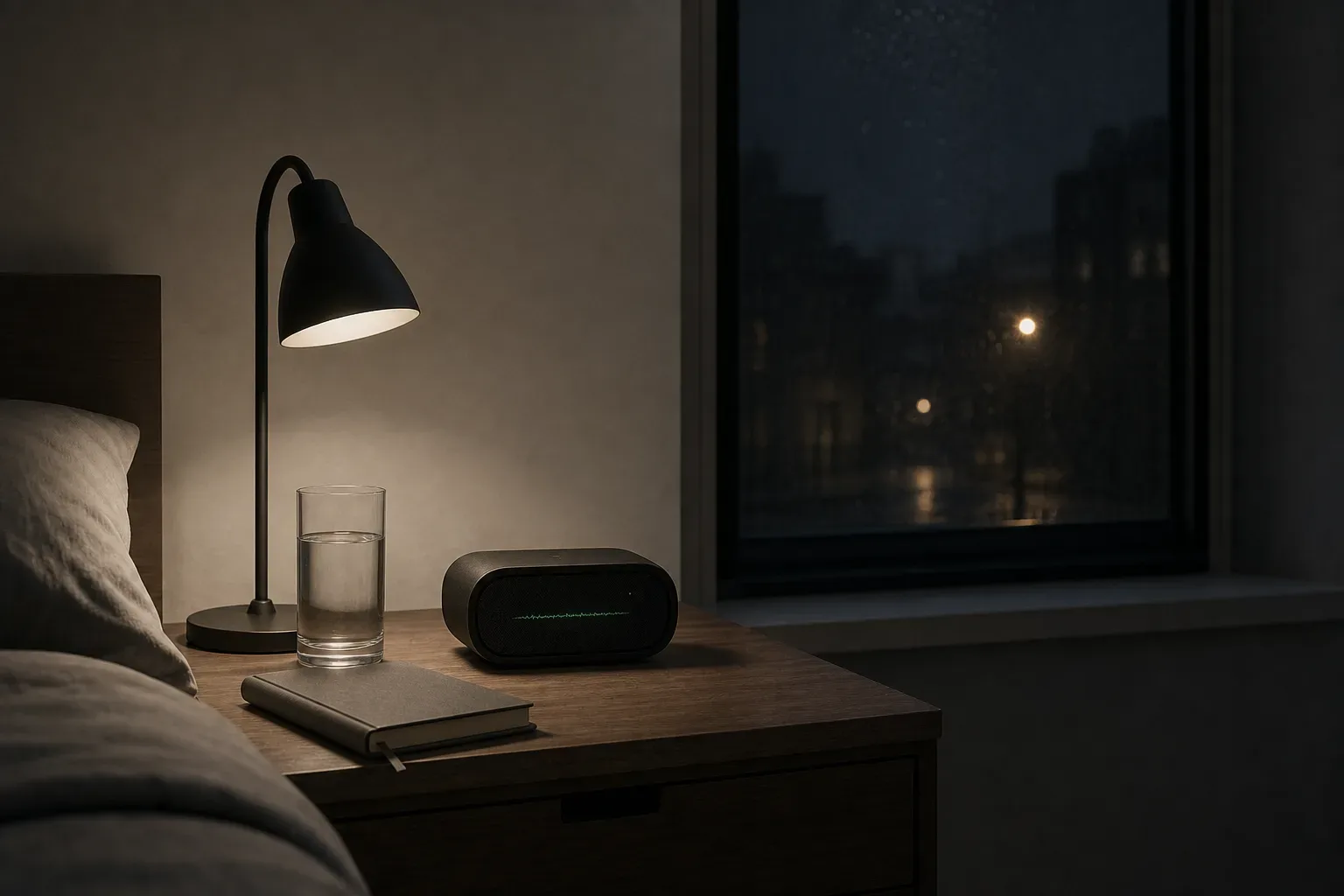
A sleep schedule reset works best when you anchor wake time, morning light, and a short repeatable cue before bed. The 3-minute Dream-Self audio cue doesn’t force sleep. It marks the change from daytime attention to night physiology, so your routine becomes easier to repeat for 7 to 14 nights.
What is a sleep schedule reset, exactly?
A sleep schedule reset is a planned shift in sleep timing using consistent wake time, light exposure, and evening cues.
Your body keeps time with a circadian system that runs close to 24 hours. The suprachiasmatic nucleus in the hypothalamus receives light information from the eyes and helps time melatonin, body temperature, alertness, and sleep pressure. The American Academy of Sleep Medicine recommends at least 7 hours of sleep for most adults, but the clock that makes those 7 hours feel possible is trained by repetition.
A reset is not the same as one early night. If you usually fall asleep at 1:00 a.m. and decide to sleep at 10:30 p.m. tonight, your body may treat the new bedtime as a long, quiet waiting room. In practice, many people do better by moving bedtime 15 to 30 minutes earlier every 2 or 3 nights while keeping wake time fixed. That gives the clock a clear signal without asking it to jump three time zones.
The Centers for Disease Control and Prevention has reported that about 1 in 3 U.S. adults sleep less than 7 hours on a typical night. Some of that is work, caregiving, pain, and noise. Some of it is timing. A sleep schedule reset addresses the timing part plainly: wake at the same hour, get light early, reduce light late, and repeat a short cue until the body recognizes the sequence.
A routine is not a spell. It is a signal repeated often enough for the body to trust it.
The 3-minute cue sits near the end of the reset. It should not carry the whole structure. Use it after the room is dim, after the last high-friction task is done, and before you ask the mind to go quiet. Sound prepares the room; a voice gives the room a shape.
Why use a 3-minute Dream-Self audio cue before bed?
A 3-minute Dream-Self cue works because it is short enough to repeat and specific enough to become a bedtime marker.
The AYA frame matters here. The AYA Method is a daily audio manifestation practice. Each day you listen to a short personalized recording, your Dream-Self Moment, narrated from the version of you who has already manifested the life you intend. Listening is the practice. Repetition is the work. The audio is the method.
For a sleep schedule reset, the cue should stay simple. Three minutes is long enough for several slow breaths and a change in attention, but short enough that you won’t bargain with it. A 2018 review in Sleep Medicine Reviews noted that pre-sleep cognitive arousal is strongly associated with insomnia symptoms. You don’t need more content at night. You need fewer decisions.
A spoken cue also uses context-dependent memory. The same voice, same location, same volume, and same order can become a conditioned signal. Behavioral sleep medicine often uses stimulus control: bed is for sleep and sex, not scrolling, arguing, or problem-solving. The cue is not a cure, but it can help protect that association by creating a clean border.
Keep the file plain. No swelling score. No sudden chime at 2 minutes 40 seconds. If there is music, it should sit below the voice. If there is room tone, it should breathe naturally. As a field recordist, I distrust loops that feel too perfect; the ear notices repetition before the mind names it.
A good night cue says one thing: the day is no longer asking for your best work.
How do you set up the 7-night reset?
Set the reset around one fixed wake time, then build a short evening sequence that starts 60 minutes before bed.
Start with the morning, not the night. Choose a wake time you can hold for 7 days. The National Sleep Foundation often describes regularity as a core sleep hygiene behavior, and the reason is practical: wake time sets the pressure for the next night. If you sleep in for 2 hours after a bad night, you may reduce sleep pressure when you need it most.
Then set the light rules. Within 30 to 60 minutes of waking, get outdoor light if possible. On a cloudy day, outdoor light is still often brighter than indoor light; common indoor lighting may be 100 to 500 lux, while overcast daylight can reach several thousand lux. At night, reverse the signal. Dim overhead lights 60 minutes before your target sleep time.
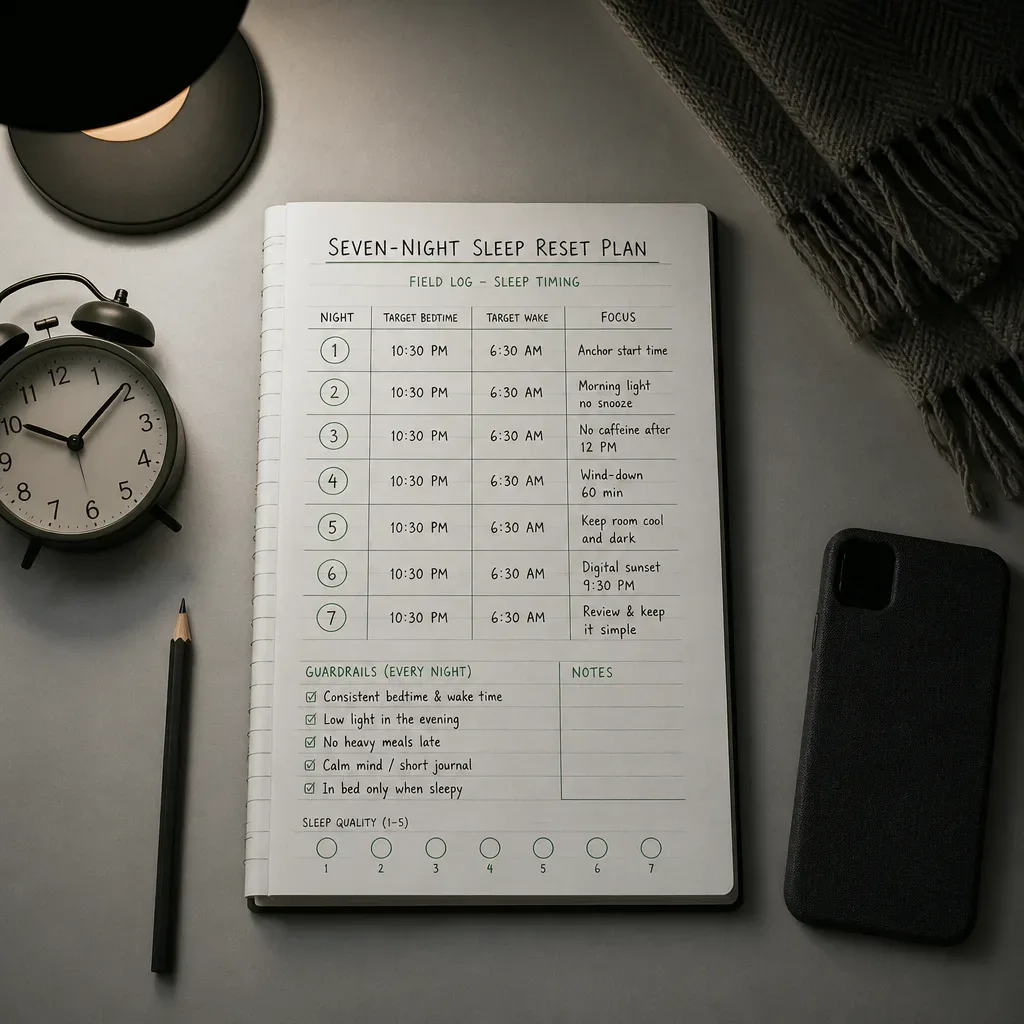
Use this sequence for 7 nights:
- Wake at the same time, within a 30-minute window.
- Get morning light for 5 to 20 minutes, depending on weather and schedule.
- Stop caffeine 8 to 10 hours before bedtime if you’re sensitive.
- Dim lights 60 minutes before bed.
- Play the 3-minute Dream-Self cue once.
- Use masking sound only if the room needs it.
- Record lights-out time and wake time in the morning.
The caffeine number is not moral advice; it is pharmacokinetics. Caffeine’s half-life is often cited around 5 hours, with wide individual variation. Dr. Andrew Huberman and many sleep clinicians suggest cutting it earlier than most people expect because even reduced caffeine can affect sleep depth in sensitive sleepers.
If you need sound after the cue, choose it by the problem in the room. Sudden hallway voices ask for white noise. Low traffic rumble may pair better with brown noise. If you use tones, test them in the afternoon first; the binaural beats generator + guide is useful for comparing how your ears respond before bedtime.
The reset succeeds when the sequence becomes boring in the best way. Boring is not failure. Boring is a nervous system with fewer negotiations.
What should the audio cue sound like?
The cue should sound close, steady, low in volume, and free of sharp transients.
For sleep, the recording has two jobs: intelligibility and softness. You should hear the words without leaning in, but the voice should not behave like a podcast host trying to keep you engaged. Aim for a playback level lower than normal conversation. The World Health Organization has used 40 dB as a night-noise guideline for protecting sleep in community settings, and while a phone speaker isn’t a calibrated meter, the principle holds: quieter than you think.
The script should be present tense, but not theatrical. It can describe the version of you who wakes at the intended time, moves through the morning without panic, and keeps the promise again tonight. Avoid goals that cause calculation. A cue that makes you plan tomorrow’s calendar has missed the room.
Use these audio details as a starting point:
| Element | Better for reset | Usually worse at night |
|---|---|---|
| Length | 2:30 to 3:30 minutes | 12-minute monologue |
| Voice | Close, unhurried, even | Bright, sales-like, dramatic |
| Volume | Conversation-soft or lower | Loud enough to mask thoughts by force |
| Background | Low room tone, rain, or none | Sudden bells, cymbals, hard loops |
| Ending | Gentle fade or final sentence | Startling notification sound |
Natural sound can help, but it should not compete with the voice. Rain on canvas has a soft mid-frequency grain. Rain on metal has more high-frequency attack, which can feel alerting for some sleepers. Surf works when the wave cycle is slow and not too close-miked. The ear trusts small imperfection: a distant car, a shift in wind, a bird far outside the main image.
If frequency traditions interest you, keep the categories clean. The Solfeggio frequencies guide explains the lore around tones such as 528 Hz respectfully, while noting that clinical evidence for specific life outcomes is limited. You can like a tone without asking it to prove more than it has measured.
The right sleep audio does not impress the ear. It gives the ear less to defend against.
What if your room is noisy, your partner is awake, or your mind is loud?
Use the cue as the fixed marker, then adjust the sound bed and environment around the specific obstacle.
Noise is not one problem. It can be steady, intermittent, high, low, close, or distant. A refrigerator hum is different from a scooter passing under the window. In sleep research, intermittent noise is often more disruptive than continuous sound because the brain reacts to change. A 2012 World Health Organization review on environmental noise noted that night noise can affect sleep through awakenings, body movement, and cardiovascular activation.
For a noisy room, masking helps when it raises the acoustic floor gently. Press play below on the white noise generator + guide and listen for the difference between a sharp room and a steady room. If white noise feels too hissy, try pink or brown noise. Brown noise isn’t deeper sleep. It’s deeper sound: more low-frequency acoustic energy, less top-end spray. Some nervous systems prefer it. Yours gets a vote.
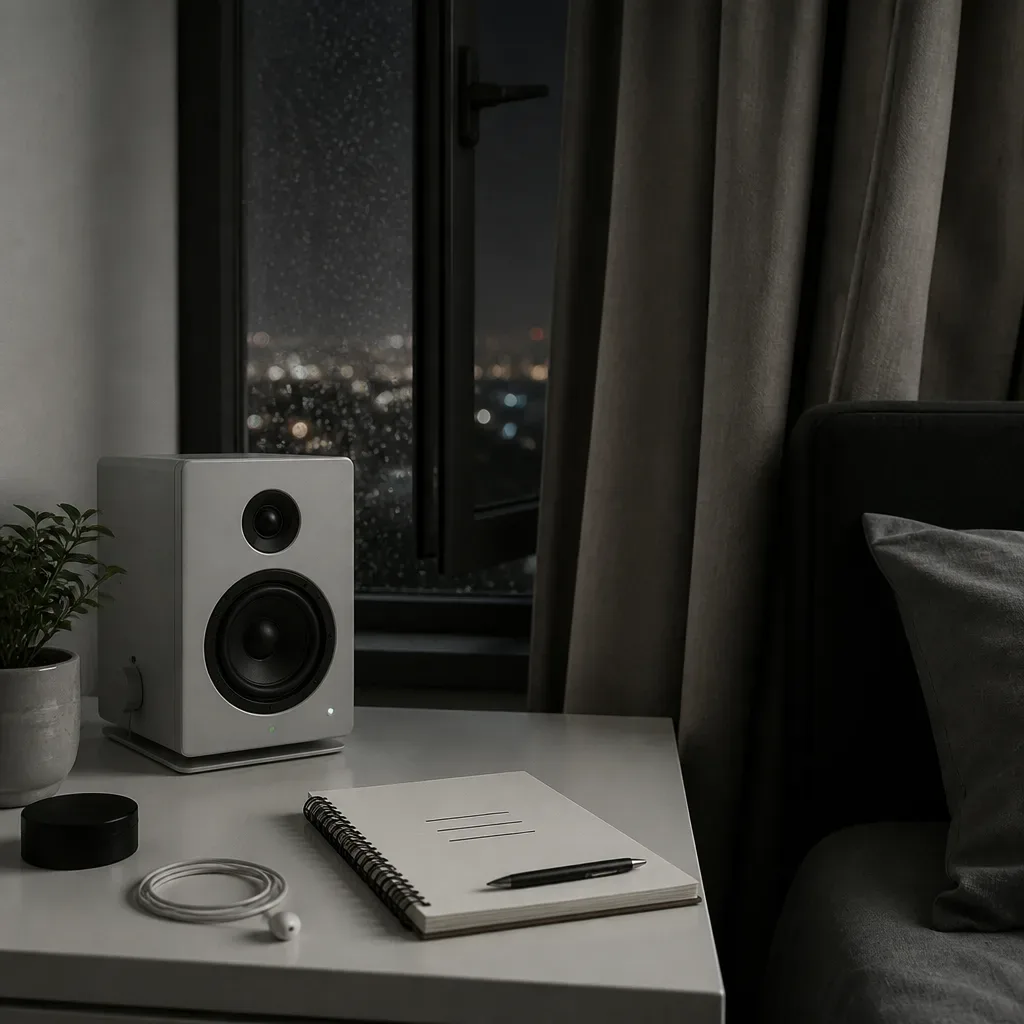
If your partner stays awake later, make the cue private but not isolating. Use one earbud at low volume, a pillow speaker, or a phone placed close enough that you don’t need volume. Keep headphone levels conservative, especially for children. The National Institute for Occupational Safety and Health uses 85 dBA over 8 hours as an occupational exposure limit, but bedtime listening should sit far below that. You are not trying to overpower the room.
For a loud mind, don’t add more instructions. Try a short written offload 30 minutes before the cue: three unfinished tasks, one next action for each, then close the notebook. In a small 2018 study in the Journal of Experimental Psychology, writing a to-do list before bed helped participants fall asleep faster than writing about completed tasks. The sample was modest, so treat it as a useful clue, not a law.
If anxiety, tinnitus, apnea symptoms, or chronic insomnia are part of the pattern, bring in professional help. A cue can support a routine. It should not be asked to diagnose the night.
How do you know the reset is working?
You know it is working when wake time stabilizes first, then sleep onset becomes less effortful over several nights.
Do not judge the reset by Night 1. Circadian shifts are slow. Jet lag research often uses the rough idea of about 1 day per time zone crossed, though light timing can change that. For a home sleep schedule reset, a 7-night window is a fair minimum, and 14 nights gives a clearer read if your starting point is irregular.
Track only two or three numbers. Too much data at bedtime can make sleep feel like a test. Write down lights-out time, estimated sleep onset if you know it, and final wake time. If you use a wearable, remember that consumer devices estimate sleep stages from movement and heart rate. They can show trends, but polysomnography remains the clinical standard.
Look for these signs by Night 5 to Night 7:
- You feel sleepy closer to the intended bedtime.
- You start the cue with less resistance.
- You wake within 30 minutes of the target time.
- You stop needing a new plan every night.
- Your room feels quieter because the sequence is familiar.
If nothing changes after 14 nights, adjust the anchors, not the hope. Move the target bedtime later for a week, increase morning light, reduce evening light more strongly, or review caffeine and alcohol timing. Alcohol may make sleep onset easier but tends to fragment the second half of the night; sleep labs have shown this pattern for decades.
You can also compare sound tools. Use the binaural beats generator + guide during a daytime test, not at midnight, to see whether beat frequencies feel calming or irritating. Use the Solfeggio frequencies guide the same way: as listening practice with tradition attached, not as a guaranteed sleep intervention.
The first stable sign is often not falling asleep faster. It is arguing with bedtime less.
What should you do tonight in 10 minutes?
Tonight, choose the wake time, dim the room, play the cue once, and protect the sequence from extra decisions.
Here is the plain version. Set tomorrow’s wake alarm first. Put the phone across the room if that helps, but don’t create a system so strict that you’ll abandon it on Night 2. A sleep schedule reset should be sturdy, not elaborate.
Then reduce light. If you have only bright overheads, use one lamp in the corner. If you need a screen, lower brightness and stop using it for anything that asks for response: messages, comments, shopping, work. In laboratory studies, evening light has been shown to suppress melatonin and delay circadian timing; a well-known 2015 paper in PNAS found that evening e-reader use delayed melatonin onset compared with print reading.
Now play the 3-minute Dream-Self cue. Sit or lie down. Let the voice be the last intentional input, not the start of a new analysis. If your mind comments, let it comment. The practice is listening once and continuing the sequence.
After the cue, choose one steady background sound only if needed. Rain, white noise, or a low fan can be enough. If silence is comfortable, use silence. Field recordings teach this well: the best sound is often the one that removes the fewest choices.
For the next 7 nights, keep the same order. If one night breaks, resume the next night without punishment. Behavior research is clear on this point across many habit studies: consistency matters, but all-or-nothing thinking breaks consistency faster than a missed session does.
The room doesn’t need to become perfect. It needs to become familiar enough for sleep to find the path again.