sleep science
Sleep Inertia After Dream-Self Audio
Sleep inertia after Dream-Self audio is usually timing, light, and arousal state. Use this 10-minute reset to wake clearer without forcing it.
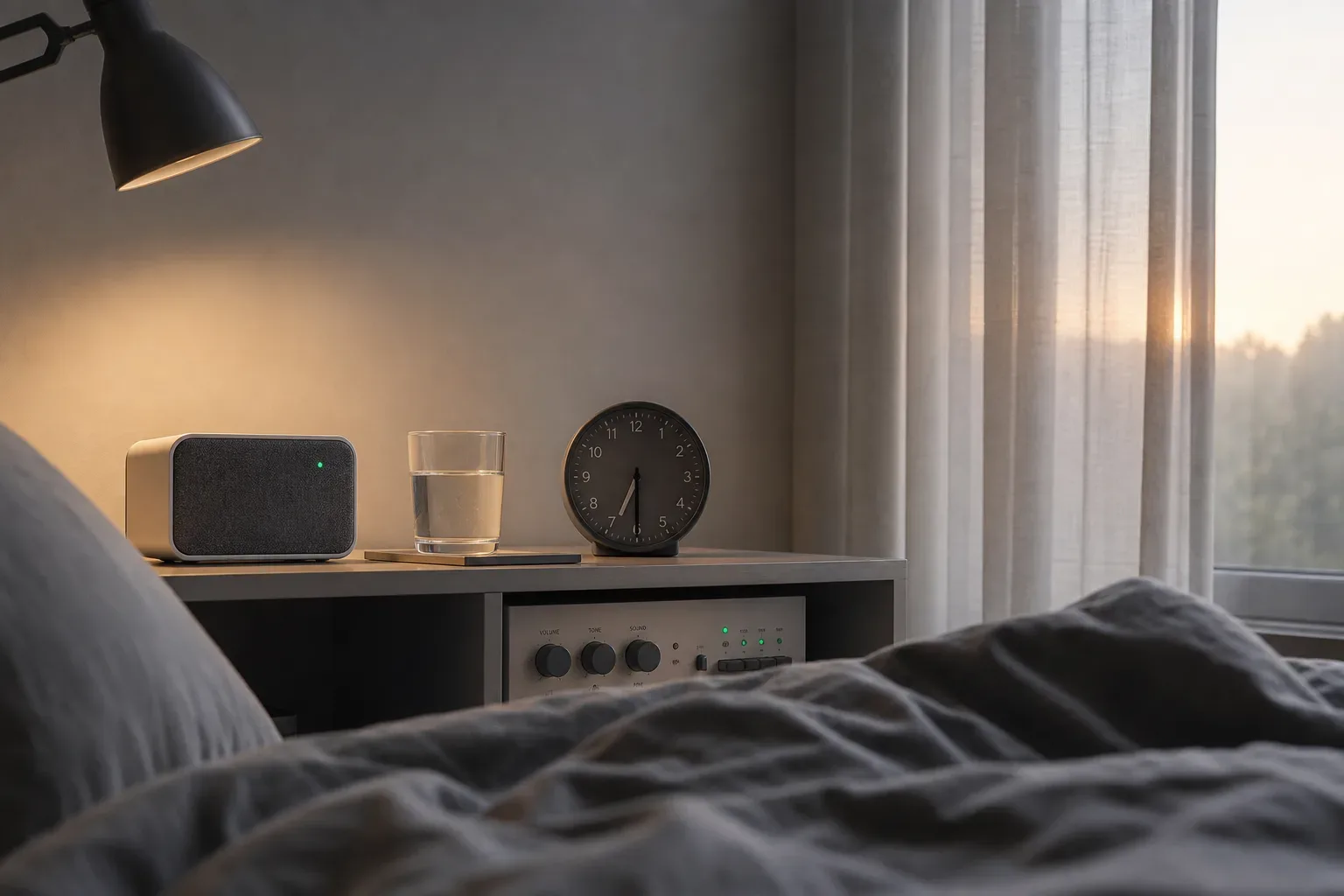
Sleep inertia is the groggy, slowed state that can follow waking, especially from deep sleep or a poorly timed alarm. After Dream-Self audio, it usually means your brain needs a cleaner transition: less late stimulation, lower volume, brighter morning light, and a 10-minute wake protocol that starts before your phone does.
What is sleep inertia after Dream-Self audio?
Sleep inertia after Dream-Self audio is normal morning grogginess made more noticeable by the contrast between a focused inner recording and the blunt mechanics of waking.
Sleep inertia has been studied for decades. A review by Tassi and Muzet in 2000 described measurable drops in alertness and performance immediately after waking, especially after awakening from slow-wave sleep. Later sleep research often places the strongest impairment in the first 1 to 10 minutes, with some effects lasting 20 to 30 minutes and, in harder cases, longer than an hour. That range matters. If you feel thick for 7 minutes, you may be inside ordinary physiology. If you lose half the morning, change the setup.
Dream-Self audio adds a specific variable: meaning. The AYA Method is a daily audio manifestation practice. Each day you listen to a short personalized recording, your Dream-Self Moment, narrated from the version of you who has already manifested the life you intend. Listening is the practice. Repetition is the work. The audio is the method. If you listen close to sleep, the voice may help you settle. If you listen after a 5 a.m. waking, it may keep cognition half-lit while the body still wants sleep.
The sound is not the whole cause. Sleep stage, sleep debt, room temperature, light, alcohol, medication, and alarm timing all change the wake state. The American Academy of Sleep Medicine recommends at least 7 hours of sleep for most adults. When you run below that for several nights, sleep inertia tends to get heavier, regardless of what you played.
Sleep inertia is not a character flaw. It is a state transition with measurable drag.
Why can a meaningful audio track make waking feel heavier?
A meaningful audio track can make waking feel heavier because it engages attention while the brain is still managing sleep pressure.
Spoken audio is different from steady noise. A plain hum masks the room without asking much from language circuits. A personalized recording contains phrases, memory cues, imagined scenes, and future-oriented identity statements. That can be useful at the right time. It can also leave a trace of cognitive activity if the track ends near an alarm or repeats during the last sleep cycle.
Sleep cycles average about 90 minutes, though they vary. Slow-wave sleep is more common in the first third of the night, while REM periods usually lengthen toward morning. If your Dream-Self audio wakes you from a lighter stage, the transition may be gentle. If an alarm cuts through deeper non-REM sleep after a short night, the same audio may be blamed for a problem mostly caused by timing.
Volume is another lever. The World Health Organization has warned that long exposure to elevated sound can affect hearing risk, and consumer audio guidance often uses 85 dB as a key occupational reference point for limited exposure. Sleep audio should be far below that. In practice, I aim for 40 to 50 dB at the pillow for adult overnight sound. If you need it louder to hear the words, it may be the wrong moment for a spoken practice.
A simple distinction helps:
| Audio type | What it asks of the brain | Better timing |
|---|---|---|
| Personalized spoken audio | Language, imagery, self-reference | Before sleep or seated morning practice |
| White or pink noise | Low attention, steady masking | Overnight or short wake buffer |
| Binaural tones | Headphone-dependent auditory illusion | Short sessions, not needed overnight |
| Silence | No added stimulus | Best when the room is already quiet |
A voice can settle you at night and still be too interesting at dawn.
How do you wake clear in 10 minutes?
You wake clearer in 10 minutes by giving the nervous system simple, repeated cues: upright posture, bright light, water, movement, and one completed task.
Use this as a measured protocol, not a personality test. Set it up the night before so the first minute requires almost no judgment. NASA fatigue research has shown that sleep inertia can impair operational performance after naps, which is why pilots, physicians, and shift workers treat wake transitions as a safety issue. Your morning may be lower stakes, but the mechanism is the same.
- Minute 0 to 1: sit up before the phone. Turn off the alarm, place both feet on the floor, and sit upright. Do not read messages yet. Reading pulls you into decisions while alertness is still uneven.
- Minute 1 to 3: add bright light. Open curtains or turn on a lamp. Outdoor light can exceed 10,000 lux on a bright morning; indoor rooms may sit closer to 100 to 500 lux. The difference is large enough to matter.
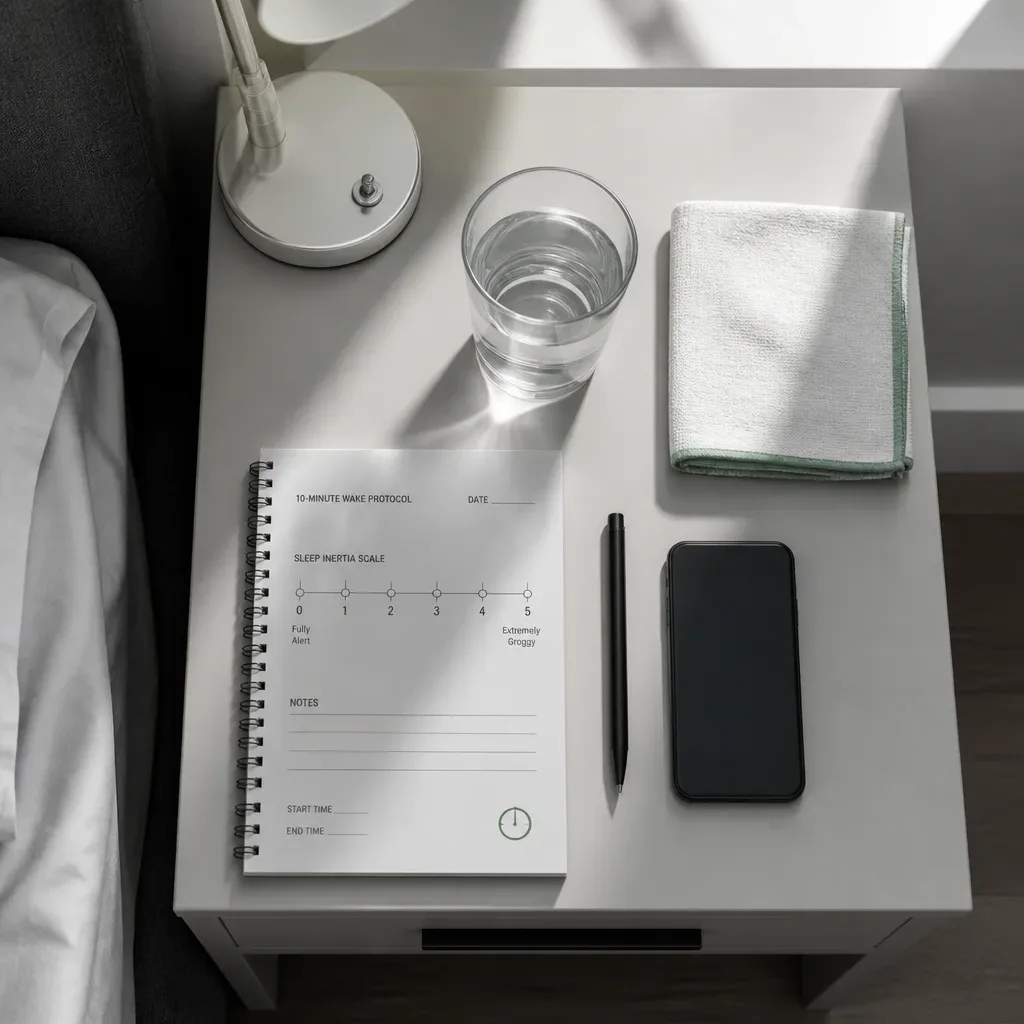
- Minute 3 to 4: drink water. Keep a glass beside the bed. You do not need a supplement. You need a repeatable cue.
- Minute 4 to 6: cool the face. Rinse with cool water or use a cloth for 20 to 30 seconds. It is simple and hard to overthink.
- Minute 6 to 8: move slowly. Walk, stretch, or do five squats. Keep intensity low. The point is circulation and orientation, not training.
- Minute 8 to 10: finish one plain task. Make the bed, start coffee, or write one sentence. Completion is a small cognitive handrail.
If sound helps, use a nonverbal track for the first 10 minutes. Press play on the White noise generator + guide at a low setting and listen for steady masking, not stimulation. Keep it quieter than conversation. If you live with a baby or child, measure at their ear position and stay conservative.
What should you change the night before?
The night-before change is to move spoken audio earlier and make the final sleep environment boring, steady, and low.
Start with timing. If you currently play Dream-Self audio after getting into bed and then let it loop, try one clean listen 20 to 40 minutes before sleep instead. Sit or lie down, listen once, then switch to silence or steady noise. Many tracks used for reflection are 3 to 8 minutes long; even a short recording can feel too active if it repeats through multiple awakenings.
Next, reduce friction. Put the phone across the room only if that does not lead to a harsher alarm. Use a dedicated speaker if your phone tempts you into scrolling. Pew Research Center has reported for years that large majorities of adults keep smartphones close at night. That habit is common, but it is not neutral when you are trying to wake cleanly.
Use sound as room design. White noise contains equal acoustic power per hertz, which reads as bright hiss to many ears. Pink noise reduces level as frequency rises and often feels softer. Brown noise has even more low-frequency weight. None is deeper sleep by default. It is deeper or softer sound, and your nervous system gets a vote.
For a plain test, try this 3-night adjustment:
- Night 1: Dream-Self audio once, then silence.
- Night 2: Dream-Self audio once, then low pink or brown-style noise.
- Night 3: Dream-Self audio earlier in the evening, then no spoken audio in bed.
Rate sleep inertia each morning from 0 to 5. A 0 means clear within 2 minutes. A 5 means the fog lasted past 30 minutes. Three nights is not a clinical study, but it is enough to reveal obvious failure modes.
Which sounds help after the alarm, and which should wait?
After the alarm, use steady, low-information sound if you need audio at all; save complex tones or spoken tracks for later.
The first minutes after waking are a poor time for dense input. If your brain is already slow, a podcast, news briefing, or another personalized recording adds language before orientation. A steady sound can be kinder. The White noise generator + guide is useful when the room has abrupt sounds: doors, pipes, traffic, a partner moving around. Set it low enough that it masks edges without becoming the main event.
Binaural beats are more specific. A binaural beat is an auditory illusion produced when each ear receives a slightly different tone. For example, 200 Hz in one ear and 210 Hz in the other can be perceived as a 10 Hz beat. Research on mood, attention, and anxiety is mixed, with small studies and varied protocols. If you use the Binaural beats generator + guide, do it when you are awake enough to choose the session, usually after the first 10 minutes. Avoid sleeping all night in headphones.
Solfeggio frequencies sit in a different category. They are part of a modern frequency tradition around tones such as 396 Hz, 417 Hz, and 528 Hz. Some listeners find them beautiful or steadying. Evidence for specific biological claims is limited, so treat the Solfeggio frequencies guide as a listening tradition, not a medical tool.
A morning sound should do less than you think. The body is already doing a lot.
A practical morning order looks like this:
| First 10 minutes | After 10 minutes | Later in the day |
|---|---|---|
| Low white, pink, or brown noise | Dream-Self audio if you prefer morning listening | Binaural beats or Solfeggio listening |
| Bright light | Journaling or planning | Longer reflection |
| Simple movement | Breakfast and decisions | Focus sessions |
What if sleep inertia keeps happening?
If sleep inertia keeps happening, treat it as a data problem first: measure timing, sleep length, light, volume, and wake consistency for one week.
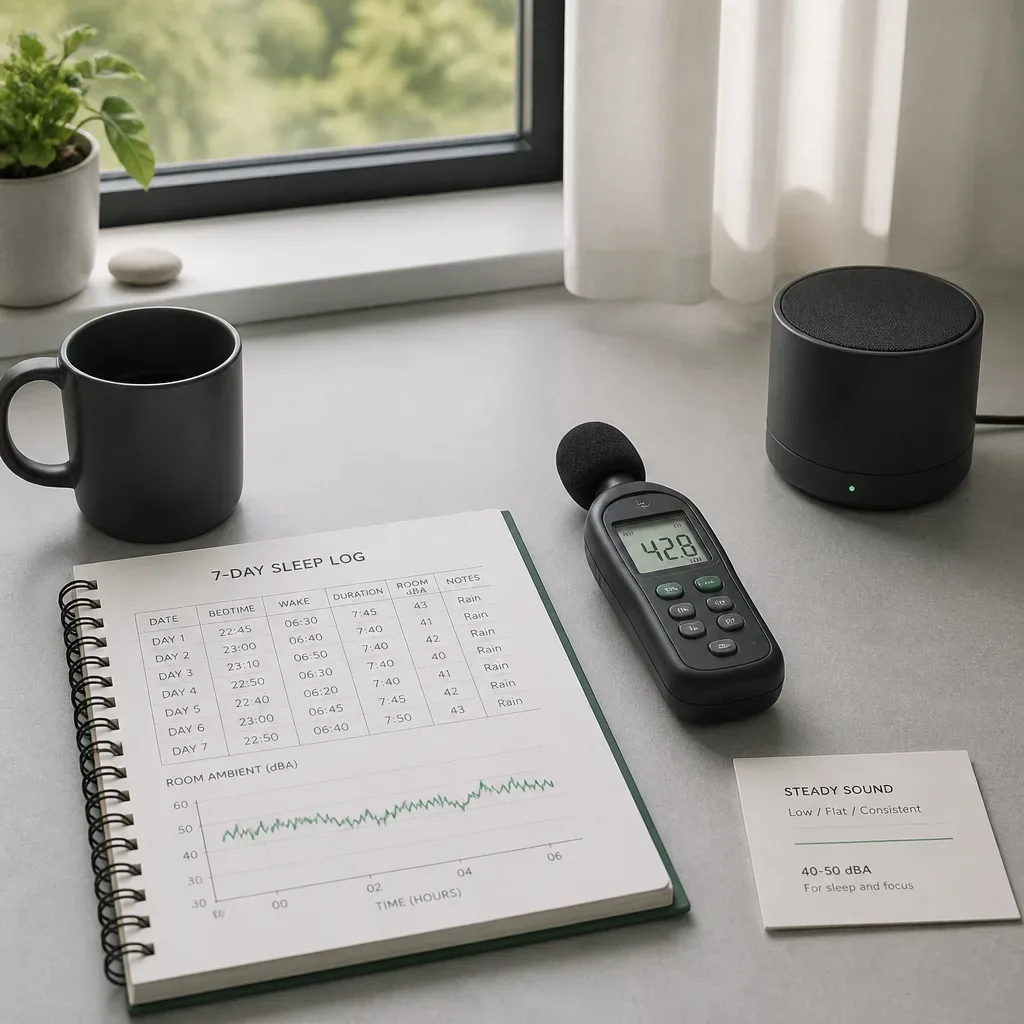
Do not change everything at once. I learned this the hard way with baby sleep machines: if you change volume, placement, timer, room light, and bedtime in one night, you learn nothing. The same rule applies here. Choose one variable for 3 nights, then compare. Most adults can run a useful home test with a notes app and, if available, a cheap decibel meter.
Track these five numbers:
- Bedtime and wake time.
- Estimated total sleep time, rounded to 15 minutes.
- Audio timing, including start time and whether it looped.
- Volume at pillow level, in dB if possible.
- Sleep inertia score from 0 to 5.
A 2023 discussion in sleep medicine literature continued to note that consumer wearables can estimate sleep patterns but are not equivalent to polysomnography. Use them for trends, not verdicts. If a watch says you woke from deep sleep and you feel terrible, useful. If it gives a precise stage label for every minute, treat that precision carefully.
Also check the alarm itself. Harsh alarms can cause a stress spike; too-soft alarms can create repeated micro-wakings. Dawn simulators often brighten over 20 to 30 minutes, which may help some people reduce abrupt waking. Dr. Andrew Huberman and many circadian researchers regularly emphasize morning light because light is the strongest daily timing cue for the human circadian system.
If your Dream-Self audio feels important but the timing is not working, move it to a seated morning slot after the 10-minute reset. That keeps the daily repetition intact without asking a half-awake brain to process language in bed.
When is morning grogginess a sign to get help?
Morning grogginess needs professional attention when it is severe, persistent, safety-relevant, or paired with symptoms such as gasping, loud snoring, depression, or medication effects.
Sleep inertia is common. Chronic impairment is different. If you regularly feel unsafe driving, fall back asleep without intending to, or need hours to function, talk with a clinician or sleep specialist. Obstructive sleep apnea affects a substantial minority of adults; estimates vary by age and method, but large reviews have placed moderate to severe sleep-disordered breathing in double-digit percentages for some adult groups. Morning headaches, dry mouth, witnessed pauses in breathing, and heavy snoring are worth taking seriously.
Medication and substances matter too. Sedating antihistamines, some sleep aids, alcohol, cannabis, and certain mental health medications can change morning alertness. Do not stop prescribed medication because of a sleep article. Bring a simple one-week log to the person who prescribed it and ask about timing, dose, and alternatives.
For tinnitus, chronic insomnia, trauma-related sleep disruption, or panic on waking, sound can support the room but should not carry the whole load. A qualified clinician, audiologist, or behavioral sleep medicine provider can help you sort signal from noise. Cognitive behavioral therapy for insomnia has a strong evidence base, with multiple guidelines recommending it as first-line care for chronic insomnia.
Sound can prepare the room. It should not be asked to diagnose the body.
How do you keep the 10-minute reset repeatable?
You keep it repeatable by making the wake sequence visible, short, and almost boring.
Design the first 10 minutes like a device interface. The best interface at 6:30 a.m. has one obvious next action. Put water where your hand lands. Put the lamp switch where you can reach it. Set the sound generator before sleep, not while foggy. If you use the Binaural beats generator + guide or Solfeggio frequencies guide, bookmark them for later, not for the first alarm minute.
Here is the simplest version I would test for 7 days:
- Listen to Dream-Self audio once before sleep, not on loop.
- Keep the final sleep sound steady or silent.
- Set one alarm and one backup 10 minutes later.
- Sit up before touching notifications.
- Get bright light within 3 minutes.
- Use low, nonverbal sound only if the room feels too sharp.
- Score sleep inertia from 0 to 5 after breakfast.
Seven days gives you enough weekdays and at least part of a weekend. It is not a lab study, but it is better than guessing from one bad morning. If the average score drops from 4 to 2, keep the setup. If nothing changes, look harder at sleep length, apnea risk, medication, and stress.
The quieter rule is this: do not make the wake routine emotionally expensive. A 10-minute protocol should feel plain enough to repeat when you are tired, late, or unimpressed by your own plans.
Keep the first ten minutes plain.