sleep science
Revenge Bedtime Procrastination: 5-Minute Reset
Revenge bedtime procrastination keeps rest out of reach. Use a 5-minute Dream-Self audio reset to mark the day closed and sleep sooner.
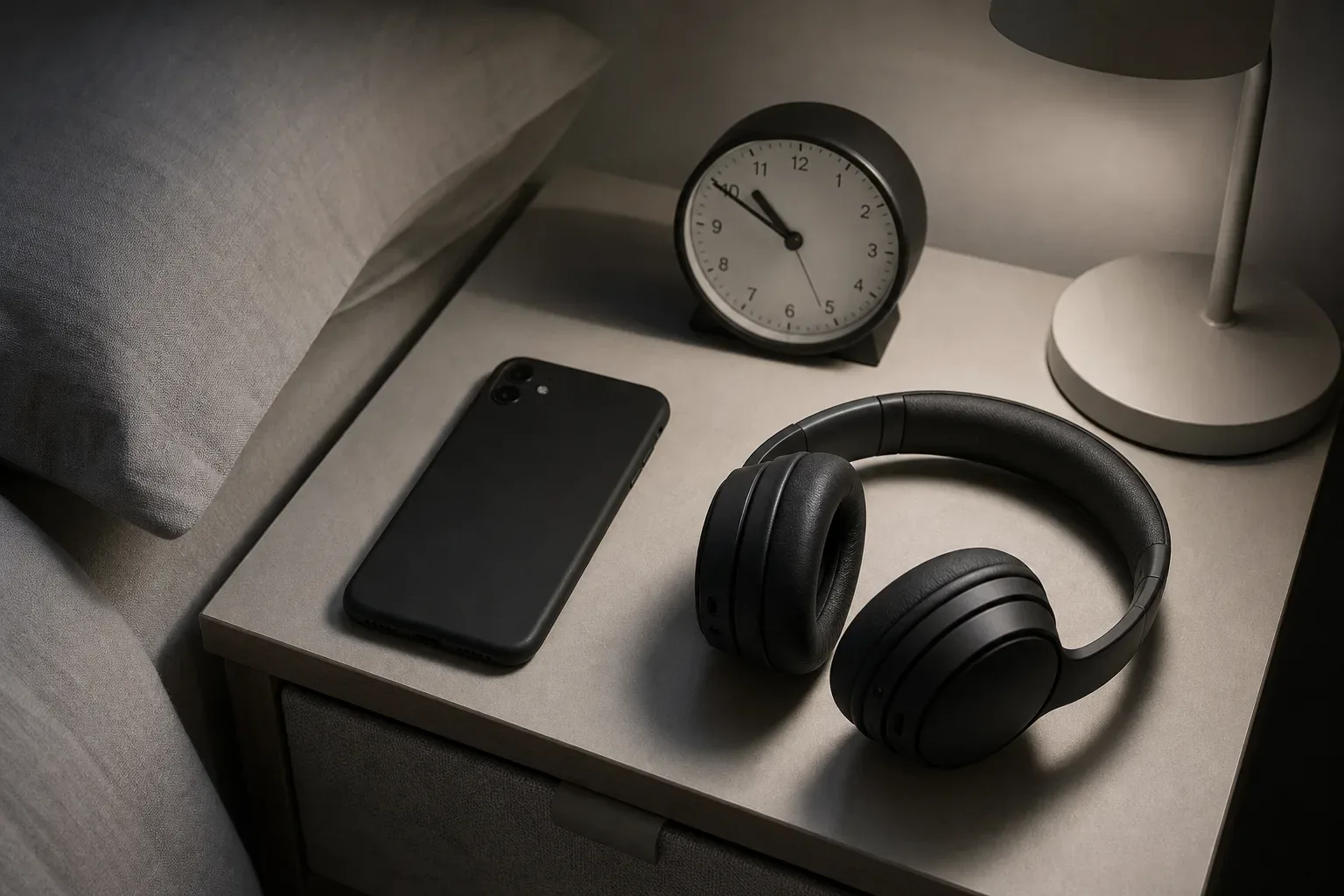
Revenge bedtime procrastination is the habit of delaying sleep to reclaim personal time, even when you’re tired. A 5-minute Dream-Self audio reset helps by giving the brain a clear stopping cue, a single sound to follow, and a repeatable end to the day before scrolling fills the gap.
What is revenge bedtime procrastination, really?
Revenge bedtime procrastination is bedtime delay with an emotional reason: the night becomes the only time that feels like yours.
Sleep researchers Kroese, De Ridder, Evers, and Adriaanse described bedtime procrastination in 2014 as failing to go to bed at the intended time when no external circumstance prevents it. The revenge version adds a social texture. The day has taken too much; the late hour feels like payback. It may look like 47 minutes of videos, one more episode, or reorganizing a cart you don’t need at 12:16 a.m.
The behavior is common because the pressure is common. The American Academy of Sleep Medicine recommends at least 7 hours of sleep for most adults, yet CDC surveillance has repeatedly found that about 1 in 3 U.S. adults report short sleep, usually defined as under 7 hours in a 24-hour period. That gap creates a quiet negotiation at night: rest now, or take back a small private hour.
Mechanically, the problem is not only willpower. After a full day of decisions, the prefrontal systems that help with inhibition and planning are less crisp. Screen feeds are built on variable rewards; you don’t know whether the next item will be boring or funny, so the hand keeps checking. Light matters too. Evening bright light can shift circadian timing, and laboratory work on melatonin suppression has shown effects from relatively ordinary indoor light levels, depending on timing and wavelength.
Revenge bedtime procrastination is not a sleep problem first; it is a boundary problem that shows up at the edge of sleep.
That distinction is useful. If the issue were only sleepiness, you would go to bed. If the issue were only entertainment, stopping would be neutral. Instead, stopping can feel like surrendering the last unmeasured part of the day. A good reset has to respect that feeling without letting it run the night.
Why can a 5-minute audio reset interrupt the loop?
A 5-minute audio reset works because it replaces negotiation with a small sensory script.
The brain handles repeated cues efficiently. In habit research, the cue-routine-reward loop is not just a productivity idea; it is a way to reduce decision load. At bedtime, decision load is expensive. If you ask, Should I sleep now, check one more thing, or prepare tomorrow, the phone usually wins because it offers a reward within seconds. A 5-minute audio reset gives the next step before the debate starts.
Sound is especially suited to this job because hearing stays available in the dark. You don’t need to look at a screen, read a page, or count breaths perfectly. You press play, lower the body, and let attention attach to a voice or steady tone. The auditory system can track rhythm with millisecond precision, which is one reason metronomes, lullabies, and prayer recitations have been used for settling across cultures long before sleep apps existed.
The evidence is modest but relevant. A 2019 meta-analysis by Garcia-Argibay, Santed, and Reales reviewed 22 studies on binaural beats and reported small to medium effects on anxiety, memory, attention, and pain, with large variation in methods. Mindfulness-based sleep studies also tend to show improvements, but many trials use 6 to 8 weeks of practice, not a single bedtime track. The honest claim is smaller: sound can help some people downshift, and a short routine is easier to repeat.
The reset is not a sedative. It is a closing ritual with audio as the handle.
Five minutes is long enough to mark a state change and short enough that the tired brain does not object. If you usually lose 40 minutes to revenge scrolling, a 5-minute practice that prevents even 15 minutes of delay has paid for itself 3 times over. The aim is not perfect sleep architecture tonight. The aim is to cross the threshold.
How do you do the 5-minute Dream-Self audio reset tonight?
You do it by making one cue, one audio track, and one after-action rule nonnegotiable for five minutes.
Use a timer if it helps, but avoid turning the reset into another task list. The sequence below is deliberately plain. It does not require waking earlier, journaling for 20 minutes, or buying a new device. Keep headphone volume low, roughly under 60% of your device’s output and preferably softer than a normal speaking voice. If you use earbuds nightly, take ear comfort seriously; the World Health Organization has warned that unsafe listening levels put more than 1 billion young people at risk of hearing harm.
- Minute 0:00 to 0:30, set the cue. Plug in the phone, dim the room, or turn off the main light. Use the same cue each night for 7 nights.
- Minute 0:30 to 1:00, remove the next choice. Put the phone on Do Not Disturb. Open only the audio you will play.
- Minute 1:00 to 4:30, listen. Play your Dream-Self audio, a quiet spoken recording, or a settling track. Keep eyes closed unless you need to adjust volume.
- Minute 4:30 to 5:00, name tomorrow’s first action. Choose one action under 2 minutes, such as drink water, open curtains, or place feet on the floor.
- After 5:00, place the device face down. No feed, no inbox, no second queue.
This is where the AYA Method fits cleanly. The AYA Method is a daily audio manifestation practice. Each day you listen to a short personalized recording, your Dream-Self Moment, narrated from the version of you who has already manifested the life you intend. Listening is the practice. Repetition is the work. The audio is the method. At bedtime, that means the spoken recording is not decoration around the routine; it is the routine’s center.
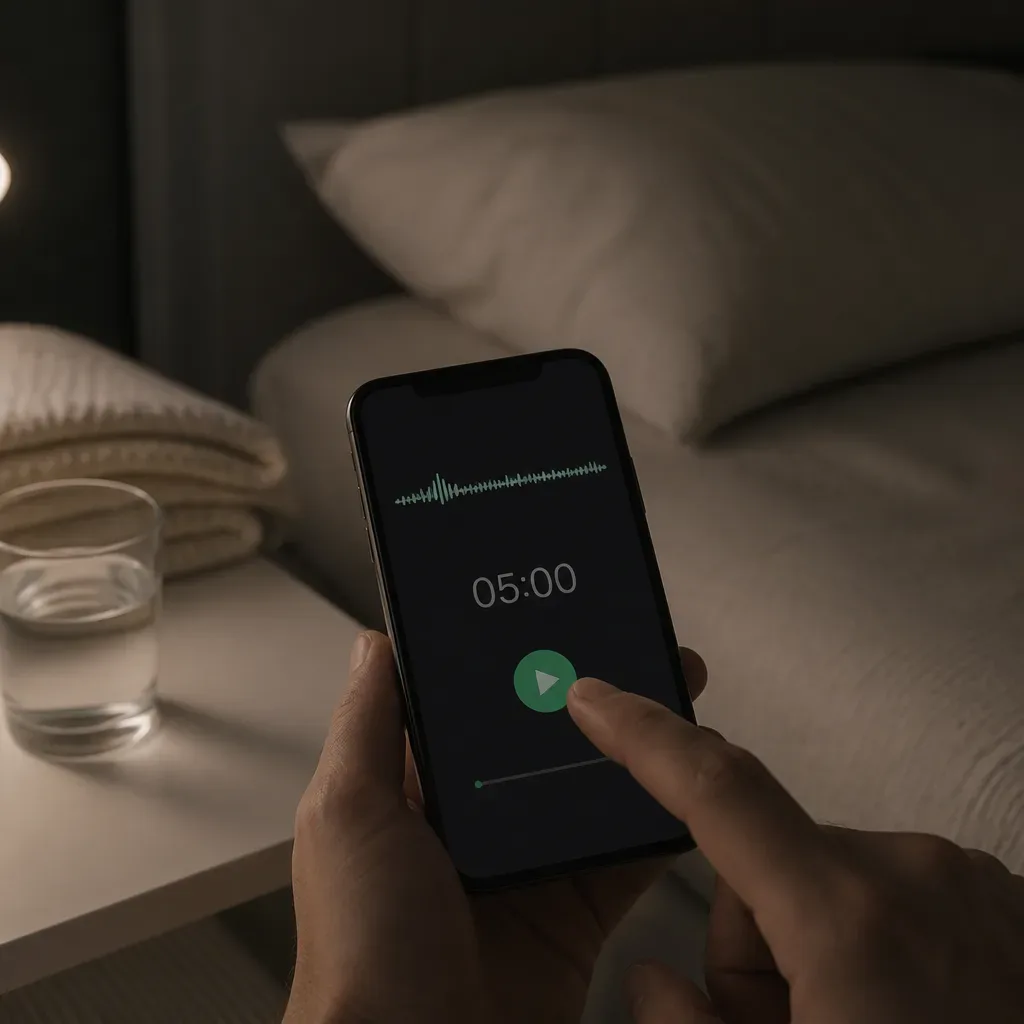
If manifestation language feels too large at night, make the recording concrete. Use simple future-self lines tied to rest and repair: I stop when the day is complete enough. I protect tomorrow by ending tonight. I do not have to earn sleep by finishing one more thing. A 2022 Sleep Foundation survey reported that many adults use phones near bedtime; the reset assumes that reality and changes the final use of the device.
The last thing your phone does at night should be to close the day, not reopen it.
What should you play before or after the reset?
Play the sound that removes the main obstacle: masking, rhythmic settling, or spoken closure.
Not every bedtime delay needs the same audio. If the room is noisy, speech may be harder to follow and masking may come first. If the mind is alert but the room is quiet, a low, steady tone may help. If the problem is emotional, a spoken Dream-Self track can give the night a clear sentence to end on. In practice, 2 minutes of masking followed by 5 minutes of spoken audio is often enough.
Use conservative volume. For adults, many hearing-health groups use the 60/60 rule as a simple guardrail: no more than 60% volume for no more than 60 minutes, though bedtime listening is better softer. For children, avoid earbuds for sleep when possible and keep speakers low. Sound should mask sharp interruptions, not dominate the room.
| If the obstacle is… | Try this | Why it may help | Quiet Frequencies tool |
|---|---|---|---|
| Traffic, neighbors, hallway noise | White or brown noise | Broad masking reduces contrast between sudden sounds and the room | White noise generator + guide |
| Busy thoughts, alert body | Low-volume binaural beat | Headphones present two close tones and the brain detects their difference | Binaural beats generator + guide |
| Preference for named tones | Solfeggio track | The tradition gives familiar labels, while evidence remains limited | Solfeggio frequencies guide |
| Emotional resistance to stopping | Dream-Self audio | A voice gives the day a clean final cue | the AYA Method |
Press play below the relevant guide and listen for the difference for 30 seconds, not 10 minutes. Brown noise is lower and less hissy than white noise. Pink noise sits between them. Binaural beats require headphones; without separate tones in each ear, the beat illusion is not created. Solfeggio frequencies have a long modern wellness tradition, especially numbers like 396 Hz, 528 Hz, and 852 Hz, but clinical evidence does not support large claims tied to specific frequencies.
A sound can be meaningful to you without needing a medical claim attached to it.
The cleanest stack is simple: masking if needed, Dream-Self audio as the reset, silence or low noise after. If you wake in the night, do not restart a 45-minute playlist unless you truly need it. A 5-minute repeat is enough to preserve the cue.
What does the evidence say, and where does it stop?
The evidence supports a cautious claim: audio can support relaxation and attention, but it does not override sleep biology.
Start with sleep timing. Adults tend to cycle through sleep stages in roughly 90-minute cycles, though real cycles vary. Losing 30 to 60 minutes at bedtime can remove a meaningful portion of one cycle, especially if the morning alarm is fixed. A 2010 review by Lim and Dinges linked sleep deprivation with reduced attention and working memory, which matters because bedtime procrastination often makes the next day harder, then the next night more tempting.
For bedtime procrastination specifically, Kroese and colleagues connected the behavior to self-regulation problems. Later studies in student and adult samples have associated it with stress, smartphone use, and lower sleep quality. Many of these are cross-sectional, meaning they show association, not proof of cause. Still, the pattern is consistent enough to guide practice: reduce friction, reduce screen pull, and create a reliable off-ramp.
For audio, the strongest evidence is not that any single frequency forces sleep. The better-supported mechanism is attention and arousal regulation. Slow breathing audio can reduce respiratory rate. Relaxation scripts can reduce cognitive arousal. Binaural beat studies show mixed EEG and mood findings; some report changes near the target frequency, while others find no meaningful behavioral effect. Dr. Andrew Huberman has often emphasized morning light, evening dimness, and temperature as core circadian levers; sound is a support, not the clock itself.
That boundary matters. If a delta track helps you lie still with your eyes closed for 20 minutes, it may help sleep even if the EEG entrainment claim is weak. Ritual, reduced stimulation, and masking are not fake effects. They are plain mechanisms. My own theta track works partly because of the beat, partly because of repetition, and partly because headphones tell me I am finished making decisions.
Keep the mechanism honest and the practice kind.
The 5-minute reset should be measured by behavior first. Did you stop sooner than usual? Did you keep the phone closed after the track? Did you protect 15 more minutes of sleep 4 nights this week? Those numbers are more useful than guessing whether your brain entered a perfect theta state.
How do you keep the reset from becoming another bedtime task?
You keep it light by tracking only the behavior that matters: whether you started the reset before the delay widened.
Most night routines fail because they ask too much from the most tired version of you. A 12-step routine can be soothing on a calm Sunday and impossible on a crowded Wednesday. The reset should survive a bad day. That means no perfection score, no long written reflection, and no requirement to feel peaceful. You can be annoyed and still press play.
Use a 7-night test, not a life plan. Pick a target bedtime and a reset time 10 minutes before it. If your intended sleep time is 11:00 p.m., start the cue at 10:50 p.m. If you miss it, start when you notice. The point is pattern repair, not self-criticism. Behavioral sleep medicine often uses sleep diaries for 1 to 2 weeks because short records show patterns without turning every night into a verdict.
Try these rules for the first week:
- Track only 3 items: reset started, phone stayed closed, estimated lights-out time.
- Use the same audio for at least 7 nights before judging it.
- Keep the file under 5 minutes unless a clinician has given you a longer protocol.
- Do not compare your bedtime to anyone else’s.
- If you miss a night, restart the next night without adding a penalty.
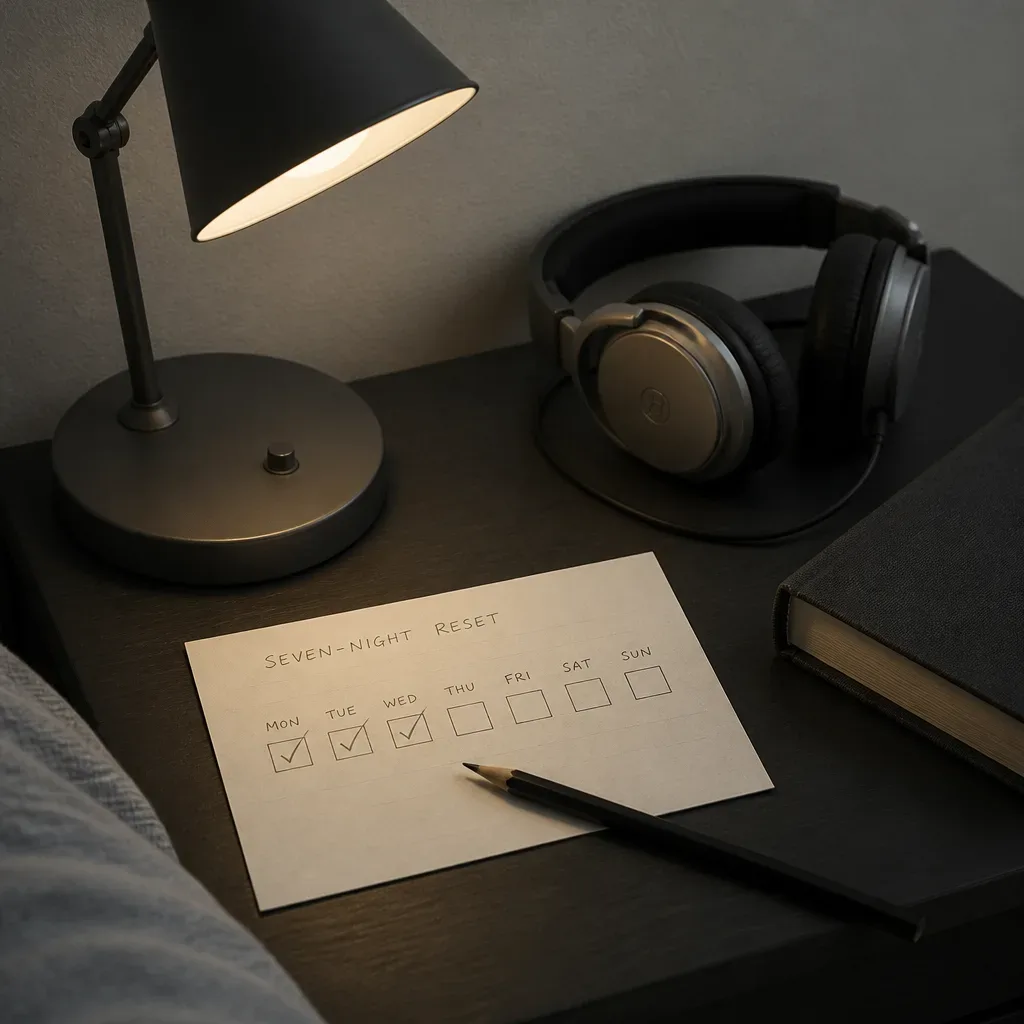
A small paper mark works better than a detailed app for many people because it does not reopen the phone. Put seven boxes on a sticky note. Check the box if you start the reset, not if you sleep perfectly. This matters because sleep is partly involuntary. You can choose the cue. You cannot command unconsciousness on schedule.
If you want a sound bed under the spoken track, use something stable from the White noise generator + guide at low volume. If you prefer a tonal bed, test the Binaural beats generator + guide earlier in the evening first, because some listeners find tones irritating in bed. If frequency lore helps you settle, choose from the Solfeggio frequencies guide with the same clear boundary: preference is valid; big biological claims need better evidence.
The best bedtime routine is the one your tired self can still perform.
When should you stop self-optimizing and ask for help?
Ask for help when delayed sleep is persistent, impairing, or paired with symptoms that audio cannot assess.
If revenge bedtime procrastination happens occasionally, a 5-minute reset is a reasonable practice. If it happens 4 or more nights a week for several months, and you feel impaired during the day, it deserves more than another playlist. Chronic insomnia is commonly defined as sleep difficulty at least 3 nights per week for at least 3 months, with daytime consequences. Cognitive behavioral therapy for insomnia, often called CBT-I, has strong evidence and is recommended as first-line care by major sleep organizations.
Some signs point beyond procrastination. Loud snoring, gasping, witnessed breathing pauses, morning headaches, and severe daytime sleepiness can suggest sleep apnea. Restless legs, panic symptoms, depression, medication effects, shift work, pain, and perimenopause can all change sleep timing and sleep quality. A phone-based audio reset cannot sort those causes. A clinician can.
There is also a practical threshold. If bedtime has become the only private time in your life, the fix may need daylight hours. That might mean 15 minutes alone after work, a firmer end to messages, or one fewer evening obligation. Pew Research Center has reported high levels of near-constant internet use among adults, with younger adults especially likely to be online frequently. The night cannot carry every unmet need from the day.
Use the reset as a signal, then listen to what it reveals. If five minutes of audio helps, keep it. If it keeps failing, reduce the load earlier. If fear, grief, pain, or breathing problems are present, get care. Sleep tools should make the room quieter; they should not make you smaller.
Leave one sound to finish the day, then let the room answer softly.