sleep science
Sleep Calculator: Pick Bedtime and Dream-Self Audio
Use this sleep calculator to choose a bedtime by 90-minute cycles, set a gentle wind-down, and play Dream-Self audio without rushing.
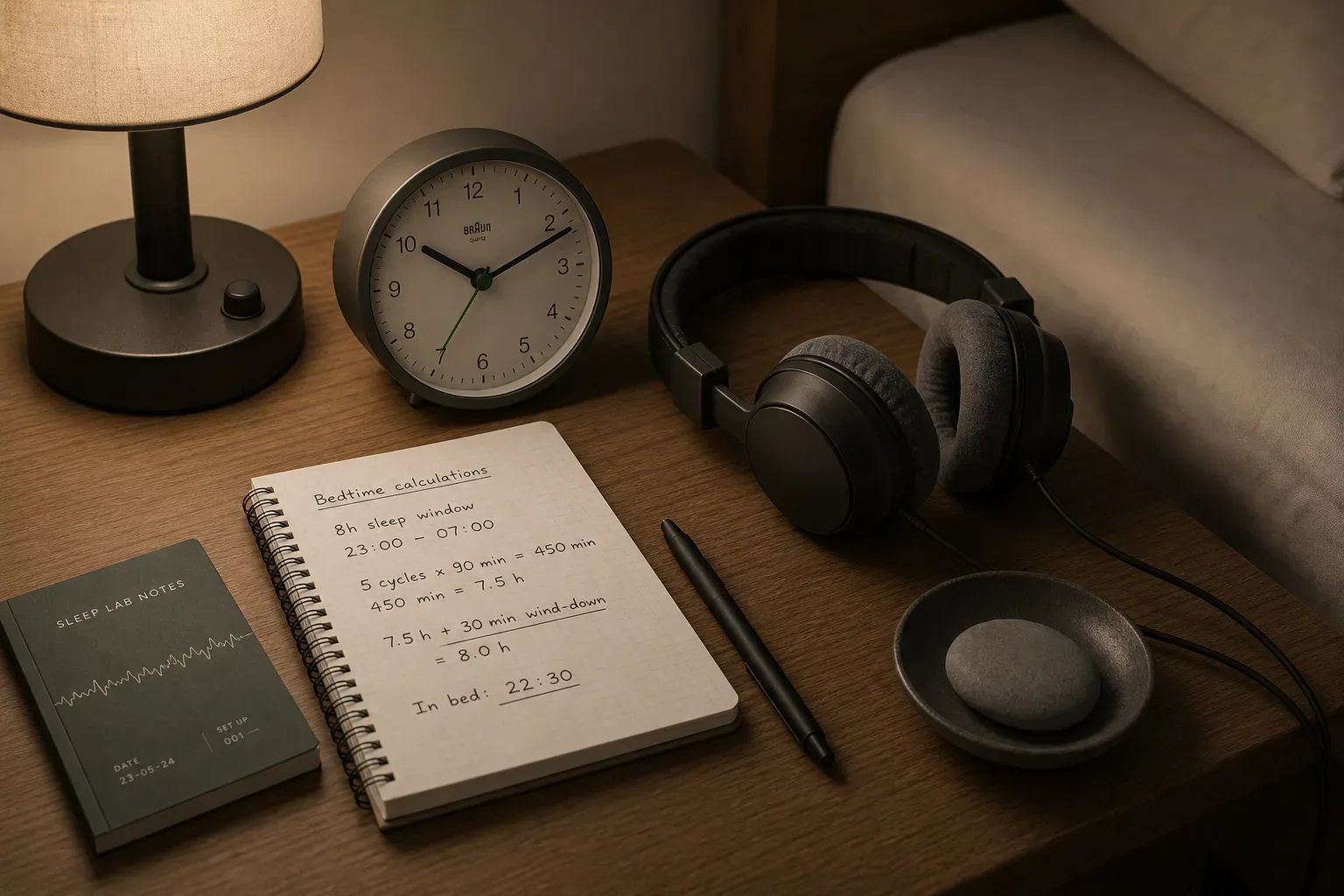
A sleep calculator helps you choose a bedtime by counting sleep cycles backward from your wake time, then adding a buffer for falling asleep. Use it as a plain planning tool, not a diagnostic device. Once the window is set, play your Dream-Self audio quietly inside the wind-down, not after you’re already half asleep.
How does a sleep calculator actually work?
A sleep calculator estimates bedtime by using average sleep-cycle length, wake time, and a realistic delay for falling asleep.
Most calculators use 90 minutes because adult sleep tends to move through non-REM and REM stages in cycles of roughly that length. The National Institute of Neurological Disorders and Stroke describes a full cycle as about 90 minutes, repeated 4 to 6 times per night. That number is useful, but it’s not a metronome. Your first cycle may be shorter, later REM periods may be longer, and alcohol, stress, illness, age, and light exposure can shift the pattern.
A useful calculator asks for three inputs: the time you must wake, the number of cycles you want to protect, and the time it usually takes you to fall asleep. The American Academy of Sleep Medicine recommends at least 7 hours of sleep for healthy adults, and many people need closer to 8 or 9 hours to feel steady. That means the calculator should protect sleep opportunity, not just time unconscious.
Here is the plain formula:
bedtime = wake time - cycle time - sleep onset buffer
For a 6:30 a.m. wake time, five 90-minute cycles equal 7.5 hours. Add a 20-minute sleep-onset buffer, and the bedtime target becomes 10:40 p.m. Six cycles equal 9 hours, which moves the target to 9:10 p.m. if the same 20-minute buffer is used.
A sleep calculator is not a promise of perfect sleep. It’s a way to stop negotiating with the clock at 11:47 p.m.
The calculation matters because decision-making at night is usually poor. A 2019 review in Sleep Medicine Reviews reported that insufficient sleep is linked with poorer emotional regulation and attention the next day. When bedtime is precomputed, you remove one small argument from the room.
What bedtime should you pick if you know your wake time?
Pick the earliest bedtime you can repeat for seven nights, then adjust by 15 minutes based on how you feel in the morning.
Start with your wake time. Keep it honest. If your alarm rings at 6:30 a.m. but you scroll until 6:50, use 6:30. Circadian systems respond strongly to wake timing and morning light; Dr. Andrew Huberman often summarizes this as a practical anchor: consistent light exposure soon after waking helps set the body clock. The mechanism is well established in chronobiology, even when the exact timing varies by person.
Use this table as a first pass. It assumes a 20-minute sleep-onset buffer, which is close to what many sleep clinicians consider normal. The Sleep Foundation commonly describes 10 to 20 minutes as a typical adult sleep latency, while persistent 30-plus minute latency can be worth discussing if it causes distress.
| Wake time | 5 cycles plus 20 min | 6 cycles plus 20 min | Best first choice |
|---|---|---|---|
| 5:30 a.m. | 9:40 p.m. | 8:10 p.m. | 9:40 if evenings are tight |
| 6:00 a.m. | 10:10 p.m. | 8:40 p.m. | 10:10 for most adults |
| 6:30 a.m. | 10:40 p.m. | 9:10 p.m. | 9:10 if you need more sleep |
| 7:00 a.m. | 11:10 p.m. | 9:40 p.m. | 10:15 to 10:45 as a compromise |
| 7:30 a.m. | 11:40 p.m. | 10:10 p.m. | 10:10 if mornings feel heavy |
If you consistently wake groggy from the five-cycle time, do not assume the calculator failed. You may simply need more sleep. The Centers for Disease Control and Prevention has reported that about 1 in 3 U.S. adults do not get enough sleep. A calculator can reveal that problem cleanly: if the math says you have allowed 6 hours and 40 minutes in bed, the issue may be arithmetic before it is physiology.
Use a small adjustment rule:
- Choose the calculated bedtime.
- Hold it for seven nights.
- Note morning alertness from 1 to 5.
- If the average is below 3, move bedtime 15 minutes earlier.
- If you wake before the alarm for three mornings, move bedtime 15 minutes later.
Small changes are measurable. Large changes are dramatic, and dramatic routines tend to be abandoned by Thursday.
How do you add Dream-Self audio without delaying sleep?
Play Dream-Self audio after practical noise control and before final lights-out, using a short, low-volume session that fits inside the calculated bedtime window.
The mistake is adding audio on top of bedtime, as if the night has unlimited space. If your sleep calculator says lights-out should be 10:20 p.m., the listening sequence begins before that, not after it. A clean order is room, sound, voice, sleep. That means you lower the room first, then use masking or tonal sound if needed, then listen to your Dream-Self audio while attention is still available.
The AYA Method is a daily audio manifestation practice. Each day you listen to a short personalized recording, your Dream-Self Moment, narrated from the version of you who has already manifested the life you intend. Listening is the practice. Repetition is the work. The audio is the method.
This belongs naturally near the end of a wind-down because speech asks for more attention than noise. If you use sound masking, press play on the White noise generator + guide first and listen for whether the room’s sharp edges soften. White noise contains equal acoustic power per hertz, which can sound bright. Pink or brown noise may feel lower because the spectrum tilts down as frequency rises. Keep the level conservative: for adults, many sleep-audio engineers aim for roughly 40 to 50 dB at the pillow, similar to a quiet library or soft rainfall. For children, use lower levels and keep speakers away from the crib or bed.
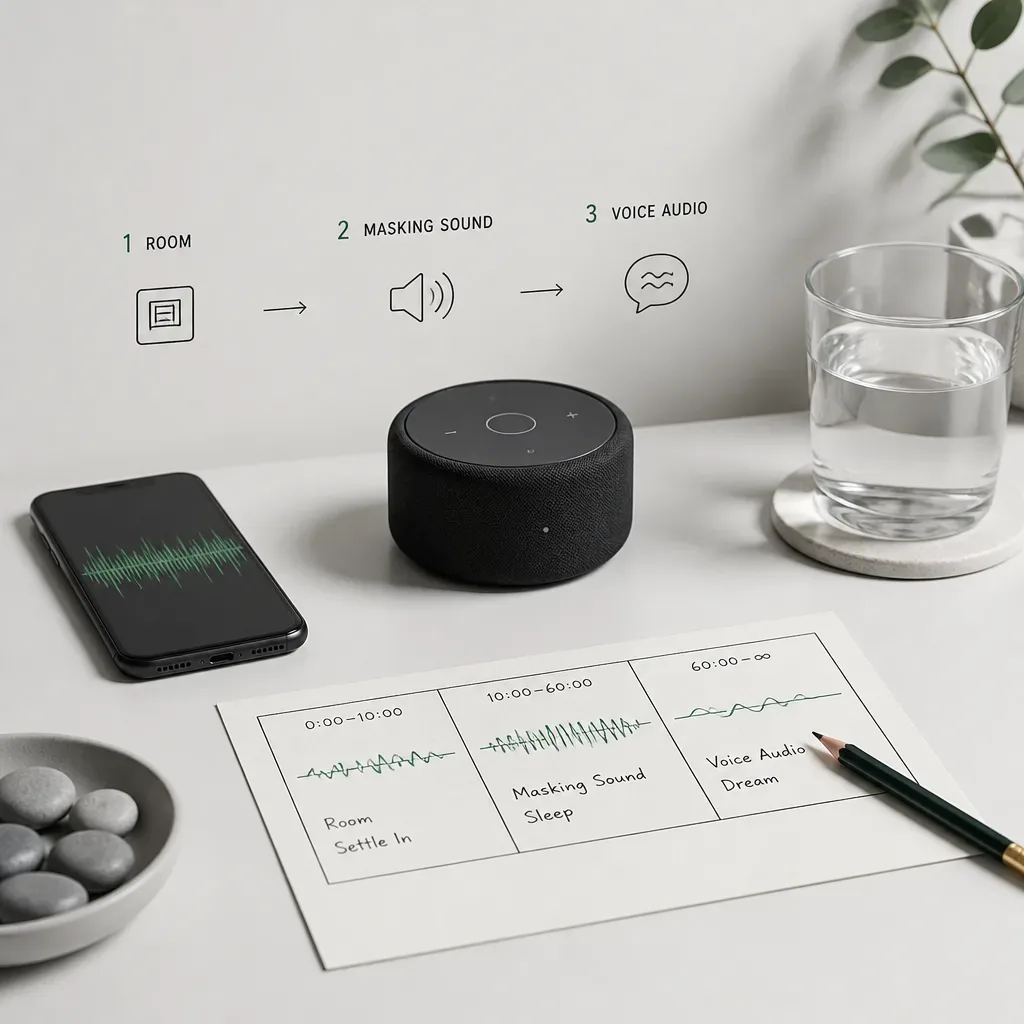
A practical night sequence can be as short as 12 minutes:
- 3 minutes: dim lights, set the room temperature, place the phone face down.
- 4 minutes: play masking sound if needed and adjust volume.
- 5 minutes: play Dream-Self audio, then stop active listening.
The American Psychological Association has noted in multiple stress surveys that many adults report lying awake because of stress. Audio does not erase the cause, but it can narrow the attentional field. A steady hum masks the hallway. A familiar voice gives the mind one track to follow. The body still has to sleep on its own.
Which sounds help the room settle before the audio starts?
Use masking sound for external noise, binaural beats for focused listening, and frequency music only if you like it at a low volume.
Different sounds do different jobs. White noise masks broad-band interruptions, such as a neighbor’s television or a distant road. Brown noise places more acoustic energy in low frequencies, so it often feels rounder and less hissy. Pink noise sits between them, dropping about 3 dB per octave, which is why it resembles rain or ventilation more than static.
Binaural beats are different. A binaural beat is an auditory illusion created when each ear receives a slightly different tone, often through headphones. For example, 200 Hz in one ear and 210 Hz in the other may be perceived as a 10 Hz beat. A 2019 meta-analysis in Psychological Research found that binaural beats can have small effects on anxiety, memory, and attention in some contexts, but results varied by frequency, duration, and study design. That means you can test them without treating them as guaranteed sleep technology.
| Tool | Mechanism | Best use tonight | Caution |
|---|---|---|---|
| White noise | Broad-band masking | Noisy apartment, traffic, voices | Can sound bright if too loud |
| Brown noise | Low-frequency weighted masking | Low hum preference, less hiss | Small speakers may distort lows |
| Binaural beats | Two-tone auditory illusion | Headphone listening before bed | Avoid if headphones bother sleep |
| Solfeggio tones | Musical and spiritual tradition | Gentle ritual, preference-based listening | Claims exceed evidence |
If you want to compare tones, use the Binaural beats generator + guide for a controlled test. Try 5 minutes at a comfortable level, then turn it off before sleep if headphones make you aware of your ears. If frequency lore appeals to you, read the Solfeggio frequencies guide with the distinction intact: the tradition is meaningful to many listeners, but the medical claims are not established by strong clinical evidence.
The simplest rule is this: choose the sound that lowers effort. If the track makes you evaluate, compare, or wait for a result, it is too interesting for bedtime.
How loud should bedtime audio be?
Set bedtime audio just loud enough to hear clearly, usually below normal conversation level, and never use volume to force relaxation.
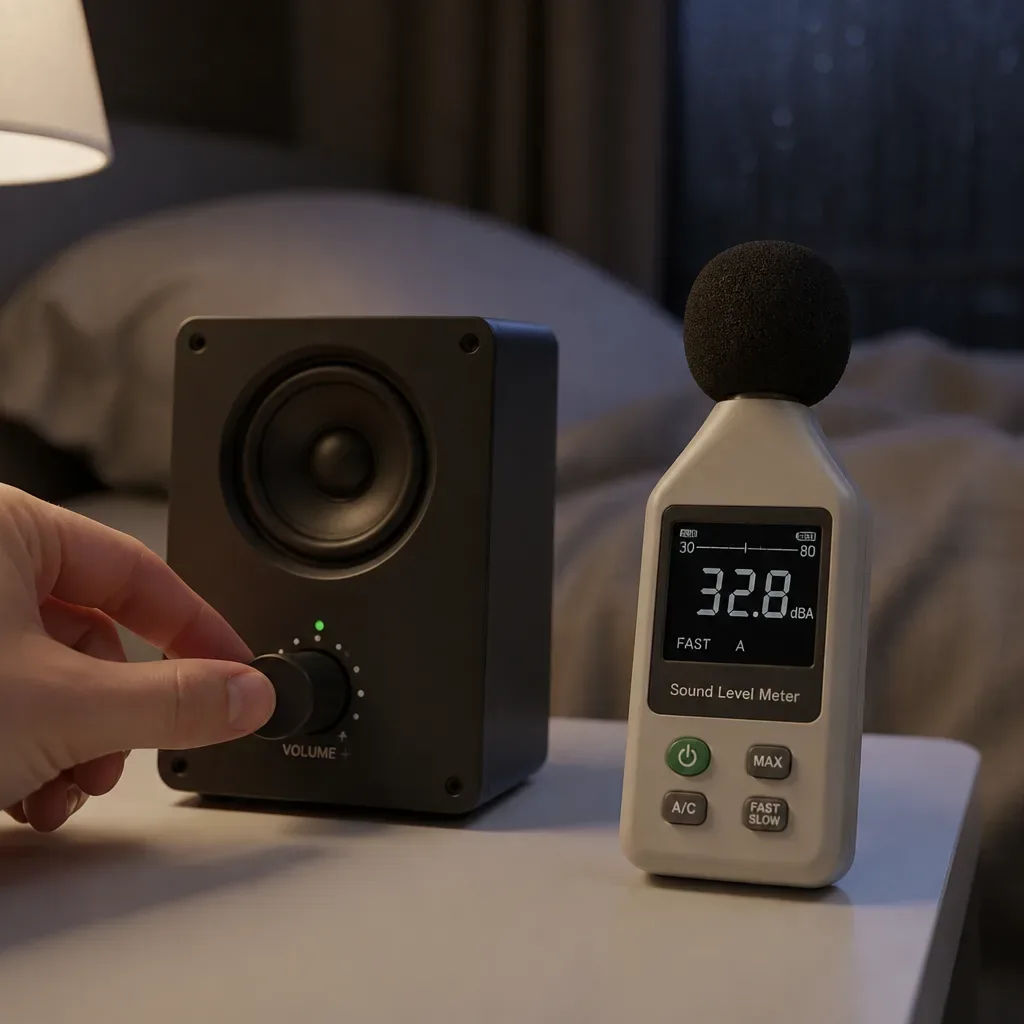
Volume is the safety variable people skip. Normal conversation is often around 60 dB at 1 meter. The World Health Organization has advised that night noise above 40 dB outdoors can begin to affect sleep for some populations, though indoor listening levels are measured differently. For personal audio at the pillow, softer is better: audible, stable, and easy to ignore when sleep arrives.
Use this practical calibration:
- Start at zero volume.
- Raise the sound until speech or noise is barely clear.
- Lower it one step.
- Lie down in your real sleep position.
- If you can still hear the track without effort, stop adjusting.
A phone speaker on a bedside table may need less volume than you expect because it’s close to the ear. Earbuds can be risky for sleep because they keep sound close, may create pressure, and can make you less aware of your environment. If you share a room, a small speaker placed 1 to 2 meters away is often a better compromise.
Good sleep audio does not dominate the room. It gives the room a floor.
Protecting hearing is not dramatic; it is arithmetic. The U.S. National Institute for Occupational Safety and Health uses 85 dBA over 8 hours as an occupational exposure limit, with allowable time halving for every 3 dB increase. Bedtime audio should be far below that. If you are tempted to raise the volume because the room is loud, the better fix may be distance, window sealing, a fan, or a different masking spectrum.
For tinnitus, hyperacusis, chronic insomnia, or suspected sleep apnea, speak with a qualified clinician. A sound routine can be a support, but it is not a substitute for assessment.
What if the sleep calculator gives a bedtime you can’t keep?
Use the calculator as a target, then build a smaller repeatable routine around your real evening constraints.
A perfect bedtime you miss five nights a week is less useful than a modest bedtime you can keep. Sleep regularity has measurable value. A 2017 study in Scientific Reports linked irregular sleep patterns in college students with worse academic performance and delayed circadian timing. The population was specific, but the principle travels well: the body reads timing as information.
If your calculated bedtime is 9:40 p.m. and your household cannot be quiet until 10:20, do not pretend otherwise. Choose a two-stage plan. First, set a non-negotiable wake time. Second, protect a latest lights-out time. Third, move bedtime earlier in 15-minute steps when the week allows. This is less elegant than an ideal calculator, but it survives contact with dishes, children, messages, and late trains.
A useful compromise looks like this:
- Ideal bedtime: six cycles plus sleep-onset buffer.
- Minimum bedtime: five cycles plus sleep-onset buffer.
- Recovery rule: if you hit the minimum for two nights, choose the ideal on the third.
- Audio rule: Dream-Self audio stays short; it never becomes a reason to stay up.
You can also split sound by purpose. Use a masking bed from the White noise generator + guide if the room is unpredictable. Use Dream-Self audio as the last intentional listening. If you enjoy tones, place them earlier in the evening, not at the moment you need sleep.
The quietest routine is the one with the fewest decisions. Decide once in daylight: wake time, bedtime range, audio order, volume ceiling. At night, you follow the lab note.
How do you review the routine after one week?
Review seven nights by looking for patterns in timing, sleep latency, wake grogginess, and whether the audio helped you stop negotiating.
Do not change the system after one bad night. Sleep varies. A 2020 paper in npj Digital Medicine using wearable data from more than 100,000 people found large differences in sleep timing and duration across individuals and days. Consumer wearables are imperfect at staging sleep, but they are often useful for timing patterns. The point is not to grade one night; it is to see the curve.
Use a plain seven-night log:
| Measure | What to write | Why it matters |
|---|---|---|
| Bedtime target | Calculated time | Shows whether the plan was realistic |
| Lights-out time | Actual time | Reveals drift |
| Sleep latency | Estimate in minutes | Helps set the buffer |
| Wake time | Alarm and actual rise | Tests consistency |
| Morning state | 1 to 5 rating | Captures functional sleep |
| Audio used | Noise, beat, voice, silence | Separates tool from timing |
After seven nights, adjust only one variable. If you fell asleep in under 10 minutes most nights but woke too early, your bedtime may be too early or your sleep pressure too high at the wrong time. If you took more than 30 minutes to fall asleep most nights, consider moving the wind-down earlier, reducing late caffeine, or discussing persistent insomnia with a clinician. The Journal of Clinical Sleep Medicine has published consensus guidance that cognitive behavioral therapy for insomnia is a first-line treatment for chronic insomnia, not a last resort.
Measurement is not the opposite of tenderness. It is how you stop blaming yourself for patterns you haven’t named yet.
Keep the audio review simple. Did the masking sound reduce interruptions? Did binaural beats make you calmer or more analytical? Did Dream-Self audio feel clear at low volume? Your nervous system gets a vote, but the clock gets one too.
Set the time, lower the sound, and let the room become ordinary again.