sleep science
Caffeine Before Bed: When to Stop Before Dream-Self Audio
Caffeine before bed can thin sleep and blunt your wind-down. Use this timing guide to stop early enough for calm Dream-Self audio tonight.
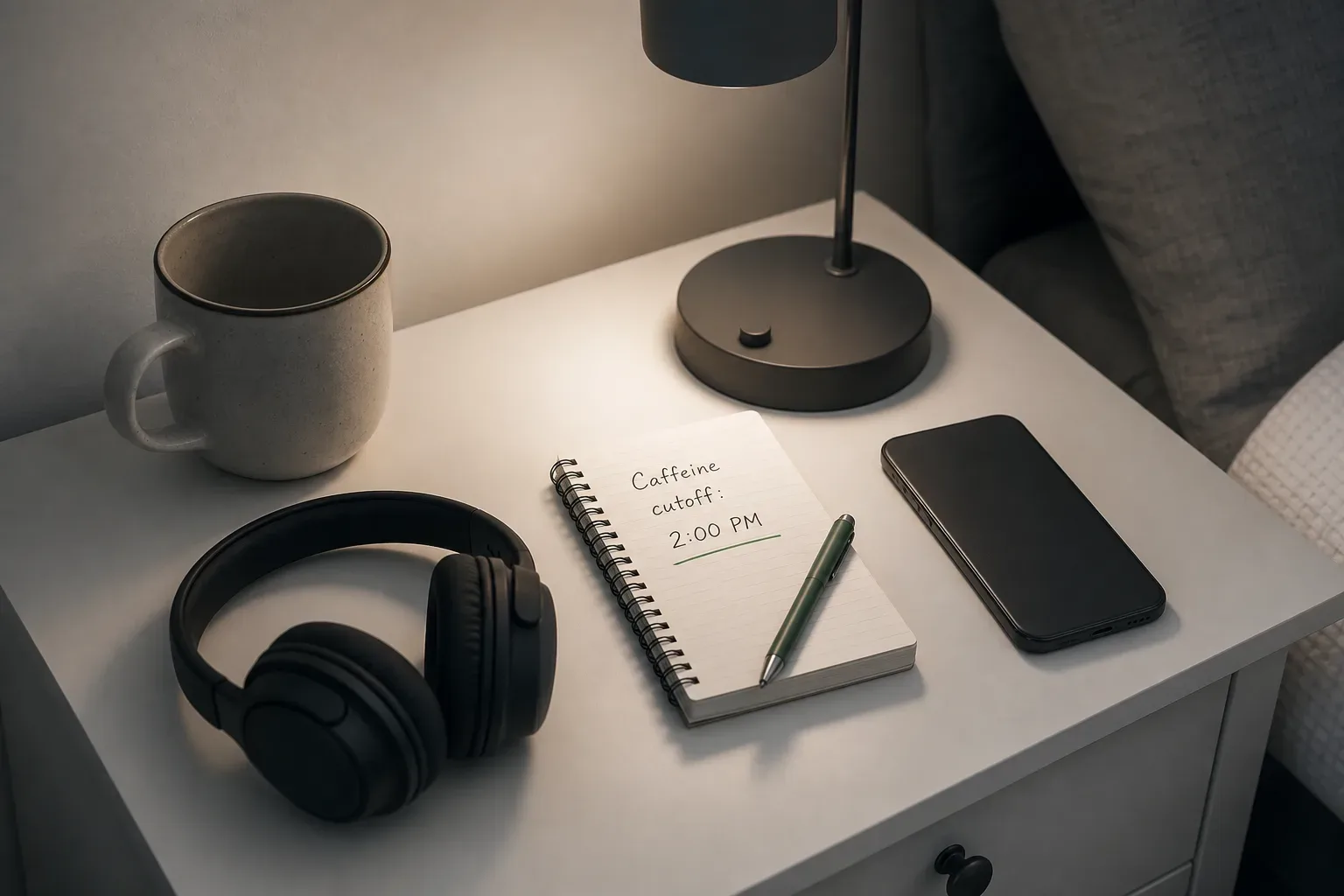
Caffeine before bed is best stopped 8 to 10 hours before your Dream-Self audio, and earlier if you’re sensitive. Caffeine blocks adenosine, the sleep-pressure signal, so the body can feel tired while the brain stays chemically propped up. Use timing, dose, and sound design together tonight.
Why does caffeine before bed disrupt Dream-Self audio?
Caffeine disrupts bedtime audio because it keeps arousal high while the recording asks attention to become steady and low.
Caffeine is an adenosine receptor antagonist. Adenosine builds across waking hours and helps the brain measure sleep pressure. When caffeine blocks that signal, you may still feel emotionally tired, but the nervous system receives less chemical permission to settle. The U.S. Food and Drug Administration lists about 400 mg per day as a general upper limit for many healthy adults, but that number is not a bedtime recommendation.
Dream-Self audio needs a quieter state than a work call or podcast. The AYA Method is a daily audio manifestation practice: each day you listen to a short personalized recording, your Dream-Self Moment, narrated from the version of you who has already manifested the life you intend. Listening is the practice. Repetition is the work. The audio is the method.
Caffeine does not erase the meaning of the recording. It changes the physiology around it. A 2013 randomized study in the Journal of Clinical Sleep Medicine found that 400 mg of caffeine taken 0, 3, or 6 hours before bed reduced total sleep time; even the 6-hour dose cut sleep by more than 1 hour in objective sleep measurements. That is not a subtle effect when your wind-down is only 20 to 30 minutes long.
A useful distinction is simple: sound prepares the room; a voice fills it. Noise can mask the hallway, tones can cue stillness, and your Dream-Self audio can hold attention once the stimulant load is low enough. Caffeine does not borrow wakefulness; it delays the body’s accounting of fatigue.
If you have chronic insomnia, sleep apnea symptoms, severe anxiety, heart rhythm concerns, or persistent tinnitus, use this as general sleep hygiene and speak with a qualified clinician.
When should you stop caffeine before bed?
Most adults should stop caffeine 8 to 10 hours before bed, then adjust earlier if sleep stays light or broken.
The common 6-hour rule is based on evidence, but it is often too tight for sensitive sleepers. Caffeine’s half-life is usually reported around 3 to 7 hours in adults, meaning that after 6 hours, a meaningful amount can remain. If you drink 200 mg at 3 p.m., you may still have about 50 to 100 mg active near 9 p.m., depending on metabolism, liver enzymes, medications, hormones, and smoking status.
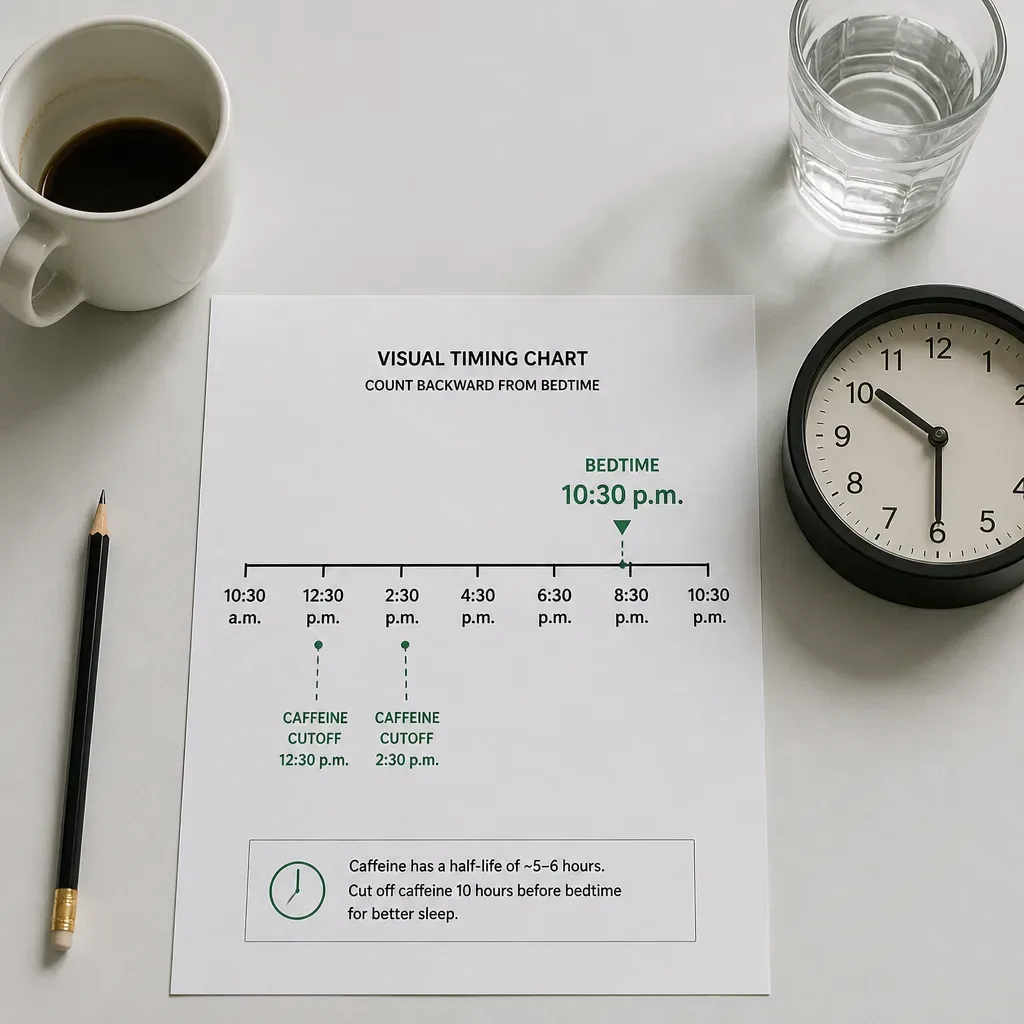
Use bedtime rather than audio time as the anchor. If lights out is 10:30 p.m., an 8-hour cutoff is 2:30 p.m.; a 10-hour cutoff is 12:30 p.m. For people who wake at 3 a.m., the earlier cutoff often matters more than the sleep-onset moment. Caffeine can reduce deep sleep and increase awakenings even when you fall asleep on schedule.
| Bedtime | 8-hour cutoff | 10-hour cutoff | Best first test |
|---|---|---|---|
| 9:30 p.m. | 1:30 p.m. | 11:30 a.m. | Stop by lunch |
| 10:30 p.m. | 2:30 p.m. | 12:30 p.m. | Last coffee after breakfast or lunch |
| 11:30 p.m. | 3:30 p.m. | 1:30 p.m. | No late-afternoon caffeine |
| 12:30 a.m. | 4:30 p.m. | 2:30 p.m. | Watch tea and cola after dinner |
The dose matters as much as the clock. An 8 oz brewed coffee often contains 80 to 100 mg of caffeine, but large coffeehouse drinks can exceed 200 mg. Black tea commonly lands around 40 to 70 mg per 8 oz, green tea around 20 to 45 mg, and many cola drinks around 30 to 50 mg per 12 oz. Labels vary, so read the number when it is available.
A clean rule for tonight is this: stop caffeine by lunch if your Dream-Self audio is part of a serious sleep routine. The best evening stimulant is the one you already skipped.
How do you know if you’re a slow caffeine metabolizer?
You may be a slow caffeine metabolizer if afternoon caffeine changes your sleep, heart rate, anxiety, or next-morning steadiness.
Caffeine sensitivity is not a character trait. It is partly biology. Variants in the CYP1A2 gene affect caffeine metabolism, and adenosine receptor differences may affect how strongly caffeine feels. Pregnancy can slow caffeine clearance substantially, and some oral contraceptives and medications may also change how long caffeine stays active. The American College of Obstetricians and Gynecologists commonly advises limiting caffeine to 200 mg per day during pregnancy, a separate issue from bedtime timing.
You do not need a genetic test to make a practical decision. Your night gives usable data. If one cup after 2 p.m. leads to a busy mind at 11 p.m., treat yourself as sensitive. If you fall asleep but wake after 4 or 5 hours, test an earlier cutoff before blaming the audio, the mattress, or your discipline.
Use this 7-night check:
- Keep bedtime within a 30-minute window.
- Keep Dream-Self audio at the same time each night.
- Use the same sound bed, such as White noise generator + guide, at a low volume.
- Stop caffeine at your usual time for 2 nights and write it down.
- Move the cutoff earlier by 90 minutes for 3 nights.
- Compare sleep onset, awakenings, dreams recalled, and morning alertness.
- If sleep improves, keep the earlier cutoff for 2 more weeks.
This is not laboratory polysomnography, but it is better than guessing. Consumer sleep trackers can misread stages; several validation studies show better accuracy for sleep duration than for deep or REM staging. Still, the pattern of awakenings and subjective morning steadiness can guide a routine.
Your nervous system is allowed to be specific. A rule that works for a stranger at 3 p.m. may be too late for you at noon.
What should your evening audio routine look like after caffeine?
Your evening audio routine should reduce stimulation in layers: light first, room sound second, Dream-Self audio third.
Start with the parts that do not require belief. Dim lights 60 to 90 minutes before bed. Bright light suppresses melatonin, and laboratory studies show that evening light timing can shift circadian rhythm. Keep the room cool if possible; many sleep clinicians suggest roughly 60 to 67°F, or 15.5 to 19.5°C, though comfort and bedding matter.
Then choose a sound bed. White noise masks sudden changes: doors, pipes, traffic, voices. Brown noise has more low-frequency weight and less high hiss, which some people prefer at night. If you want to hear the difference directly, press play in the White noise generator + guide and compare white, pink, and brown at the same volume.
Binaural beats are different. They require headphones because each ear receives a slightly different tone, and the brainstem tracks the difference as a beat. A 2020 meta-analysis in Psychological Research reported small effects of binaural beats on anxiety, cognition, and pain, with large variation across studies. For bedtime, that means they may help some people settle, but they are not sedation. Try the Binaural beats generator + guide if headphones feel comfortable and safe for your sleep position.
Keep volume conservative. A good target is below conversational level, often around 40 to 50 dB if measured near the pillow. The World Health Organization has warned about cumulative noise exposure above safe listening levels; sleep audio should be quieter than daytime headphone music. For children, keep it lower and farther from the ear.
A simple order works well:
- 10 minutes of room sound, such as brown noise or rain-like white noise.
- 3 slow breaths with the phone face down.
- 5 to 8 minutes of Dream-Self audio.
- Optional continued noise on a timer for 30 to 60 minutes.
Do not make the recording compete with caffeine, light, and a loud room. Give the voice less to push through.
What if you already had caffeine too late tonight?
If you already had caffeine too late, lower the demands of the night and protect the routine without forcing sleep.
Do not punish the body by lying still in frustration for 2 hours. Caffeine has already occupied receptors; irritation adds another layer of arousal. The better move is to keep the ritual small and plain. Play your Dream-Self audio once at low volume, then switch to a neutral masking sound if your mind keeps reaching for stimulation.
A late dose is also a reason to avoid extra sleep hacks. Alcohol may make sleep onset faster, but it tends to fragment the second half of the night and reduce REM sleep in dose-dependent ways. Heavy food near bed can add reflux or warmth. A second supplement because coffee ran late is rarely the cleanest test.
Use a tonight-only plan:
- Put tomorrow’s caffeine cutoff in your calendar now.
- Stop screens or use the dimmest setting for the next 30 minutes.
- Drink water, but avoid large amounts right before bed.
- Use steady sound at a low level, not a complex playlist.
- Listen to Dream-Self audio once, not five times.
- If awake after about 20 to 30 minutes, get up briefly and do something quiet in low light.
The 20 to 30 minute instruction comes from cognitive behavioral therapy for insomnia principles: when the bed becomes a place of effort, leaving briefly can reduce conditioned arousal. You do not need to stare at a clock; estimate gently.
If you like tonal traditions, a quiet track from the Solfeggio frequencies guide can be a familiar cue. Treat 528 Hz or 432 Hz as preferred sound and tradition, not as a guaranteed biological switch. Liking a tone is enough reason to use it when the claim stays honest.
How much caffeine is too much for Dream-Self audio days?
Too much is the amount that makes the evening recording feel effortful, but many people should begin by staying under 200 to 300 mg before lunch.
General safety limits and sleep-friendly limits are not the same. The FDA’s 400 mg daily figure is a broad adult guideline, not a promise of clean sleep. Two medium coffees can reach 200 mg before you count tea, chocolate, cola, or pre-workout powder. Some energy drinks list 160 to 300 mg per can, and concentrated caffeine powders have caused poisonings because the dose is easy to mismeasure.
For audio practice, think in three zones:
| Daily caffeine pattern | Likely sleep effect | Suggested change |
|---|---|---|
| 50 to 100 mg before 10 a.m. | Often mild for average metabolizers | Keep if sleep is steady |
| 150 to 250 mg before noon | Manageable for many adults | Test 8 to 10 hour cutoff |
| 300 mg or more, or any dose after 2 p.m. | More likely to thin sleep | Reduce dose or move earlier |
The goal is not moral purity. It is a repeatable acoustic and biological setup. If the audio is your daily practice, the body should learn the cue: low light, low sound, same voice, no stimulant surge. Repetition becomes more legible when the inputs are stable.
Notice the morning loop too. Late caffeine can shorten sleep; short sleep can increase next-day caffeine use. The National Sleep Foundation’s adult recommendation is 7 to 9 hours for most adults aged 18 to 64. When sleep drops below that for several nights, the next cup may be treating yesterday’s timing.
A practical taper is kinder than a sudden stop. Reduce by 25 to 50 mg every 2 to 3 days, or replace the last cup with half-caf for a week. Headaches can occur when regular caffeine drops quickly, often within 12 to 24 hours. Water, food, and gradual change help.
The cleanest bedtime audio is not louder or longer; it is protected earlier in the day.
How can you build a caffeine cutoff you will actually keep?
You keep a caffeine cutoff by making it visible, boring, and tied to the sound routine you already want at night.
Start with one rule you can measure. For the next 14 days, choose either no caffeine after noon or no caffeine within 10 hours of bedtime. Fourteen days is long enough to pass through a few variable nights without overreading one bad sleep. It is also short enough that the experiment feels plain.
Pair the cutoff with replacement behavior. If your 3 p.m. coffee is partly a pause, keep the pause. Change the liquid. Try decaf, peppermint tea, warm water, or a short walk outside. A 10-minute walk can improve subjective alertness for some people without adding a stimulant that remains at bedtime.
Write the cutoff where you will see it:
- Calendar alert: “Last caffeine now. Protect tonight’s audio.”
- Coffee machine note: “Morning only.”
- Work mug rule: caffeinated before lunch, decaf after.
- Phone reminder 10 hours before lights out.
Then measure only 3 things each morning: time to fall asleep, number of remembered awakenings, and how steady you feel in the first 30 minutes after waking. These are crude measures, but they are usable. If you want a sound comparison, keep the same Binaural beats generator + guide setting or the same White noise generator + guide setting during the test. Changing everything at once hides the signal.
After 2 weeks, decide by evidence, not mood. If your audio feels calmer and sleep is less broken, keep the cutoff. If nothing changes, your main issue may be light, stress, timing, pain, apnea, medication, or room noise. That is useful information too.
Tonight, stop the stimulant early enough that the quiet can do its ordinary work.