sleep science
Blue Light Before Bed: 30-Minute Dim Routine
Blue light before bed can delay sleep timing. Use this 30-minute dim routine before Dream-Self audio to lower light, settle sound, and protect sleep.
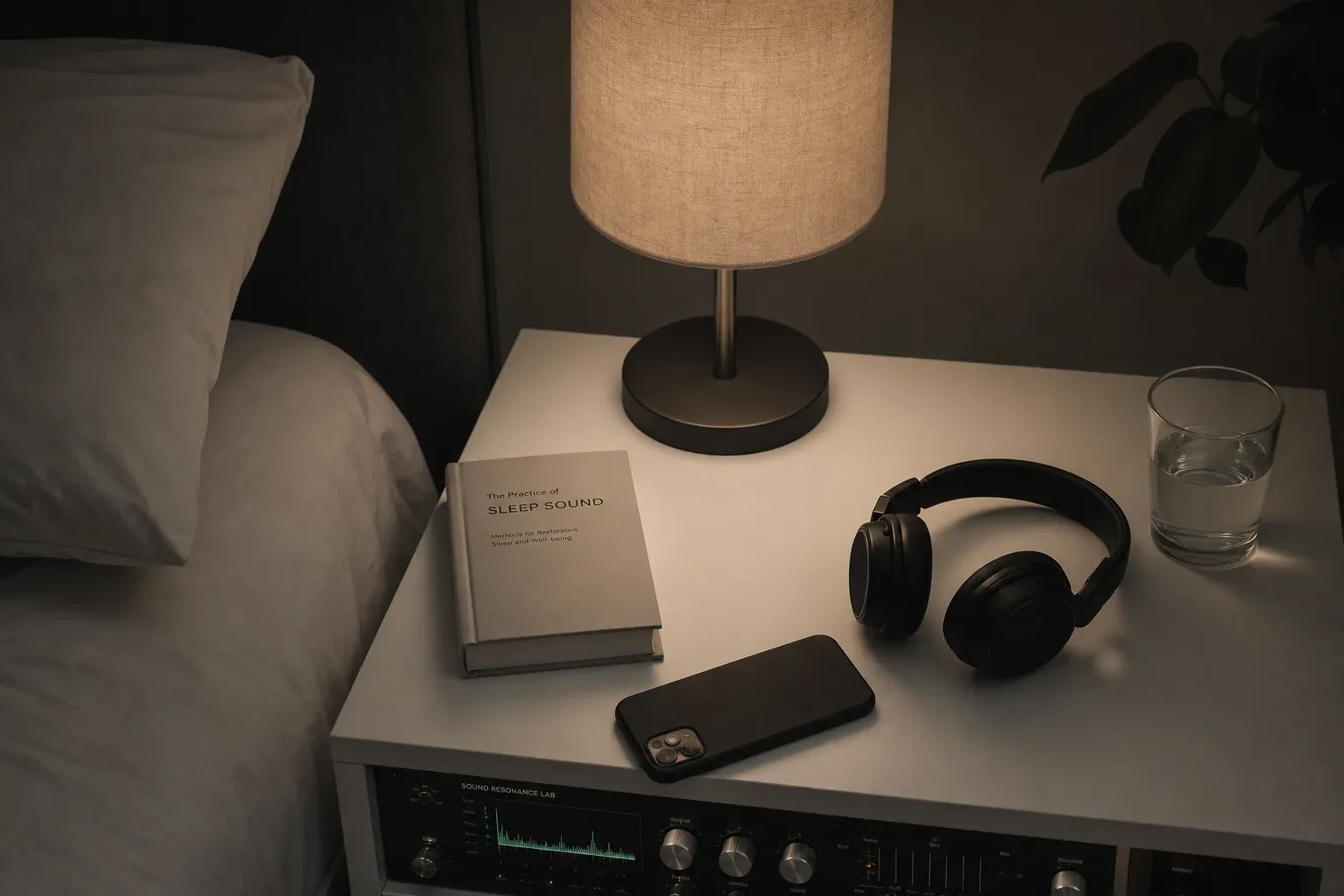
Blue light before bed is most useful to reduce in the last 30 to 60 minutes because short-wavelength light can delay melatonin timing and keep the brain reading the room as daytime. A 30-minute dim routine gives you a realistic bridge: lower light first, then play Dream-Self audio with the phone acting only as a sound source.
What does blue light before bed actually do to sleep timing?
Blue light before bed can shift the circadian signal later, especially when it is bright, close to the eyes, and used for long sessions.
The sensitive range is roughly 460 to 480 nanometers, where melanopsin-containing retinal cells respond strongly to short-wavelength light. Those cells do not help you read text; they help the brain measure day and night. In the evening, that measurement matters. Melatonin usually rises about 2 hours before habitual sleep in dim conditions, a marker often called dim-light melatonin onset, or DLMO.
A well-known 2015 PNAS study by Anne-Marie Chang and colleagues compared reading on a light-emitting e-reader with reading a printed book before bed. The study was small, 12 adults, but tightly controlled. The e-reader condition suppressed melatonin, delayed circadian timing, reduced evening sleepiness, and lowered next-morning alertness compared with print. Small samples do not settle every question, but the direction is plain enough for practice.
The mechanism is not mystical. The eye sends a timing signal to the suprachiasmatic nucleus, the brain’s central circadian clock. Bright light at 8 a.m. and bright light at 11 p.m. are not the same instruction. One tends to anchor the morning; the other can ask the clock to wait.
The screen is not the problem by itself. The problem is a daytime signal delivered at bedtime.
Distance and brightness change the dose. A tablet held 30 centimeters from the face is a different instrument than a dim phone across the room. A ceiling LED can matter as much as the screen. If you reduce only the phone and leave the bathroom lit like a clinic, the eye still receives a strong timing cue.
Why choose a 30-minute dim window before audio?
Thirty minutes is a practical minimum that changes the room before it tries to change your state.
Sleep labs often use dim light below about 10 lux when measuring DLMO, but normal homes rarely run that low. A reasonable home target is often under 50 lux for the last part of the evening, with warm, indirect lighting. For reference, a bright office may sit around 300 to 500 lux, while a very dim bedside lamp can fall near 20 to 40 lux depending on shade and distance.
The 30-minute window is not a guarantee that melatonin will rise on command. Biology does not obey a kitchen timer. It is enough time, however, to remove the most common conflicts: overhead LEDs, close scrolling, bright bathroom mirrors, and last-minute message checks. The American Academy of Sleep Medicine has often advised keeping electronics away from bedtime; many clinic handouts use 30 to 60 minutes because people can actually follow it.
Sound works better after light gets quieter. If you begin audio while the room still looks like midday, the body receives mixed instructions. Noise masks the world, tones can steady attention, and spoken audio has less to fight when the visual system has stopped reporting daylight.
A field note from recording rooms applies here: the first improvement is often subtraction. When I record rain on canvas, removing a single refrigerator hum can make the whole take feel calmer, even before I touch the microphones. Night routines work the same way. Remove the bright signal, then add the intended sound.
How do you set up the 30-minute dim before Dream-Self audio?
Set one cue, lower the light, prepare the phone as audio only, then listen without returning to the screen.
Use the same order each night for at least 7 nights. Repetition reduces decision load, and decision load is one reason people keep screens open. A 2023 Pew Research Center report found that 97 percent of U.S. adults owned a cellphone; the device is close because it is useful. The routine has to work with that fact, not pretend the phone will vanish.
Here is the plain sequence:
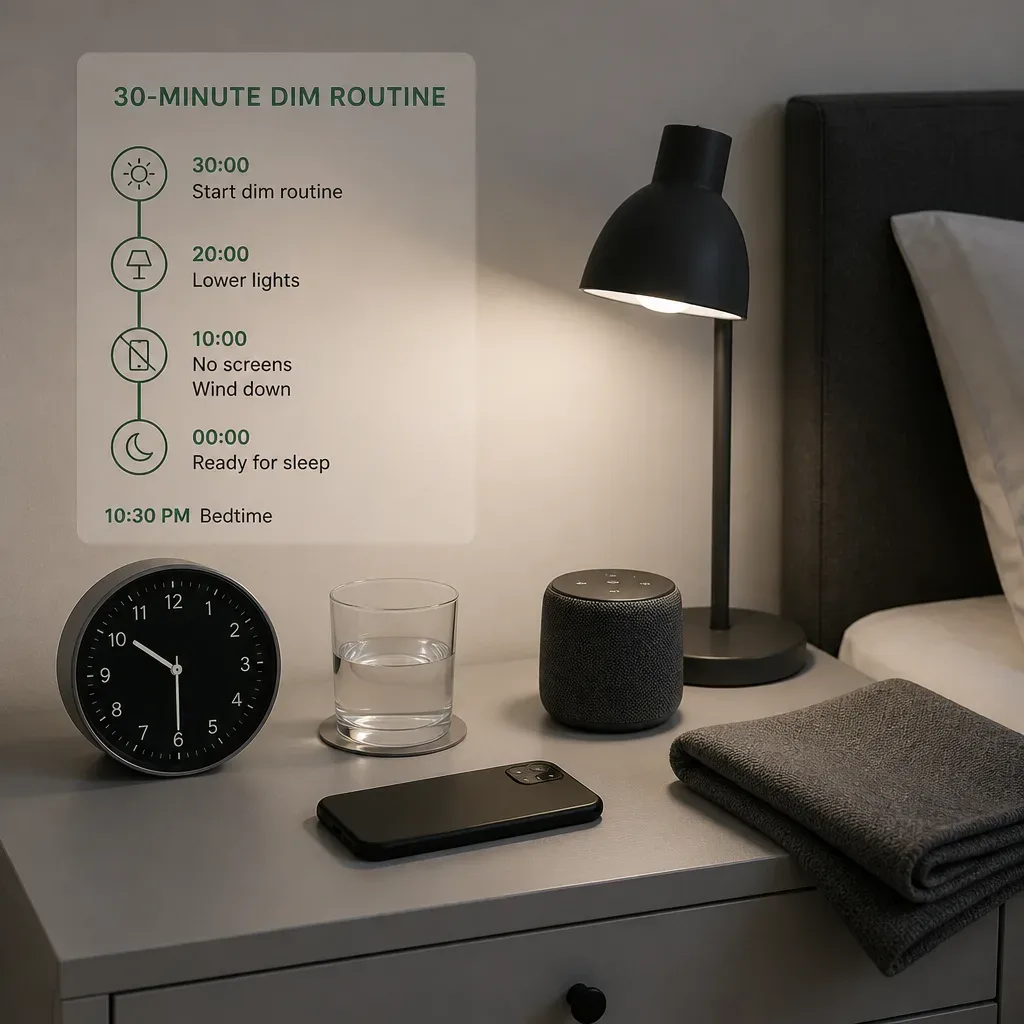
- T minus 30 minutes: set a small alarm labeled dim. When it rings, stop overhead light.
- T minus 28 minutes: switch to one warm lamp, shaded or indirect. Keep it behind you, not pointed at your face.
- T minus 25 minutes: put the phone in focus mode or do-not-disturb. Lower brightness to the minimum you can still operate safely.
- T minus 20 minutes: prepare the bed, water, and any needed medication before the room gets darker.
- T minus 10 minutes: start any background sound you use for masking. Keep it low.
- T minus 5 minutes: start Dream-Self audio, place the phone face down, and stop touching the screen.
This is where the AYA Method fits naturally. The AYA Method is a daily audio manifestation practice. Each day you listen to a short personalized recording, your Dream-Self Moment, narrated from the version of you who has already manifested the life you intend. Listening is the practice. Repetition is the work. The audio is the method.
The daily affirmation and Manifestation Board can support the practice, but they are not the center of this night routine. At bedtime, the useful instruction is simpler: dim first, then listen. A board asks the eyes to work. A recording lets them close.
What should the room sound like once the lights are dim?
The room should sound steady, low enough to ignore, and quiet enough that your Dream-Self audio remains clear.
If the room is already quiet, do not add sound for decoration. Silence is a good baseline. If there are intermittent disturbances, a masking layer can help: traffic, hallway doors, elevator motors, or a partner’s late movement. The White noise generator + guide is useful when the problem is sudden sound, because broad-band noise reduces contrast. A door click is less sharp when the room already has a steady bed of sound.
Volume should stay conservative. Many sleep sound specialists advise keeping continuous audio well below normal conversation, often around 40 to 50 dB at the pillow. The World Health Organization’s 2018 environmental noise guidelines note that night noise can affect sleep, with outdoor night levels above 40 dB associated with measurable sleep disturbance in population research. Your speaker does not need to win against the room; it only needs to soften it.
| Sound choice | Best for | Caution | Starting level |
|---|---|---|---|
| White noise | Sharp, varied household sounds | Can feel hissy to some ears | 40 dB |
| Pink or brown noise | Lower, softer masking | May muddy speech audio | 35 to 45 dB |
| Binaural beats | Headphone listening with tones | Evidence is mixed and volume must stay low | Barely audible |
| Solfeggio tones | Ritual, familiarity, tonal focus | Tradition is stronger than clinical evidence | Low background |
A Binaural beats generator + guide can be interesting if you use headphones and like a stable tone, but the claims are mixed. A 2020 meta-analysis in Psychological Research reported small effects across studies, with variation by frequency and timing. Treat binaural beats as an attention aid, not a medical tool.
The Solfeggio frequencies guide belongs in a different category. Solfeggio tones carry a tradition around named frequencies such as 396 Hz, 528 Hz, and 852 Hz. People may like them because they are familiar, simple, and repeatable. The tradition deserves accurate naming, and the evidence should stay plain: there is no strong clinical proof that one named frequency fixes sleep.
Good sleep audio does not impress the ear. It gives the ear less to defend against.
What if you need your phone for the audio?
Use the phone as a closed audio player, not as a lit object in your hand.
This distinction matters because most people do not use screens in one clean block. A 2022 Sleep Foundation survey reported that many adults used electronics in bed at least a few nights per week, and phone checks often stretch beyond the intended task. The danger is not only blue light. It is also novelty, social threat, unfinished work, and time loss.
Set up the phone before the final dim period if possible. Download the recording, choose the output device, and test the volume earlier in the evening. At T minus 30 minutes, the phone should need only one or two taps. If you use wireless earbuds, pair them before the lamp goes low. If you use a speaker, place it 1 to 2 meters from the pillow so the sound fills the room without needing high volume.
Night Shift, Night Light, and similar warm-display settings reduce short-wavelength output, but they do not make a bright screen harmless. In laboratory work, brightness and duration still matter. A warm phone at full brightness near the face can remain a strong light source. Lower brightness first; color shift second.
Try this phone setup:
- Turn on do-not-disturb or sleep focus.
- Set display brightness near minimum.
- Use a warm display setting after sunset.
- Start the audio, then place the phone face down.
- Keep notifications off until morning.
- If you wake at night, avoid checking the time unless necessary.
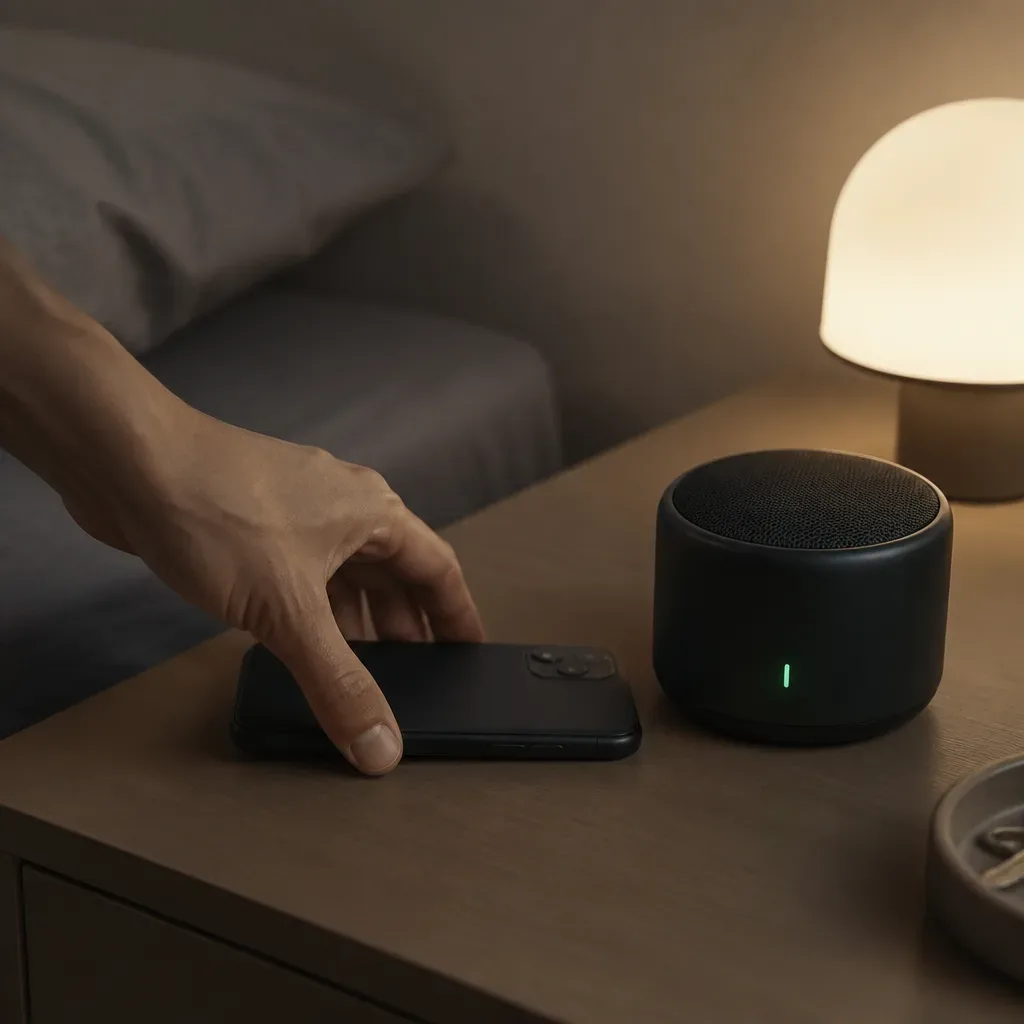
A phone face down is not a moral victory. It is a light-control tool. The screen cannot pull the room brighter if it is not visible.
Who should be more careful with light, sound, or timing?
Children, people with tinnitus, shift workers, and anyone with chronic insomnia should use the routine more cautiously and get help when symptoms persist.
Children’s eyes transmit more short-wavelength light than older adult eyes, and their circadian systems can be sensitive to evening light. A 2018 study in Physiological Reports found that preschool children exposed to bright light before bedtime showed strong melatonin suppression, although the sample was small. The practical advice is simple: dim earlier for children, keep screens out of the bed, and avoid headphones for sleep unless a clinician recommends them.
Tinnitus changes the sound question. Masking can help some people by reducing contrast, but too much noise can irritate the ear or make sleep feel dependent on volume. If tinnitus is new, one-sided, pulsatile, or linked with hearing loss or dizziness, speak with a qualified clinician. Use low sound, ideally from a speaker rather than sealed earbuds, and keep it steady.
Chronic insomnia also deserves respect. If you have trouble falling asleep or staying asleep at least 3 nights per week for 3 months, that meets a common clinical threshold for chronic insomnia disorder. Cognitive behavioral therapy for insomnia, CBT-I, has strong evidence and is recommended by the American College of Physicians as first-line treatment for chronic insomnia in adults.
Shift workers have a different problem: they may need bright light at night for safety and darkness in the morning for sleep. If that is you, the 30-minute dim window still helps, but place it before your sleep episode, not by the clock on the wall. Blackout curtains and morning light control can matter more than the phone.
A routine is not a diagnosis. It is a small, repeatable condition you can test.
What is the exact 30-minute routine for tonight?
Tonight, dim the room for 30 minutes, remove visible screens, keep sound low, and let the last active step be audio.
Use this as a measured script, not a performance. If you miss a minute, continue. The body responds to the total pattern more than perfect timing. In sleep research, even 1 hour of evening light exposure can change circadian markers, but home routines are built from smaller, repeated reductions. Consistency across 7 to 14 nights will teach you more than one perfect evening.
The 30-minute script
- 30:00 to 25:00, lower the light. Turn off overhead fixtures. Use one warm lamp, ideally below eye level. If you can read small print easily across the room, it may still be brighter than needed.
- 25:00 to 20:00, finish practical tasks. Brush teeth, set water down, plug in devices away from the pillow. Bathrooms are often the brightest room used before bed, so keep the visit brief or use a lower light if safe.
- 20:00 to 15:00, reduce inputs. No news, work messages, or social feeds. If one thought needs capture, write a 1-line note on paper.
- 15:00 to 10:00, set sound. If masking is needed, press play below and listen for the difference. Choose the quietest setting that softens interruptions.
- 10:00 to 02:00, play Dream-Self audio. Start the recording. Put the phone down. Let the voice carry the practice.
- 02:00 to 00:00, do less. Keep the room dim. Let the last two minutes be plain breathing, not another adjustment.
If you want to compare sound beds on another night, test them before the routine starts. Use the White noise generator + guide for masking, the Binaural beats generator + guide for headphone-based tone experiments, or the Solfeggio frequencies guide if a named tone helps you keep the ritual simple. Do the choosing earlier. Bedtime is not the best lab bench.
Keep the volume gentle enough that you could speak over it without raising your voice. For most rooms, that means the sound is felt as a floor, not a foreground. If another person shares the room, ask for their vote. Sleep audio that comforts one nervous system can keep another one alert.
The best night setting is the one you can repeat without argument.
Dim the room, place the phone down, and let the next sound be enough.