frequencies binaural
Binaural Beats Manifestation Under Dream-Self Audio
A measured guide to binaural beats manifestation: choose beat ranges, set safe volume, and layer them under Dream-Self audio without masking the voice.
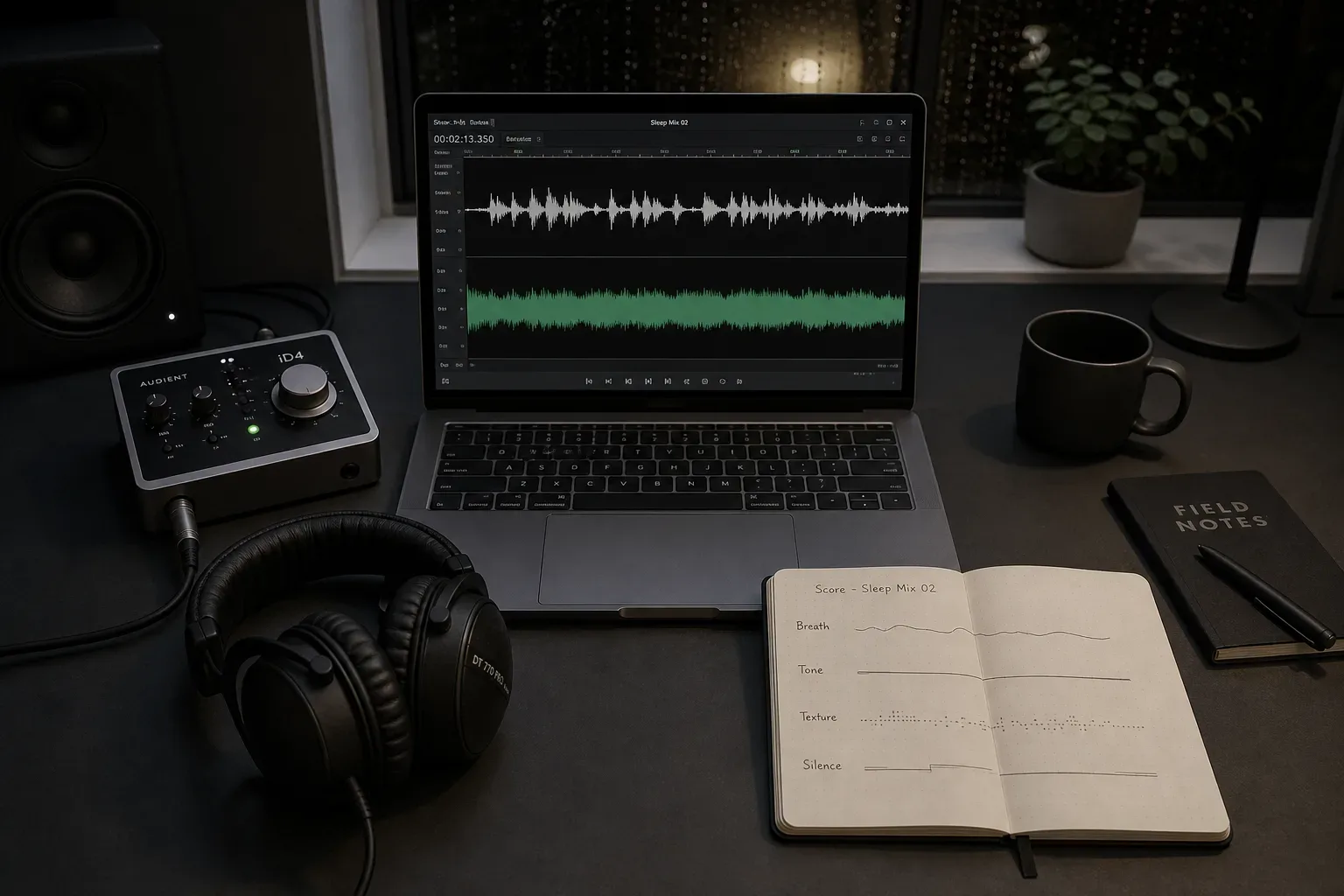
Binaural beats manifestation is the practice of placing a low binaural beat beneath a spoken manifestation track so attention has somewhere steady to rest. The beat doesn’t manifest for you. It may help you settle, keep headphones on, and repeat the Dream-Self audio at a consistent time each day.
What are binaural beats doing under manifestation audio?
Binaural beats create a perceived pulse when each ear hears a slightly different pure tone through headphones.
If the left ear hears 200 Hz and the right ear hears 208 Hz, the auditory system tends to perceive an 8 Hz beat. That 8 Hz pulse is not physically present in the room. It is a neural construction created by the way the brainstem and auditory cortex compare timing between the ears. Gerald Oster described the modern psychoacoustic framing in Scientific American in 1973, and the basic effect is still taught as an auditory illusion rather than a special signal.
For manifestation audio, that distinction matters. The spoken track carries the meaning: the future-self language, the memory cue, the repeated identity statement. The binaural beat is only a substrate. A good layer behaves like low room tone in a film mix. You don’t follow it. You lean on it.
The evidence is mixed, not empty. A 2015 systematic review by Chaieb and colleagues in Frontiers in Human Neuroscience found that binaural beat studies vary widely in beat frequency, session length, and outcome measures. A 2019 meta-analysis by Garcia-Argibay and colleagues in Psychological Research reviewed 22 studies and reported small-to-moderate effects on memory, attention, anxiety, and pain, with strong caution about heterogeneity. That means binaural beats may help some tasks and some listeners, but they aren’t a reliable switch.
For a manifestation routine, I’d describe their role more plainly: binaural beats can make the listening field feel steadier. They can also become annoying after 3 minutes if the carrier tone is too high, the level is too loud, or the loop is careless. A sound that demands attention is the wrong sound for a practice built on repetition.
The beat is not the message. The beat is the floor the message stands on.
If you want to hear the mechanism directly, use the Binaural beats generator + guide with headphones and switch between 4 Hz, 8 Hz, and 12 Hz differences. Press play and listen for the change in steadiness, not for a dramatic event.
Which beat range should you choose for a Dream-Self session?
Choose alpha for calm focus and theta for evening wind-down, then let comfort decide.
Most manifestation listening happens in one of two states: alert enough to hear language, quiet enough to stop negotiating with the day. Alpha-range beats, usually described as about 8 to 12 Hz, are often used for relaxed attention. Theta-range beats, about 4 to 8 Hz, are often used for drowsy imagery and pre-sleep listening. Those labels borrow from EEG bands, but a binaural beat at 6 Hz does not force your brain into theta. It offers a rhythmic cue that may encourage a similar tempo of attention.
A conservative starting table is better than frequency folklore:
| Use tonight | Beat difference | Session length | Best placement |
|---|---|---|---|
| Calm review of your Dream-Self audio | 10 Hz | 8 to 12 minutes | Early evening or after journaling |
| Pre-sleep manifestation listening | 6 Hz | 6 to 10 minutes | In bed, before removing headphones |
| Morning focus with spoken intention | 12 Hz | 5 to 8 minutes | Seated, eyes open or soft |
| If tones irritate you | No beat | Same length | Use noise or music instead |
Notice the short durations. Many binaural beat studies use sessions between 5 and 30 minutes, and longer isn’t automatically better. For nightly use, shorter sessions are easier to repeat and less likely to cause ear fatigue. The National Institute for Occupational Safety and Health recommends an 85 dBA exposure limit over 8 hours for workplace sound; sleep listening should sit far below that. If you can measure, keep the signal near quiet conversation or softer, roughly 40 to 55 dBA at the ear.
The carrier tone also matters. A 200 Hz and 206 Hz pairing tends to feel lower and less piercing than 500 Hz and 506 Hz. If you hear a whistle, buzz, or pressure sensation, don’t argue with your nervous system. Lower the volume, change the carrier, or remove the beat.
The best frequency is the one that lets the spoken recording remain primary for 7 straight days.
How do you layer binaural beats without masking the voice?
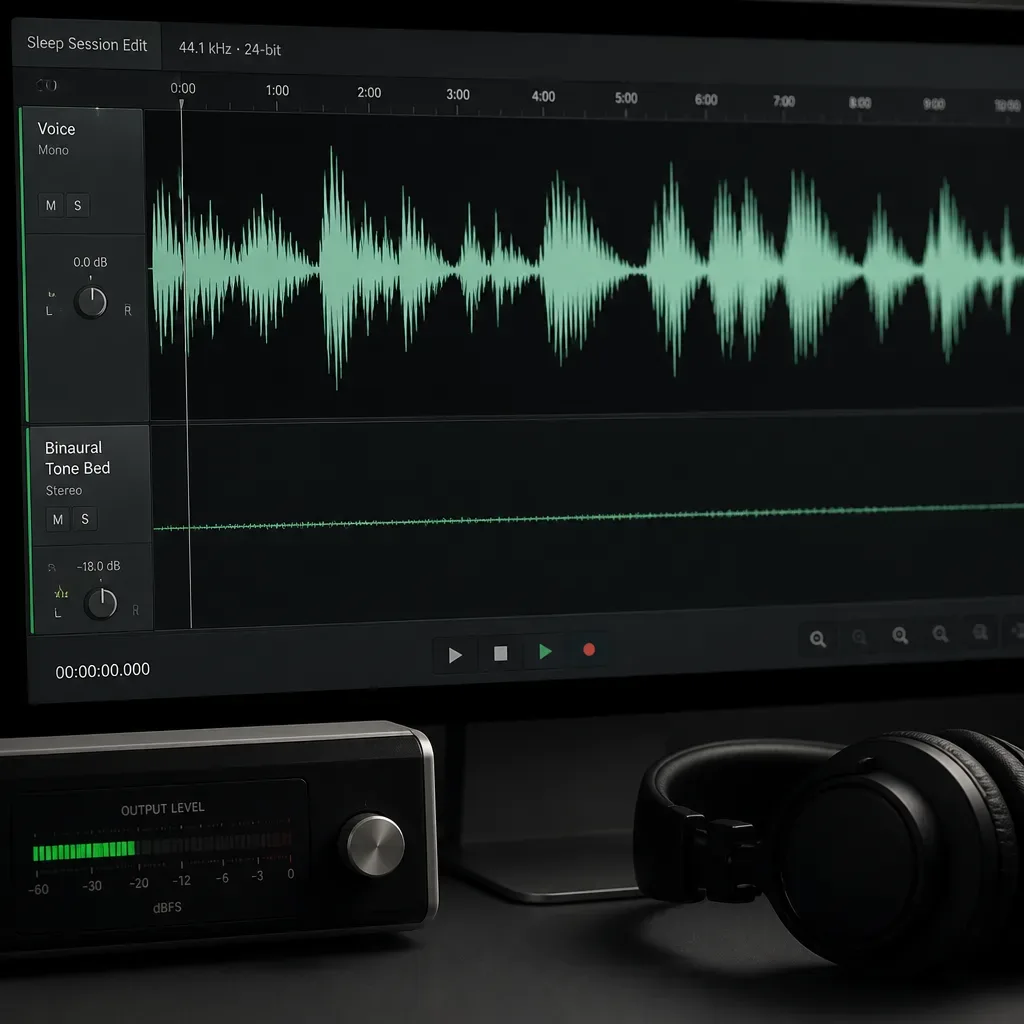
Set the spoken voice first, then bring the beat up only until it is barely present beneath pauses.
In audio work, masking is not a metaphor. It is a measurable problem. When two signals occupy nearby frequency ranges, the louder one can hide the quieter one. Speech intelligibility depends heavily on consonants between roughly 2 kHz and 6 kHz, while warmth and body sit lower, often around 150 Hz to 500 Hz. A pure carrier tone in the wrong place can make a voice feel thinner or more tiring, even when it seems quiet.
Use this order:
- Put on headphones at the volume you’d actually use tonight.
- Play the Dream-Self recording alone and set the voice to clear, not loud.
- Start the binaural beat muted.
- Raise the beat until you notice it in the pauses.
- Lower it by a small step, usually 10 to 15 dB below the voice.
- Listen for 2 minutes without touching anything.
- If any word blurs, lower the beat again.
That 2-minute wait matters. The auditory system adapts quickly, and a layer that seems too quiet in the first 10 seconds can feel obvious by minute 3. In app production, I often test sleep beds in loops of at least 10 minutes because short previews hide fatigue. A beat that survives the first minute can still become the only thing you hear by minute 8.
If your spoken audio has music already printed under it, be careful. Stacking a binaural beat under a music bed can produce beating, roughness, or pitch conflict. In that case, choose either the music bed or the binaural bed, not both. You can also use a non-tonal masker such as the White noise generator + guide if your room has traffic, hallway speech, or HVAC clicks.
A manifestation track should feel close, plain, and easy to return to. If the beat makes the voice feel farther away, the mix has failed.
Where does the AYA Method fit in the stack?
Use the AYA Method as the main spoken layer, with binaural beats only as optional support beneath it.
The AYA Method is a daily audio manifestation practice. Each day you listen to a short personalized recording, your Dream-Self Moment, narrated from the version of you who has already manifested the life you intend. Listening is the practice. Repetition is the work. The audio is the method.
That definition is useful because it keeps the stack honest. You don’t need five pillars, seven tools, or a complicated board beside the bed. If you’re using binaural beats, their job is to make it easier to hear the Dream-Self Moment and repeat it tomorrow. They are not a second practice competing for attention.
There is some psychological support for repetition and future-self rehearsal, though not as proof of manifestation claims. Peter Gollwitzer’s work on implementation intentions, widely cited since 1999, showed that specific if-then plans improve follow-through across many behavior studies. Gabriele Oettingen’s research on mental contrasting, summarized in her 2014 book Rethinking Positive Thinking, suggests that future imagery works better when paired with present constraints. A Dream-Self recording can act as a daily cue: not a guarantee, but a repeated instruction to attention and behavior.
Here is a simple 12-minute stack:
- Minute 0 to 1: Put on headphones, set the room, check that the volume is low.
- Minute 1 to 3: Start a 6 to 10 Hz binaural beat and breathe normally.
- Minute 3 to 9: Play the Dream-Self Moment over the beat.
- Minute 9 to 11: Let the final lines land without adjusting the mix.
- Minute 11 to 12: Remove headphones before sleep if they press or heat the ears.
If you use frequency-based music too, keep the categories separate. The Solfeggio frequencies guide explains the tradition around tones such as 396 Hz, 528 Hz, and 963 Hz, while also stating the evidence plainly. Tradition can be meaningful without being overstated.
How should you test whether the layer helps?
Test one binaural setup for 7 nights before changing the frequency, volume, or track order.
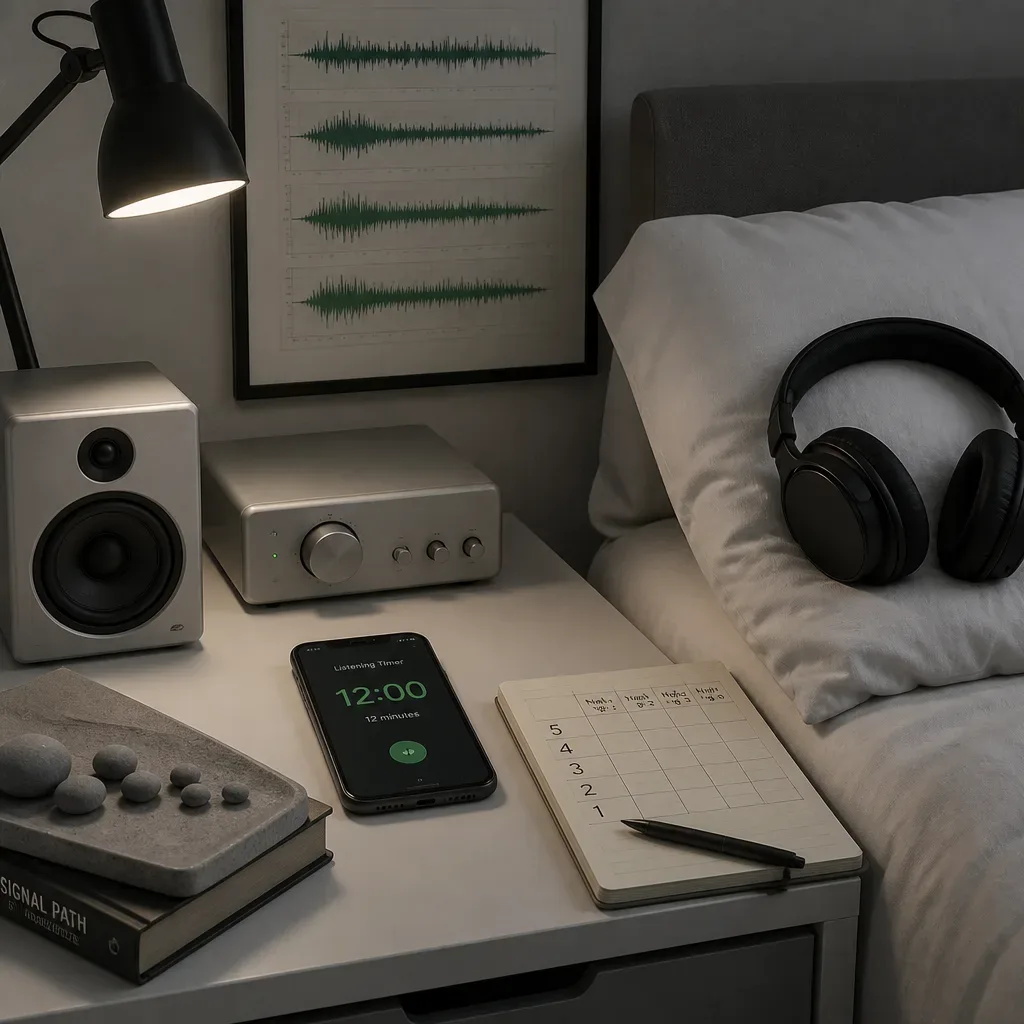
The biggest error I see in sleep and manifestation audio is changing too many variables at once. One night you use 6 Hz, the next you use 10 Hz, then rain, then 528 Hz music, then no headphones. By the end of the week you have impressions, not data. A simple 7-night protocol gives you enough repetition to notice patterns without turning the ritual into lab work.
Track only four things, each scored from 1 to 5:
| Measure | 1 means | 5 means |
|---|---|---|
| Voice clarity | Words blurred or masked | Every line easy to hear |
| Settling | Restless throughout | Body settled within minutes |
| Irritation | Tone became annoying | Beat disappeared into the background |
| Completion | Stopped early | Finished without effort |
Seven nights is not a clinical trial, but it is better than one strong opinion. In behavioral research, adherence often matters more than the elegance of the tool. A routine that you repeat 25 nights in a month has more practical value than a technically perfect mix you abandon after night 2.
Keep a note beside the bed or use a plain phone note, but don’t write paragraphs. Four numbers and one sentence are enough. Example: voice 5, settling 4, irritation 2, completion 5; carrier felt too high after the second listen. That tells you exactly what to adjust. Lower the carrier, lower the level, or choose a noise bed instead.
If you’re testing masking rather than beats, compare one week of binaural audio with one week of pink or brown noise. The White noise generator + guide can help you hear how different noise colors cover speech and room tone. Brown noise has more low-frequency weight; white noise has more high-frequency hiss. Some nervous systems prefer one immediately.
A useful sound layer is boring by design. It earns its place by making the practice easier to repeat.
What safety and listening rules matter before sleep?
Keep the volume low, keep sessions short, and don’t use headphones in a way that disturbs sleep or safety.
Binaural beats require different signals in each ear, so headphones are part of the mechanism. That creates practical limits. Over-ear headphones can trap heat. In-ear buds can create pressure. Wired headphones can tangle. Sleep headbands can shift and unbalance the stereo image. If the hardware distracts you, the method is already losing.
For most listeners, I’d keep pre-sleep binaural sessions between 6 and 12 minutes. Remove the headphones when the spoken track ends unless your setup is specifically comfortable for sleep. If you need all-night masking, use speakers at low level with broadband sound instead. True binaural effect is less important than safe, steady sleep.
Volume guidance should be conservative. The World Health Organization’s 2018 environmental noise guidance treats nighttime sound as a health concern when levels are high or disruptive. For personal audio, exact ear-level measurement is hard without proper equipment, so use a simple rule: if someone speaking softly beside you would be hard to hear after you remove the headphones, your session was likely too loud.
Don’t use binaural beats while driving, cycling, cooking with sharp tools, or doing any task where reduced alertness is risky. If you have epilepsy, sound-triggered migraines, significant tinnitus, sleep apnea, or chronic insomnia, speak with a qualified clinician before making nightly beat sessions part of your routine. Sound can support rest, but it should not replace medical care.
For children, be even more cautious. Lower volume, shorter sessions, and open-air speakers are usually safer than headphones. A child’s sleep sound should be simple, stable, and easy for an adult to monitor.
The quietest layer that works is usually the most respectful one.
What should you play tonight?
Tonight, play one spoken Dream-Self track with one low binaural beat, and change nothing else.
Here is the plain setup I’d use if I were mixing for a listener I’ll never meet: a calm voice in the center, no bright reverb, a 6 Hz binaural difference using low carriers, and a beat layer tucked 10 to 15 dB below the voice. Total time: about 10 minutes. Fade in over 8 to 12 seconds. Fade out longer, around 20 seconds, so the room doesn’t snap back.
If you don’t have a beat layer yet, start with the Binaural beats generator + guide and choose a gentle alpha or theta setting. If you dislike tones, use the Solfeggio frequencies guide to understand tone-based traditions, then decide whether music or a simple noise bed suits you better. If your room is the problem, not your attention, a masker from the White noise generator + guide may help more than any beat.
Use this final checklist before pressing play:
- The voice is clear at a low level.
- The beat is quieter than you think it should be.
- The session is under 12 minutes.
- Headphones feel comfortable now, not just tolerable.
- You know what you’ll score in the morning.
Manifestation audio benefits from repeatability. Binaural beats can support that repeatability when they reduce friction, hold a steady background, and leave the words alone. They become a problem when they ask to be interpreted. Your attention has a limited channel width; spend most of it on the recording that carries the meaning.
Low enough to forget, steady enough to return.