noise colors
Brown Noise vs Green Noise for Clear Dream-Self Voice
Brown noise vs green noise for keeping a spoken Dream-Self recording audible, calm, and steady without masking the voice you need to hear.
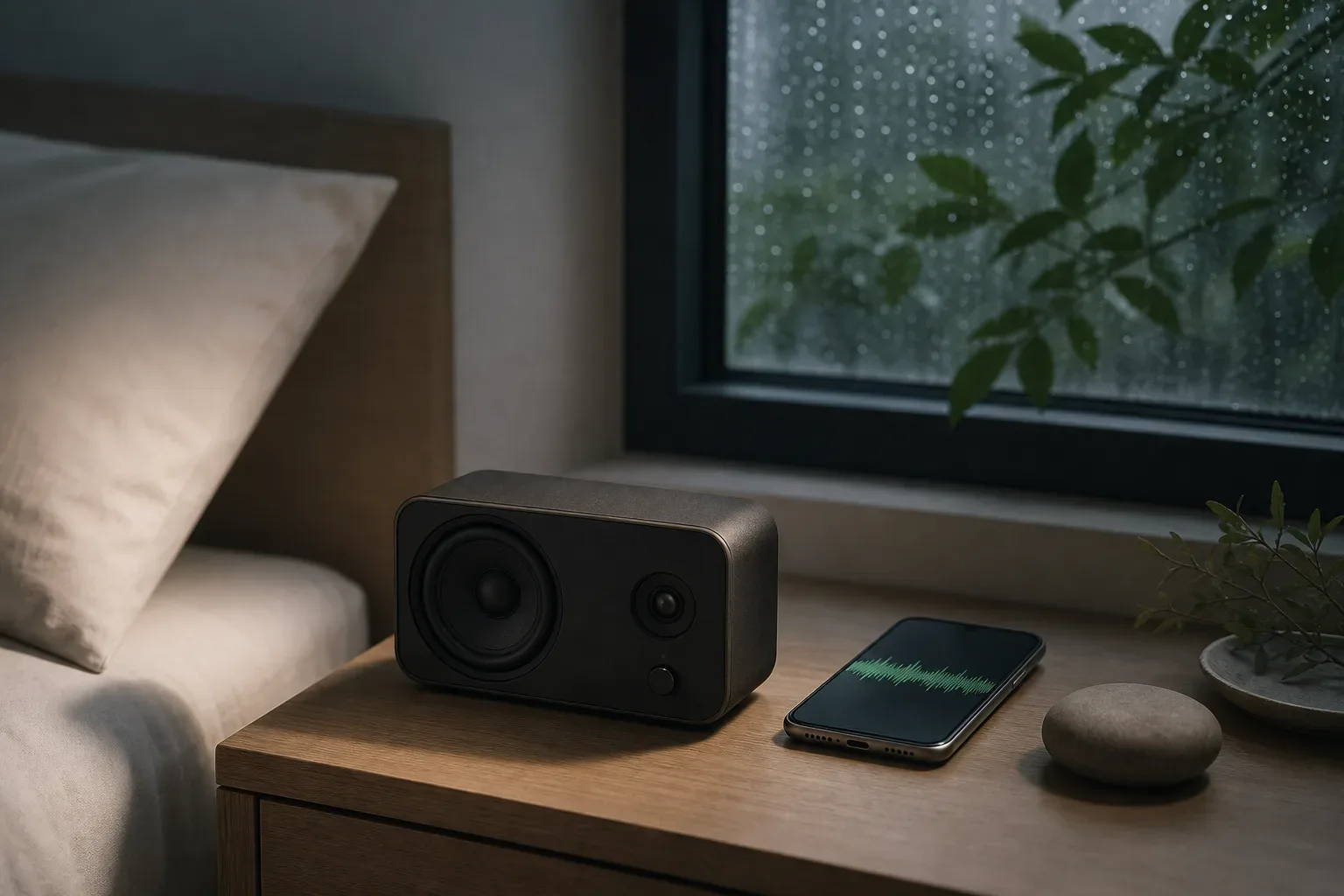
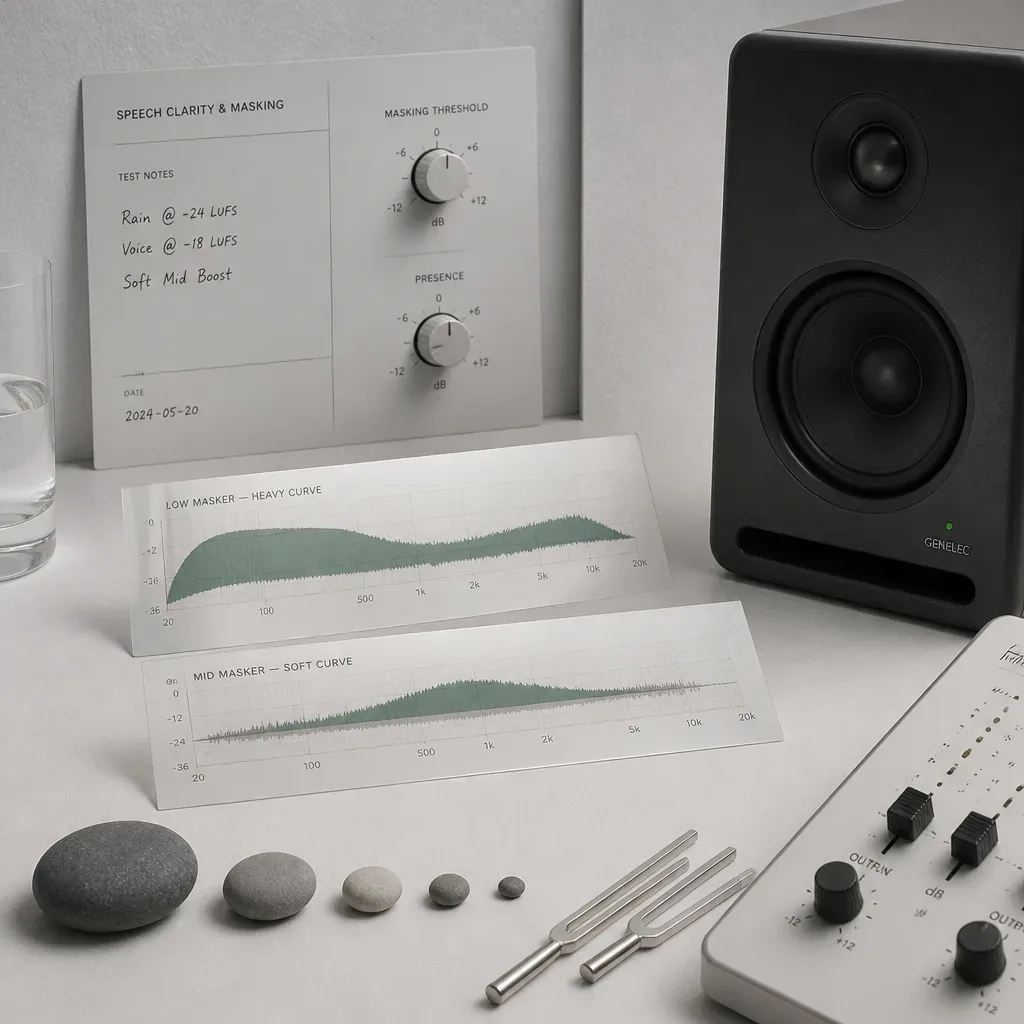
Brown noise vs green noise comes down to masking strength versus voice clarity. Brown noise gives a deeper, heavier low-frequency cover, while green noise sounds softer and more mid-focused. For a Dream-Self voice, green noise usually keeps speech clearer; brown noise is better when the room itself is low, loud, or uneven.
What is the real difference between brown noise and green noise?
Brown noise is a low-heavy noise curve, while green noise is a softer band of noise often shaped around the middle of the hearing range.
Brown noise, also called Brownian or red noise, drops by about 6 dB per octave as frequency rises. That means the low end carries much more acoustic energy than the top. You hear it as a deep hum, not a hiss. It can feel close to distant surf, an aircraft cabin, or wind pressing against a building. The name comes from Brownian motion, not the color brown itself.
Green noise is less formally standardized. In apps and generators, it usually means noise with emphasis around the middle frequencies, often near 500 Hz to 2,000 Hz, with less extreme bass than brown noise and less high hiss than white noise. That range overlaps with leaves, rain at a distance, and soft outdoor air. Because there is no single engineering standard for green noise, one generator may sound more natural than another.
A quick comparison helps:
| Feature | Brown noise | Green noise |
|---|---|---|
| Main impression | Deep, low, heavy | Natural, soft, leafy |
| Frequency tilt | About -6 dB per octave | Usually mid-shaped, varies by source |
| Best masking target | Rumble, traffic, bassy neighbors | Light voices, small clicks, room texture |
| Speech risk | Can blur warmth and low consonant cues | Usually preserves speech more easily |
| Starting level | Very low, then raise slowly | Low to moderate, below the voice |
The difference is not spiritual or symbolic. It is spectral. A sound that carries more low-frequency acoustic energy will cover other low-frequency sounds more efficiently. A sound that sits nearer the middle can mask small details without swallowing the whole body of a voice.
The best background noise is not the one you notice most. It is the one the room stops arguing with.
If you want to hear the contrast directly, use the White noise generator + guide as a reference point. White noise is flatter and brighter than both. Then compare it with brown and green curves if your playback tool allows filtering. Your ears will understand the chart before your eyes do.
Which noise keeps a Dream-Self voice clearer?
Green noise usually keeps a spoken Dream-Self voice clearer because it masks the room without filling as much of the voice’s low body.
Speech intelligibility depends on more than volume. Adult speech commonly spans roughly 85 Hz to 255 Hz for fundamental pitch, with important consonant information higher up, often from 2 kHz to 8 kHz. A recording can be loud enough and still feel unclear if its consonants are covered or its warmth is thickened. Brown noise can do both when it is played too high.
The AYA context matters here. The AYA Method is a daily audio manifestation practice. Each day you listen to a short personalized recording, your Dream-Self Moment, narrated from the version of you who has already manifested the life you intend. Listening is the practice. Repetition is the work. The audio is the method. If the voice is the method, the background should behave like furniture, not another speaker in the room.
In practice, green noise tends to be the better first layer because it can soften environmental edges without making the narration feel buried. I usually set the voice first, then bring the noise up from silence until the room feels less sharp. If I can no longer understand every word without effort, the noise is too loud.
Use this order tonight:
- Play the Dream-Self voice alone at a comfortable level.
- Add green noise very quietly, then raise it until the room softens.
- If outside rumble remains, test brown noise at a lower level than green.
- Keep the voice at least 10 dB louder than the noise when possible.
- Stop adjusting once the words are plain.
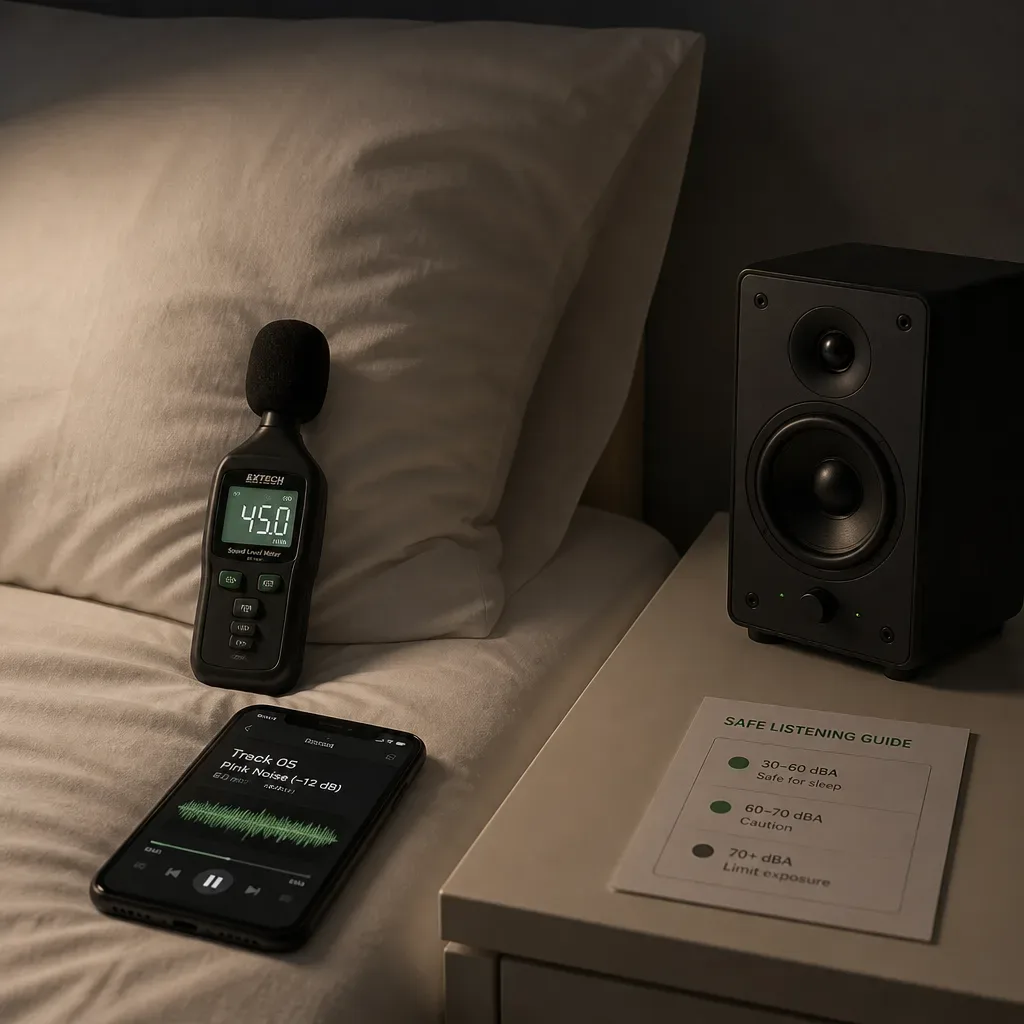
The National Institute for Occupational Safety and Health uses 85 dBA over 8 hours as an occupational exposure limit, but sleep listening should sit far below that. Many bedrooms rest between 30 and 45 dB when quiet. For all-night use, lower is kinder. A clear voice at low volume is better than a dramatic mix at a high one.
When is brown noise the better choice?
Brown noise is better when the main disturbance is low-frequency sound, especially traffic, building systems, or bass from another room.
Low frequencies travel through walls more easily than higher frequencies. That is why a truck can wake you before you hear its engine detail, and why apartment bass can feel present even when the song is not recognizable. Brown noise can cover some of that because it lives in the same general region. It does not cancel the sound. It masks it by giving your auditory system a steadier low bed.
A 2021 review in Sleep Medicine Reviews noted that environmental noise is associated with measurable sleep disturbance, though individual sensitivity varies widely. The practical lesson is plain: irregular noise is usually harder to sleep beside than steady noise at a similar level. Brown noise can make an uneven room feel more continuous.
Brown noise may also suit listeners who find high hiss irritating. White noise contains equal acoustic energy per hertz and often feels bright. Pink noise reduces that brightness by dropping around 3 dB per octave. Brown noise goes further, dropping around 6 dB per octave. Each step down the slope feels less sharp, though also less airy.
Use brown noise when:
- The room has low traffic rumble below the window line.
- A refrigerator, boiler, or ventilation system pulses at night.
- White or pink noise feels too sharp after 5 minutes.
- You are not trying to hear a quiet spoken track at the same time.
- You can keep it low and still get relief.
Brown noise has a cost. It can make a narrator sound as if they are speaking through fabric. If your Dream-Self voice contains soft consonants, breathy delivery, or a low speaking register, brown noise may sit too close. The fix is not to raise everything. The fix is to subtract.
Clarity is often made by removing sound, not adding more of it.
When is green noise the better choice?
Green noise is better when you want a natural-sounding mask that still leaves room for speech, music, or a quiet guided track.
Because green noise is usually built around a less extreme curve, it often feels less dominant than brown noise. Many people describe it as close to leaves, distant rain, or a calm outdoor bed. Those are not exact measurements, but they are useful listening notes. The sound tends to sit around you rather than under you.
For spoken audio, this matters. Human hearing is especially sensitive in the midrange. The ear canal naturally amplifies roughly 2 kHz to 5 kHz, a range that helps us detect speech. If a background sound overfills that area, words become tiring. Good green noise should soften the room without crowding the consonants.
There is not yet a large clinical literature on green noise as its own category. Most research groups study white noise, pink noise, music, or broader environmental sound. In small sleep studies, steady sound sometimes improves sleep onset or perceived sleep quality, but results vary. That means green noise should be treated as a tool to test, not a guarantee.
You can make the test simple:
| Listening question | If yes | Adjustment |
|---|---|---|
| Do I understand every word easily? | Keep level | Do nothing |
| Do consonants feel soft or smeared? | Noise too high | Lower noise 2 to 3 dB |
| Does the room still feel jumpy? | Masking too low | Raise noise 1 to 2 dB |
| Does the voice feel far away? | Bed too thick | Reduce low mids |
Green noise is also gentler under sleep music. As a composer, I keep many sleep pieces under a resting heartbeat, often around 50 to 65 beats per minute, and avoid bright attacks. A soft green bed can hide tiny room changes without making the music seem larger than it is. Sleep music should be allowed to be boring on purpose.
For other tonal options, the Binaural beats generator + guide is worth comparing. Binaural beats create a perceived beat from two slightly different tones, while green noise is broadband masking. One asks the brain to follow a pulse. The other asks the room to become less noticeable.
How should you mix noise under a spoken recording?
Set the voice first, then add the noise only until distractions soften, because the spoken track must remain the foreground.
The common mistake is treating background sound as a second feature. It isn’t. If you are listening to a Dream-Self Moment, the background is there to protect the voice from interruption. It should not compete for attention. A good mix sounds almost underwhelming for the first 30 seconds.
Start with the playback device. Phone speakers lose bass and can make brown noise sound papery. Small Bluetooth speakers often exaggerate the low-mid range around 150 Hz to 300 Hz. Headphones reveal detail but raise safety concerns if used for long sessions. If you sleep with earbuds, use a timer and keep volume lower than you think you need.
The World Health Organization’s Night Noise Guidelines for Europe identified 40 dB Lnight outside as a health-based target for protecting sleep, with 55 dB as an interim target where lower levels are not yet feasible. Your pillow measurement will differ from an outdoor average, but the principle is useful: quiet is not weakness. Quiet is the point.
Try this plain mixing rule:
- Put the voice at the lowest level where every word is easy.
- Add green noise until sharp room details lose their edge.
- Switch to brown noise only if low rumble remains.
- If the voice loses intimacy, lower the noise rather than raising the voice.
- Use a 20 to 45 minute timer if you do not need all-night masking.
The foreground should carry meaning. The background should carry weather.
If you also use frequency-based sound, keep it separate at first. The Solfeggio frequencies guide explains the tradition around tones such as 396 Hz, 528 Hz, and 852 Hz while keeping the evidence plain. A tone can be pleasant and still not belong under speech. Test one variable at a time.
What does the evidence say about noise, sleep, and attention?
The evidence supports steady sound as a masking tool for some people, but it does not prove that any color works for everyone.
Noise affects sleep through arousal. A sudden sound can trigger a micro-awakening even when you do not remember it. The sleeping brain keeps monitoring the environment. In a 2012 paper in Annals of Internal Medicine, hospital noise was linked with sleep disruption in healthy volunteers, including changes in cardiovascular activation. The study was small, but the mechanism is familiar to anyone who has slept near an elevator.
Steady sound can help by reducing contrast. If the room is silent and one door clicks, the click is large. If the room has a low, steady bed, the click is smaller relative to the background. This is masking, not magic. It changes the signal-to-noise relationship at the ear.
Research on colored noise is uneven. Pink noise has received more attention than brown or green noise. A 2017 study in Frontiers in Human Neuroscience reported that acoustic stimulation synchronized to slow-wave sleep improved memory consolidation in older adults, but that was timed pink-noise stimulation, not a simple app loop. White noise studies in infants and adults show mixed results, and pediatric use needs special care because children’s ears and sleep needs differ.
For manifestation audio, the relevant evidence is more behavioral than mystical. Repetition strengthens familiarity. Attention improves when the signal is clear. A consistent nightly cue can become part of a habit loop, a framework described in behavior research by Wendy Wood and others. The noise helps if it makes the daily listening easier to repeat.
Here is the quiet hierarchy I trust:
- First, protect hearing.
- Second, protect speech clarity.
- Third, mask the room.
- Fourth, choose the color you personally tolerate for 10 minutes or more.
A sound practice fails when it asks your nervous system to admire the equipment.
If tinnitus, sleep apnea, chronic insomnia, or distressing nighttime anxiety is present, speak with a qualified clinician. Background noise can support rest, but it should not be used to avoid care when symptoms are persistent.
Which one should you choose tonight?
Choose green noise first for Dream-Self voice clarity, then use brown noise only when low-frequency disturbance still breaks through.
The fastest test takes 6 minutes. Play your spoken recording with no background for 1 minute. Add green noise for 2 minutes. Then switch to brown noise for 2 minutes at the same perceived loudness. Return to green noise for the final minute. Do not judge which feels richer. Judge which lets you understand the voice with less effort.
If both work, choose the quieter one. If green noise leaves traffic exposed, use brown noise but lower it until consonants return. If brown noise feels comforting but the voice becomes woolly, use brown noise before the spoken track, then fade it down when the voice begins. A simple crossfade can preserve the low settle without stealing the words.
You can also combine tools, but keep the chain sparse. A steady green bed plus a spoken track is already enough for most rooms. Adding rain, music, binaural beats, and a tone can create a crowded mix. More layers do not mean more rest. They often mean less room for the thing you meant to hear.
For reference, compare these use cases:
| Tonight’s condition | Better first choice | Why |
|---|---|---|
| Quiet room, spoken Dream-Self voice | Green noise | Leaves speech open |
| Traffic rumble or bass through walls | Brown noise | Masks lower frequencies |
| Sharp household clicks | Green noise | Softens edges without heaviness |
| Bright white noise feels irritating | Brown or green | Both reduce hiss |
| Sleep music with no speech | Either | Choose by comfort |
A conservative volume plan is simple: the spoken voice should be comfortable, the noise should be lower, and the whole mix should feel easy after 10 minutes. If you need to raise the level several times, the sound may be solving the wrong problem. A fan, window seal, timer, or different speaker placement may do more than another decibel.
Press play, lower the room, and leave the voice enough air.