noise colors
Grey Noise Sleep: Keep Dream-Self Audio Clear
Grey noise sleep can mask room sounds without burying spoken audio. Learn when to use it, volume limits, and how to keep Dream-Self audio clear.
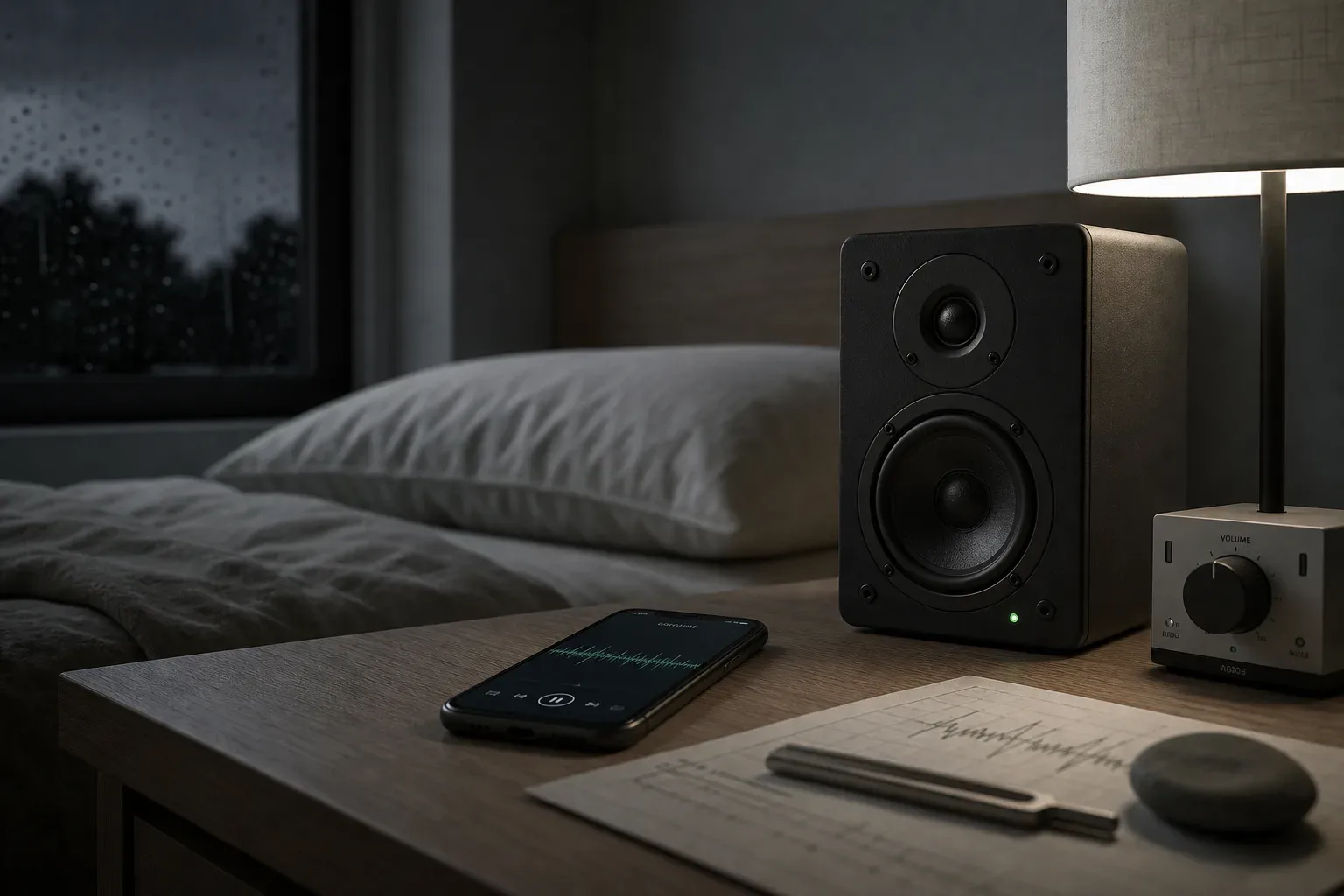
Grey noise sleep means using a perceptually balanced noise signal at night so the room sounds steadier without making spoken audio hard to understand. It sits between technical masking and comfort listening: enough sound to soften interruptions, not so much that your Dream-Self recording loses words, timing, or intimacy.
What is grey noise, and why does it sound different at bedtime?
Grey noise is broadband noise shaped so the human ear hears it as more even than raw white noise.
White noise contains equal acoustic power per hertz. Because human hearing is more sensitive in parts of the mid and high range, plain white noise can feel sharp, like air leaving a vent. Grey noise applies a filter based on equal-loudness contours, often linked to ISO 226 research, so the result tends to feel flatter to the listener rather than flatter on a measurement graph.
That distinction matters at night. A sleeping room is not a studio. It has HVAC hum, street tires, pipes, pets, refrigerators, and sometimes a phone speaker only 60 cm from your pillow. Grey noise aims to cover those small edges without calling attention to itself. The better sleep sound is often the one you stop noticing first.
There is no single universal grey-noise recipe. One generator may dip the midrange more than another. One speaker may add bass that was not in the file. If you compare grey noise with the White noise generator + guide, listen for perceived sharpness rather than volume alone. Two sounds can measure at the same decibel level and feel very different in the body.
A useful rule is plain: the sound should make the room less readable. You should hear fewer tiny events, not a new event called noise. If grey noise feels like a soft, steady sheet behind the room, it is doing its job.
Does grey noise sleep have evidence behind it?
The evidence for grey noise specifically is limited, but the broader evidence for steady sound masking during sleep is plausible and mixed.
Most sleep studies do not isolate grey noise as a named category. They study white noise, pink noise, music, traffic masking, or acoustic stimulation. A 2021 review in Sleep Medicine Reviews found that continuous noise interventions had inconsistent results, partly because studies used different sounds, volumes, participants, and outcome measures. That does not make grey noise useless. It means the claim should stay modest.
Small studies have found benefits from background sound in noisy settings. For example, clinical studies on white noise in hospital environments have reported improvements in sleep quality scores for some patients, often with sample sizes under 100. Hospitals are not bedrooms, and sleep-quality questionnaires are not the same as polysomnography. Still, the mechanism is reasonable: reduce the contrast between baseline quiet and sudden disturbance.
Sleep is sensitive to change. The brain can ignore a steady signal more easily than an unpredictable one. A door click at 35 dB may wake you from a nearly silent room, while the same click under a 32 dB noise bed may pass without notice. Masking is not magic; it is contrast management.
For manifestation audio, the evidence question changes slightly. You are not asking grey noise to cause sleep. You are asking it to keep the room steady while the voice remains clear. In that use, the measurement is simple: can you understand every word without strain at your chosen level?
How do you keep Dream-Self audio clear over grey noise?
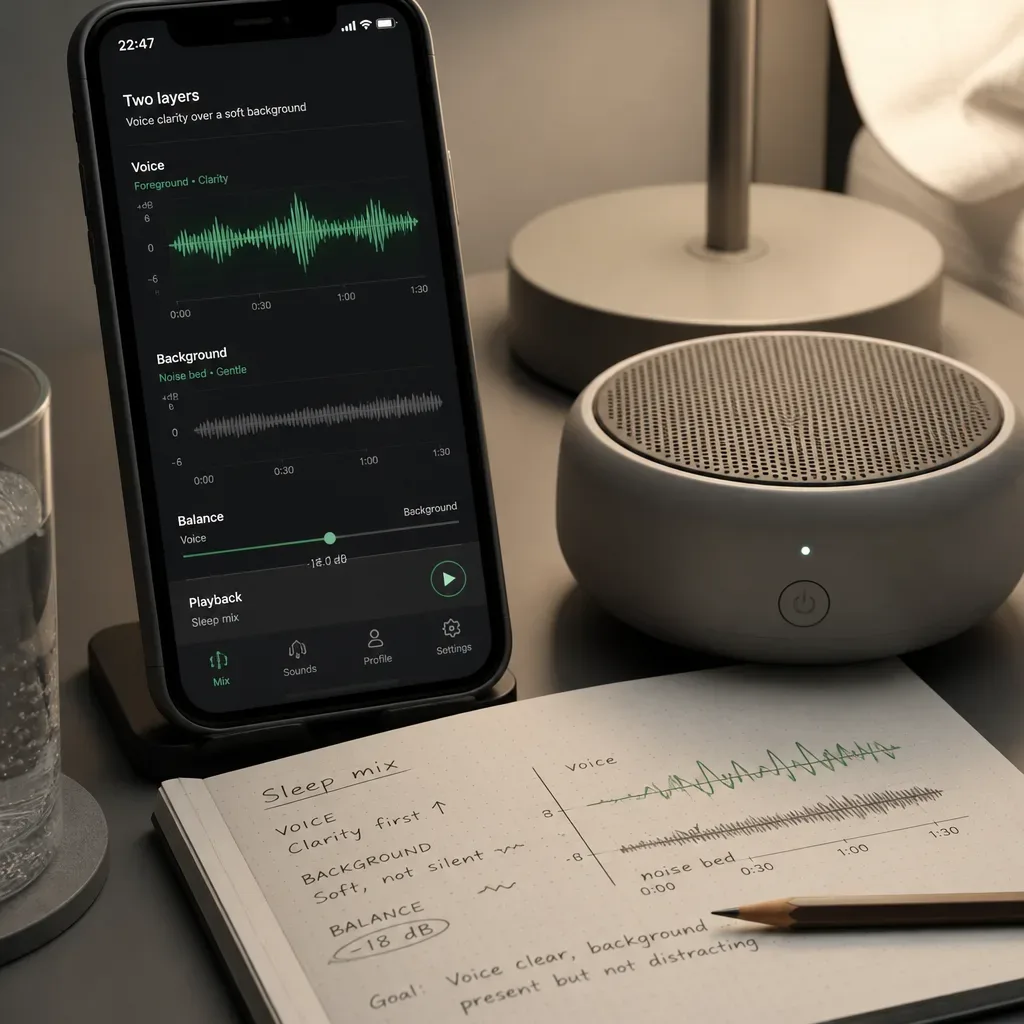
Keep the spoken track in front, then raise grey noise only until the room stops interrupting it.
The AYA practice is voice-led, so intelligibility is the priority. The AYA Method is a daily audio manifestation practice: each day you listen to a short personalized recording, your Dream-Self Moment, narrated from the version of you who has already manifested the life you intend. Listening is the practice. Repetition is the work. The audio is the method.
Spoken-word clarity lives mostly in the midrange, especially around 1 kHz to 4 kHz for consonants. If grey noise is too loud in that band, words lose their edges. You may still hear a pleasant voice, but the message becomes soft clay. For Dream-Self audio, that is too much masking.
Use this quick setup before sleep:
- Start the Dream-Self audio alone at a low, comfortable level.
- Add grey noise at zero and raise it slowly over 10 to 20 seconds.
- Stop the moment hallway, traffic, or HVAC detail feels less separate.
- Repeat one sentence of the voice in your head. If you miss consonants, lower the noise.
- Set a timer if continuous sound tends to wake you later in the night.
A 3 dB change is small but audible for many listeners. A 10 dB change is commonly heard as roughly twice as loud, though perception varies. Make adjustments in small steps. If your phone volume has 16 clicks, one click can be enough.
The noise is not the message. The noise is the margin around the message.
What volume is safe for grey noise at night?
Use the lowest volume that masks the disturbance, and treat long nighttime listening more conservatively than daytime listening.
The World Health Organization has discussed night noise guidelines around 40 dB outside bedrooms to protect sleep, with higher levels linked to more disturbance over time. That number is not a perfect target for a speaker beside your bed, but it gives useful humility. Sleep sound should not become the loudest thing in the room.
Phone sound-meter apps are approximate. Microphones differ, cases block ports, and low frequencies are hard to measure accurately. Still, an app can tell you whether you are closer to 30 dB or 60 dB. In practice, many people do well with a level below quiet conversation, which is often cited around 50 to 60 dB at 1 meter.
For children, be stricter. The American Academy of Pediatrics has warned that infant sleep machines can reach levels that may be unsafe when placed close to a crib. Put any speaker at a distance, keep it low, and avoid playing sound all night at high output. Small ears deserve large margins.
Here is a conservative reference table:
| Situation | Starting level | Placement | Check |
|---|---|---|---|
| Adult bedroom, mild street noise | Low 30s dB if measured nearby | 1 to 2 m from pillow | Voice still clear |
| Shared room with partner movement | Lowest audible bed | Away from both ears | No hiss irritation |
| Child bedroom | Quieter than adult level | Across the room | No overnight blasting |
| Dream-Self audio underlay | Below spoken voice | Same device or separate speaker | Every word understood |
If you have tinnitus, ear pain, sound sensitivity, chronic insomnia, or suspected sleep apnea, speak with a qualified clinician. A steady sound can support comfort, but it should not replace care.
When is grey noise better than white, pink, or brown noise?
Grey noise is better when white noise feels sharp, brown noise feels too thick, and you still need speech to stay readable.
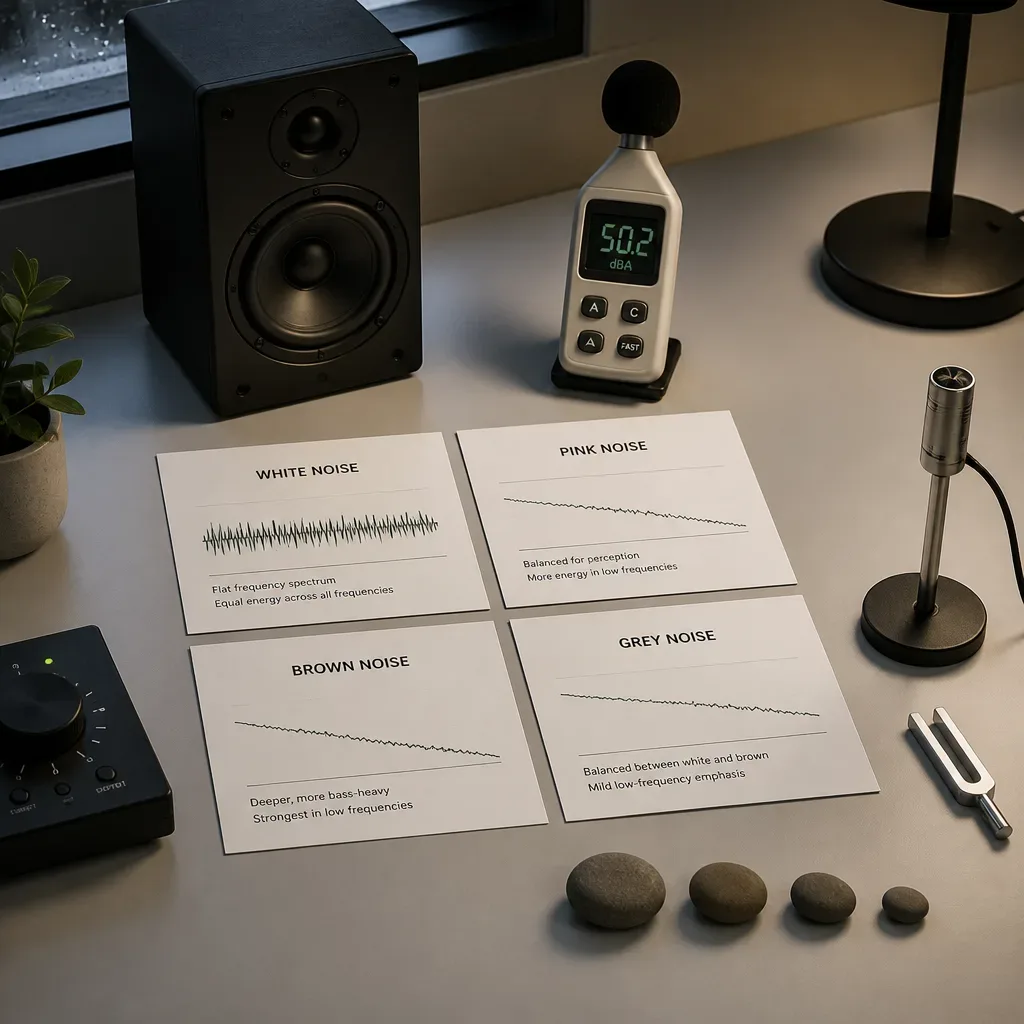
Noise colors are names for spectral shapes. They are not medical categories. White is equal per hertz. Pink reduces power as frequency rises, often sounding softer. Brown drops more steeply, giving a low, heavy hum. Grey is shaped for perceived evenness, which can make it useful when you need masking without obvious bass weight.
Compare them by function, not by folklore:
| Sound | Common feel | Useful for | Watch for |
|---|---|---|---|
| White noise | Bright, hiss-like | Sharp environmental detail | Can irritate sensitive ears |
| Pink noise | Softer, rain-like | General sleep masking | May still blur speech |
| Brown noise | Low, thick hum | Low rumble, some nervous systems | Can muddy small speakers |
| Grey noise | Even, measured | Masking while keeping voice present | Depends strongly on generator |
If you want to hear the difference directly, press play in the White noise generator + guide and then compare it with grey noise at the same phone volume. Do not judge in the first 5 seconds. Give each sound 60 seconds, because the sleeping ear cares about fatigue as much as first impression.
Binaural beats are a different tool. A binaural beat is an auditory illusion created when each ear receives a slightly different tone, such as 200 Hz in one ear and 206 Hz in the other. You can read the mechanism in the Binaural beats generator + guide. Grey noise masks; binaural beats pulse. They should not be confused.
Solfeggio frequencies are different again. They come from a modern spiritual sound tradition that assigns meaning to tones such as 396 Hz, 528 Hz, and 852 Hz. The Solfeggio frequencies guide explains the tradition respectfully and separates it from clinical evidence. You can like 528 Hz without pretending a lab has proved every claim attached to it.
Can grey noise make sleep worse?
Yes, grey noise can make sleep worse if it is too loud, too close, too bright on your speaker, or used when silence would be better.
Some brains treat any added sound as a task. They monitor it. They compare it. They wait for loops, artifacts, or tiny shifts in compression. As a composer, I think of this as failed disappearance. Sleep music and sleep noise share the same ethical demand: they must ask for almost nothing.
There are also practical problems. Phone speakers can distort low frequencies. Bluetooth speakers can add startup tones or battery alerts. Some apps loop with a click every few minutes. A 2012 study on environmental noise and sleep in Noise and Health noted that intermittent sounds are often more disturbing than steady ones, even when average decibels are similar. The edge wakes the body.
Watch for these signs that grey noise is wrong tonight:
- You keep checking whether it is still playing.
- Spoken audio becomes soft or cloudy.
- Your ears feel tired after 10 minutes.
- You wake around the same time and notice the sound first.
- Your partner sleeps worse with it on.
If that happens, reduce the level, move the speaker farther away, try pink or brown noise, or return to silence. A tool earns its place by being useful tonight, not by belonging to a category.
What is a simple grey noise sleep routine for tonight?
Use grey noise as the room layer, then let the voice or sleep track carry the attention for a short, repeatable routine.
Keep the routine short enough to survive ordinary tiredness. Ten minutes is more useful than a perfect 45-minute system you abandon after two nights. Behavioral sleep guidance often emphasizes consistency because the nervous system learns cues through repetition. The National Sleep Foundation commonly recommends regular timing, a cooler room, and reduced stimulation before bed; sound can be one cue among those, not the whole structure.
Try this 12-minute version:
- Put the speaker 1 to 2 meters from your pillow, not beside your ear.
- Set grey noise very low and listen for 60 seconds.
- Start your Dream-Self audio or another spoken track.
- Lower grey noise until every consonant is clear.
- After the spoken track, either stop the noise or let it run on a timer for 20 to 45 minutes.
If you prefer music after the voice, choose slow, uneventful pieces. For sleep composition, I keep tempo under a resting heartbeat, often below 60 beats per minute, and avoid harmonic turns that ask the ear to follow. The best bedtime music is generous because it lets you leave in the middle.
You can also test combinations. Grey noise under voice may work well. Grey noise under binaural beats may become cluttered if headphones are required. Grey noise with a Solfeggio tone may be pleasant, but keep the tone low enough that it does not become the main event. Measure by the morning: did you fall asleep more easily, wake less often, or feel less annoyed?
One quiet metric is enough. If the room felt steadier and the words stayed clear, grey noise did its work.
The room can be held without being filled.