noise colors
Earplugs vs White Noise: Keep Audio Audible
Earplugs vs white noise compared for sleep, masking, and Dream-Self audio so you can lower disturbance without losing the voice you meant to hear tonight.
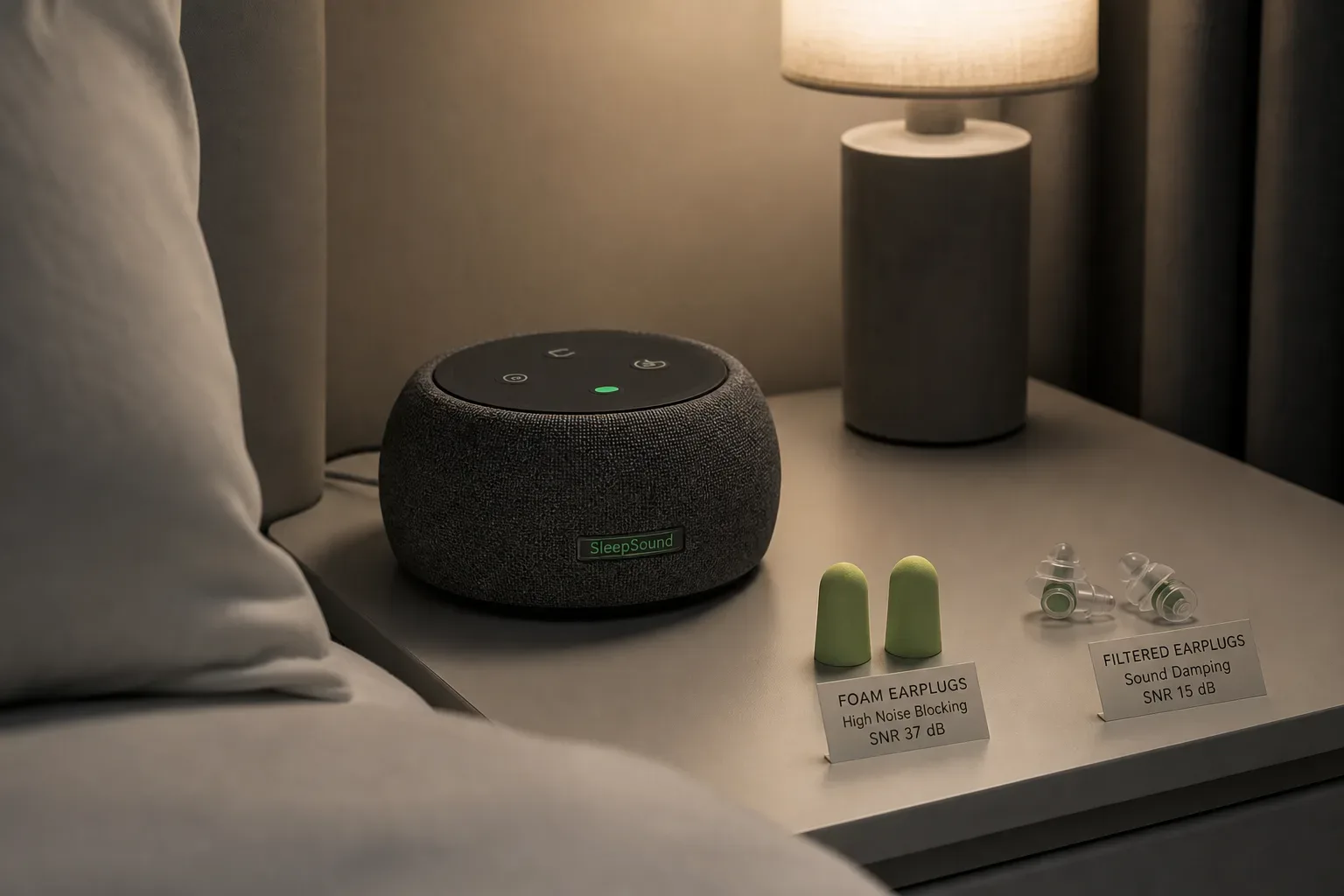
Earplugs vs white noise is a blocking-versus-masking choice: earplugs reduce all sound before it reaches your ear, while white noise adds a steady sound that covers irregular noise. If you need Dream-Self audio to stay audible, white noise or light filtered plugs usually work better than full isolation.
What is the real difference between earplugs and white noise?
Earplugs attenuate incoming sound; white noise raises the room’s acoustic floor so interruptions stand out less.
That distinction matters when you’re trying to hear speech. A foam earplug rated at Noise Reduction Rating 32 dB does not remove exactly 32 dB in ordinary sleep use, but it can still reduce a quiet spoken recording enough to blur consonants. NIOSH and OSHA both treat noise reduction ratings conservatively because real-world fit varies; a plug that looks excellent on the package often performs much lower in a tired hand at 11:30 p.m.
White noise works from the opposite direction. It does not block the neighbor’s door, the truck outside, or the radiator tick. It masks them by making the background more steady. True white noise has equal acoustic power per hertz, which is why it can sound bright or hissy. Many sleep machines labeled white noise are softened in the high frequencies because unfiltered white noise can feel sharp after 20 minutes.
For speech, masking needs care. Human speech carries much of its intelligibility between about 1 kHz and 4 kHz, with vowels lower and consonants higher. If your noise is too loud in that band, a Dream-Self recording can still play but lose its edges. A voice you can hear but not understand is not useful sleep audio.
Here is the practical split:
| Tool | Main action | Best for | Main risk |
|---|---|---|---|
| Foam earplugs | Blocks sound at the ear | Loud partners, travel, sudden room noise | Reduces desired audio too |
| Filtered earplugs | Reduces sound more evenly | Keeping some speech and alarms audible | Costs more, fit varies |
| White noise | Masks irregular sound | Apartments, traffic, light household noise | Can cover speech if too loud |
| Pink or brown noise | Masks with less high hiss | Low hums, soft sleep routines | May not cover sharp sounds as well |
A quiet room is not always a silent room; it is a room where the signal you chose remains the easiest thing to follow.
Which one keeps Dream-Self audio more audible?
White noise usually keeps Dream-Self audio more audible because it can sit under the voice instead of reducing the voice at the ear.
If you use the AYA Method, the distinction is central. The AYA Method is a daily audio manifestation practice. Each day you listen to a short personalized recording, your Dream-Self Moment, narrated from the version of you who has already manifested the life you intend. Listening is the practice. Repetition is the work. The audio is the method.
A spoken recording needs a signal-to-noise margin. In plain terms, the voice should be clearly above the masking sound. Audiology classrooms often teach that speech recognition becomes strained as background noise approaches speech level, and many speech-in-noise tests use signal-to-noise ratios in 2 dB to 10 dB steps because small level changes matter. At bedtime, a practical target is simple: the voice should sound at least a little closer than the noise, not buried inside it.
Earplugs reduce both the room and the chosen audio unless the audio comes through bone conduction or an in-ear device. With a bedside speaker, foam plugs can make a calm narration sound distant. You may turn the speaker up to compensate, which can disturb a partner or create the very stimulation you were trying to avoid. If the voice matters, do not solve noise by making the voice fight through foam.
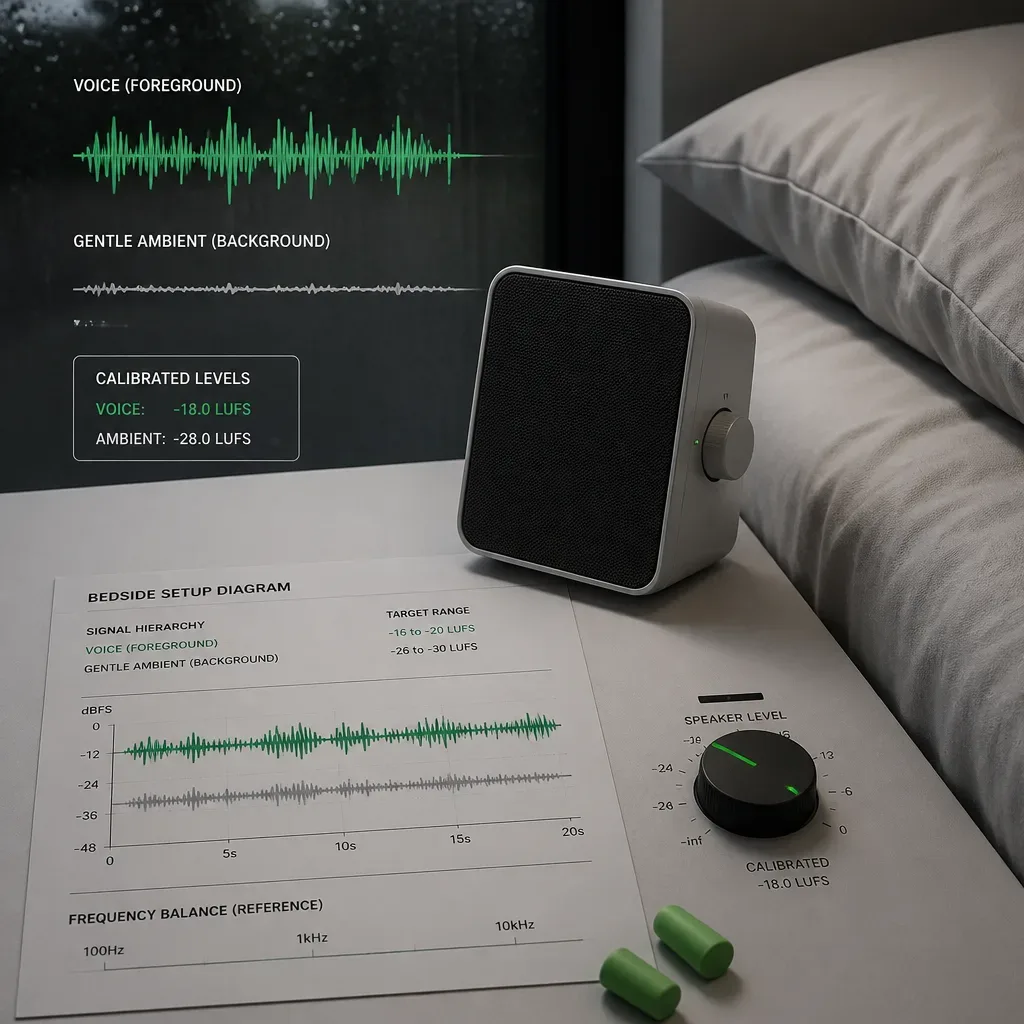
White noise lets you set two independent levels: the masking bed and the spoken audio. Press play on the White noise generator + guide, start low, then play your recording above it. If you can understand every word while lying on your side, the setting is probably workable. If consonants soften, lower the noise first before raising the voice.
Use this order tonight:
- Set the Dream-Self audio to a soft but clear level.
- Add white, pink, or brown noise underneath it.
- Lower the noise until speech stays crisp.
- Turn off any fan or machine that adds a competing pitch.
- Recheck from your pillow, not from your hand.
Speech is the foreground. Noise is the floor.
When are earplugs the better choice?
Earplugs are better when the room is too loud, too unpredictable, or shared with a sound source you cannot mask safely.
A snoring partner, a hotel hallway, or construction starting before 7 a.m. can exceed what a gentle noise bed can cover. Snoring often lands in the 50 to 70 dBA range at the listener’s side of the bed, with peaks higher in some measurements. Trying to cover that with a speaker can push the masking sound into a level that feels tiring and may bother someone else. Blocking at the ear is more efficient.
Earplugs also help when the noise is close to you. A white noise machine on your nightstand has to compete with the source after the source has already filled the room. A plug changes the last step in the chain, right at the ear canal. That is why a modest attenuation can feel more effective than a louder speaker in the corner.
Fit decides the result. Foam plugs need to be rolled down, inserted gently, and held while they expand. Many people skip the hold time, which is often 20 to 30 seconds. If the plug sits shallow, it attenuates less and may press against the outer ear when you turn on your side. Silicone putty can be more comfortable for some side sleepers because it seals the entrance rather than filling the canal.
There are tradeoffs. Earplugs can make internal sounds louder through occlusion: breathing, swallowing, jaw movement, and pulse. They can also reduce alarm audibility. If you rely on an alarm, test it while wearing the plugs before a workday. If you have tinnitus, chronic ear irritation, ear surgery history, or sudden hearing changes, ask an audiologist or clinician rather than treating the ear canal as a storage place for foam.
A useful compromise is a filtered sleep plug with lower attenuation. Some musician-style filters aim for flatter reduction, often around 9 dB, 15 dB, or 20 dB depending on the insert. They cost more than foam, but they preserve more tonal balance, which can make speech and alarms less muffled.
When is white noise the better choice?
White noise is better when the disturbance is moderate and you still want speech, alarms, or a partner’s voice to remain reachable.
Apartments are the classic case. Footsteps, plumbing ticks, elevator motors, and far traffic are often not dangerously loud; they are irregular. The sleeping brain is good at noticing change. A steady sound reduces contrast, so one stairwell door does not leap out of silence. In sleep research, arousals can occur without full awakening, and the American Academy of Sleep Medicine scoring manual treats brief EEG arousals in 3-second units because sleep can be disturbed in small slices.
The level should stay low. The World Health Organization’s 2009 night noise guidelines discussed 40 dB Lnight as a level below which adverse health effects are not expected for most people, while higher long-term outdoor night noise becomes more concerning. Your bedside reading is not the same as Lnight, and phone apps are not lab meters, but the number gives a sober reference. A common home target is roughly 35 to 45 dBA at the pillow.
White noise is not the only option. Pink noise reduces level by about 3 dB per octave, so it sounds less bright. Brown noise falls faster, about 6 dB per octave, and carries more low hum. If white noise feels hissy, try a lower color before raising volume. The spectrum matters more than the label on the button.
You can hear the difference with on-site tools. Start with the White noise generator + guide, then compare a lower sound such as brown noise if high hiss makes you alert. If tones interest you, keep them separate from masking: the Binaural beats generator + guide explains how two nearby tones can create a perceived beat, but it is not a substitute for covering a hallway door.
White noise is a measured compromise: enough sound to smooth the room, not enough sound to become the room.
How do you set levels so the voice stays clear?
Set the voice first, add masking second, and keep both quieter than your first instinct.
The ear adapts quickly. A level that seems barely audible at minute 1 can feel normal at minute 6. That is one reason sleep audio often gets turned up too high. Occupational hearing limits are much higher than sleep recommendations, but they give context: NIOSH recommends limiting exposure to 85 dBA over 8 hours, with allowed duration halving for each 3 dB increase. Bedside sleep sound should sit far below that. You are not trying to win against a factory floor.
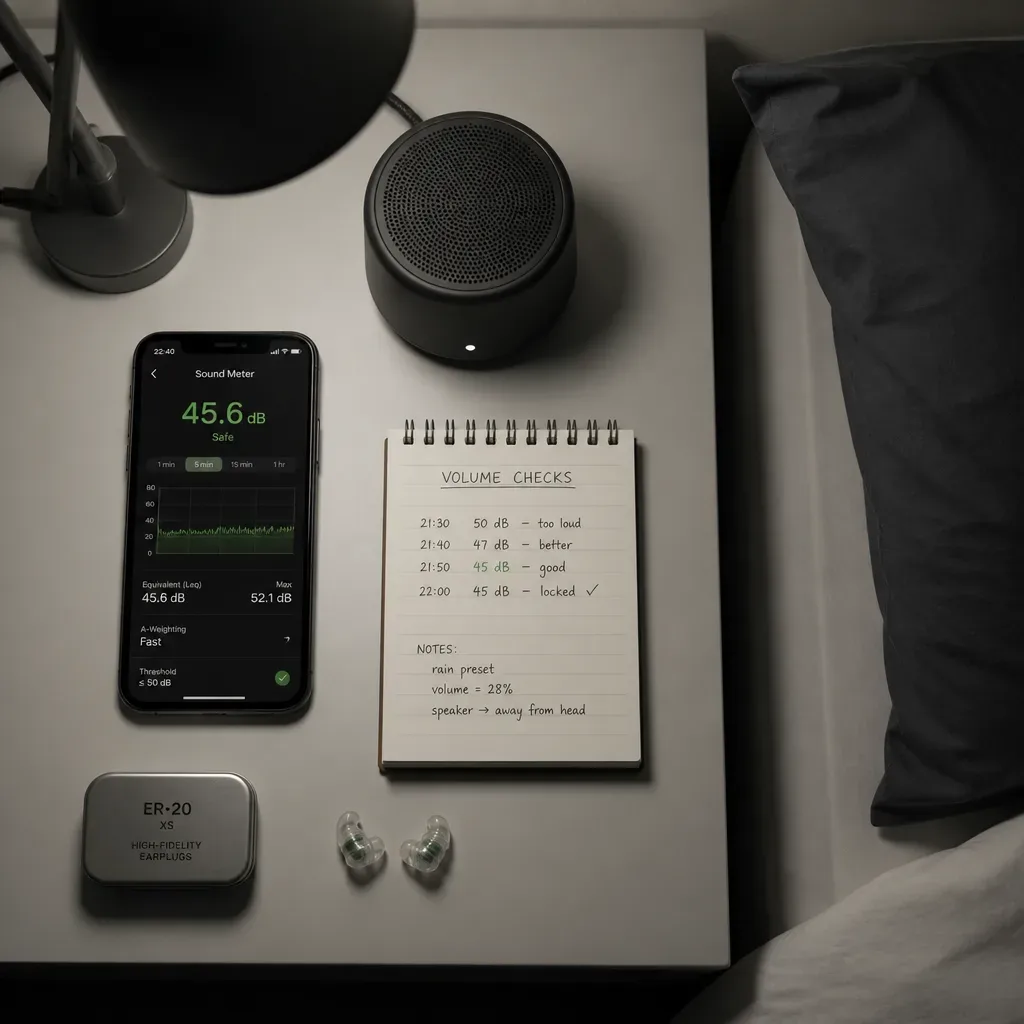
Use a phone sound meter only as a rough check. Microphones vary, cases block ports, and A-weighting may not be precise. Still, an estimate can stop drift. If the app reads 55 to 60 dBA at your pillow for a sleep noise machine, that is louder than many people need. Move the speaker farther away or reduce the volume.
A clean setup has three distances: the speaker distance, the pillow distance, and the partner distance. Sound drops with distance in free space, roughly 6 dB per doubling of distance before room reflections complicate it. Moving a speaker from 30 cm to 60 cm from your head can matter. A small bedside speaker aimed toward your pillow at low level is often clearer than a loud device across the room.
Try this calibration:
- Play the spoken audio alone and lower it until words begin to blur.
- Raise it one small step so every consonant returns.
- Add masking noise at the lowest available setting.
- Reduce masking if the letters s, f, t, and k soften.
- Lie in your normal sleep position and test again.
- If a partner is present, check their side before settling.
For children, be more conservative. The American Academy of Pediatrics has warned about infant sleep machines being placed too close or played too loud, referencing measurements where some devices exceeded 50 dBA at short distances. Keep speakers away from cribs, use the lowest level that works, and do not put earbuds or plugs in a child’s ears for routine sleep without medical guidance.
A voice should not have to shout to become calming.
What should you choose for common sleep situations?
Choose the tool that reduces contrast without hiding the sound you need to hear.
The best answer changes by room. A city bedroom with distant traffic does not need the same tool as a hotel room with a loud ice machine. The comparison below assumes adult use, normal hearing, and a goal of keeping spoken audio intelligible. If you have hearing loss, tinnitus, apnea symptoms, or chronic insomnia lasting more than 3 months, involve a qualified professional. Sound can support a routine, but it is not diagnosis or treatment.
| Situation | Better first choice | Why | How to keep audio audible |
|---|---|---|---|
| Distant traffic | White, pink, or brown noise | Steady masking covers variation | Put voice 3 to 6 dB above noise |
| Partner snoring | Earplugs or filtered plugs | Source may be too loud to mask safely | Use lighter filters if speech matters |
| Thin apartment walls | White or pink noise | Masks intermittent voices and steps | Keep noise below narration |
| Hotel hallway | Earplugs plus low noise | Blocks peaks, masks smaller sounds | Test alarm and voice before sleep |
| Sensitive to hiss | Pink or brown noise | Less high-frequency bite | Compare colors at same low level |
| Needs alarm audibility | White noise | Does not block the ear canal | Place alarm separate from speaker |
If you use frequency-based audio, separate tradition from measurement. The Solfeggio frequencies guide explains the historical naming around tones such as 528 Hz while keeping evidence plain. A single tone may be pleasant, but it is poor at masking broad household noise. For masking, broad-band sound usually works better because real rooms do not interrupt us at only one frequency.
There is also a behavioral point. A 2023 review of sleep hygiene research would not say one sound fixes sleep for everyone; routines tend to work by reducing decision-making and repeated arousal cues. Choose a setup you can repeat for 7 nights before judging it. Constant switching can become its own source of alertness.
The right tool is the one that lowers the room without lowering the message.
What is the safest practical setup tonight?
The safest practical setup is low masking noise under clear spoken audio, with earplugs reserved for rooms that are too loud to mask gently.
Start with the least invasive option. If your room is moderately noisy, use a small speaker, not earbuds, and place it 60 to 120 cm from your pillow. Set the Dream-Self recording first. Then bring in a low noise color underneath it. If white noise feels sharp, switch to pink or brown rather than increasing volume. You can compare the curve in the pink noise guide and hear why a 3 dB per octave roll-off often feels softer.
If the room is loud, add plugs carefully. Try filtered plugs before maximum foam if you still need speech. With full foam plugs, consider playing the voice closer and quieter rather than making the whole room louder. Avoid sleeping in standard music earbuds all night; pressure, cable movement, and high local sound levels can irritate the ear. If you use sleep-specific flat earbuds, set a volume limit and take breaks.
Here is a plain decision rule:
- If the noise is soft but distracting, use white, pink, or brown noise.
- If the noise is loud and close, use earplugs.
- If you need spoken audio, avoid deep attenuation unless necessary.
- If speech blurs, lower the masker before raising the speech.
- If your ears hurt, stop and change the setup.
Keep one number in mind: lower is usually enough. Many bedrooms only need a small lift in background sound, not a wall of hiss. The goal is not silence. The goal is a stable acoustic floor with one chosen voice above it.
Let the room get steady, then let the voice stay near.