noise colors
White Noise vs Silence for Dream-Self Audio
White noise vs silence changes how clearly you hear Dream-Self audio. Learn when masking helps, when quiet wins, and how to set safe levels.
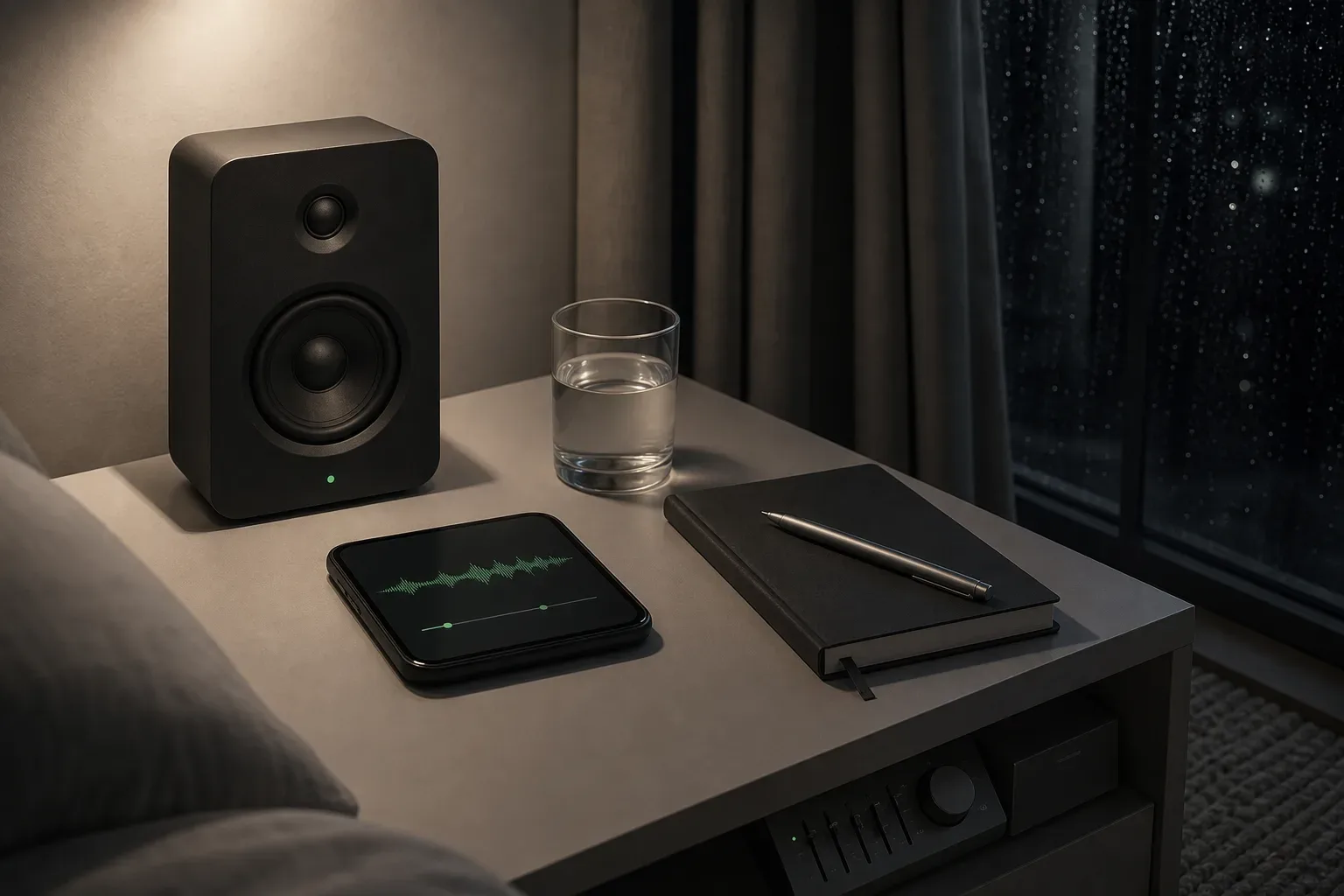
White noise vs silence is a clarity question, not a loyalty test. Use white noise when the room has sudden sounds that interrupt attention. Use silence when the room is already steady enough. For Dream-Self audio, the voice should stay 10 to 15 dB clearer than any background.
What does white noise do to spoken Dream-Self audio?
White noise masks change, which can make a spoken recording feel steadier in an uneven room.
Technically, white noise contains equal acoustic power per hertz across the audible range, usually described from about 20 Hz to 20,000 Hz for young healthy ears. That flat distribution is why it can sound like a bright hiss. It covers many kinds of household detail at once: a refrigerator click, a car passing at 2 a.m., a hallway voice, or the small snap of heating ducts.
Masking is useful because the sleeping brain tends to notice contrast. A 2015 review in Sleep Medicine Reviews notes that environmental noise is linked with sleep disturbance, especially when sound events are intermittent rather than steady. In practice, a constant layer can be less intrusive than ten small surprises. The ear does not stop listening when you close your eyes.
But white noise also competes with speech. Consonants carry much of their intelligibility in the higher bands, often above 2 kHz. White noise is strong there, too. If it sits too close to the spoken track, it can sand down the edges of words. You may still hear a voice, but not the exact sentence.
A good sleep sound is not the loudest thing in the room. It is the least sound that makes the room predictable.
If you want to hear the masking effect directly, use the White noise generator + guide and speak a sentence over it at different levels. At a low level, the room settles. At a high level, the sentence loses teeth. For Dream-Self audio, that second state is the problem.
What does silence preserve that white noise can cover?
Silence preserves micro-detail in the voice, especially consonants, breath, pacing, and emotional contour.
A spoken recording is not only words. It is timing, mouth noise, distance from the microphone, and the low movement of the room tone around the narrator. Speech science often uses signal-to-noise ratio, or SNR, to describe how far the voice sits above background. Many listening situations need at least a positive SNR, and difficult rooms may need +10 dB or more for comfortable comprehension.
Silence gives that ratio for free, if the room is truly quiet. You do not have to fight a bright hiss to catch the end of a word. You do not need to raise the voice to compensate. A whisper-level recording can remain plain and close because there is no synthetic layer taking up the same bands.
The problem is that home silence is rarely silent. A library can sit near 40 dBA. A quiet bedroom may be around 30 dBA, while urban night noise can climb well above that depending on windows, street distance, and HVAC. The World Health Organization’s older community noise guidance uses 30 dB LAeq indoors as a sleep-protective reference for bedrooms, with lower peaks preferred.
Silence is not the absence of sound. It is the absence of interruption.
This matters for Dream-Self audio because the aim is daily repetition, not dramatic listening. If the room stays still, silence lets the recording feel intimate and unforced. If the room keeps changing, silence makes every change more noticeable. That is when masking earns its place.
Which keeps the AYA Method clearer: white noise or silence?
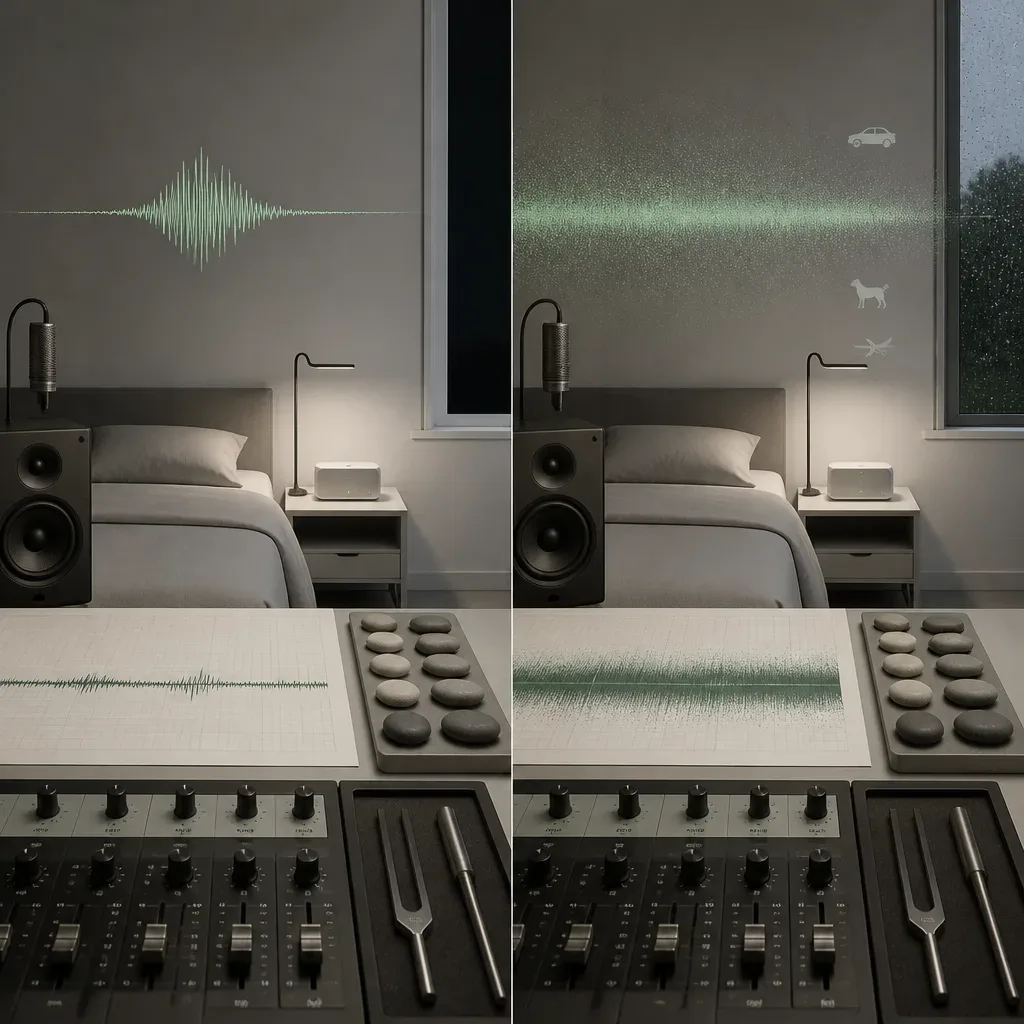
Silence keeps the audio clearest in a stable room; low white noise keeps it clearer in a room with sudden intrusions.
The AYA Method is a daily audio manifestation practice. Each day you listen to a short personalized recording, your Dream-Self Moment, narrated from the version of you who has already manifested the life you intend. Listening is the practice. Repetition is the work. The audio is the method.
That definition matters because the audio is not decoration. If the background covers the words, the method is being made harder than it needs to be. In a studio, I check spoken beds by turning them down until the words are almost too soft, then adding background slowly. The failure point is easy to hear: vowels remain, consonants disappear.
Use this comparison as a starting point, not a rulebook. A 2021 systematic review in the Journal of Clinical Sleep Medicine found that evidence for continuous noise improving sleep is limited and mixed, partly because studies use different sounds, levels, and populations. That matches what sound designers find at the bedside: the right layer is personal, but the wrong level is obvious.
| Listening condition | Best use | Risk for Dream-Self audio | Starting level |
|---|---|---|---|
| Silence | Quiet bedroom, low interruptions | Outside sounds stand out | Voice at soft conversational level |
| Low white noise | Traffic, hallway voices, appliances | High consonants can blur | Noise 10 to 15 dB below voice |
| Pink or brown noise | Bright white noise feels sharp | Low rumble may mask warmth | Slightly below white-noise level |
| Music bed | Familiar wind-down cue | Harmony can pull attention | Very low, no lyric content |
Sound prepares the room; a voice fills it.
If you use tones before the recording, keep them separate or very low. The Binaural beats generator + guide explains why two steady tones can create a perceived beat in headphones, but that same steadiness can compete with speech. The Solfeggio frequencies guide covers the tradition respectfully; for clarity, the evidence is still much thinner than the simple physics of masking.
How should you set levels so the voice stays clear?
Set the spoken audio first, then add background only until the room stops pulling your attention.
This order prevents the common mistake: starting with a pleasant noise level, then raising the voice to fight it. For sleep, that can push the whole setup louder than needed. OSHA’s 85 dBA limit over 8 hours is designed for workplaces, not bedrooms. For nightly listening, treat it as a warning line, not permission. If you use headphones, keep the level lower than you think you need.
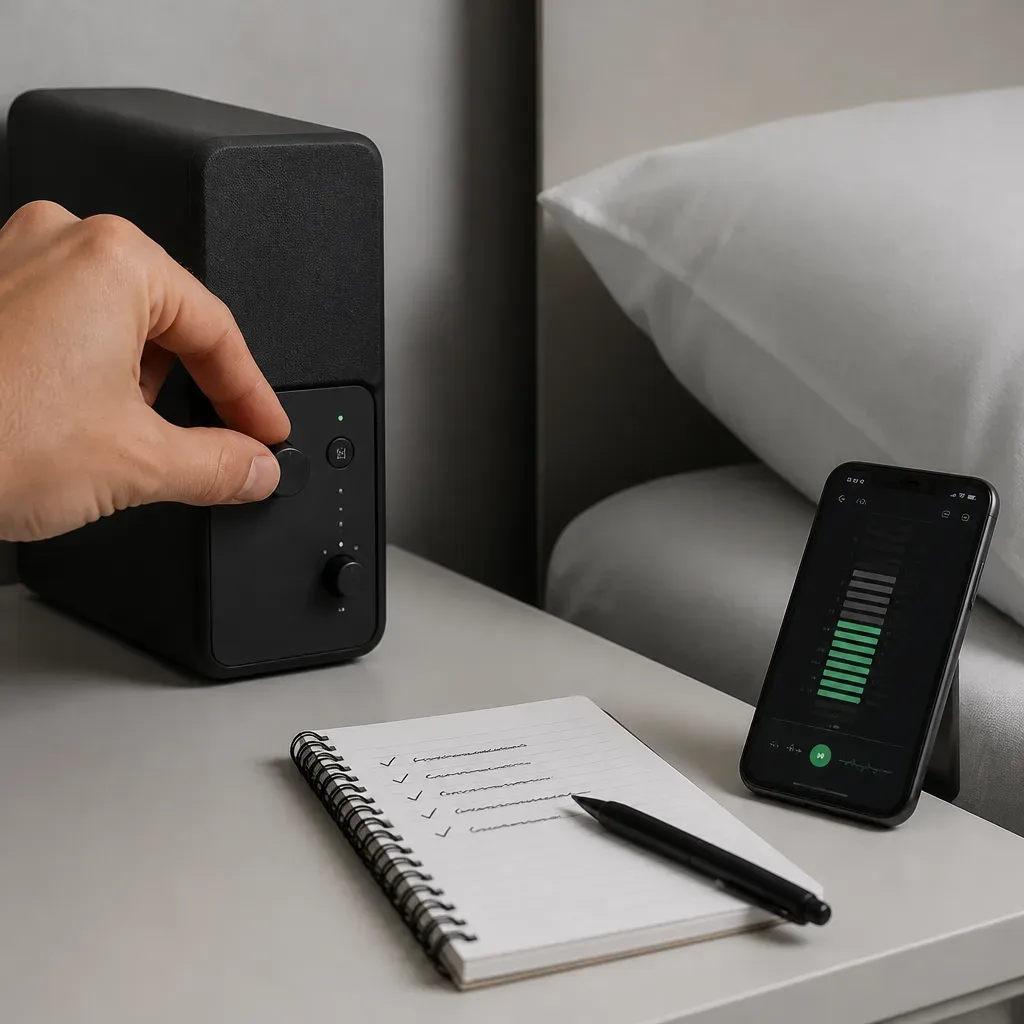
A simple phone sound meter is not laboratory-grade, but it can teach relative level. Place the phone near your pillow, play the Dream-Self audio, and note the approximate reading during speech. Then add white noise until it sits clearly below the voice. The number matters less than the relationship. Speech first, mask second.
Try this 5-minute calibration:
- Play the spoken recording alone at the softest clear level.
- Listen for one full minute without changing anything.
- Add white noise at minimum volume.
- Raise it slowly until outside sounds feel less sharp.
- Stop before any consonant in the voice becomes fuzzy.
- If you cannot understand every word, lower the noise or choose silence.
For many bedside speakers, the usable range is narrow: one or two volume clicks. Bluetooth speakers can jump by 3 to 6 dB per step, which is enough to change clarity. If the jump is too large, lower the source volume in the app and use the speaker as the fine control.
Protecting the ear is part of the practice. A clear recording at a low level beats a loud recording under a louder hiss.
When should you choose white noise instead of silence?
Choose white noise when the room is unpredictable enough that silence makes every interruption louder by contrast.
Apartment bedrooms are the obvious case. A closing door may peak 20 dB above the room. A passing motorcycle may jump much higher for 5 seconds. A partner’s cough, a pet moving, or a radiator click can become the loudest event of the night because the baseline is so low. White noise raises the floor gently, so small peaks feel less separate.
Research on hospital sound gives a useful analogy, even though a bedroom is quieter. ICU studies often report nighttime peaks above 60 dBA, and small trials have tested white noise to reduce perceived disturbance. The evidence is not uniform, but the mechanism is plain: steady sound can mask irregular sound. Your bedroom version should be far quieter than an ICU trial.
White noise is also useful if anticipation is the problem. Some listeners lie still waiting for the next car or hallway step. A steady bed gives the auditory system fewer edges to track. That does not mean deeper sleep is guaranteed. It means fewer sound shapes are available to count.
Use white noise when:
- traffic changes suddenly outside your window
- other people move around after you lie down
- plumbing, heating, or elevators click at random times
- the spoken audio feels exposed in silence
- you keep waiting for the next interruption
For a softer test, compare white noise with a lower color using the white noise guide. Some nervous systems prefer less high-frequency hiss. Yours gets a vote, and it should vote after 3 to 5 real nights, not after 30 seconds.
When should you choose silence instead of white noise?
Choose silence when the room is already steady and the background layer would cover more detail than it protects.
Silence is often best for carefully produced speech. A close microphone, light compression, and a clean noise floor can make a short recording feel near without being loud. Add a bright mask underneath and the same recording may feel farther away. In audio terms, the background reduces contrast. In human terms, the voice stops feeling close.
This is especially true if you listen through small phone speakers. Many phones emphasize the midrange and upper midrange because that is where speech survives on tiny drivers. Add white noise from the same speaker and the two signals share the same small acoustic space. A bedside speaker with a wider driver can separate them better, but silence still wins when the room allows it.
Silence is also safer for people who tend to raise volume. If you keep turning the track up to hear through noise, remove the noise first. The National Institute for Occupational Safety and Health recommends 85 dBA as an 8-hour exposure limit, with allowed time dropping as level rises. Sleep listening is long, so conservative levels are sensible.
Choose silence when:
- your room is steady below roughly 30 to 35 dBA
- you can understand every word at a low level
- white noise makes s, f, t, or k sounds less crisp
- you wake because the sound itself feels too present
- you use earbuds and cannot measure level reliably
If you enjoy tones, keep them outside the spoken track or use them before it. The binaural beats guide is a useful reference for that separation. For Dream-Self audio, intelligibility is not a luxury feature. It is the main signal.
What should you test tonight before making it a habit?
Test silence first, then low white noise, and keep the version that leaves the voice clearest at the lowest comfortable level.
One night is not enough data, but it is enough to stop guessing. Use the same recording, same device, same pillow position, and same approximate bedtime for 3 nights. Night 1: silence. Night 2: white noise below the voice. Night 3: repeat the better condition. If a major outside event happens, such as loud neighbors or weather, mark that night as noisy and do not overread it.
A small listening log works better than memory. Keep it plain:
| Night | Background | Voice clarity, 1-5 | Interruptions noticed | Morning note |
|---|---|---|---|---|
| 1 | Silence | |||
| 2 | Low white noise | |||
| 3 | Best repeat |
The useful score is not whether the sound was pleasant in the first minute. It is whether the words stayed available without effort. Consumer sleep studies often rely on self-report, and self-report is imperfect, but a 3-night personal log is still better than changing settings every evening. Consistency is a measuring tool.
If you have tinnitus, sleep apnea, chronic insomnia, or sound sensitivity that causes distress, ask a qualified clinician before using nightly sound as a workaround. Audio can support a routine, but it is not medical care.
For most rooms, the answer is modest: silence when the room is kind, low white noise when the room is not. Keep the mask below the message. Let the recording remain the thing you came to hear.
Set the room low, then let the voice stay plain.