noise colors
Fan Noise vs White Noise Under Dream-Self Audio
Fan noise vs white noise for Dream-Self audio: compare masking, voice clarity, loop stability, and safe volume settings for listening tonight.
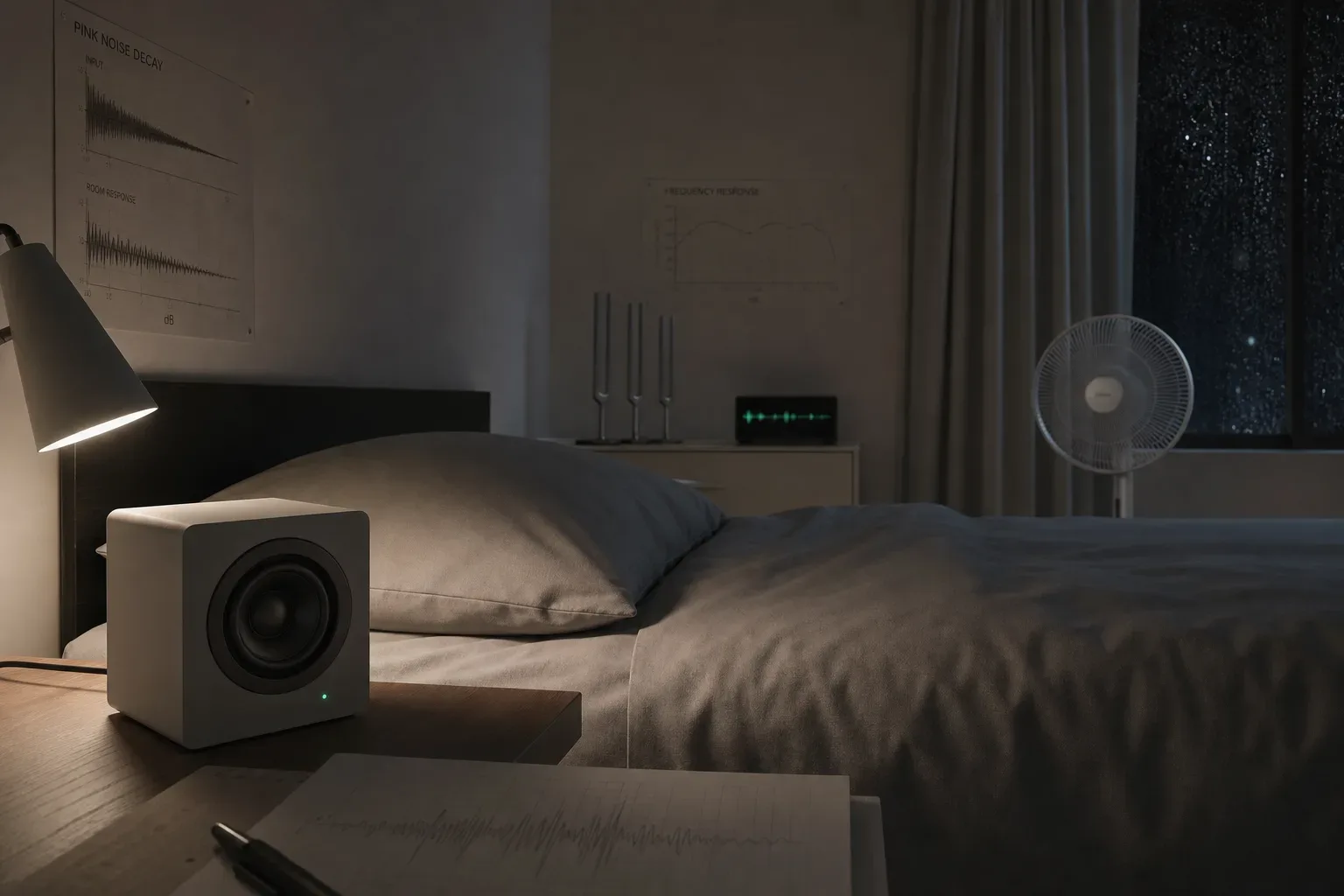
Fan noise vs white noise is a control question: fan noise is physical airflow with motor and room artifacts, while white noise is a measured signal with equal power per hertz. Under Dream-Self audio, white noise usually gives clearer speech; fan noise can feel gentler if it stays below the voice.
What is the actual difference between fan noise and white noise?
Fan noise is a moving object in a room; white noise is a defined signal you can measure and repeat.
A fan produces sound from at least three sources: blade turbulence, motor vibration, and air striking nearby surfaces. Depending on speed, blade count, and distance from the wall, the sound may include a low hum near 50 or 60 Hz, a blade-pass rhythm often below 200 Hz, and broadband airflow above 1,000 Hz. Move the fan 30 cm, and the balance changes.
White noise is simpler on paper. It has equal power in every 1 Hz band across its range, so 100 to 101 Hz carries the same power as 5,000 to 5,001 Hz. Because our ears group sound by octaves, true white noise often sounds bright or hissy. That’s why many people prefer pink noise, which falls about 3 dB per octave, or brown noise, which falls about 6 dB per octave.
The distinction matters when a spoken recording is playing on top. A voice carries much of its intelligibility between about 1,000 and 4,000 Hz, with vowel body lower, often near 150 to 800 Hz. A fan can leave gaps, peaks, and pulses in exactly the places a narrator needs space. A well-set generator can be lowered, filtered, or shifted until the words stay plain.
If you want to hear the difference directly, press play on the White noise generator + guide, then place the same spoken clip above a real fan. Use the same speaker and the same chair. The ear adapts quickly, often within 2 to 5 minutes, so change only one variable at a time.
A background sound is good only if it makes the foreground easier to receive.
Which one masks bedroom distractions better?
White noise usually masks sudden high-frequency distractions better, while fan noise often masks low, familiar room sounds more pleasantly.
Masking works by covering contrast. A quiet room at 28 dBA can make a 42 dBA pipe click sound sharp because the jump is obvious. A steady background at 38 dBA reduces that jump. The World Health Organization’s 2018 environmental noise guidance treats night noise as relevant to health, with outdoor night levels above 40 dB Lnight associated with increasing concern. Indoors, the goal is not more sound; it’s fewer spikes.
White noise is strong at masking hiss-like, broadband, and higher-frequency sounds: light traffic through a window, hallway footsteps with shoe scrape, distant voices, or a refrigerator relay. Its weakness is brightness. If you raise true white noise enough to cover bass thumps, the upper band can become tiring.
Fan noise tends to mask the home sounds many people already know: HVAC rumble, street wash, a neighbor’s fan, or a ceiling vent. Because much fan sound leans low and mid, it can feel less sharp than white noise. But it may fail against speech consonants. The letters s, t, f, and sh often carry above 3,000 Hz, and those are exactly the fragments that can wake attention even when the words aren’t understood.
| Background | Best at masking | Common weakness | Best use under Dream-Self audio |
|---|---|---|---|
| Real fan | HVAC rumble, room hush, light traffic | Motor tone, airflow pulses, placement changes | When it sits low and doesn’t touch the words |
| White noise | Sudden broadband sounds, voices, hallway detail | Can sound bright at higher volume | When speech clarity and repeatability matter |
| Pink noise | Mid-band room noise, softer masking | Less bite against sharp sounds | When white noise feels too hissy |
| Brown noise | Low rumble, distant traffic | May not mask speech detail | When the body prefers a lower hum |
The best masking sound is not the loudest one. It is the quietest sound that makes interruptions less distinct.
Which background keeps Dream-Self audio clearer?
White noise keeps Dream-Self audio clearer when it is set below the narrator and not allowed to crowd the speech band.
Dream-Self audio depends on words. If you’re listening to the AYA Method, the practice is daily audio manifestation: each day you listen to a short personalized recording, your Dream-Self Moment, narrated from the version of you who has already manifested the life you intend. Listening is the practice. Repetition is the work. The audio is the method. That means the background is not the main event.
Speech clarity depends on signal-to-noise ratio. In acoustics, a 6 dB increase is often perceived as a clear step up, and a 10 dB difference is commonly heard as roughly twice as loud, depending on frequency and context. For spoken practice, the voice should feel plainly forward. If you have to strain to catch a sentence, the background is too loud, too bright, or too close in pitch.
A fan can sit beautifully under a voice if it has a soft, stable wash. It can also betray you with a bearing whine around 1,500 Hz or a wobble every 0.8 seconds. The brain is good at ignoring steady sound; it’s less good at ignoring pattern. A repeating tick can become the only thing you hear.
White noise gives you fewer surprises. You can lower it 2 dB, switch to pink if the hiss is sharp, or add a sleep timer. If you use the Binaural beats generator + guide on another night, the same rule applies: keep any carrier tone or background below the spoken track unless the voice is not part of the session.
How loud should the background be for safe listening?
Set the background low enough that the voice is effortless, and keep the combined level well below occupational exposure limits.
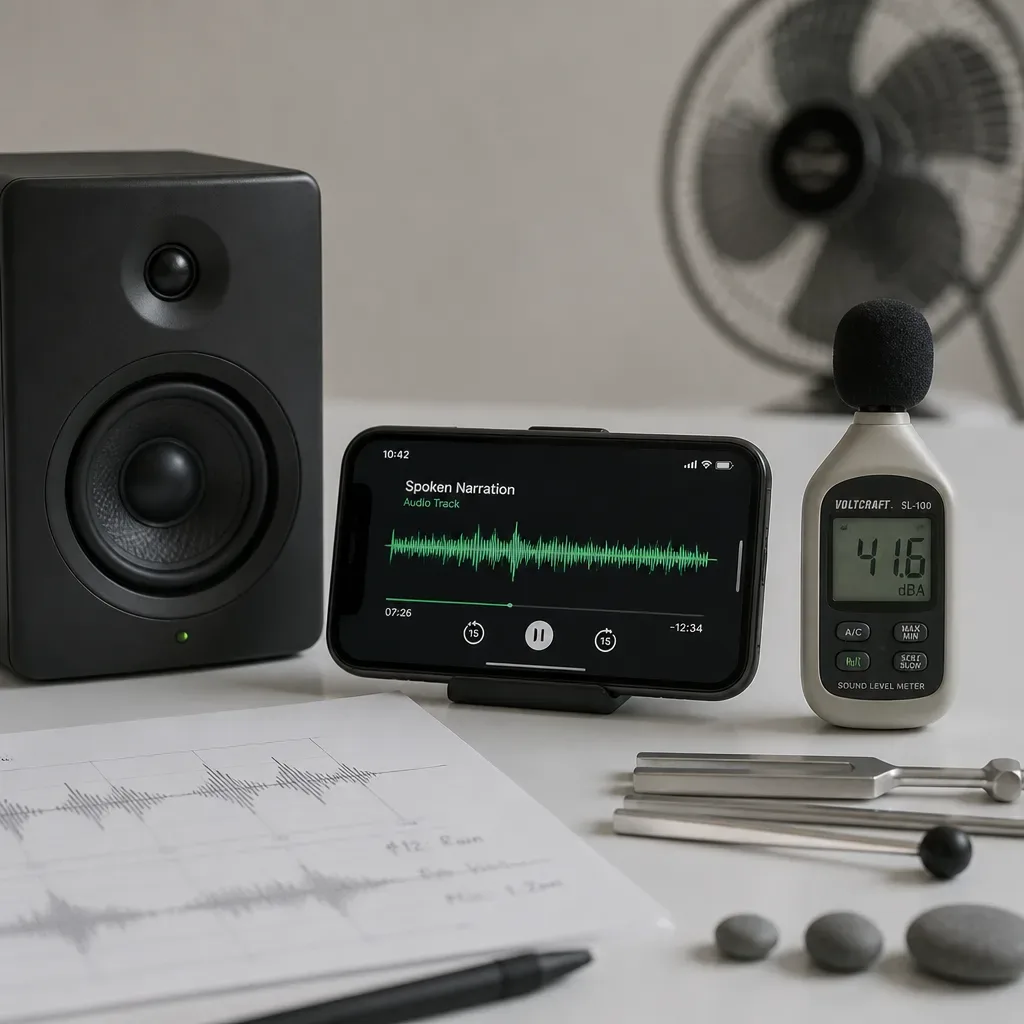
A practical pillow target is about 35 to 45 dBA for the background sound, measured where your head rests. Phone sound meters are imperfect, often off by several dB, but they are useful for comparing settings. If your bedroom is already around 30 dBA, a 38 dBA noise bed may be enough. If traffic spikes to 50 dBA, no safe sleep sound will erase it completely.
Use conservative numbers. NIOSH recommends 85 dBA as an 8-hour exposure limit for workplaces, with a 3 dB exchange rate, meaning each 3 dB increase halves recommended exposure time. That is not a bedtime target. Sleep listening should sit much lower, especially through earbuds, where the sound source is millimeters from the ear canal.
For children, be stricter. A 2014 study in Pediatrics measured infant sleep machines and found some could exceed 50 dBA at crib distance and much higher when placed close. The American Academy of Pediatrics has advised placing such machines away from the infant and keeping volume low. Adult Dream-Self audio is not infant audio, but the principle travels: distance and volume matter.
A simple setup sequence works:
- Start the Dream-Self audio at a comfortable speaking level.
- Add the fan or noise generator from zero, not from its last setting.
- Raise the background only until room distractions soften.
- Lower it 1 small step after 2 minutes, once your ear adapts.
- If the voice loses consonants, reduce the background or switch spectrum.
The safest useful level is the one you forget is on.
When is fan noise the better choice?
Fan noise is better when airflow comfort, habit, and a softer low-mid sound help you settle without covering the narration.
Some bodies associate a fan with sleep because it has been part of the room for years. Habit is not trivial. Sleep medicine often treats regular cues as useful; cognitive behavioral therapy for insomnia commonly uses consistent stimulus control, including a stable sleep setting and repeated timing. If a fan is one of the cues that tells your body the day is done, don’t remove it just because a graph looks cleaner.
A fan also changes the air, not just the sound. Cooler skin can support sleep onset for many people, and core body temperature tends to drop as sleep begins. The Sleep Foundation and clinical sleep texts often describe a cool room, roughly 16 to 19 degrees Celsius for many adults, as a common recommendation, though comfort varies. White noise cannot move air across your face.
Choose fan noise when the fan has these traits:
- No bearing whine, scrape, click, or rattle.
- A stable speed that doesn’t surge with power changes.
- Placement at least 1 m from the microphone or speaker path.
- Airflow aimed for comfort, not directly at a sensitive microphone.
- A sound level low enough that the Dream-Self voice stays in front.
Avoid fan noise when you are recording your own audio in the same room. Microphones exaggerate mechanical tones that your ear may ignore. A small desktop fan 50 cm from a phone mic can put a steady buzz under every word. Record dry, then add sound later if you want it.
Fan noise is a room instrument. Tune the placement before you judge the sound.
When is white noise the better choice?
White noise is better when you need repeatable masking, precise volume, and a background that doesn’t change with weather or motor wear.
A generator gives you control. You can set the level, select white, pink, or brown curves, and repeat the same setup each night. That matters because Dream-Self audio is repetitive by design. When the spoken recording stays constant and the bed underneath stays constant, the brain has less novelty to inspect.
White noise is also easier to fit around a voice. If true white noise sounds too bright, try pink. If pink still feels busy, try brown. The Solfeggio frequencies guide covers a different tradition: named tones such as 396 Hz, 528 Hz, and 963 Hz. Many listeners like them as ritual tones, but the sleep evidence is not comparable to basic masking research. For speech underlay, a broad low noise usually interferes less than a distinct tone.
A 2021 systematic review on noise as a sleep aid reported that studies were small and methods varied, so claims should stay modest. That fits what we see in rooms: noise does not force better sleep; it reduces acoustic contrast. For some nervous systems, that is enough. For others, any added sound becomes another object to monitor.
Use white noise when:
- Your fan has a tone you keep noticing.
- You share a wall and need speech masking.
- You travel and want the same sound in hotel rooms.
- You need a timer that fades after 30, 60, or 90 minutes.
- You want to compare white, pink, and brown without buying devices.
You can start with the White noise generator + guide, then compare it with fan sound for one week. Change only one setting per night. Seven nights is not a clinical trial, but it’s better than one tired guess.
What should you use tonight?
Use the quietest stable background that leaves every word of the Dream-Self audio easy to hear.
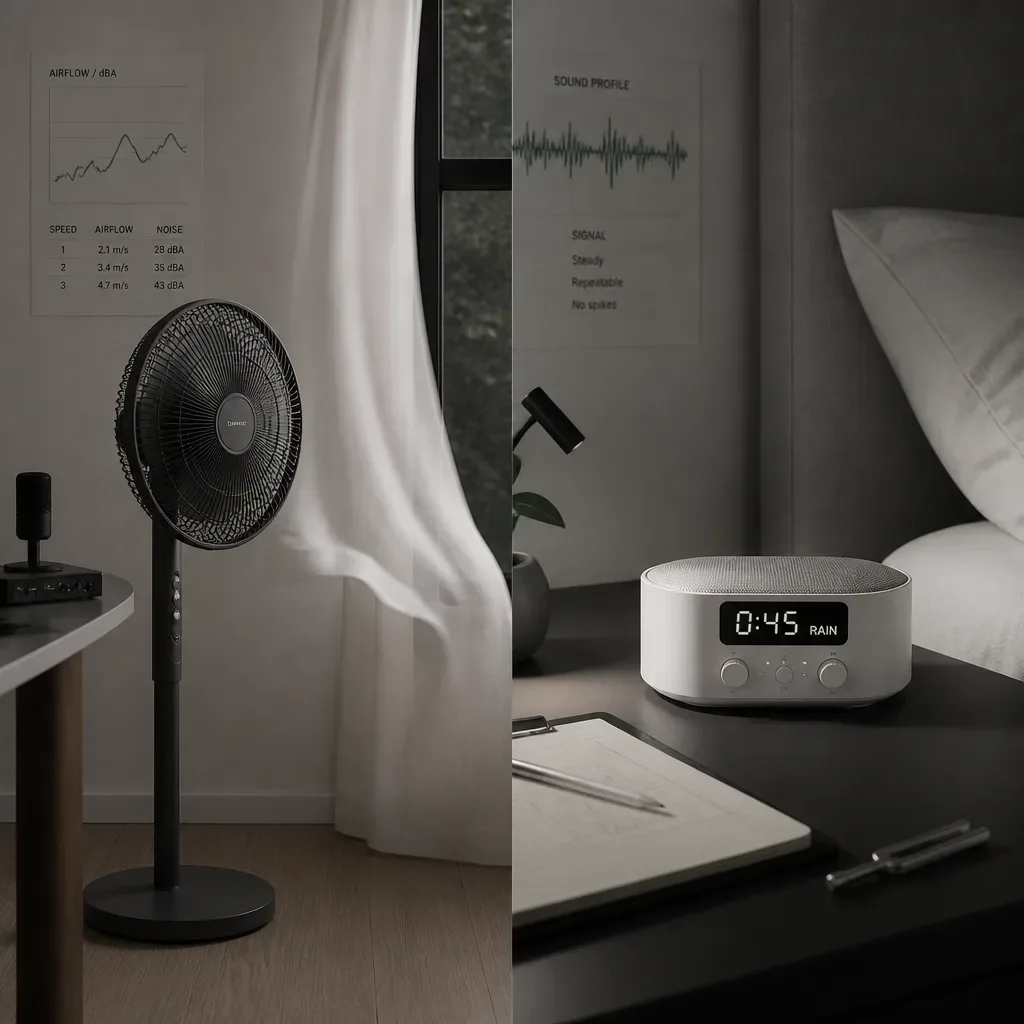
If your fan is already part of your wind-down and the voice stays clear, keep it. Put the speaker closer to you than the fan, reduce fan speed if consonants blur, and avoid aiming airflow directly at the audio device. Distance matters: doubling distance from a small sound source can reduce level by roughly 6 dB in free field conditions, though bedrooms add reflections.
If your room has unpredictable sound, choose a generator. Start with pink noise rather than bright white if you’re sensitive to hiss. Try brown if low traffic is the main issue. Use true white when voices, hallway detail, or sudden small noises keep catching your attention. The label is less important than the measured result.
Here is a plain decision path:
- If speech clarity drops, lower the background first.
- If outside voices remain distinct, try white or pink noise.
- If low traffic remains distinct, try brown noise or a low fan.
- If a tone annoys you after 3 minutes, remove that source.
- If both options work, choose the one you can repeat tomorrow.
Be careful with stacked audio. Dream-Self narration plus fan plus white noise plus binaural beats can become clutter. One foreground and one background is usually enough. If you like frequency-based listening, use a separate session and keep the claims plain; tradition and preference can sit beside measurement without pretending to be the same thing.
If insomnia is chronic, tinnitus is distressing, or breathing pauses are suspected, sound masking is not the treatment plan. A clinician can check the parts a speaker can’t.
The room doesn’t need to disappear; it only needs to stop interrupting the voice.