sleep science
Nap Length Guide: 20 vs 90 Minutes With Audio Cues
Use this nap length guide to choose 20 or 90 minutes, reduce sleep inertia, and add a quiet Dream-Self audio cue without hurting nighttime sleep.
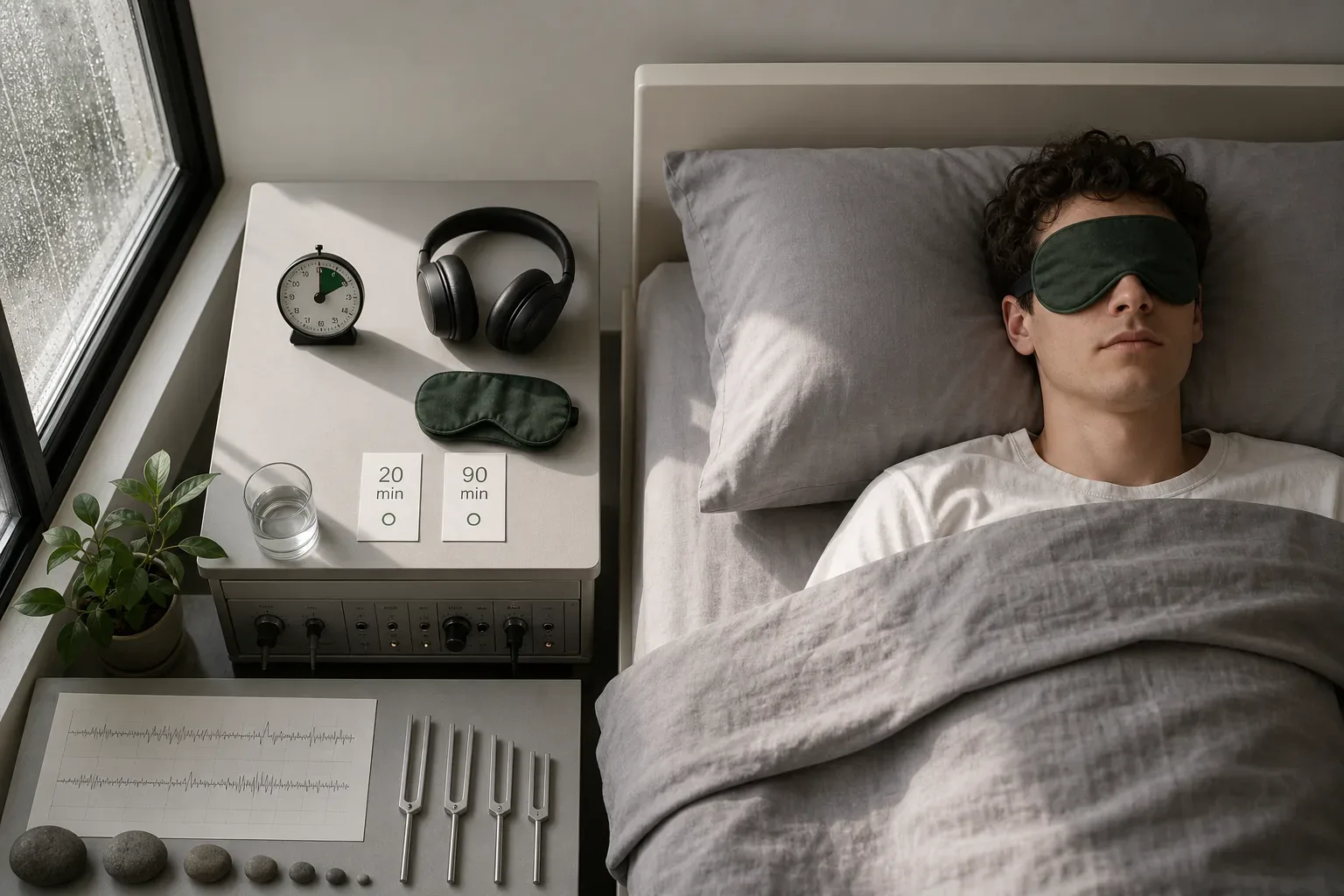
Nap length is the main control you have over whether a nap leaves you clearer or heavier. Choose about 20 minutes when you need alertness soon, or about 90 minutes when you can complete a full sleep cycle. Add a Dream-Self audio cue at the edge, not in the middle.
What nap length should you choose today?
Choose 20 minutes for alertness, 90 minutes for a fuller reset, and be cautious with the 30-to-60-minute middle.
A nap is not one thing. It is a timed entry into sleep architecture. In adults, a typical full sleep cycle is often described as about 90 minutes, though normal cycles can range from roughly 70 to 110 minutes across the night. A 20-minute nap usually stays closer to lighter non-REM stages, while a 90-minute nap has a better chance of passing through deeper sleep and REM.
The cleanest rule is practical: what do you need to do after waking? NASA researchers working with pilots and astronauts reported that a 26-minute cockpit nap was associated with a 34% improvement in performance and a 54% improvement in alertness in a 1995 field study. That does not make 26 minutes magic. It does show why short naps remain useful in safety-sensitive work.
Here is the plain comparison:
| Nap length | Best use | Main risk | After-waking plan |
|---|---|---|---|
| 10 minutes | Very quick lift | May not be enough | Stand, light, water |
| 20 minutes | Alertness without heaviness | You may not sleep at all | Move slowly for 2 minutes |
| 30 to 60 minutes | Some memory support | Higher sleep inertia risk | Allow a buffer |
| 90 minutes | Full-cycle rest | Can affect bedtime if late | Wake with light and sound |
Sleep is a state change, not a productivity trick. If you are short on time, a short nap is the safer instrument. If you are ill, sleep-restricted, or emotionally worn thin, a 90-minute window may fit better, especially before 3 p.m.
Why does a 20-minute nap feel different from 90 minutes?
A 20-minute nap tends to avoid deep sleep, while a 90-minute nap gives the brain more time to complete a cycle.
During the first part of sleep, the brain moves from wake into non-REM stage N1 and N2. Stage N2 includes sleep spindles and K-complexes, features that EEG researchers measure in microvolts and milliseconds, not in mood words. Many short naps spend most of their sleep time here. That is one reason people often wake from a 15-to-20-minute nap with less heaviness than after a longer but incomplete nap.
Slow-wave sleep, or N3, usually becomes more likely as the nap lengthens. Waking from N3 can produce sleep inertia: lowered alertness, slower reaction time, and a thick, low feeling in the body. A 2019 review in Sleep Medicine Reviews noted that sleep inertia can last from minutes to several hours, with severity shaped by sleep stage at waking, prior sleep loss, circadian timing, and task demands.
A 90-minute nap is different because it is long enough for many people to move through N2, N3, and some REM. REM is not guaranteed in every nap, and daytime sleep structure changes with timing, sleep debt, age, and chronotype. Still, a 90-minute timer respects the shape of a common sleep cycle better than a 45-minute timer does.
A useful nap ends at a biological seam. The timer is not only measuring minutes; it is trying to avoid waking you from the deepest part of the wave.
If you want a sound bed before sleep, keep it simple. The White noise generator + guide can help mask hallway noise or traffic with steady broadband sound. White noise is not deeper sleep by itself. It is a mask, and for some nervous systems, masking is enough.
How do you set up a 20-minute nap without waking groggy?
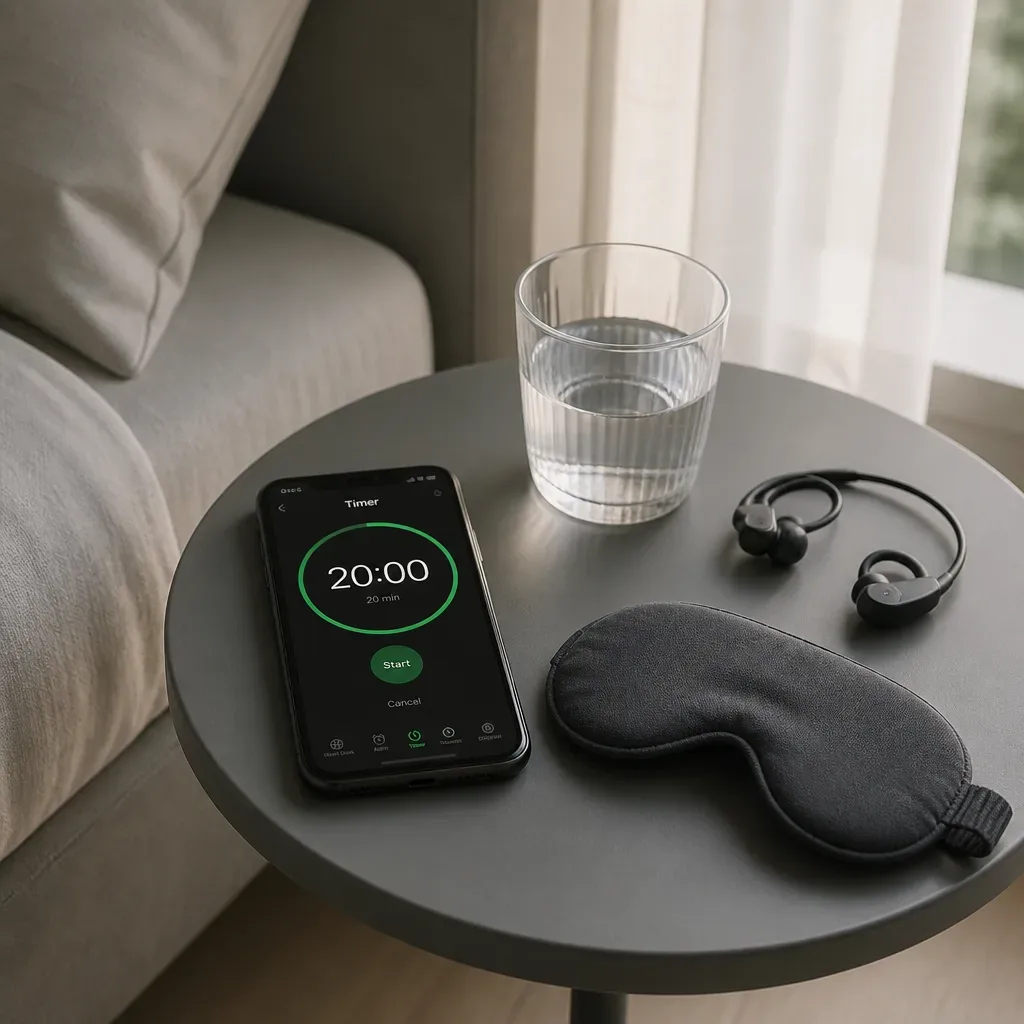
Give yourself a short runway, set a timer that includes sleep onset, and wake with a low-friction cue.
The mistake is setting a 20-minute alarm for the moment you lie down and then spending 12 minutes trying to settle. Most adults do not fall asleep instantly. In sleep studies, sleep onset latency under 10 minutes can suggest high sleep pressure, while 10 to 20 minutes is common in ordinary conditions. For a 20-minute nap, set the full timer for about 25 to 30 minutes if you expect a short settling period.
Use this sequence tonight or during a midday break:
- Pick a nap start time at least 6 to 8 hours before bedtime when possible.
- Set a 25-to-30-minute alarm for a short nap, including time to fall asleep.
- Lower the room light or use an eye mask.
- Put audio at a soft level, near or below conversational volume.
- When the alarm sounds, sit up before checking your phone.
- Get 2 to 5 minutes of light, water, and quiet movement.
The short nap is a precision tool. It does not need drama; it needs a timer and a boundary.
Caffeine timing matters. Caffeine has an average half-life of about 5 hours, though individual metabolism varies widely. A coffee at 2 p.m. can still be active near bedtime for many adults. The common caffeine nap uses caffeine before a 15-to-20-minute nap so the stimulant begins to act near waking, but it is not a good fit for late afternoon or anxious bodies.
Volume matters more than the track name. The World Health Organization has used 85 dB over 8 hours as an occupational risk reference, but sleep audio should be far below that. Think soft fan, not subway platform. For children, skip headphones and use a room speaker at a very low level if sound is needed.
How do you use a 90-minute nap when you need a full reset?
Use 90 minutes when you can protect the full window and allow a gentle return afterward.
A 90-minute nap is not a longer version of a 20-minute nap. It asks more of the day. You need enough time to fall asleep, stay asleep, and wake without rushing straight into a demanding task. If sleep onset takes 10 minutes, a 90-minute sleep opportunity may require a 100-minute calendar block.
This length can be useful after a short night, early travel, hard training, or a mentally dense morning. In laboratory studies, naps containing both slow-wave sleep and REM have been associated with memory benefits, though results depend on the task. For example, research from Sara Mednick and colleagues in the early 2000s found that naps with specific sleep stages could support perceptual learning, while other studies show smaller or mixed effects.
The tradeoff is nighttime sleep. The American Academy of Sleep Medicine notes that adults generally need 7 or more hours of sleep per night. If a long nap pushes bedtime later by 60 to 90 minutes, it may solve one problem and create another. That is especially true for people with insomnia patterns, where sleep drive is already fragile.
A 90-minute nap works best before mid-afternoon. Circadian alertness often dips after lunch, and many people find sleep easier between about 1 p.m. and 3 p.m. Late naps are more likely to compete with the night. Shift workers are an exception, but they need nap timing matched to their work sleep schedule.
For waking, choose a soft alarm first and a backup alarm 5 minutes later if you must be somewhere. Open your eyes, sit up, and let bright light do some of the work. Sleep inertia after a 90-minute nap is usually milder when you wake near a cycle boundary, but it is still possible.
Where does a Dream-Self audio cue fit in the nap?
Place the Dream-Self cue before the nap or just after waking so the audio marks the practice without disturbing sleep.
The AYA frame is audio-first. The AYA Method is a daily audio manifestation practice. Each day you listen to a short personalized recording, your Dream-Self Moment, narrated from the version of you who has already manifested the life you intend. Listening is the practice. Repetition is the work. The audio is the method.
For naps, the cleanest use is at the edge. Play the Dream-Self Moment once before you lie down, then let the nap be physiologically quiet. Or play it once after the alarm, while your eyes are still soft and the room is plain. A short cue of 60 to 180 seconds is enough for state marking without turning the nap into a listening session.
This matters because sleeping brains still process sound. Studies using EEG and auditory tones show that the sleeping brain can detect changes, especially salient or personally meaningful sounds. A 2014 Current Biology study, for example, found that people could process simple spoken information during sleep, though that does not mean complex learning during sleep is reliable. Your name, a sudden lyric, or a loud voice can pull the nervous system toward waking.
Use the cue like a doorbell, not like wallpaper. It signals the room you are entering or the one you are returning to.
A practical pattern looks like this:
- Before a 20-minute nap: listen once, set the timer, then switch to silence or low masking sound.
- After a 20-minute nap: sit up, listen once, then stand and get light.
- Before a 90-minute nap: listen only if it settles you; skip it if it makes the mind busy.
- After a 90-minute nap: listen once while the body is still slow, then rejoin the day.
If manifestation language makes your mind active at bedtime, use the cue after waking instead. The method should serve the sleep window, not compete with it.
What sound should play before, during, or after the nap?
Use steady masking sound during the nap, and save more attention-grabbing audio for before or after.
Sound has jobs. Masking sound covers interruptions. Rhythmic sound can create a sense of steadiness. Spoken audio gives meaning, which is useful for a cue but not always useful for sleep. If your nap space has traffic, neighbors, or office noise, a steady generator is often better than a playlist with changes every 3 minutes.
White noise has equal intensity per frequency band, so it can sound bright or hissy. Pink and brown noise place more emphasis toward lower frequencies, which many people hear as softer or less sharp. The evidence for colored noise and sleep is mixed, with small studies showing possible benefits in some settings and no universal effect. The mechanism is mostly masking and consistency.
Binaural beats are a different tool. A binaural beat is an auditory illusion created when each ear receives a slightly different tone, such as 200 Hz in one ear and 206 Hz in the other. The brainstem tracks the 6 Hz difference as a beat-like pattern. Research on mood, attention, and sleep remains mixed. If you use them, use headphones, keep the volume low, and treat the track as a settling aid, not as a guarantee.
You can compare tools on site before choosing your nap sound:
- Use the White noise generator + guide when the room needs masking.
- Use the Binaural beats generator + guide when headphones feel comfortable and you want a rhythmic cue.
- Read the Solfeggio frequencies guide if you like traditional frequency labels such as 528 Hz and want the evidence stated plainly.
- Return to the Binaural beats generator + guide for short tests rather than sleeping with a loud mixed track.
Press play below those guides and listen for the difference before you nap. Your ears will tell you quickly whether a sound settles or irritates. The right nap audio is the one you forget is there.
What if naps make nighttime sleep worse?
Shorten the nap, move it earlier, or stop napping until your night sleep is stable.
Naps borrow from the same sleep pressure system that helps you fall asleep at night. Adenosine builds while you are awake and drops during sleep. A nap reduces some of that pressure, which can be helpful at 1 p.m. and unhelpful at 10:30 p.m. This is why the same nap length can be medicine on one day and interference on another.
If you have chronic insomnia, untreated sleep apnea, severe daytime sleepiness, or new sleep attacks, talk with a qualified clinician rather than trying to solve it with audio. Loud snoring with pauses, morning headaches, or falling asleep while driving are not nap-planning problems. They need professional attention.
For ordinary nap trouble, adjust one variable at a time for 7 days. Keep the nap length fixed, then test timing. Or keep timing fixed, then test length. Sleep researchers use repeated measurement because one night is noisy data. Your home version can be simple: note bedtime, nap time, nap length, wake grogginess from 1 to 5, and whether bedtime shifted by more than 30 minutes.
Use this decision rule:
- If you wake groggy, avoid 30 to 60 minutes and choose 20 or 90.
- If bedtime gets later, move the nap earlier or cap it at 20 minutes.
- If you cannot fall asleep for the nap, keep the quiet rest and do not force it.
- If audio keeps your mind active, use silence or low masking sound.
- If a nap reliably helps and night sleep stays steady, keep the pattern.
Quiet rest still counts. Dr. Andrew Huberman often discusses non-sleep deep rest protocols in the 10-to-30-minute range, and while the evidence differs from nap research, the behavioral point is useful: lying still with low input can help the body reduce arousal even without sleep. It is not a failed nap. It is a lower-noise interval.
Set the timer, lower the volume, and let the room go plain.