noise colors
Pink Noise Memory: Should It Sit Under Dream-Self Audio?
Pink noise memory research is promising but narrow; learn when pink noise helps, when it masks your Dream-Self audio, and how to set levels safely.
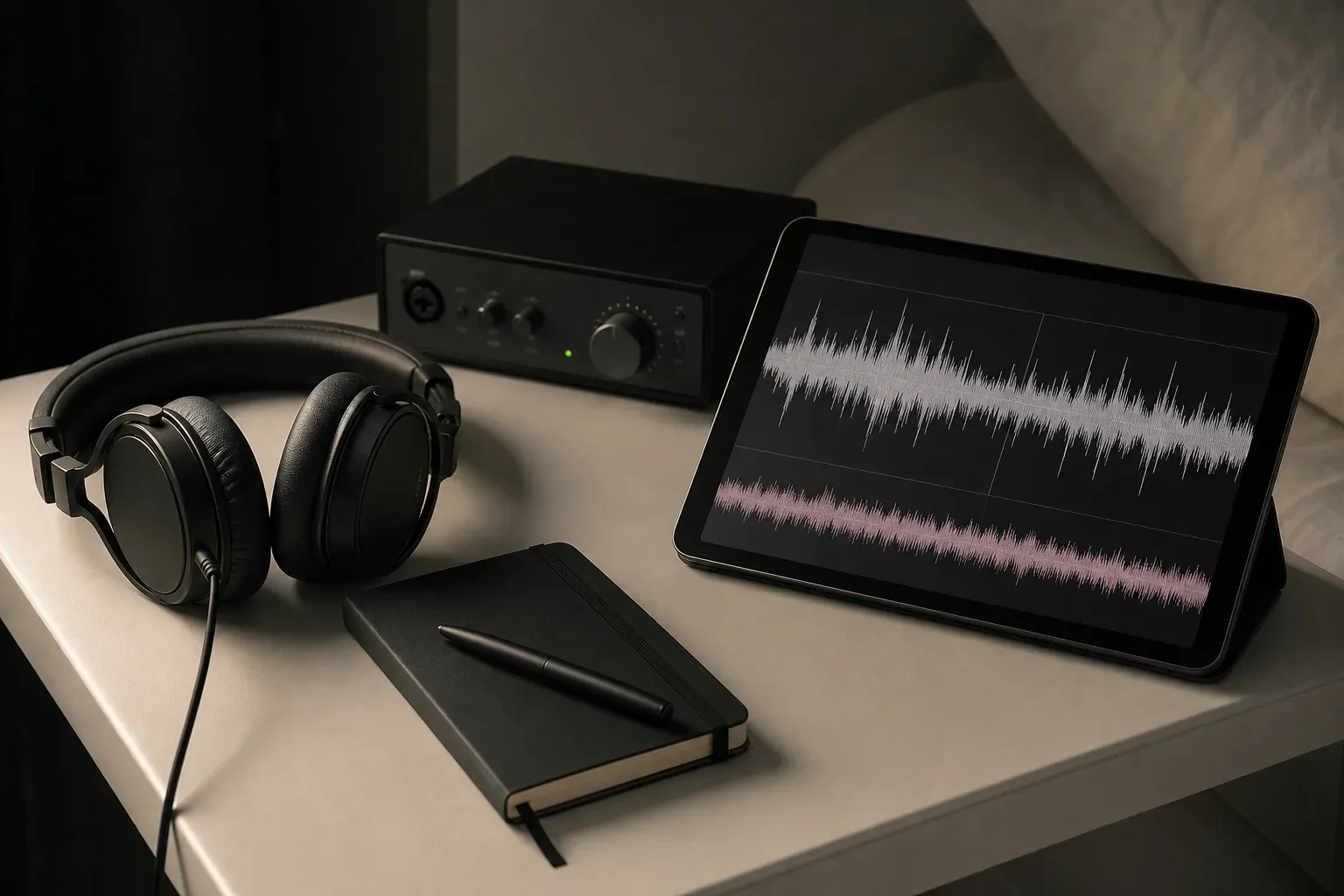
Pink noise memory claims are partly grounded in sleep research, but they don’t transfer cleanly to every audio routine. Pink noise may support memory when precisely timed to slow-wave sleep. Under Dream-Self audio, it should stay quieter than the voice and serve one job: masking distractions without blurring words.
What does pink noise memory actually mean?
Pink noise memory means using a 1/f noise spectrum, often during sleep or study, with the hope of supporting recall.
Pink noise has equal acoustic power per octave, so the octave from 100 to 200 Hz carries about the same power as the octave from 1,000 to 2,000 Hz. White noise, by comparison, has equal power per hertz, which makes it brighter and hissier to many ears. That 3 dB-per-octave downward slope is why pink noise tends to sound like rain, air movement, or a distant fan rather than steam escaping a pipe.
The memory part usually points to sleep, not to study playlists. During deep non-REM sleep, the brain produces slow oscillations around 0.5 to 1 Hz and broader delta activity up to about 4 Hz. Some researchers have tested whether soft sound pulses, timed to those slow waves, can increase their amplitude and improve next-day word recall. That is a different mechanism from playing a flat pink-noise bed all night.
Here is the quiet distinction: pink noise is not a memory button; it is a masking bed with a research footnote. It can make a room feel steadier by covering traffic, hallway voices, or radiator ticks. That steadiness may help sleep, and sleep is strongly tied to memory consolidation. The National Institutes of Health describes sleep as active brain work, not shutdown, with memory processing among its documented functions.
If you are using Dream-Self audio, the relevant question is simpler than the headline. Does pink noise help you stay with the spoken recording, or does it smear the words? A memory-supporting sleep study and a personal audio practice are related by sound, but they are not the same protocol.
What does the research say about pink noise and memory?
The strongest evidence for pink noise and memory comes from small closed-loop sleep studies, not from ordinary background tracks.
A widely cited 2013 Neuron study by Ngo and colleagues used auditory stimulation synchronized to slow oscillations in 11 healthy young adults. When tones were timed to the up-phase of slow waves, participants showed stronger slow-wave activity and better recall of word pairs the next morning. The sample was small, and the system listened to the brain in real time before playing each sound.
A 2017 Frontiers in Human Neuroscience study led by Papalambros tested a similar idea in older adults. In that small study, acoustic stimulation during sleep increased slow-wave activity and was associated with improved overnight memory retention in some participants. Again, this was not a podcast with noise under it. It was a lab-grade timing problem, measured with EEG, in a controlled room.
The evidence becomes thinner when pink noise is used as a steady sound bed. Continuous noise can improve sleep for some people by masking sudden changes, and sudden changes are what wake many sleepers. A door click may be brief, often under 1 second, but the brain reacts to contrast. A constant 40 dBA sound can make a 50 dBA hallway sound less noticeable than silence followed by the same hallway sound.
Reviews of acoustic sleep stimulation usually separate timed pulses from continuous masking. That separation matters. The timed studies aim to enhance slow waves; the masking approach aims to reduce interruption. Both can affect memory indirectly, but only one is testing a specific brain-rhythm hypothesis.
The honest reading is mixed but useful. Timed pink-noise-like stimulation has promising results in small samples. Everyday pink noise is better understood as a sleep-support tool that may protect the conditions in which memory work happens.
Should pink noise play under Dream-Self audio?
Pink noise can play under Dream-Self audio if it stays clearly below the voice and improves attention rather than competing with it.
The AYA Method is a daily audio manifestation practice. Each day you listen to a short personalized recording, your Dream-Self Moment, narrated from the version of you who has already manifested the life you intend. Listening is the practice. Repetition is the work. The audio is the method.
That definition sets the mix priority. Voice sits first. Pink noise sits second, only if the room needs a soft mask. If the narration becomes even 5 percent harder to understand, the bed is too loud, too bright, or simply unnecessary. Speech intelligibility depends heavily on consonants between roughly 2 kHz and 6 kHz. Noise that crowds that range makes language feel present but less exact.
For most Dream-Self recordings, I would start with no noise at all. Then add pink noise only in a noisy room, a shared apartment, or a place where small sounds make you track the building instead of the voice. If you want to hear the difference, compare pink noise with the White noise generator + guide for 60 seconds each at the same phone volume. Pink should feel lower and less hiss-forward.
| Layer | Main job | Good level target | Stop using it when |
|---|---|---|---|
| Dream-Self voice | Carries the practice | Clear at low volume | Words blur or feel strained |
| Pink noise | Masks room variation | 10 to 15 dB under voice | Consonants soften |
| White noise | Stronger broadband mask | Lower than pink noise | Hiss pulls attention |
| Brown noise | Low, rounded mask | Low enough to avoid rumble | Voice feels buried |
Sound should help the voice arrive, not compete for the room. In practice, the quieter layer often does the cleaner work.
How should I mix pink noise under a voice?
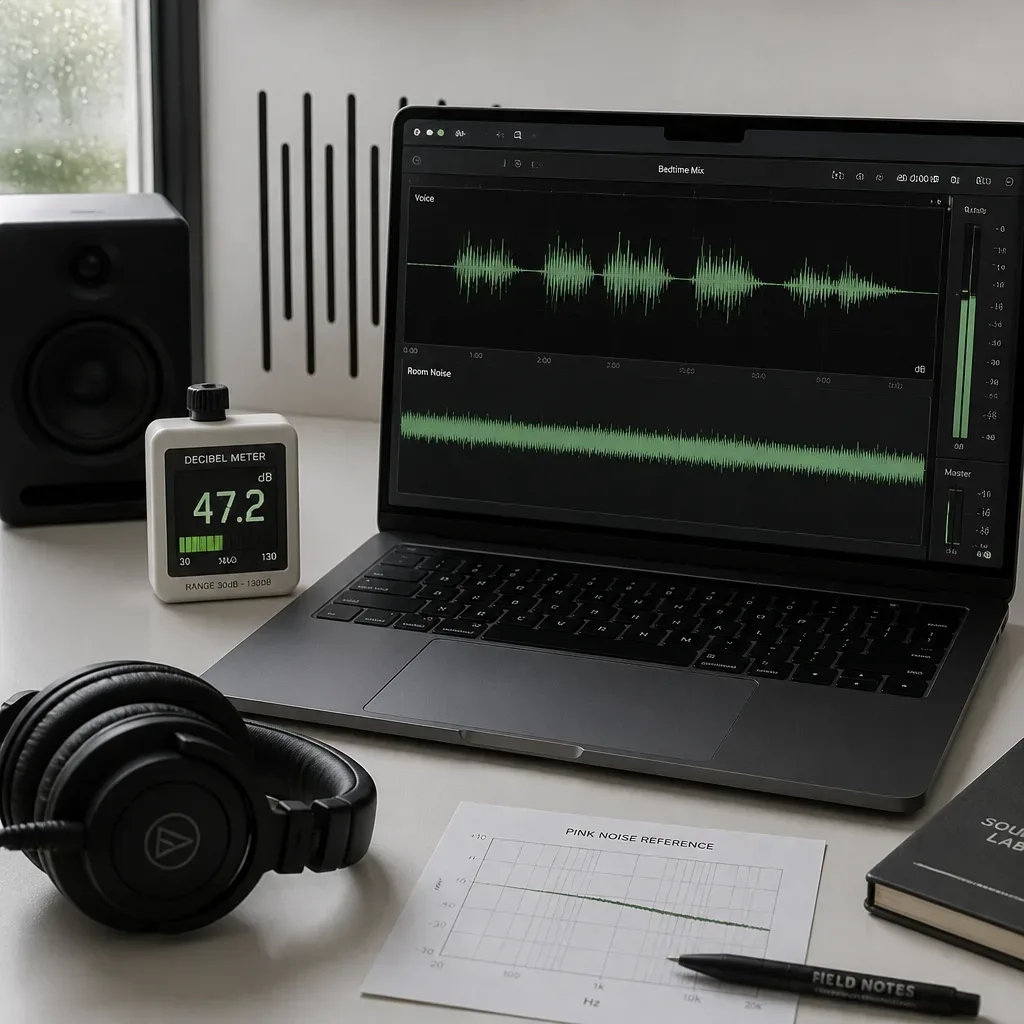
Mix pink noise under a voice by setting the narration first, then raising the noise only until the room stops calling attention to itself.
Start with the voice at the lowest level where every word is easy. On a phone speaker by the bed, that may be around 35 to 45 dBA at the pillow in a quiet room. A basic sound-level meter app is imperfect, often off by several dB, but it is better than guessing. For long listening, conservative matters. NIOSH uses 85 dBA over 8 hours as an occupational exposure limit, and sleep audio should sit far below that.
Once the voice is set, bring pink noise up slowly. The useful point is usually lower than you expect. In studio terms, I would often place a noise bed 10 to 18 dB below spoken narration. If the speaker is small and thin, pink noise can mask the lower warmth of the voice less than brown noise does, but it can still cover breath and consonant detail.
Use this quick check:
- Can you understand the first word of every sentence without effort?
- Does the voice remain centered, not pushed backward?
- Do S, T, K, and F sounds stay crisp at low volume?
- Does the noise disappear from attention after 20 to 30 seconds?
- Can you pause the voice and still feel the noise is gentle?
If one answer is no, reduce the noise by one or two volume steps. On many phones, one step is not tiny. Android and iOS volume increments vary by device, and Bluetooth speakers may add their own gain curve. That is why ear judgment matters.
A bad bed announces itself. A good bed is noticed mostly when it stops. Your nervous system gets a vote.
When is pink noise the wrong choice?
Pink noise is the wrong choice when it makes speech less clear, irritates your ears, or replaces a medical conversation you need.
Some listeners find pink noise smoother than white noise, but smooth is not universal. People with tinnitus may react differently to steady noise depending on pitch, loudness, and stress level. People with hyperacusis can find even moderate broadband sound tiring. If you have tinnitus, sleep apnea, chronic insomnia, or sound sensitivity that affects daily life, talk with a qualified clinician rather than treating noise as a fix.
Pink noise can also fail because of the speaker. A small phone speaker often rolls off below about 150 to 250 Hz and may add distortion when asked to play low-frequency content. That turns a carefully made pink-noise file into a papery hiss with a little box resonance. A bedside speaker can be better, but only if it does not hum, click, or reveal a short loop.
Loop design matters more than people think. An 8-second loop can begin to feel artificial by minute 3 because the brain learns the pattern. Sleep beds should use long renders, slow modulation, or crossfades that do not call attention to the seam. In app work, I have rejected otherwise pretty beds because the loop point appeared every 24 seconds like a small light in a dark room.
Pink noise is also not ideal when you want tonal focus. If you are using the Binaural beats generator + guide, the binaural effect depends on two slightly different tones reaching each ear, often with headphones. Adding noise can make the beat harder to notice. If you are using the Solfeggio frequencies guide, remember that Solfeggio use is a tradition and preference practice; evidence for specific frequency claims is limited. A noise bed may simply cover the tone you chose.
How can I test pink noise with Dream-Self audio tonight?
Test pink noise by comparing three short listening passes, then choosing the version that makes the voice easiest to receive.
You do not need a lab. You need a quiet room, the same speaker position, and a willingness to prefer plain sound over clever sound. The test takes about 12 minutes. Try it before you are exhausted, because tired ears accept messy mixes and then wake up annoyed at 2:40 a.m.
- Play the Dream-Self audio alone for 3 minutes. Set the lowest comfortable voice level. Notice whether the room interrupts you.
- Add pink noise for 3 minutes. Raise it from silence until outside sounds soften, then stop. Do not chase a lush bed.
- Switch to white noise for 1 minute. Use the White noise generator + guide at the same apparent loudness and hear whether the hiss helps or irritates.
- Return to pink noise for 3 minutes. If the voice now feels steadier, keep it. If not, remove it.
- Write one line. Note the setting, speaker, and result. Repeat for 3 nights before deciding.
Three nights is not clinical evidence, but it is better than one impression. Many sleep variables change night to night, including caffeine timing, room temperature, alcohol, stress, and bedtime. A 2023 National Sleep Foundation guideline still points adults toward 7 to 9 hours as the normal sleep range, but the path to that number is uneven.
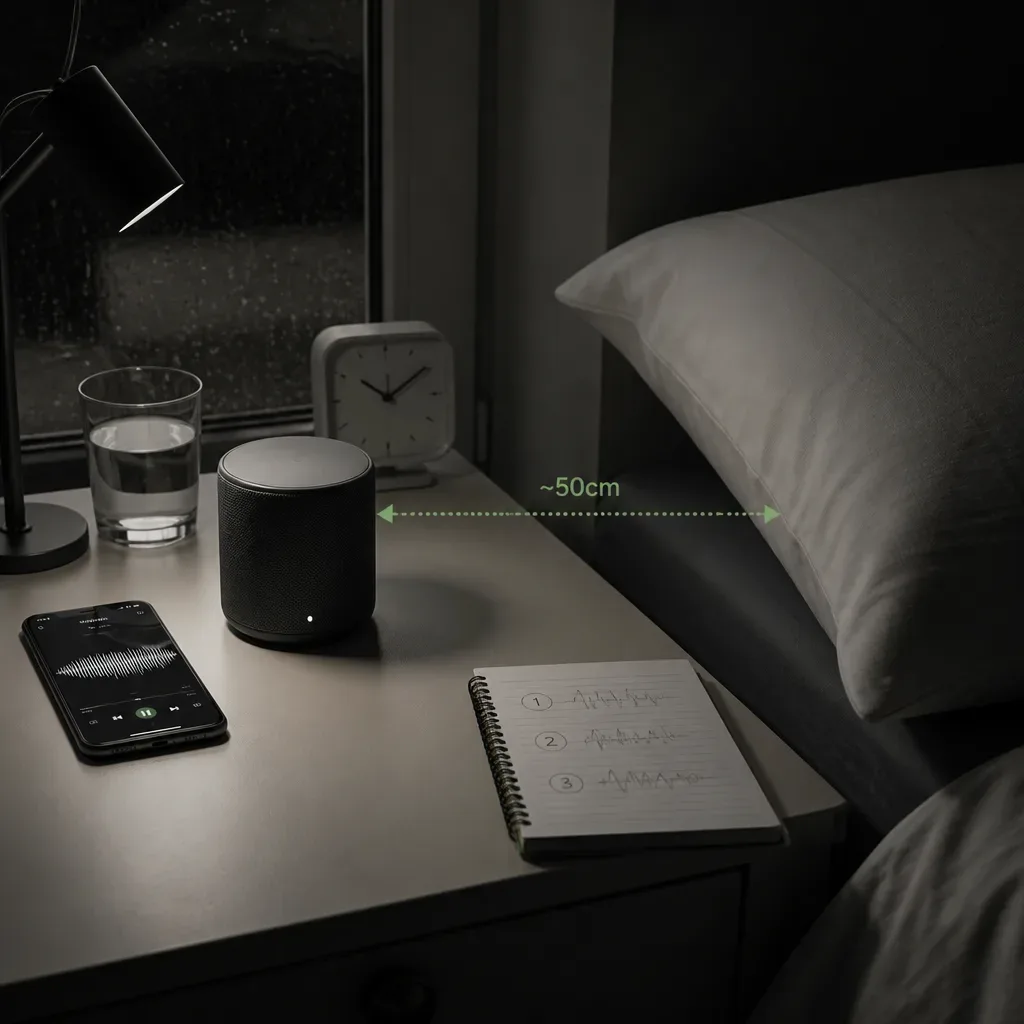
Keep the test conservative. Put the speaker at least an arm’s length from your head if possible. If headphones are involved, use a sleep-safe design and keep the level lower than you think you need. Overnight headphone use can add pressure, heat, and cable risk, especially for side sleepers.
What should I use instead if pink noise distracts me?
If pink noise distracts you, use silence, a lower noise color, a simpler mask, or no bed under the voice at all.
Silence is underrated. If your room is already steady below about 30 to 35 dBA, adding noise may solve nothing. A clean recording in a quiet room often beats a layered recording in a treated one. The point is not to make the audio feel produced. The point is to make the words easy to stay with.
Brown noise can work when pink still feels too bright. It has more low-frequency emphasis and less upper hiss, though small speakers may not reproduce it cleanly. White noise can work when the problem is sharp external sound, but it is more likely to interfere with consonants. Nature recordings can work if they are slow and non-eventful. A bird call at minute 17 is not a feature when you are trying to settle.
Here is the practical comparison:
| Option | Best for | Risk under voice | Try when |
|---|---|---|---|
| Silence | Quiet rooms | Exposes sudden sounds | The voice already feels close |
| Pink noise | Balanced masking | Softens consonants | Traffic or hallway sound varies |
| Brown noise | Low, warm masking | Adds rumble | Pink feels hissy |
| White noise | Strong masking | Sounds sharp | You need more cover |
| Slow ambience | Comfort and continuity | Event sounds wake attention | The loop is long and plain |
If you want to compare tools, use the on-site generators as instruments, not answers. Press play in the Binaural beats generator + guide, then press play in the Solfeggio frequencies guide, then return to the voice. Notice which layer makes listening simpler. Simpler is usually the better mix.
A sound bed earns its place by disappearing. If it keeps asking to be heard, it has failed its job.
What is the safest answer for memory and nightly practice?
The safest answer is to protect sleep, keep the voice clear, and treat pink-noise memory claims as promising but specific.
Memory depends on many boring conditions. Sleep duration, regular timing, alcohol, stress, medications, and untreated breathing problems all matter. Acoustic stimulation is one small lever. In the closed-loop studies, the lever was pulled with EEG timing and brief pulses. At home, you are usually using a steady mask, which is more about reducing interruption than driving slow waves.
For Dream-Self audio, this points to a plain hierarchy. First, make the recording intelligible. Second, make the room steady. Third, choose the lowest level that does both. If pink noise helps, use it. If it adds a layer you keep monitoring, remove it. The best mix is not the richest mix. The best mix is the one that lets attention stop checking the machinery.
That is also where memory and repetition meet. A daily audio practice benefits from being easy to repeat, and repetition benefits from low friction. A 5-minute recording you can hear clearly every night will usually serve you better than a complex stack you keep adjusting. Precision is not decoration here. It is respect for the sleeping listener.
If you remember one setting, remember this: voice first, pink noise second, volume lower than pride suggests. Measure when you can. Listen when you cannot. Change only one variable per night, or you will not know what helped.
Let the room become steady enough for the words to stay plain.