noise colors
Pink Noise vs White Noise for Sleep Audio
pink noise vs white noise for sleep, masking, and Dream-Self audio: compare spectra, evidence, volume, and which bed partner each fits.
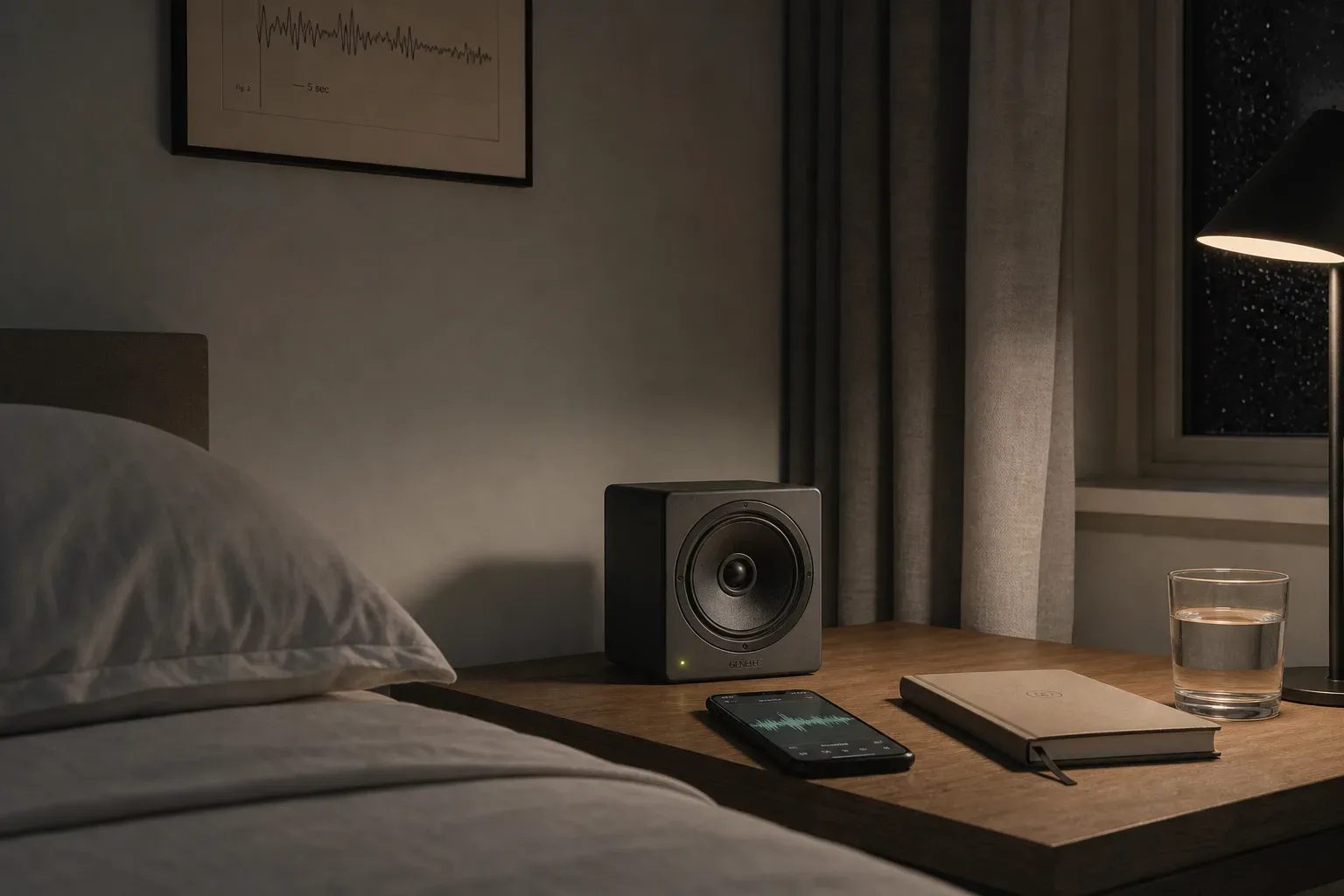
Pink noise vs white noise comes down to spectrum and purpose: white noise gives equal level per hertz and masks sharply, while pink noise drops about 3 dB per octave and sounds lower, smoother, and less hissy. For Dream-Self audio, pink noise usually leaves speech clearer at a lower volume.
What is the real difference between pink noise and white noise?
Pink noise and white noise differ by frequency distribution, not by intention or mood.
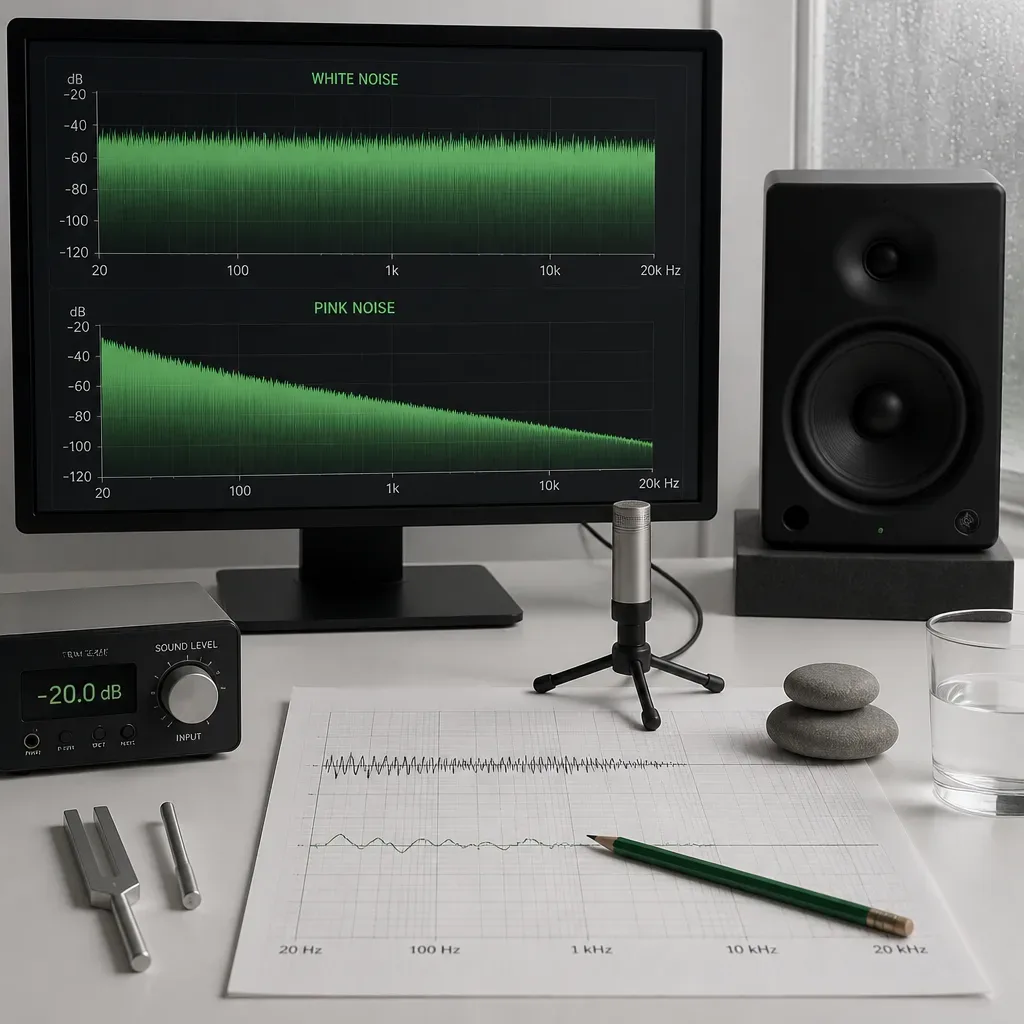
White noise contains equal acoustic level per hertz across the audible band, often described as 20 Hz to 20,000 Hz for young healthy ears. Because there are far more individual hertz in the high octaves than in the low ones, white noise can sound bright, airy, or hiss-like. It is useful because that high-frequency content masks small clicks, speech edges, and distant mechanical noise.
Pink noise is filtered so the level falls by about 3 dB per octave. Each octave carries roughly equal level, which is closer to how many natural sounds spread across frequency. To many listeners, pink noise feels steadier and less sharp than white noise. The difference is measurable on a spectrum analyzer in less than 10 seconds, and you can hear it if you press play in the White noise generator + guide and compare a bright hiss against a lower, rain-like wash.
| Signal | Spectrum shape | Common sound impression | Best use at bedtime |
|---|---|---|---|
| White noise | Equal level per Hz | Bright, hissy, dense | Masking speech and sudden room noise |
| Pink noise | About -3 dB per octave | Softer, lower, balanced | Sitting under voice or sleep music |
| Brown noise | About -6 dB per octave | Deep, low, less airy | People who dislike hiss |
The label on a machine is not enough. A 2020 review in Sleep Medicine Reviews noted that sound interventions vary widely in signal type, timing, and volume, which makes broad claims hard to compare. Two devices can both say pink noise and still differ by filter slope, loop length, speaker size, and room placement.
The spectrum matters more than the label.
Which one masks bedroom noise better?
White noise usually masks more aggressively, while pink noise often masks gently enough for sleep.
Masking works when one sound makes another sound less noticeable at the ear and less important to the brain. Sudden changes are the problem. A door latch at 2:13 a.m. or a scooter braking outside may be brief, but the nervous system is good at detecting contrast. A steady signal reduces that contrast. In a 2012 study by Buxton and colleagues, hospital noises as low as roughly 40 dB increased arousal probability during sleep, especially when the sound had meaning, such as speech or alarms.
White noise is strong at masking because it covers a wide band, including the consonant range of speech around 2,000 to 6,000 Hz. That is also why it can become irritating if you play it too loud. The same high-frequency content that hides a hallway conversation can make your pillow feel like it is next to a small air vent.
Pink noise has less high-end level, so it may not cover speech as completely. But that can be an advantage when you are layering it beneath spoken audio. If your Dream-Self recording has consonants that need to stay clean, pink noise often gives a steadier background without sanding off the words. A sound bed should make the room less interesting, not make the voice harder to understand.
Try this simple check tonight:
- Put the speaker 1 to 2 meters from your pillow, not against your ear.
- Play white noise at the lowest audible setting for 60 seconds.
- Switch to pink noise without changing your body position.
- Speak one sentence softly, or play your recording.
- Keep the signal that masks the room while preserving words.
If you need hard masking, start with white. If you need a quiet bed for voice, start with pink. If neither feels right, the problem may be level, speaker placement, or a loop seam rather than the color itself.
Which fits Dream-Self audio more cleanly?
Pink noise usually fits Dream-Self audio better because it leaves more room for speech clarity.
The AYA Method is a daily audio manifestation practice. Each day you listen to a short personalized recording, your Dream-Self Moment, narrated from the version of you who has already manifested the life you intend. Listening is the practice. Repetition is the work. The audio is the method. For that reason, any background sound has one job: prepare the room without competing with the voice.
Speech carries important information across a broad band. Vowels sit lower, often under 1,000 Hz, while consonant detail lives higher, commonly between 2,000 and 8,000 Hz. White noise can occupy that same upper range. At low levels, it is fine. At higher levels, it may blur the exact syllables that make a personal recording feel specific.
Pink noise tends to step back from that consonant band. It still fills the room, but its softer high end gives spoken audio more space. In practice, many people can keep pink noise 3 to 6 dB lower than white noise and still feel covered. A 3 dB change is small but measurable; a 10 dB increase is commonly perceived as about twice as loud, depending on frequency and listener.
Use this pairing logic:
- Dream-Self Moment with a close voice: pink noise, low level, speaker off to the side.
- Noisy apartment with intermittent speech: white noise before the recording, then lower it.
- Soft music under the voice: pink noise or no noise, because music already fills space.
- Headphones in bed: keep levels lower than you think; pressure builds quietly over time.
A personal voice recording should remain the foreground. The noise is furniture in the room.
What does the evidence say about sleep and noise colors?
The evidence suggests sound can help some sleepers, but pink noise vs white noise is not settled by large clinical trials.
White noise has been studied mostly as a masking tool. A small 2005 study in Sleep Medicine by Stanchina and colleagues tested white noise for patients exposed to intensive care noise and reported fewer arousals when masking was present. The sample was small, so it is not a universal rule, but the mechanism is plain: a steady sound can reduce the relative impact of sudden sounds.
Pink noise research is more often tied to timed acoustic stimulation during deep sleep. In a 2013 study in Neuron, Ngo and colleagues used phase-locked pink-noise bursts during slow-wave sleep and reported increased slow oscillation activity and improved memory performance in 11 participants. Papalambros and colleagues later studied closed-loop acoustic stimulation in older adults in 2017, again with small samples and careful lab timing. These studies are interesting, but they are not the same as playing a pink-noise track all night from a bedside speaker.
That distinction matters. A lab system may detect sleep phase and deliver short bursts at precise moments. A home generator usually plays continuously. Continuous pink noise may feel pleasant and may mask the room, but it should not be described as a guaranteed slow-wave enhancer. Claims outrun measurements quickly in sleep audio.
The broader sleep field is cautious. A 2021 systematic review in Sleep Medicine Reviews found mixed evidence for continuous noise improving sleep, partly because studies used different sounds, populations, and outcome measures. Some participants sleep better with masking. Some do not. A nervous system is an instrument you can learn to tune, but it is not a machine you can command with one frequency.
If you like frequency-based listening, keep categories clear. Noise colors are broadband masking signals. The Binaural beats generator + guide explains a different mechanism: two tones create a perceived beat when heard through headphones. The Solfeggio frequencies guide covers a tradition of named tones, with the evidence stated plainly. These can be meaningful listening choices, but they are not the same tool as pink or white noise.
How loud should pink or white noise be at night?
Set either noise color as low as possible, usually around 35 to 45 dB at the pillow.
Volume is the part people skip, and it is the part that protects sleep and hearing. The World Health Organization’s night noise guidance uses 40 dB as a level associated with protecting public health for outdoor night exposure, while levels above 55 dB are linked with more serious long-term disturbance. Those numbers are not a prescription for your bedside speaker, but they give useful scale.
NIOSH allows 85 dBA for 8 hours in occupational settings, with exposure time dropping as level rises. That is a workplace damage-risk standard, not a sleep target. Overnight listening should be far below it. Children need more caution because speakers may be placed closer to the ear and because they cannot always report discomfort clearly.
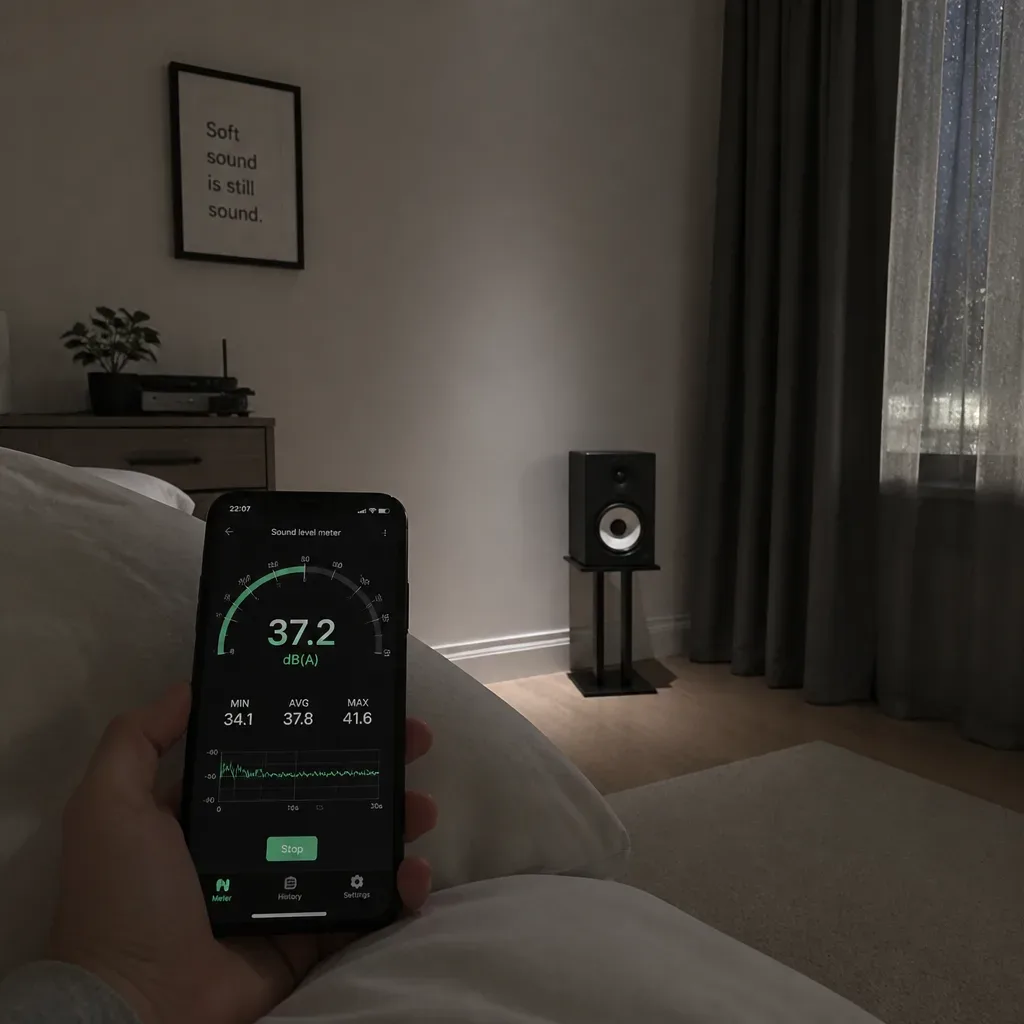
Phone sound meter apps are imperfect, often varying by several dB depending on microphone and calibration. Still, they can help you avoid obvious excess. Measure at pillow height, where your head rests, not next to the speaker. If the app reads 55 to 60 dB in a quiet bedroom, lower it. If you can hear the noise clearly from the hallway with the door nearly shut, it is probably too loud.
Speaker placement changes the result. A small speaker 30 cm from your ear can feel sharper than a better speaker 2 meters away at the same measured level because near-field balance and high-frequency directionality differ. Put the source across the room when you can. Avoid placing a phone under a pillow; it can muffle high frequencies, heat the device, and encourage higher volume.
Use this conservative setup table:
| Listener | Starting level at pillow | Placement | Note |
|---|---|---|---|
| Adult in quiet room | 35 dB | 1 to 2 m away | Raise only if needed |
| Adult near traffic | 40 to 45 dB | Between bed and window | Use curtains and sealing too |
| Child | As low as audible | Across the room | Ask a clinician for chronic sleep issues |
| Tinnitus listener | Individual | Not too close | Consult an audiologist if symptoms persist |
If you have chronic insomnia, suspected sleep apnea, bothersome tinnitus, or sudden hearing changes, use sound only as support and speak with a qualified professional.
How do you choose between pink noise and white noise tonight?
Choose by the job: white noise for masking, pink noise for comfort under voice, and silence when the room is already steady.
A good test takes less than 10 minutes. Do it before you are exhausted, because tired ears are impatient ears. Keep the speaker in the same place and change only one variable at a time. If you change the app, volume, speaker angle, and noise color together, you will not know what helped.
Use this order:
- Measure the room first. Sit in bed for 60 seconds and name the main disturbance: speech, traffic, radiator, refrigerator, pets, or your own attention.
- Start with pink noise. Set it just above audibility for 2 minutes. Notice whether your jaw and shoulders stop bracing.
- Switch to white noise. Keep the same volume knob position, then adjust down if the hiss feels sharp.
- Add the voice. Play the Dream-Self Moment or another spoken track. If words blur, reduce noise or return to pink.
- Stop at good enough. The goal is not a perfect cocoon. The goal is a stable room at a safe level.
There is no moral value in sleeping with sound or without it. Some nights need a mask. Some nights need quiet. Many people rotate by season: white noise for summer windows and street noise, pink noise for winter rooms where the main issue is mental alertness rather than outside sound.
If you want a technical comparison, use the White noise generator + guide as a reference point, then test tones separately in the Binaural beats generator + guide only when you are using headphones and want a tone-based session. If you are curious about named frequency traditions, read the Solfeggio frequencies guide with the same care: tradition can be personally useful without requiring claims the data cannot support.
The right sleep sound is the one that does the least and helps enough.
For Dream-Self audio, I would begin with pink noise at a very low level. If the building is loud, use white noise first to settle the room, then reduce it before the voice begins. The voice should not fight for space. The method asks for daily repetition, not theatrical sound design.
Tonight, choose the hum your body stops arguing with.