frequencies binaural
Solfeggio Frequencies Chart for Dream-Self Audio
A measured solfeggio frequencies chart for Dream-Self audio layers, with Hz values, lore, evidence limits, volume guidance, and mix notes.
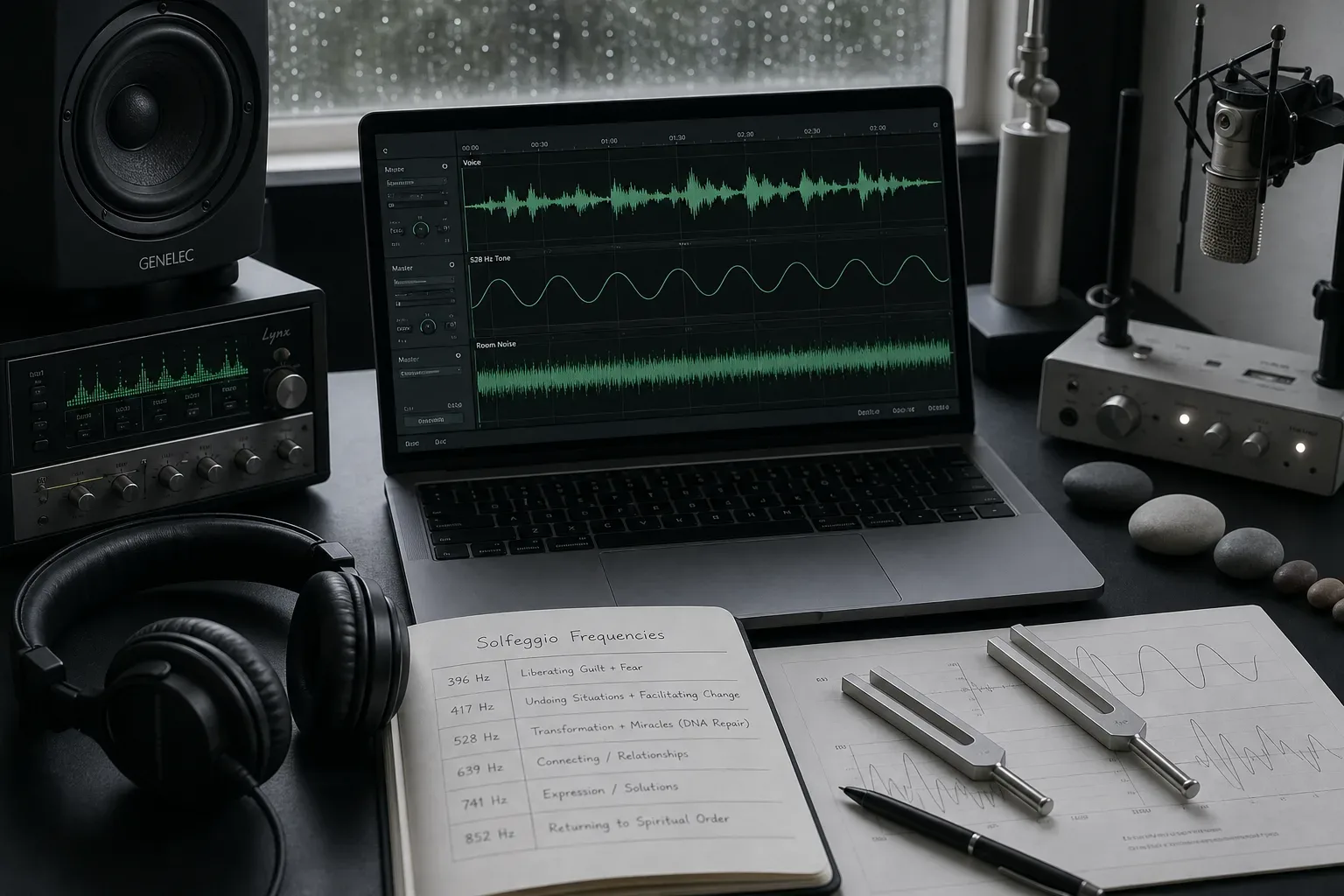
A solfeggio frequencies chart is a practical map of tone values, usually 174 Hz through 963 Hz, paired with traditional meanings. For Dream-Self audio, use it as a sound-design reference, not proof. The measurable part is frequency. The personal part is whether the tone helps you settle and listen daily.
What does a solfeggio frequencies chart actually show?
A solfeggio frequencies chart shows fixed tone frequencies in hertz, plus traditional labels that should be read as lore rather than established medicine.
The common modern chart lists 9 tones: 174 Hz, 285 Hz, 396 Hz, 417 Hz, 528 Hz, 639 Hz, 741 Hz, 852 Hz, and 963 Hz. A hertz is one cycle per second, so 528 Hz means the waveform repeats 528 times every second. That part can be measured with any basic spectrum analyzer. The meanings attached to the numbers are less firm. They come from late 20th-century sound-spirituality writing, including work associated with Joseph Puleo and Leonard Horowitz, rather than from large randomized trials.
That distinction matters because audio can be both meaningful and unproven. A 528 Hz sine wave is not vague. It is a precise tone. The claim that it repairs DNA, fixes grief, or guarantees a changed life is not in the same category of evidence. In sound work, precision is not permission to overclaim.
Here is the plain chart most readers are looking for:
| Frequency | Common traditional label | Practical audio note |
|---|---|---|
| 174 Hz | grounding, pain relief in lore | Low and easy to tuck under speech |
| 285 Hz | repair, tissue support in lore | Warm low-mid tone, audible on small speakers |
| 396 Hz | fear release in lore | Stronger pitch center, can feel serious |
| 417 Hz | change, clearing in lore | Noticeable under narration, use quietly |
| 528 Hz | love, repair in lore | Bright enough to draw attention |
| 639 Hz | connection in lore | Can interfere with voice harmonics |
| 741 Hz | expression, clarity in lore | More present, sometimes tiring |
| 852 Hz | intuition in lore | High and exposed on headphones |
| 963 Hz | crown, unity in lore | Very audible, best used sparingly |
If you want the broader background, our Solfeggio frequencies guide separates the tradition from the testable claims in more detail. A chart is useful when it helps you make cleaner decisions. It becomes noise when it asks you to believe more than the sound can carry.
A frequency chart is a map of pitches, not a map of outcomes.
How should you read the meanings without overstating the science?
Read the meanings as symbolic prompts, while treating the acoustic settings as the part you can measure and adjust.
The evidence for music and relaxation is real but broad. For example, a 2018 Cochrane review on music interventions for insomnia examined several small studies and found possible sleep benefits, but the authors noted limitations in study quality and sample size. That does not validate 528 Hz as a special biological switch. It says that structured listening can help some people downshift, especially when it is repeated and paired with a stable bedtime routine.
Solfeggio claims often sound stronger than the evidence. In small studies of sound, meditation, and stress, researchers usually test music, chanting, or frequency-assisted relaxation as whole practices, not isolated tones. If a 20-minute track lowers self-reported tension, the effect may come from the tempo, breathing, expectation, masking, voice, ritual, or simple rest. One number in hertz is rarely the whole mechanism.
That said, symbolic meaning can still be useful. A person may choose 396 Hz because the label fear release gives the session a clear emotional frame. The frame can affect attention. Placebo is not a dirty word in self-practice, but it should be named honestly. In clinical research, placebo responses can be large enough to measure, and they often depend on belief, repetition, and context.
A good working rule is simple:
- Use the Hz value to design the sound.
- Use the traditional label to choose an intention.
- Use your body to decide whether the layer belongs in the mix.
- Use daily repetition to test whether the routine holds.
The tone is not the practice. The listening is the practice.
Which solfeggio frequencies fit Dream-Self audio layers best?
The best solfeggio frequency for Dream-Self audio is the one that supports the narration without pulling attention away from it.
Dream-Self audio is voice-led. In the AYA Method, the daily practice is listening to a short personalized recording, your Dream-Self Moment, narrated from the version of you who has already manifested the life you intend. Listening is the method. A tone layer is only a support under that voice.
For spoken audio, low and low-mid tones usually behave better than high tones. Adult speech often carries important intelligibility between about 1,000 Hz and 4,000 Hz, but the warmth and body of a voice sit lower, often between 100 Hz and 300 Hz. A 174 Hz or 285 Hz layer can sit beneath narration if it is quiet enough. A 741 Hz or 963 Hz tone is closer to the region where the ear notices edges and small level changes, so it can start to compete.
Use this mixing order before choosing a mystical label:
- Set the narration first at a comfortable level.
- Add the solfeggio tone at least 12 dB lower than the voice.
- Listen for 2 minutes on the device you actually use at night.
- Remove the tone if you start monitoring it instead of hearing the words.
- Test the same mix for 7 nights before changing the frequency.
The 12 dB rule is not sacred, but it is useful. In audio engineering, a 10 dB reduction is often perceived as roughly half as loud, depending on frequency and context. Because sine tones can become irritating quickly, lower is safer than louder.
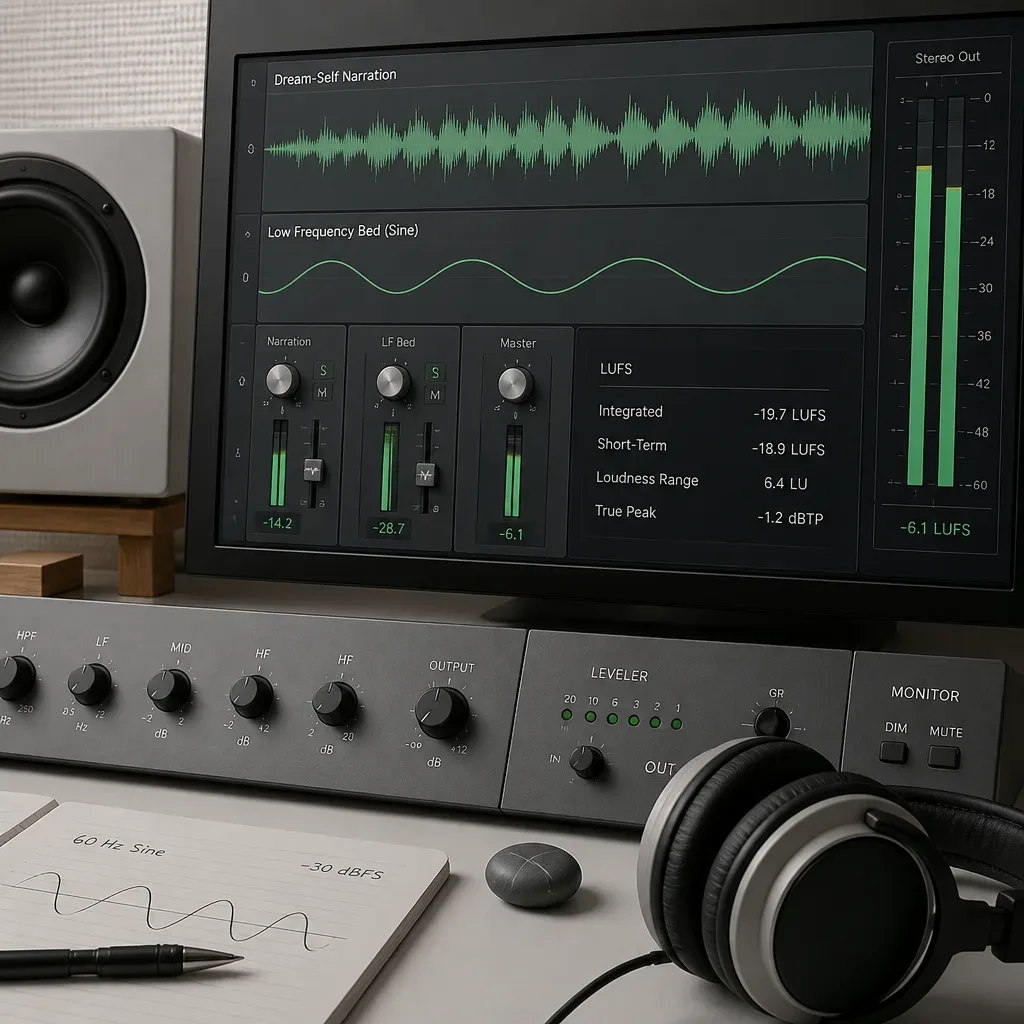
If you want a non-tonal bed under Dream-Self audio, press play on the White noise generator + guide and compare it with a sine tone. White noise masks with a broad spectrum. A solfeggio tone marks one pitch. Those are different jobs.
How do solfeggio tones compare with binaural beats and noise colors?
Solfeggio tones are single pitch references, while binaural beats create a perceived beat and noise colors use broad filtered sound.
A binaural beat needs headphones. If the left ear hears 200 Hz and the right ear hears 210 Hz, the auditory system can perceive a 10 Hz beat. Research on binaural beats is mixed. A 2019 meta-analysis in Psychological Research reported small effects on anxiety, memory, attention, and pain across studies, but results varied by frequency, duration, and design. The illusion is real. The claims around it need care.
Noise colors are different again. White noise has equal power per hertz. Pink noise reduces level by about 3 dB per octave, which makes it sound less hissy. Brown noise reduces more steeply, about 6 dB per octave, which gives it more low-frequency weight. These are spectrum shapes, not named spiritual tones.
| Tool | What it is | Needs headphones | Best use under voice |
|---|---|---|---|
| Solfeggio tone | One steady Hz value | No | Intention cue, very quiet layer |
| Binaural beat | Two tones creating perceived beat | Yes | Focused listening, not ideal on speakers |
| White noise | Broad equal-per-Hz noise | No | Masking room sound |
| Pink noise | Broad noise, -3 dB per octave | No | Softer masking for sleep |
| Brown noise | Broad noise, more low-frequency weight | No | Low hum for some nervous systems |
For a voice track, noise often masks the room more naturally than a pure tone. If your refrigerator hum, traffic, or neighbor sounds are the problem, the White noise generator + guide may help more than a 528 Hz layer. If you are curious about beat frequencies, the Binaural beats generator + guide lets you hear the difference directly.
A steady tone says, listen here. Noise says, let the room blur.
What volume, duration, and layering rules protect the ear?
Keep solfeggio layers quiet, short enough to stay comfortable, and clearly below the spoken voice.
For nightly listening, conservative volume is the correct default. The World Health Organization has warned that over 1 billion young people may be at risk of hearing loss from unsafe listening practices, largely because headphones can be played too loudly for too long. Occupational limits such as NIOSH use 85 dBA over 8 hours as a risk reference, with allowed time halving for each 3 dB increase. Bedtime audio should sit far below that.
A practical target is 40 to 50 dB SPL at the ear, similar to a quiet room or soft rainfall. Most people do not own a calibrated sound level meter, so use behavior: you should be able to speak over the track softly without raising your voice. If the tone feels like it is drilling into attention, it is too loud, even if the phone slider looks low.
Layering rules for Dream-Self audio are plain:
- Keep narration as the loudest element.
- Keep any solfeggio layer 12 to 18 dB below the voice.
- Roll off unnecessary bass below 60 Hz on small speakers.
- Avoid stacking more than 2 steady tones under speech.
- Do not use high tones with children at close headphone levels.
- If tinnitus spikes, stop and ask an audiologist or clinician.
Duration also matters. A 5-minute daily Dream-Self recording repeated for 30 days will teach you more than a 90-minute frequency stack you abandon by night 3. Habit research varies, but a widely cited 2009 study by Phillippa Lally and colleagues found a median of 66 days for a new behavior to become automatic. Audio routines work best when they are easy enough to repeat.
Quiet beats clever when the ear is tired.
Can a chart help you build a nightly Dream-Self mix?
Yes, a chart can help if you treat it as a constraint system: choose one role for the tone, set a safe level, and test the same mix for several nights.
Start with the purpose of the layer. If your Dream-Self audio already has a calm voice and soft room tone, adding 3 frequencies may make it less stable. If the recording feels too dry, one low tone can give it a floor. Engineers often solve mix problems by removing layers, not adding them. The same rule applies here.
A simple nightly mix might look like this:
| Layer | Suggested setting | Reason |
|---|---|---|
| Voice | Clear, centered, full level | The words carry the practice |
| Room bed | Pink or brown noise, very low | Masks sudden sounds |
| Solfeggio tone | 174 Hz or 285 Hz, -12 to -18 dB | Adds a steady pitch cue |
| Music pad | Optional, sparse | Avoids crowding the voice |
| Silence tail | 20 to 60 seconds | Lets the nervous system settle |
If you want to compare tone against beat, use the Binaural beats generator + guide for one session and a simple solfeggio tone for another. Keep everything else the same: same headphones, same time, same volume, same 7-night test window. Changing 5 variables at once gives you a story, not a result.
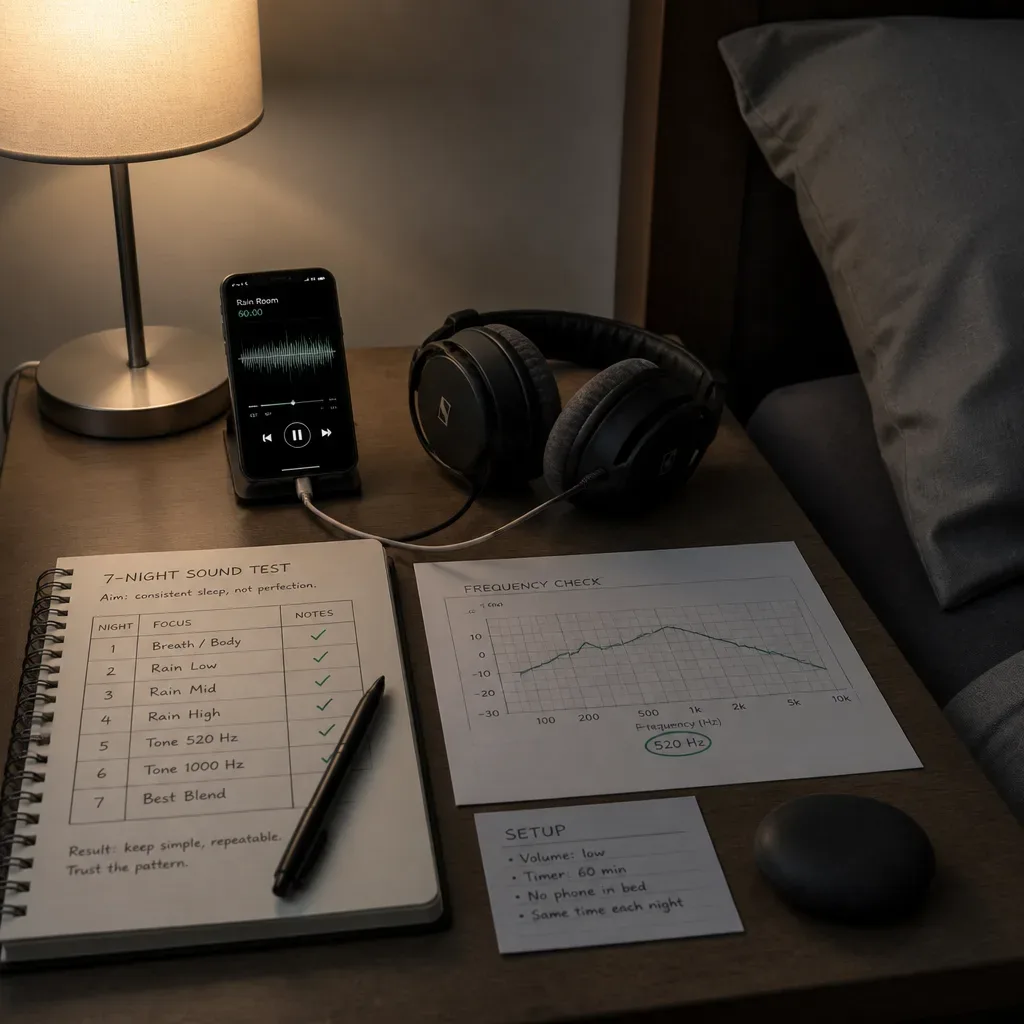
The chart can also prevent random choices. For example, if 963 Hz feels sharp under your voice memo, you can move down to 285 Hz rather than quitting the whole idea. If 528 Hz feels meaningful but distracts you, use it as a 10-second opening chime instead of a full-bed tone. Design is not devotion to a number. Design is choosing what the ear can live with.
For more context on tone traditions, keep the Solfeggio frequencies guide nearby while you test. For masking, compare the same voice over pink or brown noise in the White noise generator + guide. Press play below and listen for the difference before you decide.
What should you do if the frequency claims feel convincing but unclear?
Keep the part that helps you listen, and leave any claim that asks for certainty without evidence.
A person can love 528 Hz without claiming it has been proven to repair DNA. A person can prefer 174 Hz because it feels low and steady without needing it to be a medical treatment. The ear is allowed to have preferences. The chart is allowed to have history. Neither requires us to invent data.
This is the cleanest way to use the chart tonight:
- Pick one frequency from the chart, preferably 174 Hz, 285 Hz, or 396 Hz for spoken audio.
- Set your voice track first.
- Add the tone quietly, at least 12 dB below narration if you can measure.
- Listen for 5 to 10 minutes.
- Write one sentence afterward: easier, harder, or no difference.
- Repeat for 7 nights before changing the tone.
That is enough data for personal use. It is not a clinical trial, but it is better than chasing a new number every evening. In the Journal of Behavioral Medicine and similar fields, self-monitoring has long been used because repeated observation changes vague impressions into usable patterns. Your notes do not need to be elaborate. They need to be consistent.
If you have chronic insomnia, sleep apnea symptoms, distressing tinnitus, or new hearing changes, sound layers are not the whole answer. Speak with a qualified clinician. Audio can support a routine, but it should not delay care.
A good frequency choice does not demand belief. It earns repeat listening.
Let the quiet setting be the one you can return to.