noise colors
Sound Machine vs App Under Dream-Self Audio
Sound machine vs app: how to choose a steady bed for Dream-Self audio, compare masking, volume, looping, privacy, and tonight’s simplest setup.
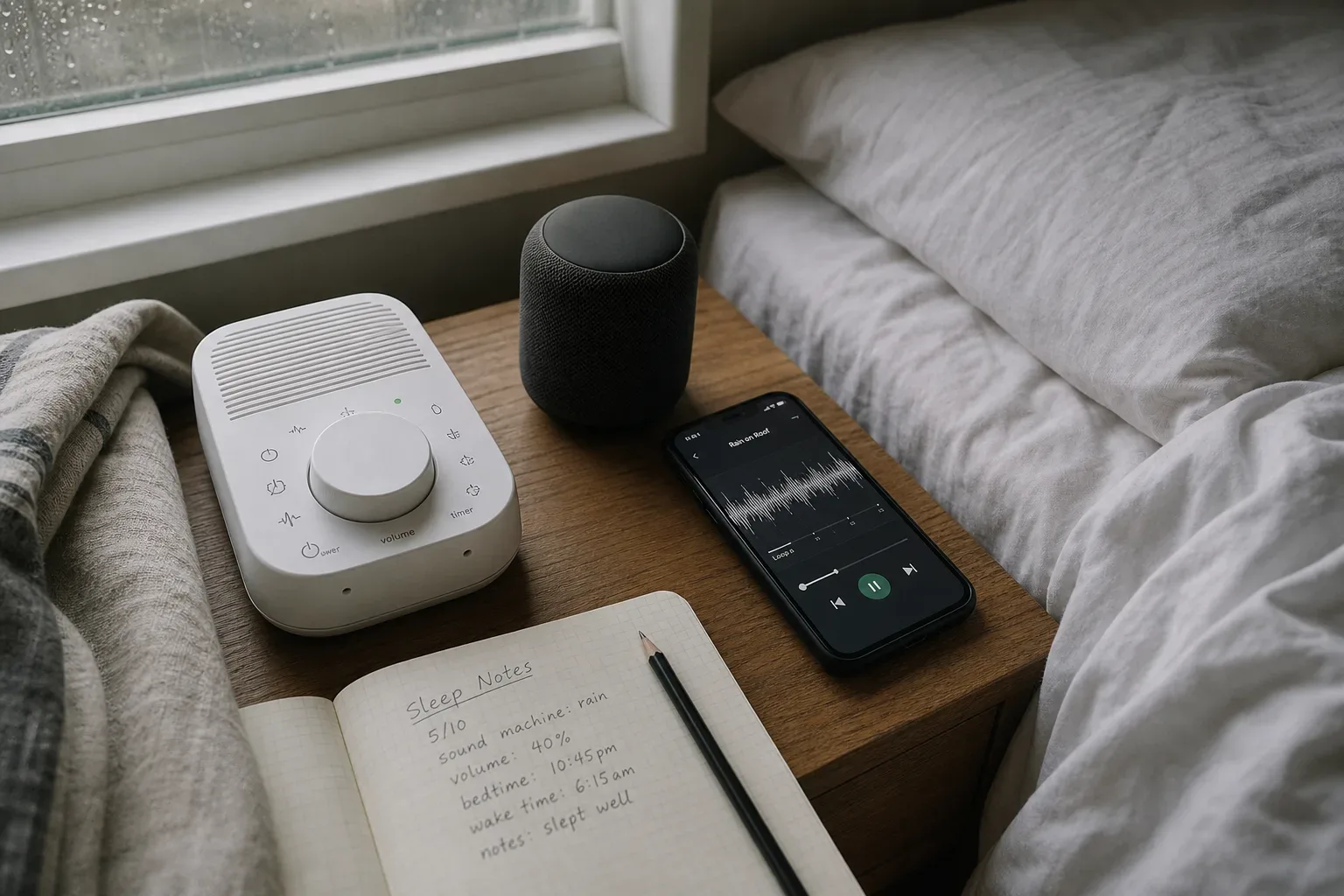
A sound machine vs app choice comes down to separation and control: a machine gives a stable background layer while Dream-Self audio plays elsewhere, while an app gives finer tone, timer, and mixing options. Choose the one that keeps the voice clear, the room masked, and the volume low.
Which option gives the steadier bed under Dream-Self audio?
A dedicated sound machine is usually steadier, while an app is usually more adjustable.
When I record rain, the bed matters more than the dramatic drops. A good bed is not interesting. It is level, plain, and easy for the ear to stop checking. Under spoken Dream-Self audio, that is the same job: make the room less jumpy without making the voice work harder. The American Speech-Language-Hearing Association often points to ordinary conversation around 60 dB; your masking layer should sit well below that at the pillow.
A sound machine wins when you want one task done reliably. It starts with one button, it does not receive messages, and it normally remembers yesterday’s setting. A phone app wins when you want to choose a noise color, shape an equalizer, or change a timer in 5-minute steps. Pew Research Center reported in 2024 that about 91% of U.S. adults own a smartphone, so the app is already in the room for most people. That convenience is real.
The issue is not whether the sound is digital. Many sound machines use digital loops too. The issue is attention. A phone brings light, alerts, battery worries, and the small temptation to adjust. A machine brings fewer controls and fewer reasons to touch it.
| Use case | Better choice | Why it tends to work |
|---|---|---|
| Spoken Dream-Self audio from your phone | Sound machine underneath | Keeps the voice source separate |
| Precise pink, brown, or white noise tuning | App | More control over color and level |
| Shared bedroom | App with timer | Easier to reduce or stop after playback |
| Child’s room | Low-volume machine | Fewer screens and fewer notifications |
| Travel | App | No extra device in the bag |
If you use the AYA Method, the audio is the practice: each day you listen to a short personalized recording, your Dream-Self Moment, narrated from the version of you who has already manifested the life you intend. Listening is the practice. Repetition is the work. The audio is the method. The background layer should serve that voice, not compete with it.
A good sleep bed is not the sound you notice. It is the sound that lets you stop checking the room.
What changes when the sound source is beside the bed?
Placement changes the low end, the perceived loudness, and how much the background layer masks the room.
Small speakers are not neutral. Put a sound machine on a wooden bedside table and it may gain a little low hum through surface vibration. Put a phone speaker face-up on fabric and the high frequencies can dull quickly. That matters because speech intelligibility lives partly in consonants between roughly 2 kHz and 5 kHz, while many traffic and HVAC intrusions sit lower. If the bed layer is too bright, it fights the voice. If it is too thin, it fails to cover the room.
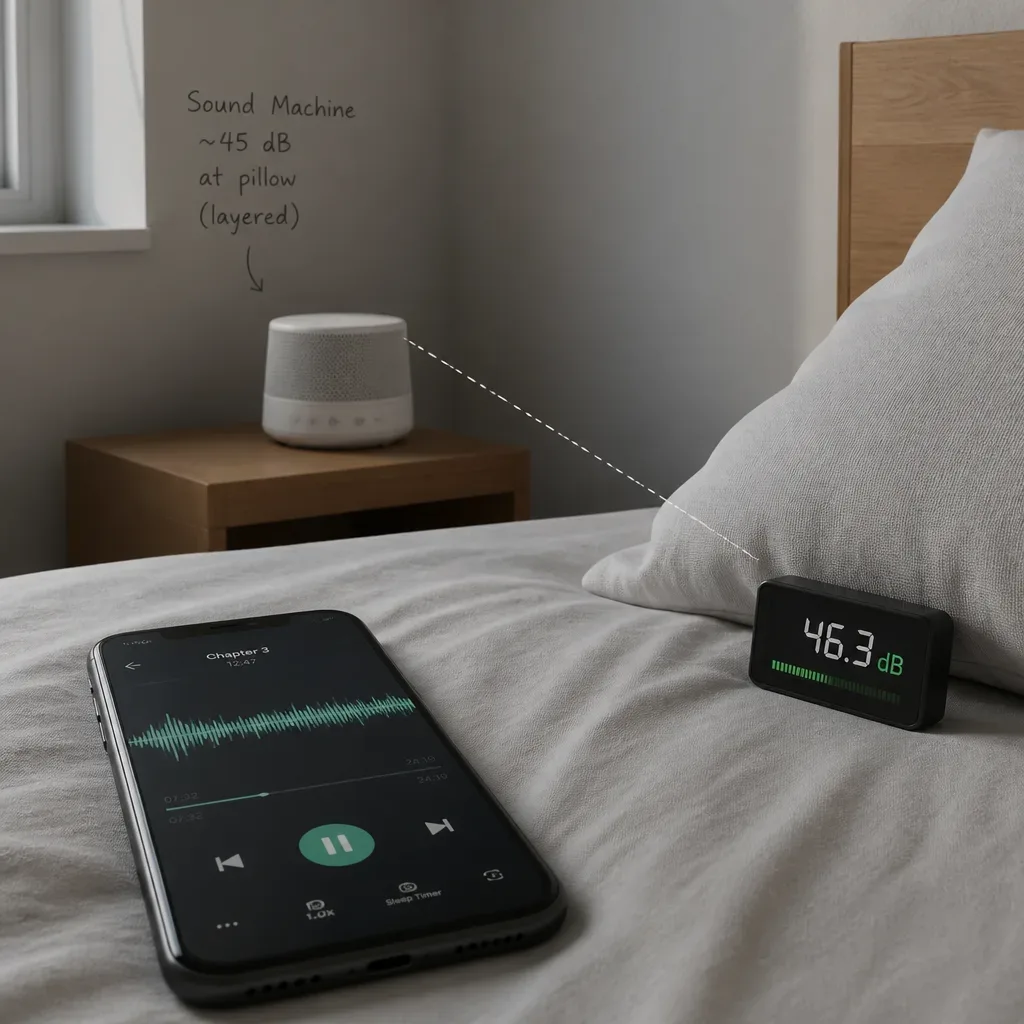
Distance matters too. A sound that measures 45 dB at the machine may be closer to 35 to 40 dB at the pillow, depending on room size and reflections. The inverse-square rule says sound pressure drops about 6 dB every time distance doubles in open space, though bedrooms soften that rule because walls reflect sound. Use the pillow as your measurement point, not the device face.
For noise color, start with a known reference. The White noise generator + guide is useful because you can press play and hear how a flat hiss differs from pink or brown-leaning beds. White noise carries equal acoustic power per hertz, so it often sounds bright. Pink noise gives equal acoustic power per octave, which many ears hear as steadier. Brown noise leans lower still.
Try this plain placement check before you decide:
- Put the machine or phone at least 1 meter from your head.
- Aim the speaker away from your ear, toward a wall or corner.
- Start the background layer before the spoken audio.
- Raise it only until the room stops pulling your attention.
- Lower it if consonants in the voice lose their edges.
The room is part of the instrument. A cheap speaker in the right place can beat a better speaker placed too close to the ear.
Which masks interruptions without covering the voice?
The better masker is the one that reduces sudden contrast while leaving speech fully intelligible.
Masking is not a blanket. It is a reduction in contrast. If a truck passes at 55 dB and your bedroom sits at 28 dB, the jump is large enough to wake some people. A low, steady bed around 38 to 45 dB can make that jump feel smaller. The World Health Organization’s 2009 night noise guidelines set 40 dB Lnight outside as a level intended to protect public health; indoors, the useful number is lower and depends on walls, windows, and sensitivity.
Under Dream-Self audio, the trick is to mask the outside without masking the narrator. I prefer a two-pass setup. First, set the voice alone at the lowest level that feels easy. Second, bring in the bed layer slowly until room sounds soften. If the voice needs more than one volume click after that, the bed layer is too high.
Apps can be excellent here because they let you tune quickly. A lower pink or brown noise often leaves speech clearer than bright white hiss. A machine can be excellent because it stays exactly where you left it, night after night. In small clinical studies, white noise has helped some hospital patients sleep through interruptions, but the evidence is mixed and setting-dependent. A 2016 study in the Journal of Caring Sciences, for example, reported improved sleep scores among coronary care patients exposed to white noise compared with usual care, but hospital rooms are not bedrooms.
Use this 4-step level method:
- Play the Dream-Self audio alone for 30 seconds.
- Set the voice so it feels clear, not loud.
- Add the noise bed from zero, one small step at a time.
- Stop when the room sounds less sharp, before the voice dulls.
Speech gets priority. The bed layer is there to carry the room, not to become the room.
What does the evidence say about sleep sounds and attention?
The evidence supports careful use of steady sound for masking and relaxation, but it does not prove one device type is medically better.
Natural sound research is stronger for stress recovery and attention than for curing insomnia. A 2021 Proceedings of the National Academy of Sciences review by Buxton and colleagues analyzed 36 publications and recordings from 221 U.S. national park sites; natural sounds were associated with reduced stress and improved mood in many of the included studies. That does not mean rain audio fixes sleep. It means the ear often reads certain steady natural patterns as less threatening than abrupt mechanical noise.
Noise studies are more mixed. A 2021 systematic review in Sleep Medicine Reviews looked at continuous noise and sleep and found low-certainty evidence, partly because studies used different sounds, durations, and populations. That matches what I hear in bedrooms: one person settles under brown noise, another finds the same low hum oppressive. Some nervous systems prefer less detail. Others need a little movement, such as rain on leaves or distant surf.
Binaural beats sit in a different category. A binaural beat is an auditory illusion produced when each ear receives a slightly different tone; the perceived beat equals the frequency difference. The Binaural beats generator + guide explains this clearly and lets you test it with headphones. Evidence around sleep and focus is mixed, with small studies and varying protocols. I would not place binaural beats underneath a spoken Dream-Self recording unless the beat is very quiet and the voice remains easy.
Solfeggio tones are also different from masking noise. The Solfeggio frequencies guide treats the tradition respectfully while separating lore from evidence. If you like 528 Hz as a tone bed, that preference counts in practice. Just do not let a tone dominate the words.
The cleanest evidence-backed claim is modest: steady audio can reduce contrast, and reduced contrast can help some sleepers settle.
Which is safer for ears, battery, and privacy?
A sound machine is often safer by simplicity, while an app can be safe if you control volume, notifications, and data settings.
Ear safety starts with level and duration. The U.S. National Institute for Occupational Safety and Health recommends an 85 dBA exposure limit over 8 hours for work settings, with risk rising as level increases. Sleep audio should be far below that. For overnight sound, I aim for roughly 35 to 50 dB at the pillow for adults, lower for children, and lower still with headphones. If you cannot hear your own breathing during quiet pauses, the bed layer may be too loud.
Sound machines reduce several risks because they do not sit inside an attention economy. There is no lock screen glow, no message preview, and no social app one tap away. Many also run from wall power, so battery state does not become a midnight problem. Their weakness is that some cheap models use short loops. The ear can learn a loop point after 20 or 30 minutes, especially if there is a distinctive water drop or bird call.
Apps vary widely. A good app offers offline playback, no ads during audio, clear timers, and independent volume. A poor app lights the room, updates at the wrong moment, or routes notification sounds through the same speaker. Apple and Android both provide Focus or Do Not Disturb modes; use them. If the app streams, remember that Wi-Fi dropouts can become sound dropouts.
Privacy is plain: a standalone machine usually knows nothing about you. An app may collect analytics, crash logs, or account data. That may be acceptable, but it should be visible in the privacy label or policy. In the European Union, the GDPR has required clearer consent standards since 2018, yet clarity still varies by developer.
For a conservative setup, use the White noise generator + guide to find the color you like, then recreate that level on a machine if you want fewer phone touches at night.
How do you test sound machine vs app tonight?
Run a short matched test: same voice, same bed level, same room, and one change at a time.
Most people compare unfairly. They try a machine on Tuesday when tired, then an app on Saturday after wine, late dinner, or a different room temperature. Sleep is noisy data. A simple test will not become a laboratory trial, but it can remove obvious bias. The American Academy of Sleep Medicine recommends consistent sleep schedules as a core behavioral habit; keep bedtime and wake time within about 30 minutes during your test if you can.
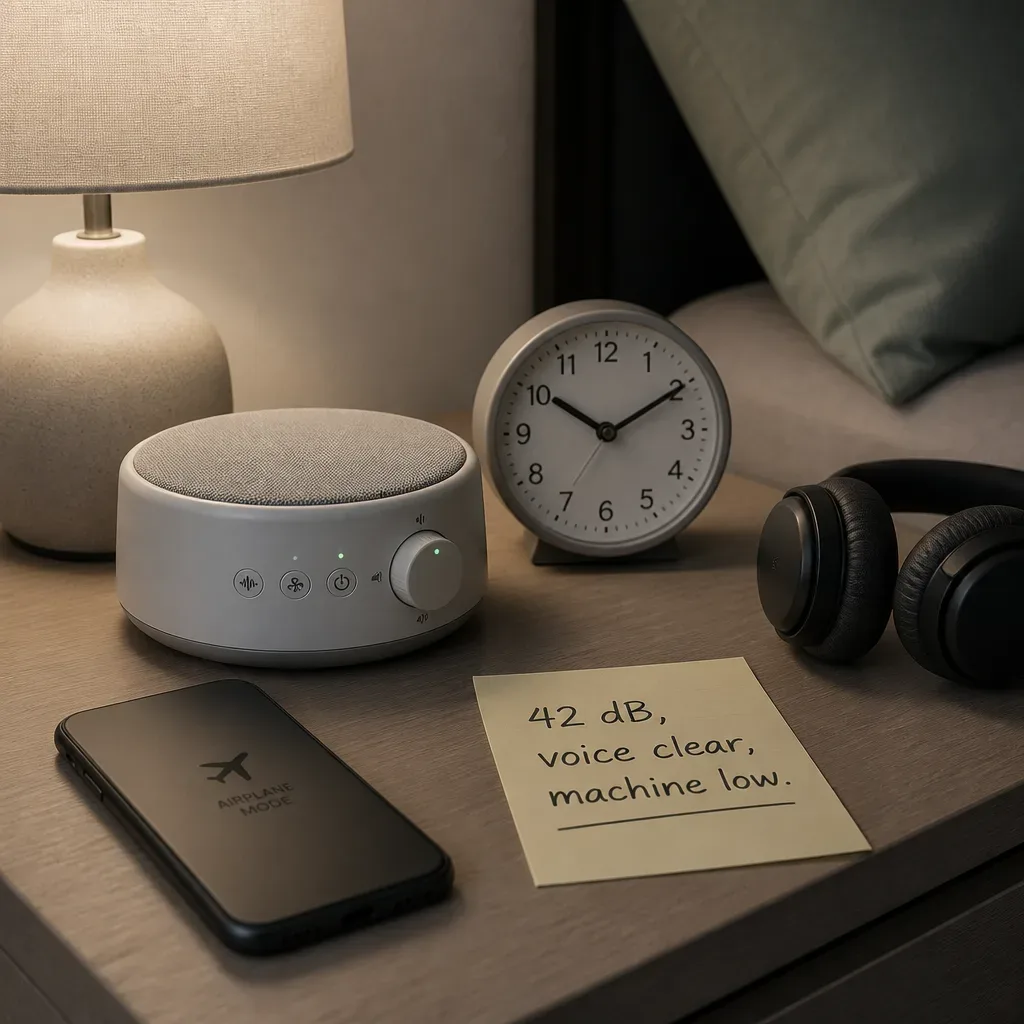
Use three nights, not one. Night one is calibration. Night two is the sound machine. Night three is the app. If you want better data, repeat the cycle for 6 nights. Do not change the Dream-Self audio, pillow, caffeine cutoff, or room fan. If you use a decibel meter app, treat it as approximate; phone microphones are not calibrated instruments, but they can help you avoid large level differences.
Record only what matters. A note with 5 fields is enough:
| Field | What to write |
|---|---|
| Bed layer | Machine, app, or none |
| Estimated pillow level | Example: 42 dB by phone meter |
| Voice clarity | 1 to 5 |
| Wake-ups noticed | Count you remember |
| Morning feel | One plain sentence |
A useful comparison is not the prettiest sound. It is the setup you can repeat when you are tired.
Keep the test humane. If you have tinnitus, chronic insomnia, suspected sleep apnea, or distress around sleep, bring that to a qualified clinician rather than trying to solve it with louder audio. For tinnitus in particular, masking that helps one person can irritate another, and audiology guidance is worth the time.
Which should you choose for the AYA Method?
Choose a sound machine if you want the background layer separate; choose an app if you need fine control or travel light.
For the AYA Method, I usually prefer separation. Put the Dream-Self audio on the clearer speaker, often the phone or a small bedside speaker. Put the masking layer on a separate sound machine, lower and farther away. That keeps the voice in front and the room behind it. The daily affirmation and Manifestation Board can support the practice, but they are not the core here. The listening is the work.
Choose a sound machine if:
- You tend to check your phone once it is in your hand.
- You share a bed and need a familiar, repeatable setting.
- You want no notifications, no streaming, and no screen light.
- You already know which sound color your nervous system prefers.
Choose an app if:
- You travel often and do not want another object.
- You want pink noise one night and rain the next.
- You need a 20-minute fade under spoken audio.
- You want to test binaural beats or tone beds at very low levels.
My field-recordist bias is simple: a bed should breathe a little. Perfect loops can become suspicious to the ear. Real rain shifts by a few decibels, a branch moves, a gutter answers, then it all returns to steady. If your app offers long natural recordings, that can be better than a tiny loop in a machine. If your machine has a good non-looping or long-loop bed, that can be better than a restless phone.
For most bedrooms, the best first answer is this: play the Dream-Self audio clearly, add a low pink or brown bed underneath, and stop adjusting after two minutes. Measure less after that. Listen more.
Keep the voice clear, keep the room kind, and let the rest stay low.