frequencies binaural
Theta Waves Sleep Track Under Dream-Self Audio
Use theta waves sleep audio safely under your Dream-Self recording with clear frequency, volume, timing, and headphone guidance for tonight.
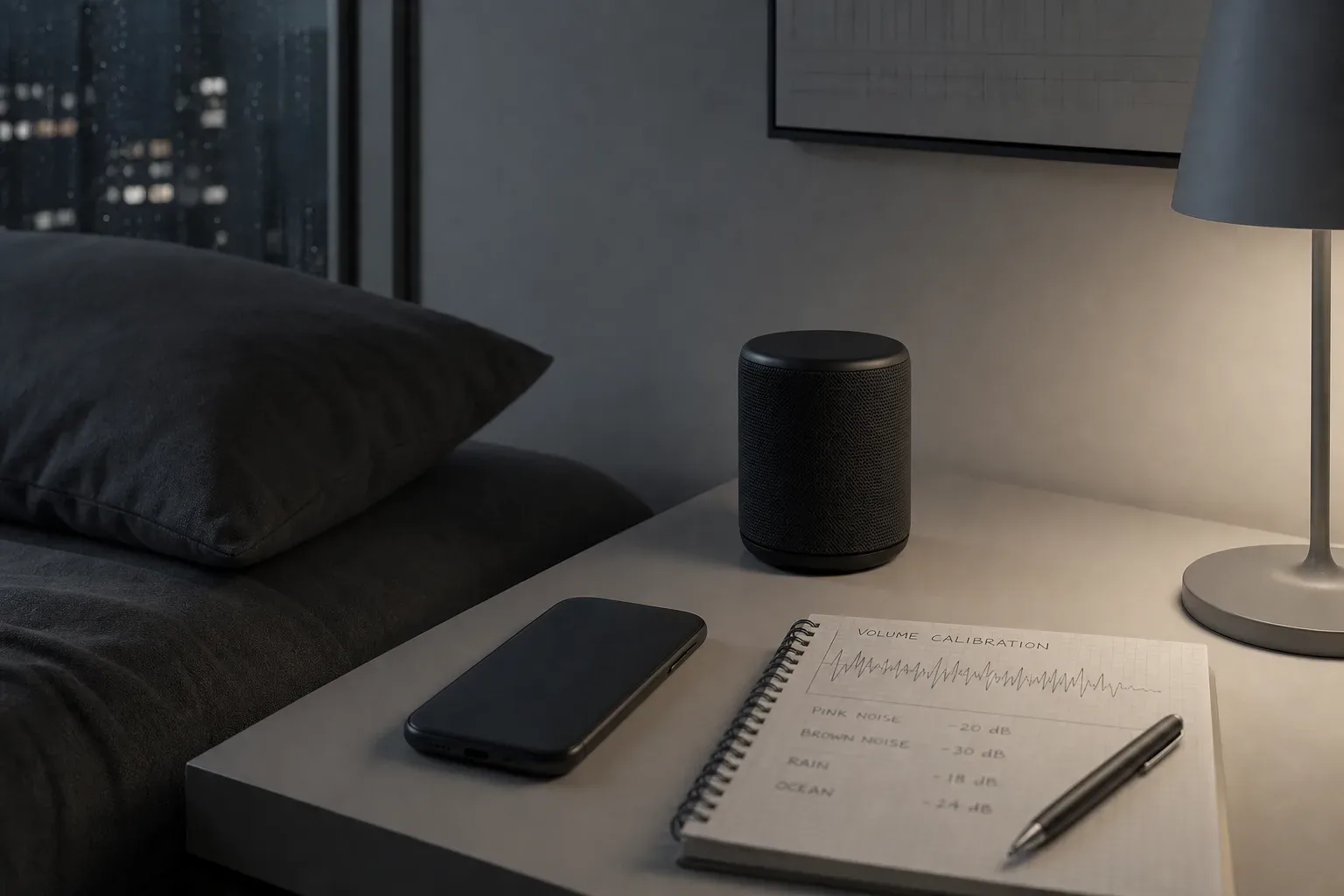
Theta waves sleep audio is best used as a quiet background layer, not the main event: choose a 4 to 8 Hz theta-style track, keep it below your Dream-Self voice, and listen during the first 10 to 20 minutes of wind-down. The words stay clear. The tone stays low. Your ears stay protected.
What are theta waves, and why do people connect them with sleep?
Theta waves are slow brain rhythms, usually measured between 4 and 8 Hz, that often appear during drowsiness, light sleep, and internally focused attention.
On an EEG, theta is not a sound. It is electrical activity measured from the scalp in cycles per second. Sleep researchers commonly divide brain rhythms into delta, theta, alpha, beta, and gamma bands, with theta sitting above deep-sleep delta, which is often described around 0.5 to 4 Hz. In the American Academy of Sleep Medicine scoring system, non-REM sleep is separated into stages N1, N2, and N3; theta activity is especially associated with the light transition into N1.
That transition matters because most people who search for theta sleep audio are not trying to force deep sleep in 3 minutes. They are trying to cross the first threshold: from thinking to drifting. A steady theta-style layer can give the ear something plain to follow while the room gets less interesting. A sleep sound does not put you to sleep. It removes a few reasons to stay awake.
There is also a manifestation-adjacent reason people use theta at night. Drowsiness is a suggestible state in the ordinary cognitive sense: attention narrows, outside input softens, and repeated phrases can feel easier to receive. Neville Goddard called the drowsy pre-sleep state useful for imaginal practice; modern sleep labs would describe the physiology more carefully, but the timing overlaps with measurable light-sleep onset.
For a Dream-Self recording, theta should support the voice rather than compete with it. The AYA Method is a daily audio manifestation practice: each day you listen to a short personalized recording, your Dream-Self Moment, narrated from the version of you who has already manifested the life you intend. Listening is the practice. Repetition is the work. The audio is the method.
Do theta waves actually improve sleep, or is the evidence mixed?
The evidence is mixed: theta-style audio may help some listeners relax, but it should not be treated as a guaranteed sleep intervention.
Binaural beat studies are real, but they are not all sleep studies, and many are small. A 2019 meta-analysis in Psychological Research reviewed 22 binaural-beat studies and found effects varied by beat frequency, exposure time, and outcome measured. That does not mean the method is useless. It means the mechanism is not as simple as play 6 Hz, get sleep.
A binaural beat happens when the left and right ears receive slightly different tones. For example, 200 Hz in the left ear and 206 Hz in the right ear can create the perception of a 6 Hz beat. Your brain constructs the difference; a speaker in the room will not deliver the same left-right separation. The illusion is real. The claims around it are uneven.
Other forms of theta-style audio use pulsing, amplitude modulation, or music mixed with slow movement. These do not require headphones, which can be better for sleep safety. A 2023 review of auditory stimulation and sleep noted that sound can influence arousal and sleep continuity, but results depend on timing, volume, and the listener. That is why conservative settings matter more than the label on the track.
Here is the practical reading of the evidence:
- Theta may help when it makes the listening field steadier.
- Theta may hurt when it becomes interesting, sharp, or too loud.
- Headphones may improve binaural delivery but reduce comfort in bed.
- A spoken Dream-Self track needs intelligibility before anything else.
Dr. Andrew Huberman often describes sleep as a system shaped by light, temperature, caffeine timing, and nervous-system state. Audio is one lever, not the control panel. If the track makes you monitor the track, it is no longer helping sleep.
How should you layer theta under Dream-Self audio tonight?
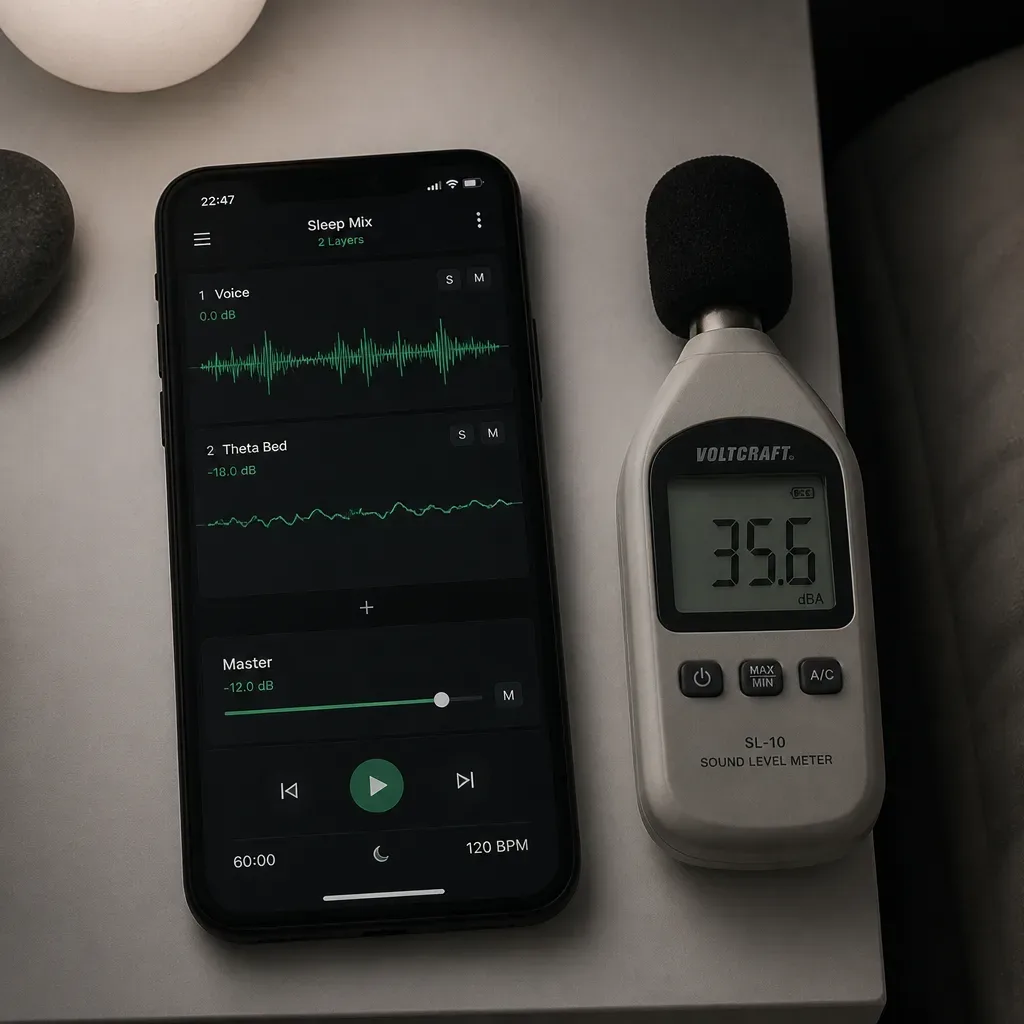
Set the spoken Dream-Self audio first, then add theta 10 to 15 dB lower so the voice remains the clearest signal in the room.
Think like a small mix engineer. Speech has to sit in front. The theta layer sits behind it, just audible enough to soften the edges of the room. If you have a phone and a small Bluetooth speaker, place the speaker 1 to 2 meters from your pillow and measure at the pillow with a basic decibel meter app. Phone apps are imperfect, often off by several dB, but they are still useful for avoiding obvious over-volume.
For adults, a comfortable wind-down level often sits somewhere around 35 to 50 dBA at the pillow, depending on room noise. For children and babies, be more conservative. The American Academy of Pediatrics has warned about infant sleep machines used too loudly and too close; one widely cited 2014 Pediatrics study found some machines could exceed 85 dBA at close distance. Keep devices away from the crib, keep volume low, and ask a pediatrician for personal guidance.
Use this simple order:
- Start your Dream-Self audio alone and set speech to a relaxed, clear level.
- Add the theta layer at minimum volume.
- Raise it until you can just detect it beneath the voice.
- Lower it one small step.
- Set a 10 to 20 minute timer if you do not want audio running all night.
The right background sound is the one you stop noticing. If the theta pulse becomes the object of attention, reduce it or remove it. A plain masking layer from the White noise generator + guide may work better on nights when the mind is already busy.
Which theta settings work best: binaural beats, pulsed tones, or music?
The best theta setting is the one that stays comfortable, quiet, and easy to ignore while your spoken audio remains clear.
A true binaural beat needs stereo separation. That usually means headphones or sleep earbuds. The benefit is precise delivery: a 6 Hz difference can be built from two carrier tones, such as 220 Hz and 226 Hz. The drawback is physical. Earbuds can press into the ear canal, over-ear headphones can trap heat, and cords do not belong in a bed. If you sleep with another person, speakers may also be kinder.
Pulsed tones and amplitude-modulated tracks can work through one speaker because the pulse is already in the audio signal. They are easier to place under a voice, but some people find pulsing obvious. Soft theta music is less clinical and often more pleasant, but the actual beat may be buried or inconsistent. Pleasant is not a flaw. For sleep, pleasant and boring often beat technically exact.
| Layer type | Needs headphones | Useful setting | Main caution |
|---|---|---|---|
| Binaural beat | Yes | 4 to 8 Hz difference | Comfort and stereo safety |
| Pulsed theta tone | No | 5 to 7 Hz pulse | Can become too noticeable |
| Theta music bed | No | Slow, low-detail movement | May mask speech |
| Plain noise | No | Steady broadband sound | Not theta-specific |
If you want to hear the difference before building a full routine, compare a stereo beat with the Binaural beats generator + guide, then try a non-beat layer through a speaker. Press play, listen for 60 seconds, and notice whether your attention settles or starts measuring.
The old frequency traditions also have their place, with clear labeling. Some listeners like pairing Dream-Self audio with 528 Hz or 432 Hz music because the tone feels gentle to them. The Solfeggio frequencies guide explains the lore respectfully, while keeping the evidence plain. Preference is allowed. Claims need support.
What volume, timing, and safety limits should you use?
Use the lowest volume that keeps the voice clear, keep the theta layer lower than speech, and avoid all-night headphone use unless it is genuinely comfortable and safe.
Volume is the one place where sleep audio stops being a matter of taste. The World Health Organization has described 40 dB outside-night noise as a guideline value for protecting sleep in communities, while 55 dB is often discussed as an interim target where lower levels are difficult. Bedrooms vary, but the direction is clear: quieter is usually better.
For a Dream-Self mix, the voice might sit at a soft conversation level, while the theta bed sits underneath. If your room is already quiet, the theta track can be barely audible. If traffic, neighbors, or a refrigerator hum keeps breaking attention, a steadier sound may help mask changes. Sudden changes wake people more reliably than stable sound; that is one reason continuous noise can feel calming.
Use these conservative limits:
- Keep speakers at least 1 meter from your head when practical.
- Avoid placing any speaker in a crib or directly beside a child.
- Check that auto-restart does not return at maximum volume after a power cut.
- Use a timer if the track includes tones that might annoy you later in the night.
- If tinnitus spikes, stop the track and ask an audiologist or clinician.
For babies, toddlers, and shared rooms, test failure modes. I learned this the practical way at 3 a.m.: a machine that fails loud is not a sleep tool, it is a household alarm. Look for devices that remember low volume, have physical buttons, and do not require a login when someone is crying.
If you are using headphones, keep sessions short. A 10 to 20 minute pre-sleep listen is enough for the Dream-Self audio and the theta layer. After that, switch to silence, a speaker-based noise, or a low room sound. The safest sleep audio is effective at a level you could forget to brag about.
How do you build a 12-minute theta and Dream-Self routine?
A good routine takes about 12 minutes: two minutes to set the sound, seven to listen, and three to let the body settle without adjusting anything.
Start before you are fully exhausted. Sleep pressure rises across the day, but behavior still matters in the final hour. Caffeine has an average half-life often cited around 5 hours, though it varies widely by person; a late cup can still be present at bedtime. Light matters too. Even moderate evening light can delay melatonin timing in sensitive people, so dimming the room helps the audio do less work.
Here is a plain 12-minute sequence:
- Minute 0 to 2: Put the phone face down, start the Dream-Self recording, and set speech volume first.
- Minute 2 to 3: Add a 4 to 8 Hz theta-style layer underneath, then lower it one step.
- Minute 3 to 10: Listen without editing the mix. If a word is unclear, pause once and fix it.
- Minute 10 to 12: Let the final sound fade, or switch to plain low noise.
- After minute 12: Stop managing the system. The routine is done.
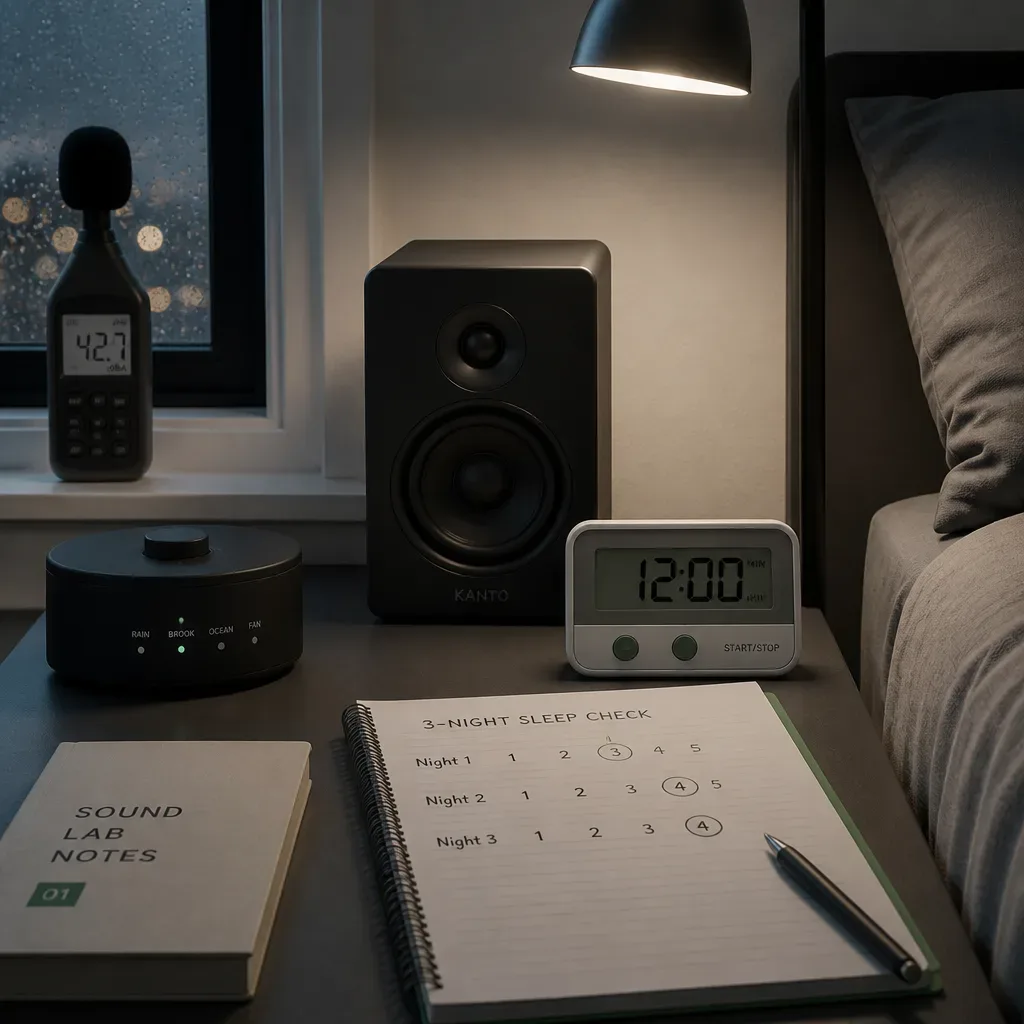
If your room needs masking after the voice ends, use a non-verbal sound. The White noise generator + guide is useful when the problem is changing sound outside the room. If you are curious about stereo entrainment but not ready to sleep with headphones, use the Binaural beats generator + guide earlier in the evening, seated, at low volume.
A routine should be repeatable under tired conditions. No complex app chain. No six-slider mix. No hidden menu. The method is daily listening, not nightly engineering.
How can you tell after three nights if theta is helping or getting in the way?
Judge theta by sleep onset, comfort, and next-morning clarity after at least three nights, not by how impressive the track sounds on the first listen.
The first night with any new sound can be misleading. Novelty itself can hold attention. Sleep researchers call this kind of disruption the first-night effect in lab settings, where people often sleep differently on night one simply because the context changed. At home, a new pulse under a familiar voice can do the same thing.
Track only a few signals. More data can make bedtime feel like a test. Use a 1 to 5 rating for each item, written in the morning:
| Signal | Good sign | Change if |
|---|---|---|
| Sleep onset | You stopped checking time | You monitored the beat |
| Voice clarity | Words stayed easy to follow | The layer masked consonants |
| Body comfort | Headphones disappeared from attention | Ear pressure or heat appeared |
| Morning state | You felt normal or steadier | You felt groggy or irritated |
If theta scores poorly, remove it without drama. Try a quieter setting, a different carrier tone, or a plain sound from the Solfeggio frequencies guide if musical tone feels better than pulsing. If insomnia lasts more than 3 months, occurs at least 3 nights per week, or comes with breathing pauses, pain, depression, or persistent tinnitus, talk with a qualified professional.
This is the quiet rule: keep what reduces friction, not what has the more technical name. Theta is a useful layer for some nervous systems and a distraction for others. Yours gets a vote.
Turn the voice down until it feels close, and let the rest of the room become less important.