noise colors
White Noise for Sleeping Under Dream-Self Audio
White noise for sleeping can support Dream-Self audio when volume, timing, and speaker placement are set carefully. Use this quiet setup.
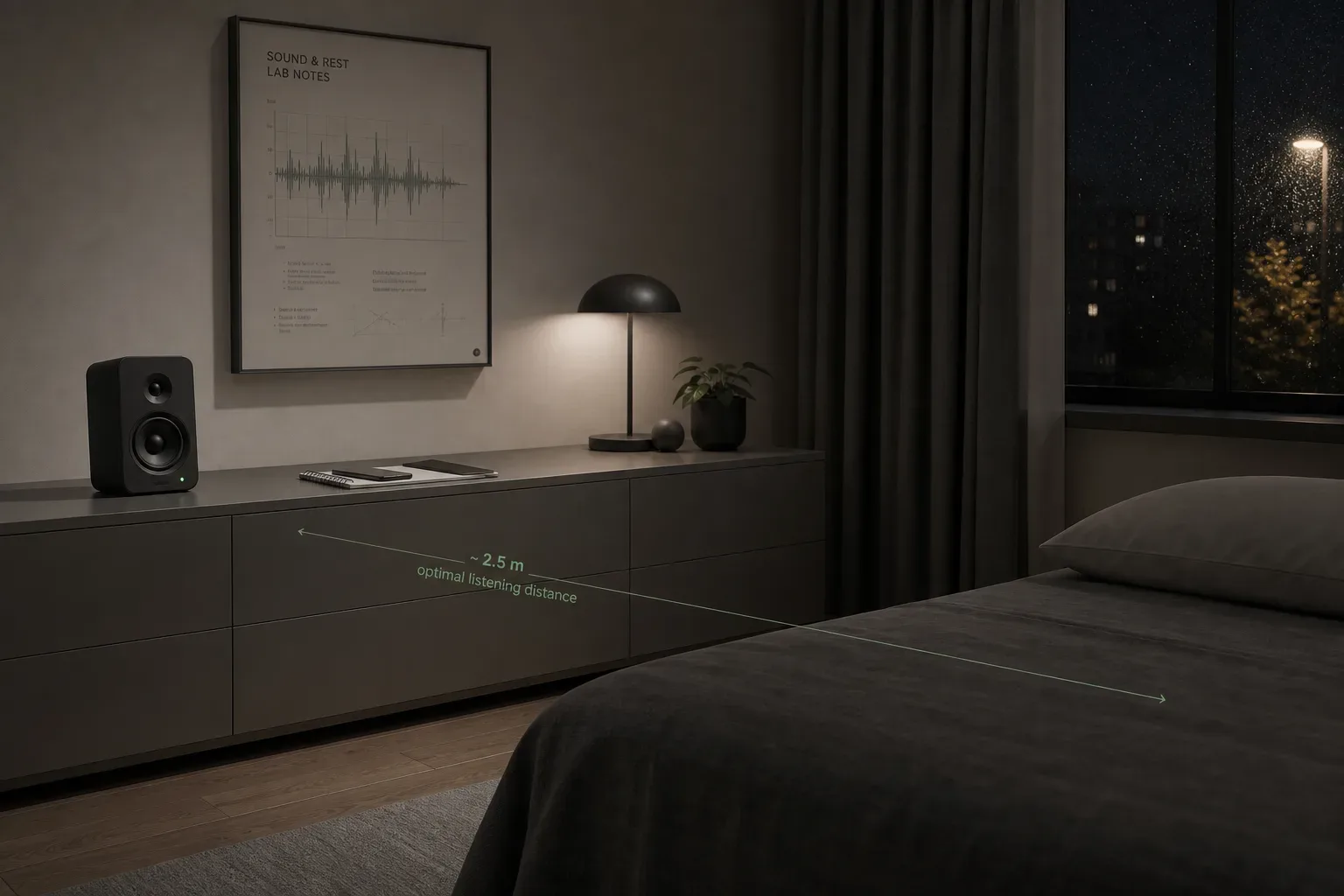
White noise for sleeping can sit under Dream-Self audio when it is quieter than the spoken track, measured at the pillow, and placed away from the ear. Use white noise as a masking bed, not the practice itself. The voice stays clear; the room becomes less interruptive.
What should white noise do under Dream-Self audio?
White noise should mask small environmental sounds while leaving the spoken recording intelligible from the first sentence to the last.
Technically, white noise contains equal acoustic power per hertz across the audible band, usually described from about 20 Hz to 20,000 Hz for human hearing. In practice, most sleep devices do not produce textbook white noise. They produce a filtered hiss shaped by a small speaker, a loop file, and the room. That is fine. The useful question is simpler: does it cover the refrigerator click, hallway footstep, or traffic wash without covering the words?
The voice track needs to remain the reference signal. Speech intelligibility depends heavily on consonants, many of which sit between roughly 2 kHz and 6 kHz. White noise also has plenty of content there, so it can blur speech quickly if you raise it too far. A good setup sounds like a steady layer behind the narrator, not like the narrator is speaking through air conditioning.
For the AYA practice, this distinction matters. The AYA Method is a daily audio manifestation practice. Each day you listen to a short personalized recording, your Dream-Self Moment, narrated from the version of you who has already manifested the life you intend. Listening is the practice. Repetition is the work. The audio is the method. White noise prepares the room around it.
A useful rule: if you miss more than 1 or 2 words in a 30-second passage, the noise is too high or too bright. The room should get quieter without the message getting softer. Sound that supports attention should not ask for attention.
How loud is safe for white noise for sleeping?
For overnight use, keep the combined sound low, usually around 35 to 50 dBA at the pillow for adults, and lower for children.
Occupational noise limits are not sleep targets. NIOSH recommends 85 dBA as an 8-hour exposure limit for workplaces, with a 3 dB exchange rate, meaning every 3 dB increase halves the recommended exposure time. A bedroom routine should sit far below that. Many quiet bedrooms measure near 30 dBA, while a soft fan at the bed may land around 40 to 50 dBA depending on distance and speed.
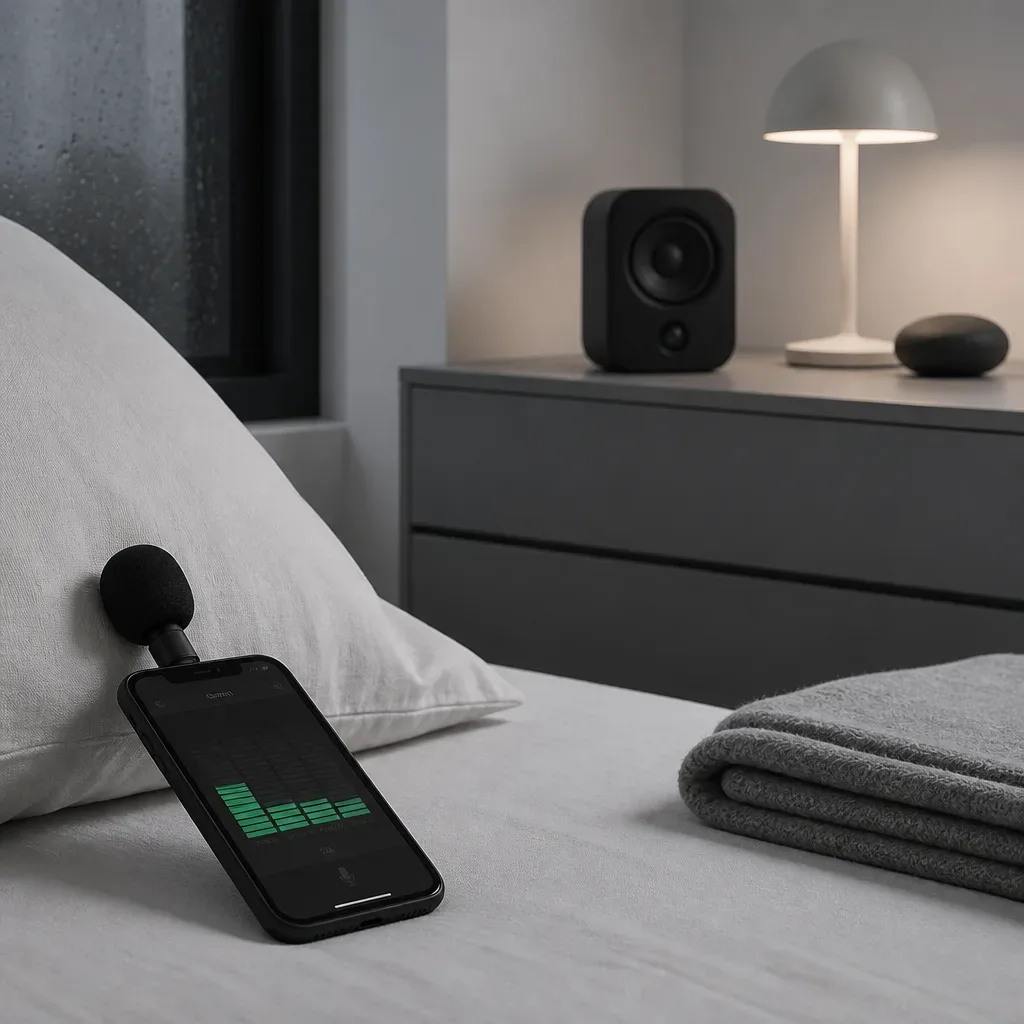
Phone sound-level apps are not laboratory meters, but they are useful for avoiding mistakes. Use A-weighting if available, hold the phone where your head rests, and measure the combined sound, not the noise alone. If the reading jumps above 55 dBA at the pillow, lower it unless there is a clear, temporary reason. The World Health Organization’s 2018 environmental noise guidance treats night noise as a public-health concern, especially when repeated sleep disturbance accumulates over time.
For babies and children, be stricter. A 2014 Pediatrics study measured infant sleep machines and found that some exceeded 50 dBA at typical crib distances, with maximum outputs that could be unsafe if used close and loud. Keep any machine well away from a crib, set it low, and avoid all-night high levels. Adults also benefit from restraint. The ear adapts to steady sound, so louder rarely stays better for long.
Use this table as a plain starting point:
| Listener and setup | Starting level at pillow | Speaker distance | Note |
|---|---|---|---|
| Adult, quiet room | 35 to 40 dBA | 1 to 2 m | Enough for small ticks and hums |
| Adult, street noise | 40 to 50 dBA | 1 to 2 m | Move speaker before raising volume |
| Child | As low as practical | 2 m or more | Never place near the head |
| Earbuds or headphones | Lowest clear setting | In ear | Better for short listening than all night |
Quiet is not the absence of sound; it is the absence of intrusion.
Where should the speaker, phone, or generator sit?
Place the sound source away from your head, aimed across the room, and closer to the noise you are trying to mask when possible.
Speaker placement changes the result as much as the volume slider. Sound drops with distance in a free field, roughly 6 dB each time distance doubles, though bedrooms add reflections from walls, windows, and furniture. A device 30 cm from your pillow can be much louder at the ear than the same device 1.5 m away on a dresser. Distance is a safety control, not a decorative choice.
If the problem is a hallway, put the speaker between the bed and the door. If the problem is a window, place the speaker on the window side but not firing directly at your head. The goal is partial masking before the disturbance reaches you. This lets you use less total level at the pillow. A lower level that is well placed usually beats a louder level beside the ear.
For Dream-Self audio, use one of three layouts:
- Single speaker: play the voice and white noise from the same speaker, with the voice clearly above the noise.
- Two speakers: place the voice closer to you and the white noise farther away, then measure the total level at the pillow.
- Phone plus room speaker: play the voice from the phone at bedside and white noise from a room speaker across the space.
If you are using a browser tool, the White noise generator + guide is the cleanest place to hear how level and tone change. Press play below the guide, set the level low, and listen for consonants in your voice recording. If the words lose their edges, reduce the noise before you change anything else.
How do you balance white noise and the spoken track?
Set the spoken track first, then raise the white noise until it masks the room while staying clearly behind the voice.
Start with the Dream-Self audio alone. Set it at the lowest level where you can understand every word without leaning in. That is your reference. Then add white noise from zero and raise it slowly. Most people overshoot in the first 10 seconds because the contrast feels pleasant. Wait 60 seconds before deciding. The auditory system adapts quickly to steady signals, and what seemed too soft at first may become enough.
A practical target is a 5 to 10 dB difference between the voice and the noise at the listening position, with the voice higher. You do not need a perfect meter reading. You need a repeatable relationship: the voice leads, the noise supports. In speech-acoustics work, small changes of 3 dB are audible, while 10 dB is commonly perceived as about twice as loud, though perception varies by frequency and listener.
Use this setup sequence tonight:
- Play 30 seconds of the Dream-Self audio with no noise.
- Lower it until it is gentle but still clear.
- Start white noise at zero.
- Raise white noise until distant sounds soften.
- Replay the same 30 seconds of voice.
- If any words blur, lower the noise by one step.
- Set a timer before you put the phone down.
Do not use white noise to force attention. If the words feel distant, the setup is wrong. If your jaw tightens, the level may be too high or the sound too bright. If you wake with a sense of ear fullness, lower the volume the next night and avoid earbuds.
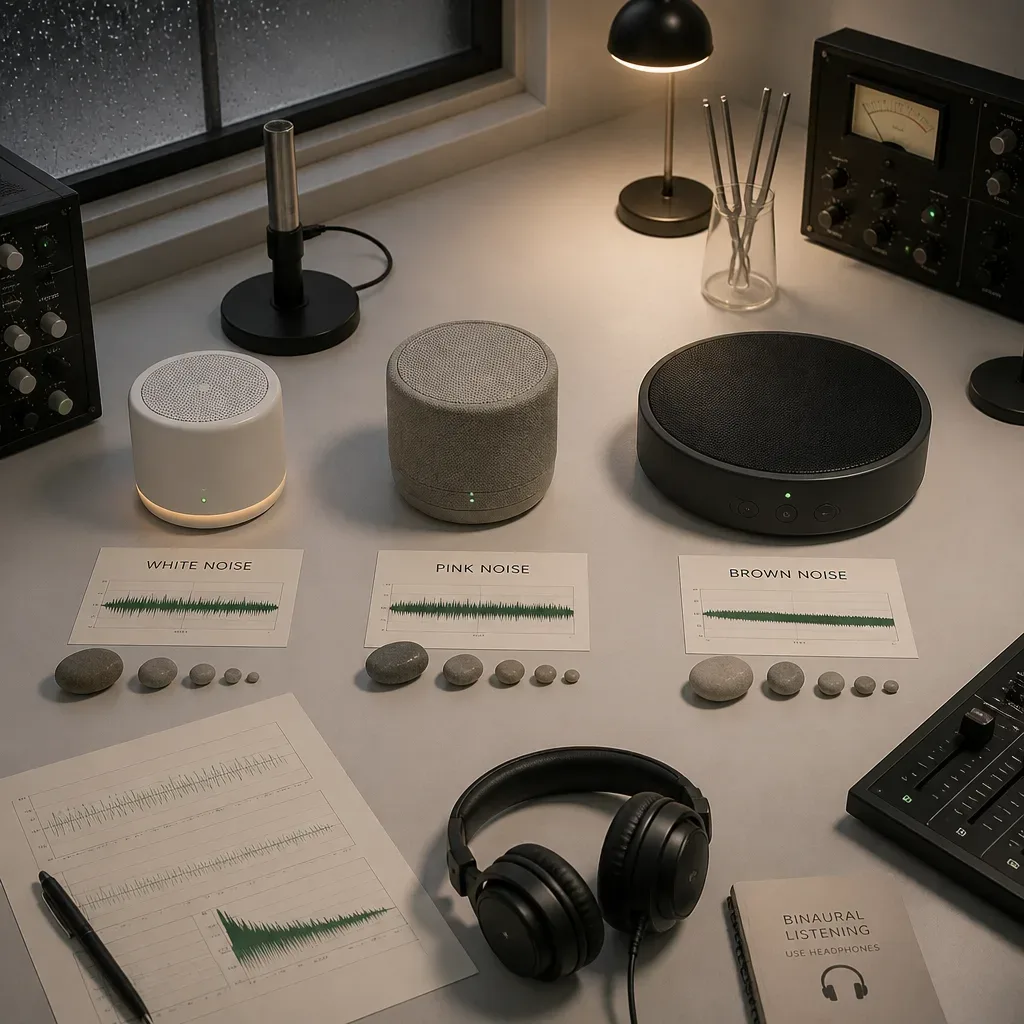
For some rooms, pink or brown noise may sit under speech more comfortably than white noise because they reduce high-frequency hiss. Pink noise falls by about 3 dB per octave, while brown noise falls by about 6 dB per octave. White noise is precise as a term, but your nervous system gets a vote about the curve.
Should you use white, pink, brown, binaural, or Solfeggio sounds?
Use the sound that masks the room at the lowest comfortable level, and do not choose a frequency label over intelligibility.
White noise is best when you need wide masking: hiss, traffic spray, HVAC clicks, or unpredictable small sounds. Pink noise is often gentler because each octave carries equal acoustic power, which many ears hear as balanced. Brown noise has more low-frequency weight and less high hiss, so it can feel steadier under a spoken track. None of these automatically improves sleep for everyone.
The research is mixed and still modest. A 2021 systematic review in Sleep Medicine Reviews found limited evidence that continuous noise improves sleep, partly because studies use different sounds, levels, and outcome measures. Pink noise has shown interesting results in small studies, including work on slow-wave activity in older adults, but sample sizes have often been small. Treat sound as a tool to test, not a guarantee.
Binaural beats are different. A binaural beat is an auditory illusion produced when each ear receives a slightly different tone, often with a frequency difference such as 4 Hz or 10 Hz. You need headphones for the effect. That makes them less ideal for all-night sleep under Dream-Self audio, though they can be useful for a short pre-sleep window. The Binaural beats generator + guide explains the mechanism and the evidence without padding the claims.
Solfeggio tones belong to a frequency tradition, not a strong clinical evidence base. You may like 528 Hz, 396 Hz, or 432 Hz as a listening preference, and that preference is valid as preference. It is not the same as proof. The Solfeggio frequencies guide separates the tradition from the measurements so you can choose without pretending the lab has said more than it has.
Here is the quick comparison:
| Sound type | Best use under voice | Main caution |
|---|---|---|
| White noise | Strong masking across many room sounds | Can blur consonants and feel hissy |
| Pink noise | Softer masking with less sharpness | May not cover high ticks as well |
| Brown noise | Low, steady hum for sensitive ears | Small speakers may distort lows |
| Binaural beats | Short headphone listening before sleep | Not ideal for overnight masking |
| Solfeggio tones | Personal preference or ritual tone | Claims exceed evidence |
The right sound is the one you can forget while still hearing what matters.
What timer and routine work best tonight?
Use a short voice-first routine, then let the noise continue only as long as it helps the room stay steady.
A safe setup does not need a long script. It needs order. Start with light reduction, then the spoken track, then low masking. Many people do best with a 10 to 20 minute voice window and a 30 to 90 minute noise timer. That fits common sleep-onset ranges; the American Academy of Sleep Medicine notes that chronic insomnia involves difficulty initiating or maintaining sleep at least 3 nights per week for at least 3 months, which is different from an occasional noisy night.
If you use an app with fades, set a 10 to 30 second fade-in for white noise and a 2 to 5 minute fade-out. Abrupt starts can make the nervous system check the room. Abrupt stops can reveal the refrigerator, the street, and the small mechanical life of the building all at once. Fades are not cosmetic. They protect continuity.
Try this 12-minute setup:
- Minute 0: Place the speaker at least 1 meter from the pillow.
- Minute 1: Measure the room without playback.
- Minute 2: Play the Dream-Self audio and set voice clarity.
- Minute 4: Add white noise underneath.
- Minute 6: Measure the combined level at the pillow.
- Minute 8: Set the white noise timer for 30 to 90 minutes.
- Minute 10: Turn the screen down or away.
- Minute 12: Stop adjusting.
The last step matters. Repeated adjustment keeps the auditory system alert. Give the setup one night before you judge it. If you want a second reference sound on another night, compare it with pink or brown noise using the same placement and level. Change one variable at a time or you will not know what helped.
If you have tinnitus, suspected sleep apnea, chronic insomnia, or sound sensitivity that causes distress, speak with a qualified clinician or audiologist. Sound masking can be useful, but it should not cover symptoms that need care.
What mistakes make this setup less safe or less useful?
The common mistakes are placing sound too close, setting noise above the voice, using earbuds all night, and raising volume instead of improving placement.
The first mistake is treating the bedside speaker like a pillow speaker. At 20 to 30 cm from the ear, small level changes matter. Move the device away before you reduce the problem with volume. A 1 meter distance is a sensible minimum for adults, and more distance is better for children.
The second mistake is using white noise as a wall. Masking is not the same as drowning. If the spoken track has to fight the noise, the method becomes strained. Speech should feel plain and close. Noise should feel like room tone with better manners.
The third mistake is ignoring frequency balance. A cheap speaker may produce a sharp, narrow hiss that reads as white noise on a label but feels tiring after 20 minutes. If that happens, use a warmer curve, lower the treble if your device allows it, or test pink noise. Your ear is allowed to reject a technically correct sound.
The fourth mistake is all-night headphone use. Some adults tolerate it, but it increases the chance of pressure, irritation, and accidental loudness. Consumer devices vary widely, and a slider at 30 percent on one phone is not the same acoustic level as 30 percent on another. The measurement at the pillow, or a strict headphone volume limit, is more useful than a percentage.
Keep the working rules simple:
- The voice is always clearer than the noise.
- The speaker is away from the ear.
- The combined level is measured low.
- The timer has an end point.
- One adjustment changes at a time.
A sleep sound is successful when you stop monitoring it.
Leave the room steady enough for the words to land.